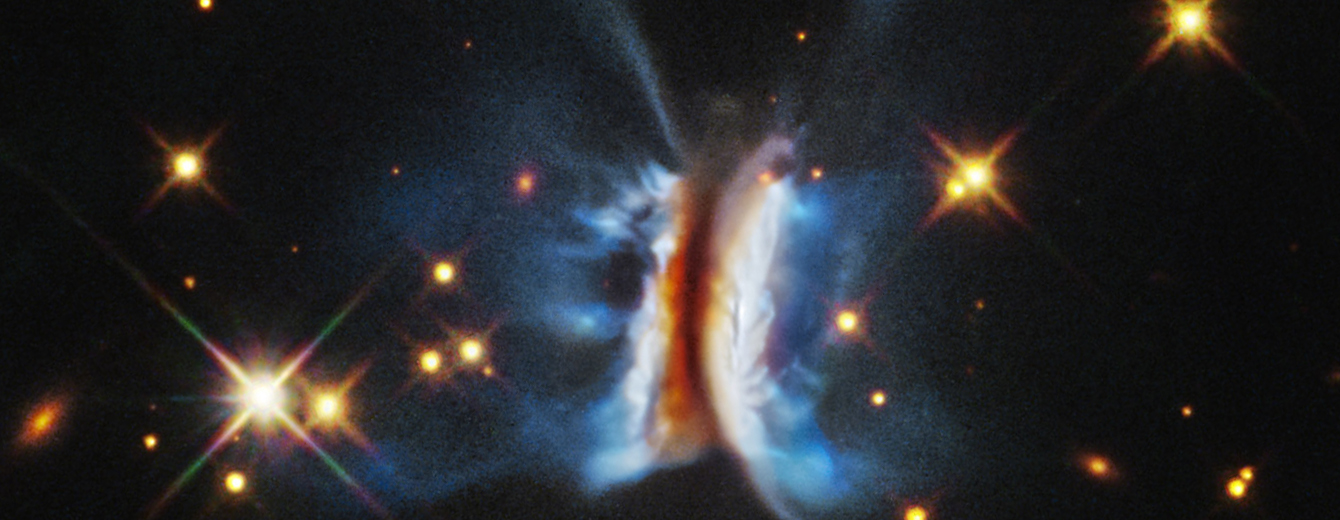
Vast dust and gas disk offers insight into the birth of star systems.
Nearly 300 years after Immanuel Kant proposed that our solar system’s family of planets condensed from a flattened disk of gas and dust, NASA’s Hubble Space Telescope revealed that such planetary nurseries are common across our galaxy. Now, Hubble has identified the largest known protoplanetary disk—spanning an astonishing 400 billion miles, roughly 40 times the diameter of our solar system. This immense structure, located just 1,000 light-years from Earth, exhibits a surprisingly chaotic and turbulent environment for planet formation. Hubble’s high-resolution imagery shows wisps of material extending far above and below the disk. This discovery provides a unique opportunity to study the complex processes and conditions that govern the birth of planetary systems.
Find additional resources at www.stsci.edu
You are receiving this email because you are subscribed to the Inbox Astronomy mailing list.


