AMSAT News Service
ANS-060
March 1, 2026
In this edition:
* AMSAT Announces Students On The Air Satellite Activity Beginning March 3
* ISS Amateur Radio Packet System Activated for Temporary APRS Testing
* Launch Planned for NUTSAT-3 with Voice Repeater and APRS Digipeater
* Astro Pi Mission Zero Challenge Offers Youth Chance to Run Code Aboard ISS
* Elon Musk Suggests Moon-Based Mass Driver for Future Satellite Deployment
* Changes to AMSAT TLE Distribution for February 27, 2026
* ARISS News
* AMSAT Ambassador Activities
* Satellite Shorts From All Over
The AMSAT® News Service bulletins are a free, weekly news and information service of AMSAT, The Radio Amateur Satellite Corporation. ANS publishes news related to Amateur Radio in Space including reports on the activities
of a worldwide group of Amateur Radio operators who share an active interest in designing, building, launching and communicating through analog and digital Amateur Radio satellites.
The news feed on
https://www.amsat.org publishes news of Amateur Radio in Space as soon as our volunteers can post it.
Please send any amateur satellite news or reports to: ans-editor [at]
amsat.org
You can sign up for free e-mail delivery of the AMSAT News Service Bulletins via the ANS List; to join this list see:
https://mailman.amsat.org/postorius/lists/ans.amsat.org/
AMSAT Announces Students On The Air Satellite Activity Beginning March 3
AMSAT has announced the launch of Students On The Air (StOTA) Days, a new initiative aimed at encouraging student participation in amateur satellite operations. The activity was inspired by AMSAT President Drew Glasbrenner,
KO4MA, and his son Carsten, KQ4SJM, and is designed to promote regular on-air activity among licensed student operators.
Students are encouraged to get on the air and operate via amateur satellites on the first and third Tuesdays of each month, beginning March 3, 2026. While student-to-student contacts are especially encouraged, all
satellite operators are welcome to participate and help make students feel welcome on the air.
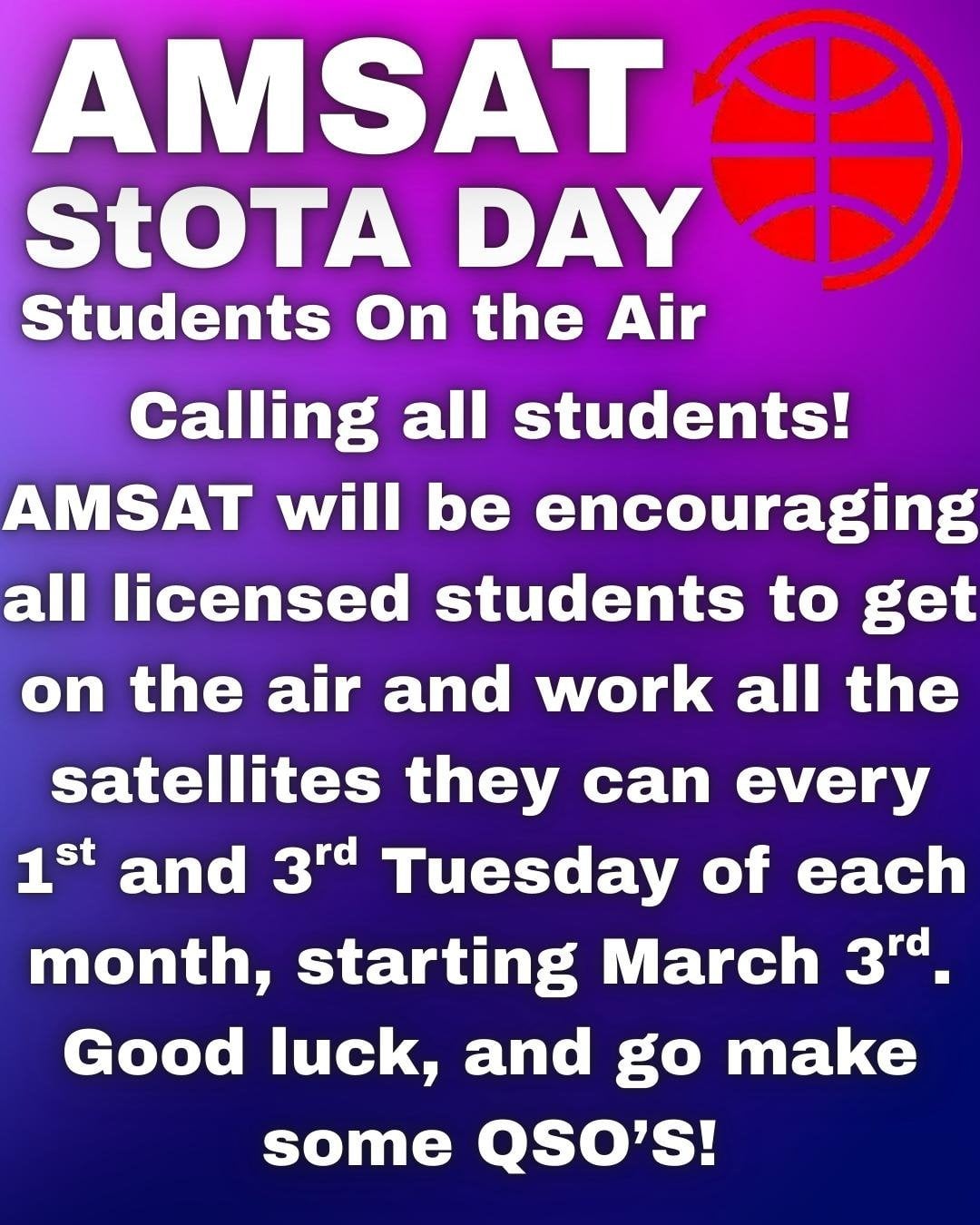
To support coordination, AMSAT has created a dedicated
#students-on-the-air channel on the AMSAT Discord server where participants can arrange contacts and share activity:
https://discord.com/channels/838897908224360498/1476716108198445066
Reports of StOTA activity and contacts are encouraged and may be submitted to Carsten, KQ4SJM, whose contact information is available via
QRZ.com. Activity reports will help AMSAT gauge participation and support future student-focused satellite initiatives.
[ANS thanks
Mark Hammond, N8MH, AMSAT Vice President – Operations and Director, for the above information]
ISS Amateur Radio Packet System Activated for Temporary APRS Testing
Amateur Radio on the International Space Station (ARISS) reports that the packet radio in the Zvezda Service Module has been configured for temporary APRS operation on 437.825 MHz. The system is expected to remain
active for testing through March 2, 2026, giving stations worldwide an opportunity to receive packet transmissions and attempt limited digipeating through the orbiting station.
Operators wishing to access the ISS digipeater are advised to include ARISS or APRSAT in the PATH field of their transmissions. The Service Module station is operating under the call sign RSØISS using FM packet at
1200 bps. ARISS recommends transmit power of 5 watts or less, preferably with a directional antenna, to improve uplink reliability and help minimize interference.
The current activation follows a prolonged outage of the Service Module amateur radio system that began during ARISS SSTV Series 30 in November 2025. Images were received early in the event, but subsequent passes
produced no SSTV transmissions, and the event was ultimately scrubbed. The Service Module radio used for APRS and SSTV was then taken out of service while teams investigated the problem.
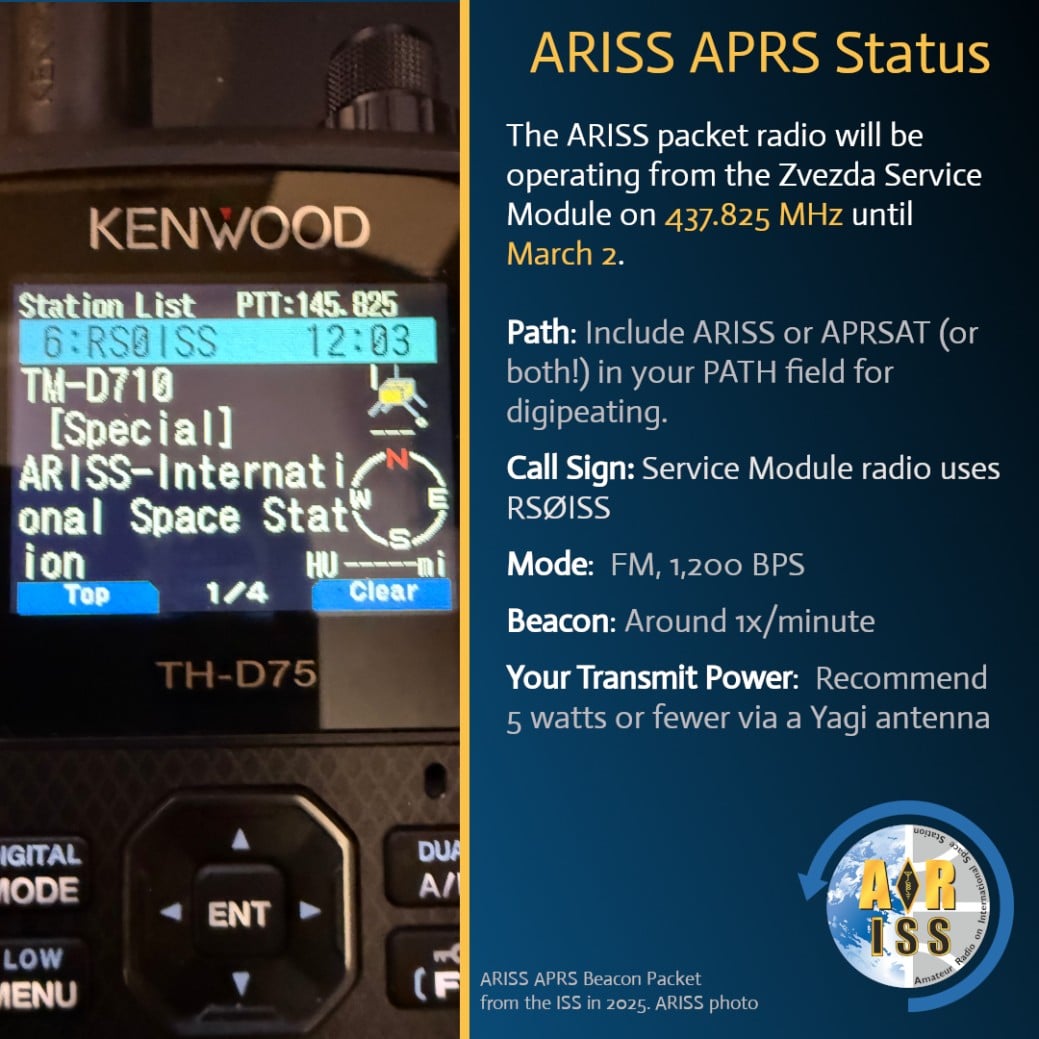
The packet radio in the ISS Zvezda Service Module is enabled for APRS testing through March 2, 2026. [Credit:
ARISS]
Subsequent ARISS updates reported that the primary Kenwood D710GA radio was replaced with an onboard spare D710E while teams continued troubleshooting and preparing reset procedures. Status reports in the following
months continued to show the Service Module radio offline while restoration efforts were planned and carried out.
The newly announced APRS configuration suggests the system is now being evaluated through on-orbit testing following these repair activities. Temporary activations such as this allow radio amateurs worldwide to help
confirm reception, observe system behavior, and provide useful reports while the station’s amateur radio capability is assessed.
ARISS encourages operators to monitor official status channels for schedule updates and to share reception reports as testing continues. Additional information on ISS amateur radio operations and current station
status is available at https://www.ariss.org.
[ANS thanks
Amateur Radio on the International Space Station (ARISS) for the above information]
Launch Planned for NUTSAT-3 with Voice Repeater and APRS Digipeater
IARU amateur satellite frequency coordination has been completed for NUTSAT-3, a 3U CubeSat dedicated to amateur radio service. The satellite, using the callsign BNØUTC, is operated with support from National Formosa
University. NUTSAT-3 is designed to provide voice repeater, APRS, and telemetry services to the global amateur satellite community.
The primary payload is a cross-band FM voice repeater with an uplink on 145.980 MHz using a 67 Hz CTCSS tone and a downlink on 435.250 MHz. Telemetry will be transmitted on 437.850 MHz using 1k2 AFSK with AX.25 protocol.
All telemetry is unencrypted and intended for public reception and analysis.
An APRS digipeater will also operate on 145.825 MHz, allowing stations to relay position and status data through the satellite. The digipeater is expected to respond to both its unique callsign and the ARISS alias
using standard APRS paths. The open telemetry format and public data distribution are intended to encourage worldwide participation, including monitoring through networks such as SatNOGS.
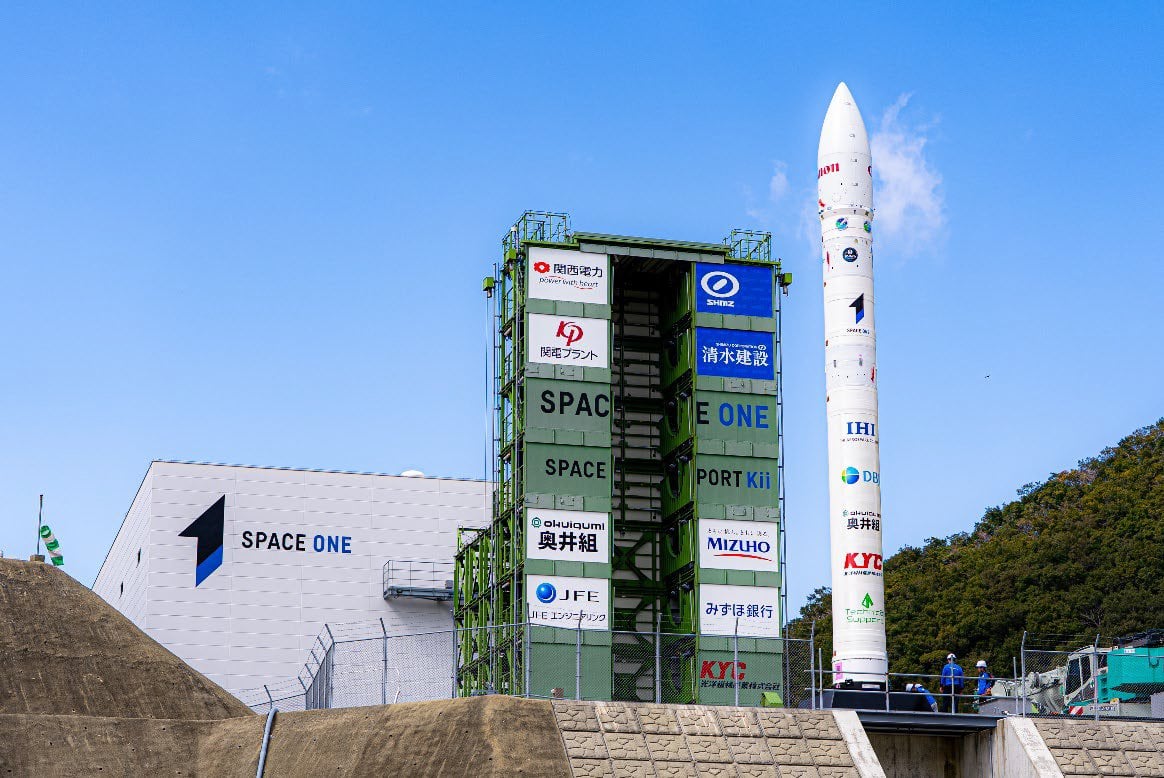
KAIROS stands at Spaceport Kii in Kushimoto, Japan ahead of its third planned orbital launch mission. [Credit:
Space One]
Beyond communications service, the mission includes a strong educational component. Students will participate in RF design evaluation, mission analysis, and satellite communications performance studies. Public dashboards
and shared telemetry are planned to promote transparency and community collaboration.
NUTSAT-3 is manifested for launch aboard a Space One KAIROS rocket from Spaceport Kii in Kushimoto, Japan into a planned 500 km polar orbit. Space One recently postponed the vehicle’s third flight following weather
analysis, and the launch window now extends through March 25, 2026. A specific launch date is expected to be announced approximately two days prior to liftoff.
KAIROS conducted two previous launch attempts in March and December 2024, both of which ended in mission failure during early flight. The upcoming mission will mark a return-to-flight opportunity for the Japanese
commercial launch provider. Frequency coordination for NUTSAT-3 was requested on December 25, 2025, and completed on January 31, 2026.
[ANS thanks the
IARU and Space One for the above information]
Astro Pi Mission Zero Challenge Offers Youth Chance to Run Code Aboard ISS
European Space Agency (ESA) astronaut and amateur radio operator Sophie Adenot, KJ5LTN, is now aboard the International Space Station following her launch on the SpaceX Crew-12 mission on February 13 and docking
on February 14. With about one month remaining before submissions close for the Astro Pi Mission Zero coding challenge on March 23, 2026, her mission highlights ongoing opportunities for young people to run their own code aboard the space station.
Astro Pi Mission Zero, organized by ESA in partnership with the Raspberry Pi Foundation and the European Space Education Resource Office (ESERO), gives young people the chance to have their code run in space. Participants
write a short Python program that reads data from the Astro Pi color and luminosity sensor aboard the ISS and uses it to set the background color of a personalized image displayed for astronauts as they go about their daily tasks inside the Columbus laboratory
module.
Adenot serves as an ambassador for the Astro Pi initiative, reinforcing the connection between astronaut missions, STEM education, and global outreach. Licensed in amateur radio, she is among the ISS crew members
able to support educational engagement activities, including ARISS (Amateur Radio on the International Space Station), which enables scheduled radio contacts between astronauts and students around the world.
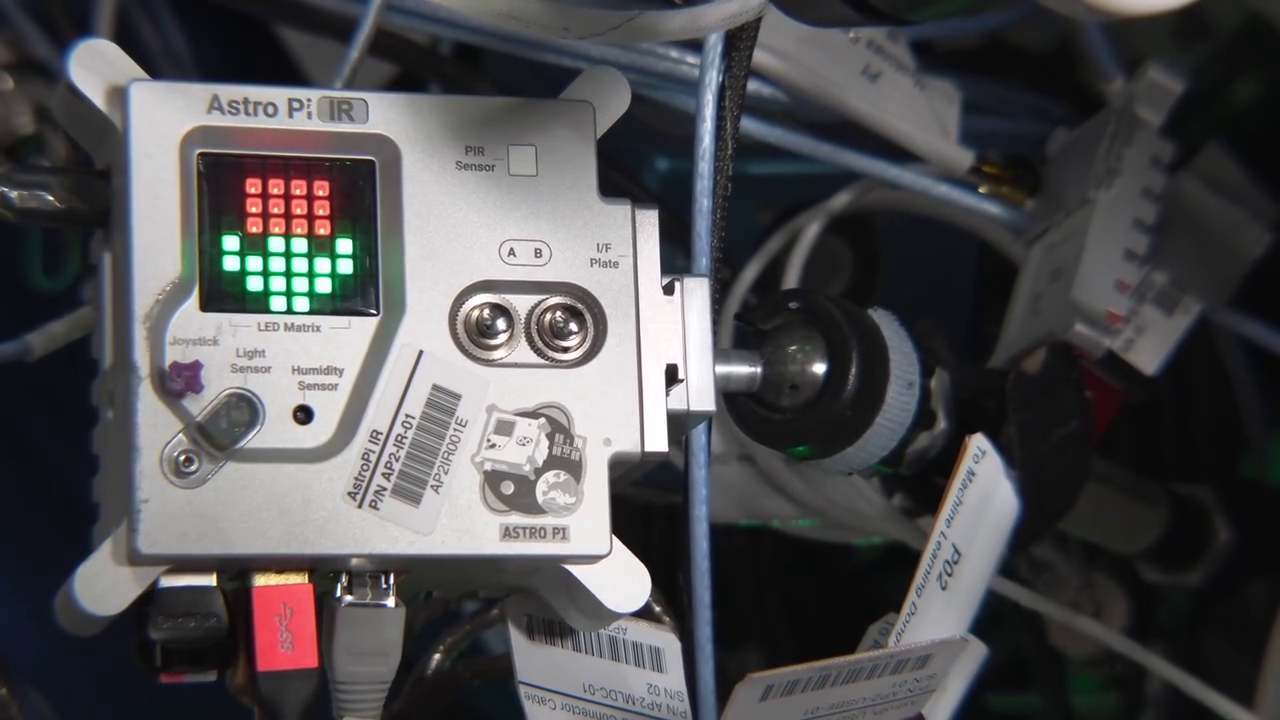
An Astro Pi IR computer aboard the ISS supports ESA’s student programs that run code in space. [Credit:
Raspberry Pi Foundation /
ESA]
Mission Zero is designed to be accessible to beginners and can typically be completed in a single one-hour session using only a web browser. Young people aged 19 and under may participate individually or in teams
of up to four, working under the supervision of a registered mentor such as a teacher, educator, parent, or youth leader, who provides the classroom submission code required to enter programs.
All eligible entries that follow the official guidelines are scheduled to run on the ISS for up to 30 seconds. Each successful team receives a certificate signed by an ESA astronaut showing the exact time their program
executed and the station’s orbital position at that moment, providing a lasting record of their software running in space.
Programs such as Astro Pi Mission Zero complement ARISS school contacts by offering multiple ways for students to interact with the International Space Station — whether by speaking directly with astronauts over
amateur radio or by running their own code aboard station hardware. Amateur radio clubs and educators are encouraged to share this opportunity while time remains for participation. Eligibility requirements vary by location; readers should consult the official
Mission Zero website for full details:
https://astro-pi.org/mission-zero
[ANS thanks the
ESA, the Raspberry Pi Foundation, and the
European Space Education Resource Office for the above information]
Elon Musk Suggests Moon-Based Mass Driver for Future Satellite Deployment
SpaceX founder Elon Musk has suggested building a giant electromagnetic “catapult” on the Moon to launch satellites into space, reviving a concept first explored more than fifty years ago. In early February, Musk
told employees at xAI that the company could eventually establish lunar factories to build artificial-intelligence satellites and launch them using an electromagnetic mass driver rather than conventional rockets.
Musk argued that advances in heavy-lift launch capability, particularly SpaceX’s Starship vehicle, could enable delivery of large amounts of cargo to the lunar surface. Once infrastructure exists, he suggested that
manufacturing satellites on the Moon and launching them from there could dramatically reduce costs. He also noted that in-space propellant transfer and lunar industrial development could support a permanent scientific and manufacturing presence beyond Earth.
The concept of a lunar electromagnetic launcher is not new. Physicist Gerard O’Neill proposed similar “mass drivers” in the 1970s as a way to fling mined lunar material into space for use in constructing orbital
habitats and solar-power satellites. Working with colleagues and student researchers at MIT, O’Neill helped build experimental prototypes demonstrating that electromagnetic acceleration could launch payloads without chemical rockets. Later designs suggested
that a system only a few hundred feet long might be sufficient to send material off the Moon.
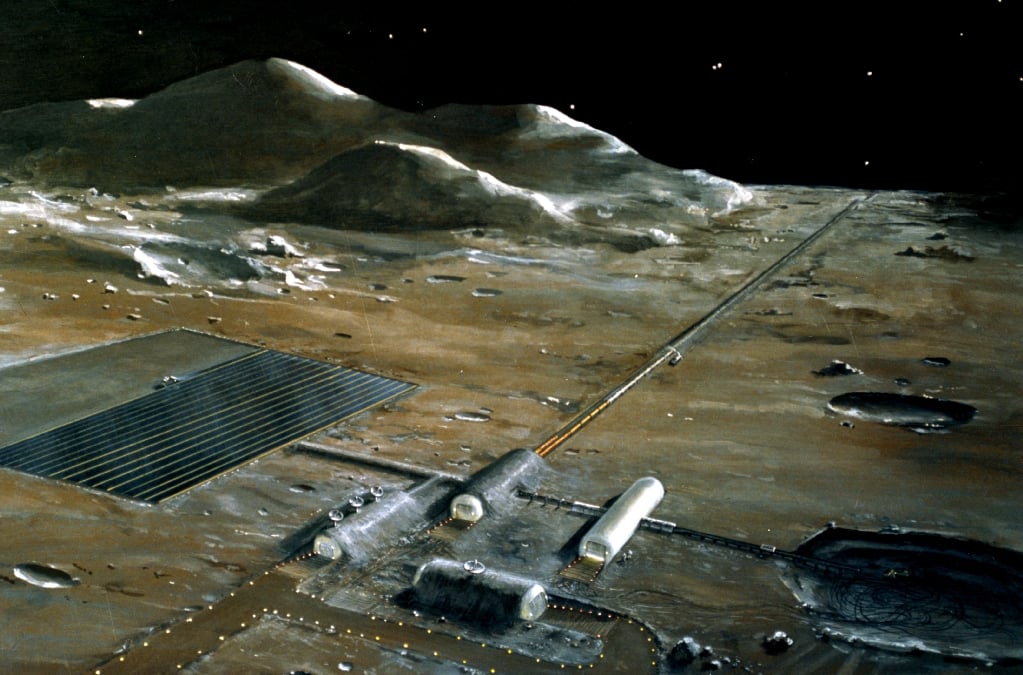
A 1970s NASA concept shows a lunar electromagnetic mass driver designed to launch payloads from the Moon into space. [Credit:
NASA]
More recent studies have continued to explore the practicality of lunar launch systems. In a 2023 report to the U.S. Air Force Office of Scientific Research, General Atomics researcher Robert Peterkin argued that
modern electromagnetic launchers could be powered by abundant solar energy on the Moon, eliminating the need to transport large quantities of rocket fuel from Earth. He suggested that adapting technologies such as the Navy’s electromagnetic aircraft launch
system could form the basis of a reliable lunar launch capability.
Such systems could play a role in a broader lunar industrial ecosystem. Early lunar bases would initially depend on machinery and supplies delivered from Earth, but the long-term goal would be to use lunar resources
— including silicon, aluminum, titanium, iron, and water ice — to manufacture hardware locally. Launching satellites or raw materials from the Moon’s weaker gravity could make resupply of lunar orbit or deep-space infrastructure far more economical than launching
everything from Earth.
While Musk’s timeline and plans remain speculative, the renewed discussion highlights growing interest in lunar manufacturing and infrastructure to support future space activity. For the satellite and amateur-radio
community, concepts like lunar mass drivers point toward a future in which large-scale space construction, power generation, and satellite deployment may increasingly take place beyond Earth’s surface.
Read the full article at:
https://www.space.com/astronomy/moon/elon-musk-wants-to-put-a-satellite-catapult-on-the-moon-its-not-a-new-idea
[ANS thanks
Leonard David, Space.com, for the above information]
The 2026 Coins Are Here! Help Support GOLF-TEE and FoxPlus.
Annual memberships start at only $120.
Join the AMSAT President's Club today and help Keep Amateur Radio in Space!
https://www.amsat.org/join-the-amsat-presidents-club/
Changes to AMSAT TLE Distribution for February 27, 2026
Two Line Elements or TLEs, often referred to as Keplerian elements or keps in the amateur community, are the inputs to the SGP4 standard mathematical model of spacecraft orbits used by most amateur tracking programs.
Weekly updates are completely adequate for most amateur satellites. TLE bulletin files are updated daily in the first hour of the UTC day. New bulletin files will be posted immediately after reliable elements become available for new amateur satellites. More
information may be found at https://www.amsat.org/keplerian-elements-resources/.
+ This week there are no additions or deletions to the AMSAT TLE distribution.
[ANS thanks Joe Fitzgerald, KM1P, AMSAT Orbital Elements Manager, for the above information]
ARISS News
Amateurs and others around the world may listen in on contacts between amateurs operating in schools and allowing students to interact with astronauts and cosmonauts aboard the International Space Station. The downlink
frequency on which to listen is 145.800 MHz worldwide.
Scheduled Contacts
+ Recently Completed
CityKidz Pre and Primary School, Johannesburg, South Africa, telebridge via AB1OC
The ISS callsign was NA1SS
The scheduled crewmember was Chris Williams KJ5GEW
The ARISS mentor was IN3GHZ
Contact was successful: Wed 2026-02-25 12:40:05 UTC via AB1OC
+ Upcoming Contacts
Escola Naval (Brazilian Navy Academy), Rio de Janeiro, Brazil, direct via PY1AA
The ISS callsign is presently scheduled to be NA1SS
The scheduled crewmember is Sophie Adenot KJ5LTN
The ARISS mentor is VE3TBD
Contact is go for: Mon 2026-03-02 12:17:25 UTC
St Joseph’s Primary School, Bombala, NSW, Australia, telebridge via VK6MJ
The ISS callsign is presently scheduled to be TBD
The scheduled crewmember is Jack Hathaway KJ5NIV
The ARISS mentor is VK4KHZ
Contact is go for: Thu 2026-03-05 08:51:56 UTC
Many times, a school makes a last-minute decision to do a Livestream or runs into a last-minute glitch requiring a change of the URL, but we at ARISS may not get the URL in time for publication. You can always check
https://live.ariss.org/ to see if a school is Livestreaming.
As always, if there is an EVA, a docking, or an undocking; the ARISS radios are turned off as part of the safety protocol.
The crossband repeater remains configured in the Columbus Module (145.990 MHz up {PL 67} & 437.800 MHz down). If a crewmember decides to pick up the microphone and turn up the volume, you may hear them on the air—so
keep listening, as you never know when activity might occur.
The Kenwood D710E in the Zvezda Service Module is currently running packet operations at 437.825 MHz through March 2, 2026. HamTV in the Columbus Module is configured for scheduled digital amateur television operations
on 2395.00 MHz.
Note, all times are approximate. It is recommended that you do your own orbital prediction or start listening about 10 minutes before the listed time.
The latest information on the operation mode can be found at https://www.ariss.org/current-status-of-iss-stations.html
The latest list of frequencies in use can be found at https://www.ariss.org/contact-the-iss.html
[ANS thanks Charlie Sufana, AJ9N, one of the ARISS operation team mentors for the above information]
AMSAT Ambassador Activities
AMSAT Ambassadors provide presentations, demonstrate communicating through amateur satellites, and host information tables at club meetings, hamfests, conventions, maker faires, and other events.
AMSAT Ambassador Clint Bradford, K6LCS, says,
“Think a 75-minute presentation on “working the easy satellites” would be appropriate for your club or event? Let me know by emailing me at k6lcsclint (at) gmail (dot) com or calling me at 909-999-SATS (7287)!”
Clint has NEVER given the exact same show twice: EACH of the 150+ presentations so far has been customized/tailored to their audiences.
Scheduled Events
Irving Amateur Radio Club Hamfest - March 7, 2026
Irving Amateur Radio Club
Betcha Bingo
2420 West Irving Boulevard
Irving, TX 75061
https://irvingarc.org/hamfest-2026/
N5AYP
Midwinter Madness Hamfest 2026 - March 21, 2026
Maple Grove Radio Club
Buffalo Civic Center
1306 County Road 134
Buffalo, Minnesota 55313
https://k0ltc.org/midwinter-madness/
KØJM, ADØHJ, KEØPBR
Tucson Area Spring Hamfest - April 11, 2026
Radio Society of Tucson
Calvary Tucson Church
8711 East Speedway
Tucson, AZ 85710
https://k7rst.club/
N1UW
For more information go to: https://www.amsat.org/ambassador/
[ANS thanks Bo Lowrey, W4FCL, Director – AMSAT Ambassador Program, for the above information]
AMSAT Remove Before Flight Key Tags Now Available
Yes, These are the Real Thing!
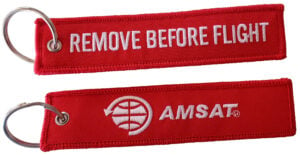
Your $20 Donation Goes to Help Fly a Fox-Plus Satellite
Includes First Class Postage (Sorry – U.S. Addresses Only)
Order Today at https://www.amsat.org/product/amsat-remove-before-flight-keychain
Satellite Shorts from All Over
+ At the 2026 Hamcation AMSAT Forum, AMSAT President Drew Glasbrenner, KO4MA, highlighted the AMSAT Status Page (amsat.org/status) as a convenient way to
see which satellites are active using user reports updated every two hours. He noted the page is especially useful for tracking scheduled or intermittent satellites and mode changes, helping operators quickly decide what to try on the air. Glasbrenner also
reviewed the breadth of current on-orbit operating resources, countering the common perception that “there are no satellites up there.” He outlined AMSAT’s education and youth efforts, including CubeSat Simulator kits, a free 113-page classroom guide at
CubeSatSim.org, and free online “Satellites in Space” courses at
BuzzSat.com. He noted that AMSAT now offers free membership for students age 25 and under with proof of student status. On the engineering side, he discussed progress on GOLF-TEE, FoxPlus 1U satellites, the LTM-1 linear transponder
module for student partners, and a modernized PACSAT board as AMSAT works toward new missions and future higher-performance opportunities. The full presentation may be viewed at
https://www.youtube.com/watch?v=n3bp0lF4u4Y. (ANS thanks the
Digital Rancher YouTube channel for recording and sharing the presentation)
+ AMSAT-HB has announced the dates for the next edition of the HB9RG Trophy, which will take place from March 2 through March 15, 2026. The competition commemorates the first amateur radio satellite contact achieved
on March 10, 1965, by Hans Rudolf Lauber, HB9RG, and Alfons Häring, DL6EZA, a milestone in amateur satellite communications. Organizers report that the event will return following strong international participation and enthusiastic feedback from previous editions
of the Trophy. Based on participant input, AMSAT-HB is currently revising the competition rules to improve fairness, accessibility, and the overall operating experience. These adjustments are intended to better reflect the needs and operating practices of
the global satellite amateur radio community. Complete rules, participation procedures, and event updates are available on the AMSAT-HB website at
https://www.amsat-hb.org/hb9rg_trophy. (ANS thanks
AMSAT-HB for the above information)
+ NASA’s Artemis II lunar mission faces a potential delay after engineers identified a helium flow issue in the upper stage of the Space Launch System rocket during recent testing at Kennedy Space Center. The helium
system is used to pressurize fuel tanks and purge propellant lines, and the anomaly requires the rocket to be rolled back to the Vehicle Assembly Building for inspection and repair. The move removes the possibility of a March launch attempt, with NASA now
targeting no earlier than April while teams investigate the cause and determine whether additional testing will be required. Artemis II is planned to send astronauts Reid Wiseman, Victor Glover, Christina Koch, and Canadian Space Agency astronaut Jeremy Hansen
on a roughly 10-day mission looping around the Moon. The flight will mark the first human journey beyond low Earth orbit since the Apollo era and is a key step toward future lunar landing missions. NASA officials say launch timing will depend on repair progress,
data review, and confirmation that the rocket’s systems perform as expected after returning to the pad. (ANS thanks
CNN for the above information)
+ Europe’s Ariane 6 rocket flew its most powerful configuration, the Ariane 64, for the first time on February 12, successfully launching 32 Amazon broadband satellites into low Earth orbit from the Guiana Space
Center in French Guiana. The satellites were deployed into an approximately 465-kilometer orbit less than two hours after liftoff, and Arianespace confirmed mission success. The spacecraft are part of Amazon’s planned Amazon LEO broadband constellation, intended
to compete with SpaceX’s Starlink network. Amazon has booked launches across multiple providers, including Ariane 6, Vulcan, New Glenn, Atlas V, and Falcon 9, as it works toward deploying thousands of satellites. Delays among several launch providers have
tightened global launch availability, prompting Amazon to secure additional rides where possible. The successful debut of the Ariane 64 restores Europe’s heavy-lift launch capability and highlights the continuing rapid expansion of large low-Earth-orbit satellite
constellations. (ANS thanks Ars Technica for the above information)
+ A total lunar eclipse on March 3, 2026, will produce a dramatic “blood moon” visible across North and South America along with parts of Asia, Australia, and the Pacific region. The event occurs when Earth passes
between the Sun and the full Moon, casting Earth’s shadow across the lunar surface and turning it reddish during totality. The total phase will last about 58 minutes, though how much of the eclipse is visible will depend on local horizon and weather conditions.
In the United States, the eclipse takes place during the early-morning hours before dawn, with some eastern locations seeing only part of the event as the Moon sets. Lunar eclipses are safe to observe with the unaided eye, binoculars, or telescopes, making
them useful opportunities for public outreach and astronomy education. Additional local timing details and visibility maps are available at
https://www.timeanddate.com/eclipse/lunar/2026-march-3. (ANS thanks
Space.com for the above information)
Join AMSAT today at
https://launch.amsat.org/
In addition to regular membership, AMSAT offers membership to:
-
Societies (a recognized group, clubs or organization).
-
Students enrolled in at least half-time status are eligible for free membership to age 25.
-
Memberships are available for annual and lifetime terms.
Contact info [at]
amsat.org for additional membership information.
73 and remember to help Keep Amateur Radio in Space!
This week's ANS Editor,
Mitch Ahrenstorff, ADØHJ
mahrenstorff [at]
amsat.org
ANS is a service of AMSAT, the Radio Amateur Satellite Corporation, 712 H Street NE, Suite 1653, Washington, DC 20002
AMSAT is a registered trademark of the Radio Amateur Satellite Corporation.