AMSAT News Service
ANS-074
March 15, 2026
In this edition:
- January/February 2026 Issue of The AMSAT Journal Now Available
- IARU Coordinates Two New Amateur Satellites
- Ten-Koh 2 Satellite With Linear Transponder Deployed
- FO-29 Enters Full Sunlight: Veteran Satellite Sees Renewed Activity in 2026
- Changes to AMSAT TLE Distribution for March 13, 2026
- ARISS News
- AMSAT Ambassador Activities
- Satellite Shorts From All Over
The AMSAT® News Service bulletins are a free, weekly news and information service of AMSAT, The Radio Amateur Satellite Corporation. ANS publishes news related to Amateur Radio in Space including reports on the activities of a worldwide group of Amateur Radio operators who share an active interest in designing, building, launching and communicating through analog and digital Amateur Radio satellites.
The news feed on https://www.amsat.org publishes news of Amateur Radio in Space as soon as our volunteers can post it.
Please send any amateur satellite news or reports to: ans-editor [at] amsat.org
You can sign up for free e-mail delivery of the AMSAT News Service Bulletins via the ANS List; to join this list see: https://mailman.amsat.org/postorius/lists/ans.amsat.org/
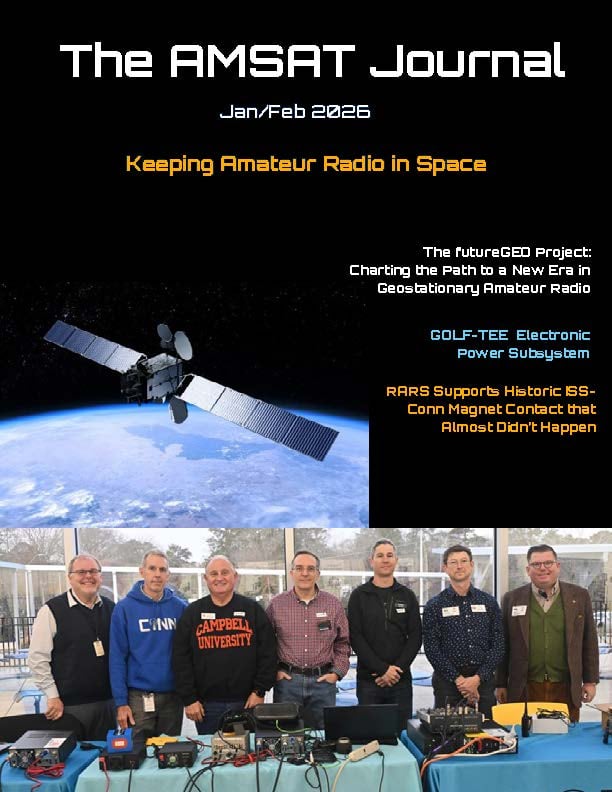
January/February 2026 Issue of The AMSAT Journal Now Available
The January/February 2026 issue of The AMSAT Journal is now available to AMSAT members on AMSAT’s Member Portal.
The AMSAT Journal is a bi-monthly digital magazine for amateur radio in space enthusiasts, published by the Radio Amateur Satellite Corporation (AMSAT). Each issue is your source for hardware and software projects, technical tips, STEM initiatives, operational activities, and news from around the world.
Inside the Current Issue:
- Apogee View - Drew Glasbrenner, KO4MA
- Educational Relations Update - Alan Johnston, KU2Y
- The futureGEO Project: Charting the Path to a New Era in Geostationary Amateur Radio - Paul Stoetzer, N8HM
- AMSAT GOLF-TEE Electronic Power Subsystem - Kip Moravec, AE5IB
- RARS Supports Historic ISS-Conn Magnet Contact that Almost Didn't Happen - Mike Nutt, K3LOE
- AMSAT-INDIA Amateur Radio & Space Communication Gallery - Activity Report - Rajesh P. Vagadia, VU2EXP
[ANS thanks The AMSAT Journal team for the above information]
AMSAT Remove Before Flight Key Tags Now Available
Yes, These are the Real Thing!
Your $20 Donation Goes to Help Fly a FoxPlus Satellite
Includes First Class Postage (Sorry – U.S. Addresses Only)
Order Today at https://www.amsat.org/product/amsat-remove-before-flight-keychain
IARU Coordinates Two New Amateur Satellites
The International Amateur Radio Union (IARU) Satellite Frequency Coordination Committee has recently completed frequency coordination for two CubeSat missions: Taiwan's Lilium-4 and Montenegro's Luca-01. These coordinations ensure that the satellites can operate without interfering with other space-based communications, paving the way for their upcoming launches and contributions to scientific research, education, and ham radio communities worldwide.
Lilium-4, a 6U CubeSat developed by National Formosa University is set to enhance amateur radio connectivity and optical experimentation in space. The satellite, with callsign BN0YCA, will feature a 1200 bps AX.25 APRS digipeater on 145.825 MHz for global intercommunication among radio enthusiasts. It also includes UHF telemetry downlink at 437.850 MHz and a high-bandwidth S-band downlink at 2405.0 MHz for monitoring an onboard optical payload. Additional capabilities involve a V/U repeater with uplink at 145.980 MHz and downlink at 435.250 MHz, plus GNSS positioning using the L1 signal at 1575.42 MHz. The mission focuses on student-led studies of space-to-ground optical signal acquisition, with unencrypted telemetry encouraging public participation in decoding and link-budget validation. IARU coordination for Lilium-4 was finalized on January 31, 2026, following a submission in late December 2025. The satellite is slated for launch no earlier than mid-March 2026 aboard a SpaceX rocket from Vandenberg Space Force Base, targeting a 510 km polar orbit.
Luca-01 represents Montenegro's entry into amateur satellite technology, spearheaded by Montenegro Space Research. This 1U CubeSat is designed for educational outreach, equipped with a charged particle sensor and a miniature camera to capture Earth's surface images. It will transmit special Slow Scan Television (SSTV) images and telemetry data to engage radio amateurs, students, and schoolchildren, using an open protocol for easy reception with affordable equipment. The mission aims to inspire young people in amateur radio and space science, including efforts to image various orbital objects. Downlinks have been coordinated on UHF frequencies: 437.180 MHz primary and 436.150 MHz spare, employing GMSK modulation at rates between 2.4 kbps and 19.2 kbps. Coordination was completed on March 13, 2026, after an application submitted on February 6, 2026. Luca-01 is planned for a Roscosmos launch from the Vostochny Cosmodrome into a 500-600 km Sun-synchronous orbit.
[ANS thanks the IARU for the above information]
The 2026 President's Club Coin is Now Here!
Help Support GOLF and FoxPlus.
Annual memberships start at only $120
Join the AMSAT President’s Club today and help
Keep Amateur Radio in Space!
https://www.amsat.org/join-the-amsat-presidents-club/
Ten-Koh 2 Satellite With Linear Transponder Deployed
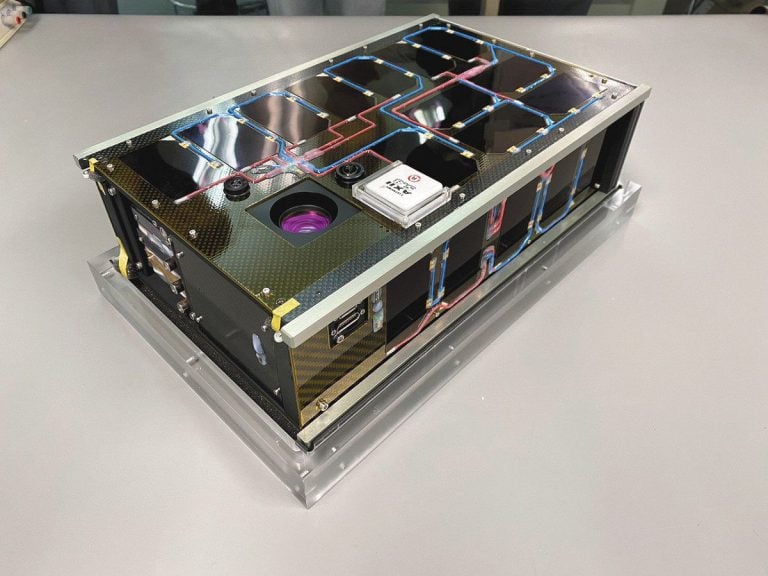
The 6U CubeSat Ten-Koh 2 (also written as Tenkoh-2 or ã¦んã“ã†2) from Japan's Nihon University was successfully deployed into orbit on March 11, 2026, at approximately 09:34 UTC. The satellite was released from JAXA's new HTV-X1 cargo spacecraft using the HTV-X Small Satellite Orbital Deployer (H-SSOD) after the vehicle departed the International Space Station (ISS) on March 6 and raised its altitude to around 500 km. This marks the first use of the H-SSOD mechanism for satellite deployment from HTV-X.
Developed by the Okuyama Laboratory in the Department of Aerospace Engineering at Nihon University's College of Science and Technology, Ten-Koh 2 builds on the legacy of its predecessor, Ten-Koh (launched in 2018). The mission focuses on low-Earth orbit environmental observations to gather data for future space development, alongside in-orbit demonstrations of next-generation communication technologies. Key goals include evaluating high-speed data transmission and enabling global access for amateur radio operators to collect telemetry and experiment with the payloads.
The satellite carries an amateur radio payload coordinated by the International Amateur Radio Union (IARU) and supported by JAMSAT (Japan Amateur Satellite Association):
- V/U Linear Transponder (inverting, 40 kHz bandwidth):
- Uplink (LSB): 145.895–145.935 MHz
- Downlink (USB): 435.875–435.915 MHz
- Additional Downlinks/Experiments:
- CW beacon, Digitalker, AFSK 1.2 kbps, GMSK up to 19.2 kbps on 435.860 MHz
- High-speed experiments (GMSK 4.8–19.2 kbps, 4FSK 38.4 kbps) and photo/picture downlinks on 435.895 MHz
- 5.839 GHz CW beacon for microwave-band communication demos (SHF experimenters take note—this provides a great target for testing dishes, feeds, and LNAs)
The transponder is expected to operate on a scheduled basis (initially two days per week, with details forthcoming from the team). Operations began shortly after deployment, with the university's ground station confirming reception of the CW beacon for basic telemetry (voltage, temperature, etc.).
Post-deployment updates from the Okuyama Lab indicate the signal level is currently weaker than anticipated, prompting ongoing monitoring and appeals for reception reports via networks like SatNOGS to aid diagnostics and performance assessment. Early passes over Japan and other regions have yielded mixed results, with some operators reporting no signals yet, while preliminary TLEs (e.g., temporary NORAD 98542) are circulating for tracking.
 ÂÂ
 [ANS thanks the Okuyama Laboratory at Nihon University for the above information]
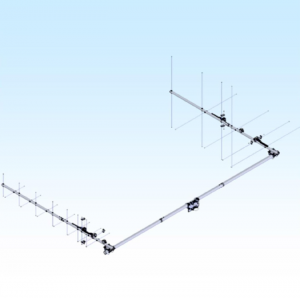
Need new satellite antennas?
Purchase M2 LEO-Packs from the AMSAT Store.
When you purchase through AMSAT, a portion of the proceeds goes towards
Keeping Amateur Radio in Space.
https://amsat.org/product-category/hardware/
FO-29 Enters Full Sunlight: Veteran Satellite Sees Renewed Activity in 2026
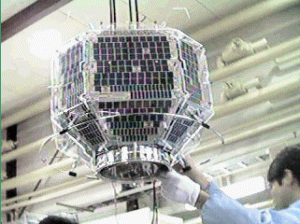
Fuji-OSCAR 29 (FO-29), also known as JAS-2, the Japanese amateur radio satellite launched in August 1996, has entered a new operational phase as of early March 2026. Now approaching its 30th anniversary in orbit, the satellite—long limited by failed batteries—relies entirely on solar panel illumination for power, meaning it only functions during sunlight periods and shuts down in eclipse.
In February 2026, the FO-29 control team (operated from Japan) continued scheduled activations of the linear transponder, with commands sent on specific dates to turn it on for limited windows. Operators noted the unstable situation due to the satellite's age, with activations sometimes failing if the onboard voltage didn't respond quickly enough. The transponder operates in Mode V/u (inverting SSB/CW): uplink LSB 145.900–146.000 MHz, downlink USB 435.800–435.900 MHz, with a CW beacon on 435.795 MHz.
Around March 9, 2026, when FO-29 transitioned into a full-sunlight orbit season. This eliminates periodic eclipses, allowing continuous operation as long as solar panels receive light. AMSAT highlighted this in early February bulletins, noting that shadow duration had decreased dramatically (from ~20 minutes to ~1 minute per orbit by mid-February), leading to the full-sun entry on March 9.
SatNOGS observers reported recent CW beacon and telemetry receptions as of March 12–13, 2026, with stations like EA5WA and DL7NDR logging data. On March 13, 2026, amateur operators reported successful SSB and CW QSOs during passes, including busy activity with calls from Japan (e.g., JO1XOK, JE6TSP), China (e.g., BA4QNR, BD5EUA, BG5FWV), and others (e.g., E27DPX). One operator described a "very busy pass" with multiple contacts, and another logged several SSB and CW exchanges despite windy conditions affecting reception.
AMSAT's live linear satellite summaries and status pages list FO-29 as active under full sunlight conditions, with the transponder remaining on until voltage drops below safe thresholds—no longer an issue in continuous sun. The digital modes (1k2/9k6 BBS) remain inactive, and the Digitalker on 435.910 MHz is rarely used.
This full-sunlight period offers a welcome revival for one of the oldest active analog linear transponders in the amateur fleet. Enthusiasts are encouraged to monitor, log contacts via the AMSAT OSCAR Status Page, and share reports to help track performance.
 ÂÂ
 [ANS thanks AMSAT, SatNOGS, and various amateur radio operators for the above information]

Changes to AMSAT TLE Distribution for March 13, 2026
Two Line Elements or TLEs, often referred to as Keplerian elements or keps in the amateur community, are the inputs to the SGP4 standard mathematical model of spacecraft orbits used by most amateur tracking programs. Weekly updates are completely adequate for most amateur satellites. TLE bulletin files are updated daily in the first hour of the UTC day. New bulletin files will be posted immediately after reliable elements become available for new amateur satellites. More information may be found at https://www.amsat.org/keplerian-elements-resources/.
Ten-Koh2 has been added to this week's distribution.
[ANS thanks Joe Fitzgerald, KM1P, AMSAT Orbital Elements Manager, for the above information]
ARISS News
Amateurs and others around the world may listen in on contacts between amateurs operating in schools and allowing students to interact with astronauts and cosmonauts aboard the International Space Station. The downlink frequency on which to listen is 145.800 MHz worldwide.
Scheduled Contacts
Lewis Center for Educational Research, Apple Valley, CA, telebridge via IK1SLD
The ISS callsign is presently scheduled to be OR4ISS
The scheduled crewmember is Sophie Adenot KJ5LTN
The ARISS mentor is AA6TB
Contact is go for: Thu 2026-03-19 17:15:13 UTC 48 deg
Watch for Livestream at https://live.ariss.org/
Amur State University, Blagoveshchensk, Russia, direct via TBD
The ISS callsign is presently scheduled to be RSØISS
The scheduled crewmember is Andrey Fedyaev
The ARISS mentor is RV3DR
Contact is go for 2026-03-26 08:50 UTC
MOBU, Ufa, Republic of Bashkortostan, Russia, direct via TBD
The ISS callsign is presently scheduled to be RSØISS
The scheduled crewmember is Sergey Kud-Sverchkov
The ARISS mentor is RV3DR
Contact is go for 2026-03-26 13:30 UTC
Many times a school may make a last minute decision to do a Livestream or run into a last minute glitch requiring a change of the URL but we at ARISS may not get the URL in time for publication.  You can always check https://live.ariss.org/ to see if a school is Livestreaming.
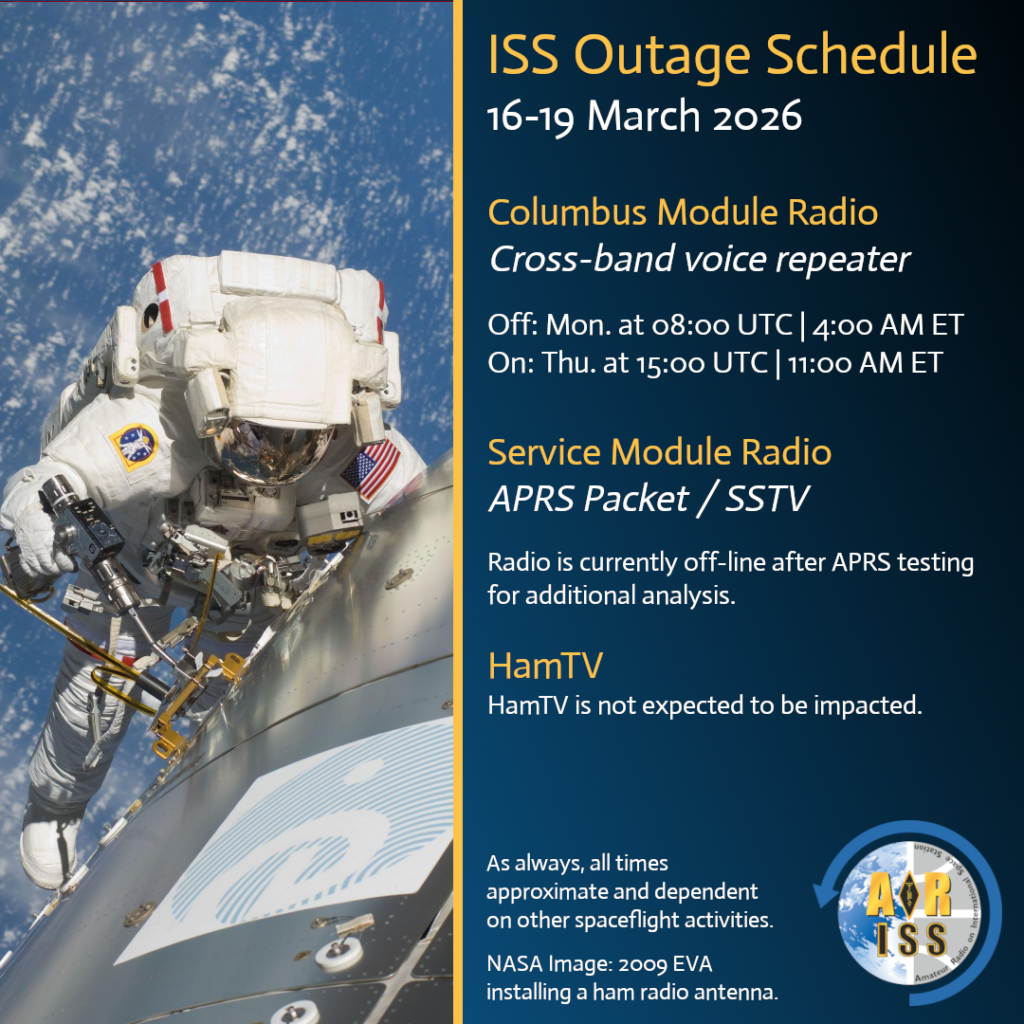
As always, if there is an EVA, a docking, or an undocking; the ARISS radios are turned off as part of the safety protocol.
The crossband repeater continues to be active (145.990 MHz up {PL 67} & 437.800 MHz down), If any crew member is so inclined, all they have to do is pick up the microphone, raise the volume up, and talk on the crossband repeater. So give a listen, you just never know.
Service Module radio: Not in APRS configuration; only being used for voice contacts at this time. Default mode is for packet operations (145.825 MHz up & down) but occasionally used for SSTV (145.800 MHz down).
Ham TV – Configured. Default mode is for scheduled digital amateur television operations (2395.00 MHz).
Note, all times are approximate. It is recommended that you do your own orbital prediction or start listening about 10 minutes before the listed time.
The latest information on the operation mode can be found at https://www.ariss.org/current-status-of-iss-stations.html
The latest list of frequencies in use can be found at https://www.ariss.org/contact-the-iss.html
[ANS thanks Charlie Sufana, AJ9N, one of the ARISS operation team mentors for the above information]
Want to fly the colors on your own grid expedition?
Get an AMSAT car flag and other neat stuff from our Zazzle store!
25% of the purchase price of each product goes towards Keeping Amateur Radio in Space
AMSAT Ambassador Activities
AMSAT Ambassadors provide presentations, demonstrate communicating through amateur satellites, and host information tables at club meetings, hamfests, conventions, maker faires, and other events.
March 21, 2026
Midwinter Madness Hamfest
Buffalo Civic Center
1306 County Rd 134
Buffalo Minnesota 55313
KØJM, ADØHJ
April 11, 2026
Tucson Area Spring Hamfest
Radio Society of Tucson
Calvary Tucson Church
8711 East Speedway
Tucson, AZ 85710
https://k7rst.club/
N1UW
Interested in becoming an AMSAT Ambassador? AMSAT Ambassadors provide presentations, demonstrate communicating through amateur satellites, and host information tables at club meetings, hamfests, conventions, maker faires, and other events.
For more information go to: https://www.amsat.org/ambassador/
[ANS thanks Bo Lowrey, W4FCL, Director – AMSAT Ambassador Program, for the above information]
Satellite Shorts from All Over
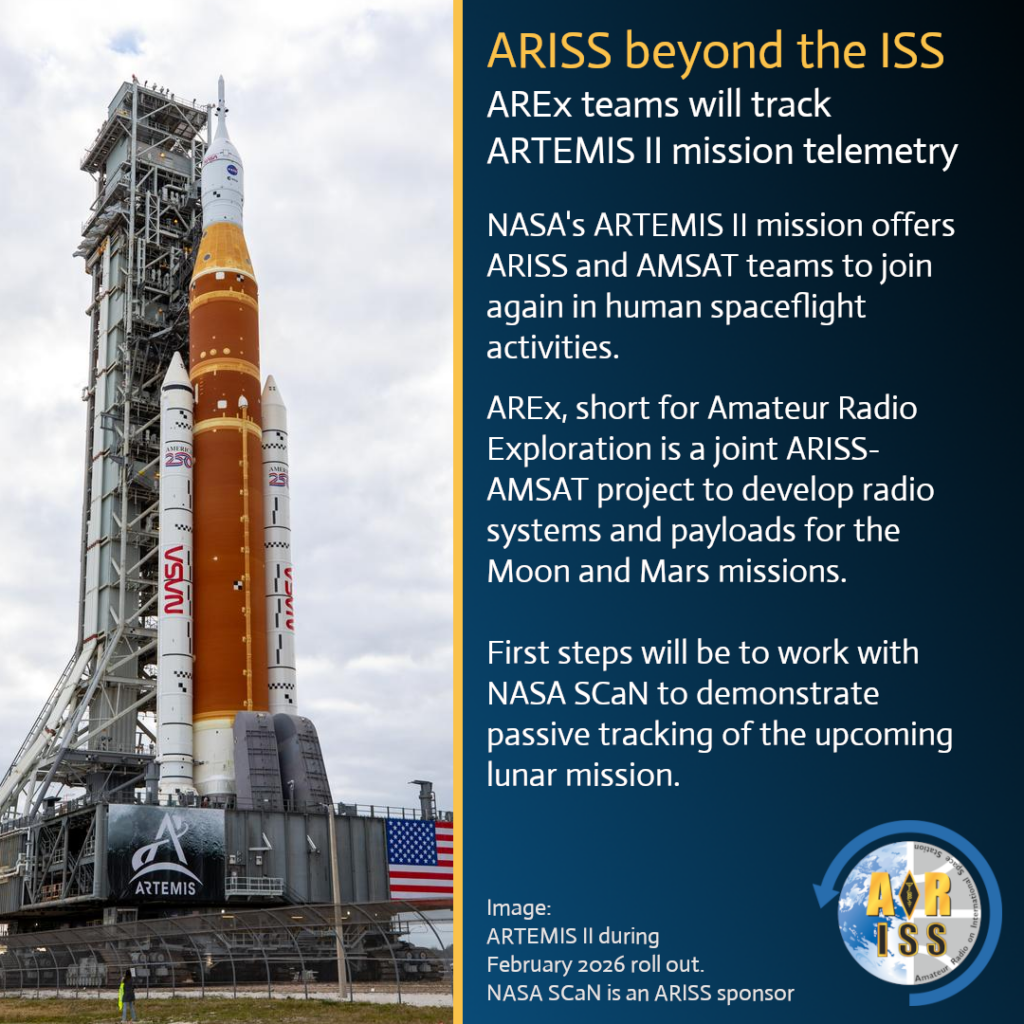
+ NASA held a live news conference on March 12 following the Artemis II Flight Readiness Review, confirming the SLS rocket and Orion spacecraft remain in the Vehicle Assembly Building at Kennedy Space Center for final prep work. Repairs to the upper stage helium system (from a quick-disconnect seal issue) are complete, with rollout to the pad expected later this month. The mission targets the first crewed lunar flyby in over 50 years, now aiming for early April launch opportunities (starting April 1) (ANS thanks NASA for the information. https://www.nasa.gov/2026-news-releases)
+ NASA's retired Van Allen Probe A (launched 2012) made an uncontrolled reentry over the Pacific west of the Galapagos on March 11. Most of the spacecraft burned up, with a low risk (1-in-4,200) of debris causing harm; its twin Probe B remains in orbit but non-operational. The probes studied Earth's radiation belts for years. (ANS thanks AP for the information. See the full article at https://www.kbtx.com/2026/03/11/old-nasa-science-satellite-plunges-back-earth)
+ Roscosmos completed repairs to the damaged Soyuz pad (Pad 31) at Baikonur Cosmodrome after a November 2025 incident where an unsecured service structure fell during launch. Over 150 personnel restored the site; first relaunch (Progress cargo to ISS) targeted for March 22. (ANS thanks Ars Technica for the information. See the full article at https://arstechnica.com/space/2026/03/rocket-report-spacex-launch-prices-are-going-up-russia-fixes-broken-launch-pad)
+ The European Space Agency has confirmed that its Coronagraph spacecraft, part of the Proba-3 solar observation mission, has gone silent following an onboard anomaly in mid-February 2026. The incident led to the loss of attitude control, preventing the satellite’s solar panels from facing the Sun and draining its battery. The spacecraft has since entered survival mode, cutting off all communication with Earth.(ANS thanks MSN for the information. See the full article at https://www.msn.com/en-in/news/insight/europe-s-solar-mission-hit-by-satellite-blackout/gm-GM11D32319?gemSnapshotKey=GM11D32319-snapshot-1&uxmode=ruby.)
Join AMSAT today at https://launch.amsat.org/
In addition to regular membership, AMSAT offers membership to:
- Societies (a recognized group, clubs or organization).
- Students are eligible for FREE membership up to age 25.
- Memberships are available for annual and lifetime terms.
Contact info [at] amsat.org for additional membership information.
73 and remember to help Keep Amateur Radio in Space!
This week's ANS Editor,
Paul Stoetzer, N8HM
n8hm [at] amsat.org
ANS is a service of AMSAT, the Radio Amateur Satellite Corporation, 712 H Street NE, Suite 1653, Washington, DC 20002
AMSAT is a registered trademark of the Radio Amateur Satellite Corporation.