|
For the first time in more than 50 years, astronauts on a NASA mission are bound to fly around the Moon after successfully completing a key burn of Orion’s main engine.
With the approximately six-minute firing of the spacecraft’s service module engine on Thursday, known as the translunar injection burn, Orion and its crew of NASA astronauts Reid Wiseman, Victor Glover, Christina Koch, and CSA (Canadian Space Agency) astronaut Jeremy Hansen accelerated to break free of Earth’s orbit and began the outbound trajectory toward Earth’s nearest neighbor.
“Today, for the first time since Apollo 17 in 1972, humans have departed Earth orbit. Reid, Victor, Christina, and Jeremy now are on a precise trajectory toward the Moon. Orion is operating with crew for the first time in space, and we are gathering critical data, and learning from each step," said Dr. Lori Glaze, acting associate administrator for the Exploration Systems Development Mission Directorate at NASA Headquarters in Washington. "Each milestone we reach marks meaningful progress on the path forward for the Artemis program. While we have eight intensive days of work ahead, this is a big moment, and we're proud to share it with the world."
NASA’s SLS (Space Launch System) rocket and Orion spacecraft lifted off from Launch Pad 39B at the agency’s Kennedy Space Center in Florida at 6:35 p.m. EDT on April 1, sending the four astronauts on a planned 10-day test flight around the Moon and back.
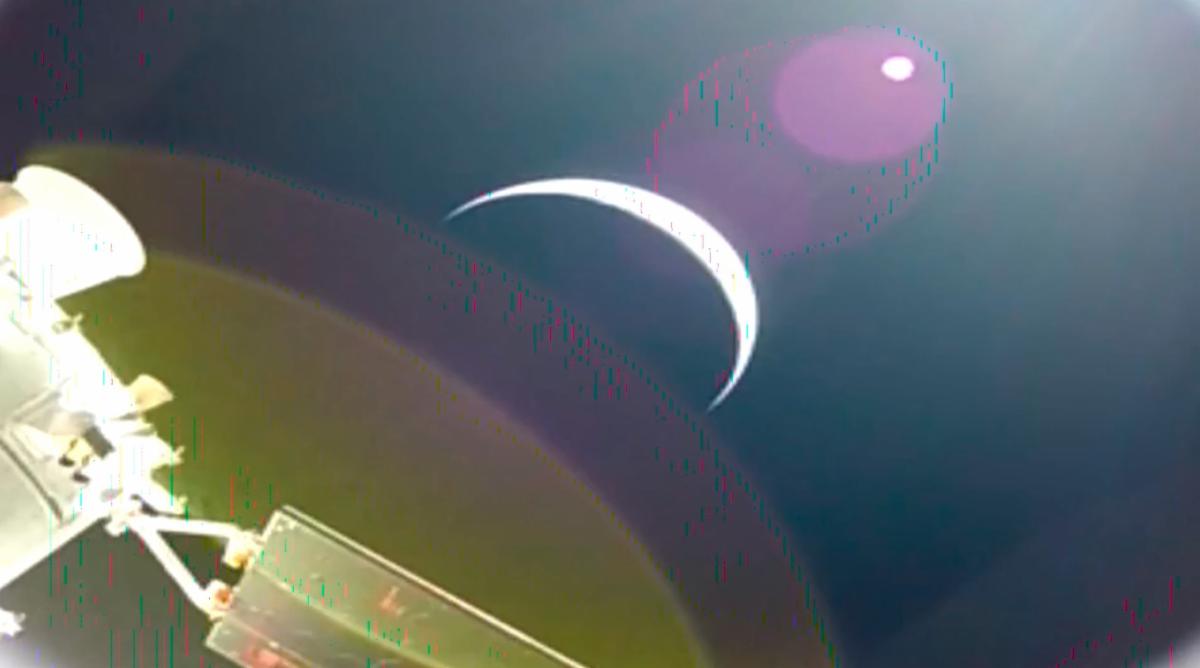
After reaching space, Orion deployed its four solar array wings, enabling the spacecraft to receive energy from the Sun, while the crew and engineers on the ground immediately began transitioning the spacecraft from launch to flight operations to start checking out key systems.
About 49 minutes into the test flight, the SLS rocket’s upper stage fired to put Orion into an elliptical orbit around Earth. A second planned burn by the stage propelled Orion, which the crew named “Integrity,” into a high Earth orbit extending about 46,000 miles above the Earth for about 24 hours of system checkouts. After the burn, Orion separated from the stage, flying free on its own.
The crew then conducted a manual piloting demonstration to test Orion’s handling qualities using the ICPS (interim cryogenic propulsion stage) as a docking target.
At the conclusion of the demonstration, Orion executed an automated departure burn to safely back away from the ICPS, after which the stage performed its own disposal burn and re-entered Earth’s atmosphere over a remote region of the Pacific Ocean.
Prior to its re-entry, four small CubeSats were deployed from SLS rocket’s Orion stage adapter.
Other tasks completed so far include a transition to the Deep Space Network for communications, the crew becoming acclimated to the space environment, completing their first rest periods, performing the first flywheel exercise, restoring the spacecraft’s toilet to normal operations, and configuring the spacecraft for the translunar injection burn.
During a planned lunar flyby on Monday, April 6, the astronauts will take high resolution photographs and provide their own observations of the lunar surface, including areas of the far side of the Moon never seen directly by humans. Although the lunar far side will only be partially illuminated during the flyby, the conditions should create shadows that stretch across the surface, enhancing relief and revealing depth, ridges, slopes, and crater rims that are often difficult to detect under full illumination.
Following a successful lunar flyby, the astronauts will return to Earth and splash down in the Pacific Ocean off the coast of San Diego.
As part of a Golden Age of innovation and exploration, NASA will send Artemis astronauts on increasingly challenging missions to explore more of the Moon for scientific discovery, economic benefits, and to build on our foundation for the first crewed missions to Mars.
Follow the latest mission progress, including more images from the test flight, at:
|