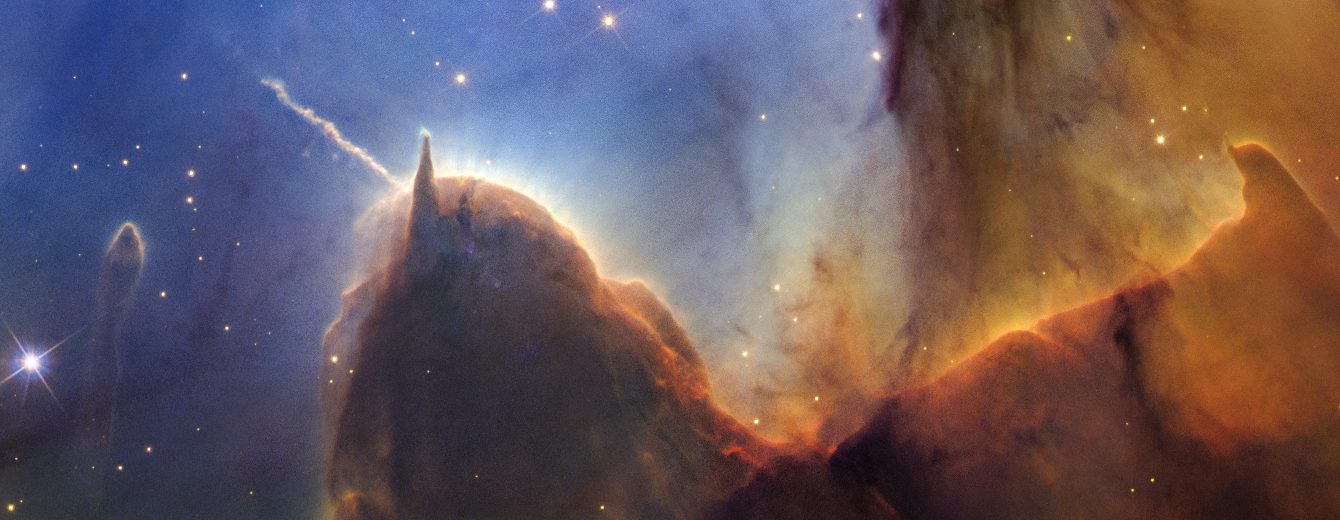
Actively forming stars are threaded throughout thick dust in this star-forming region.
Hubble is the most enduring space telescope the world has ever known. Many of its findings could not have been predicted when the concept for this telescope was proposed in 1946. Hubble provided the first confirmation that supermassive black holes exist, and that black holes are at the cores of almost all galaxies. This telescope was the first to confirm an atmosphere around a planet outside our solar system — and showed us the first images of asteroids with tails. It has observed a huge number of cosmic objects, from nearby stars and star-forming regions to more distant merging galaxies and galaxy clusters. Its extensive, precise observations are regularly referenced when astronomers calculate (and recalculate) the expansion rate of the universe itself. This great observatory is always “on” — Hubble takes new images and data daily. Its deeply detailed images capture ultraviolet, visible, and near-infrared light.
In honor of Hubble’s 36th anniversary, the telescope looked at a scene it first captured in 1997: A small portion of a star-forming region about 5,000 light-years away in the constellation Sagittarius, known as the Trifid Nebula. This before-and-after shows changes over incredibly short timescales — and instills a sense of awe and wonder about our ever-changing universe.
Find additional resources at www.stsci.edu
You are receiving this email because you are subscribed to the Inbox Astronomy mailing list.


