The first direct mass measurement from the early universe weighs in on the debate over the origins of supermassive black holes.
How could a supermassive black hole tens of millions of times the mass of the Sun, a black hole that was already enormous just 700 million years after the big bang, begin with the collapse of a single star? Maybe it didn’t.
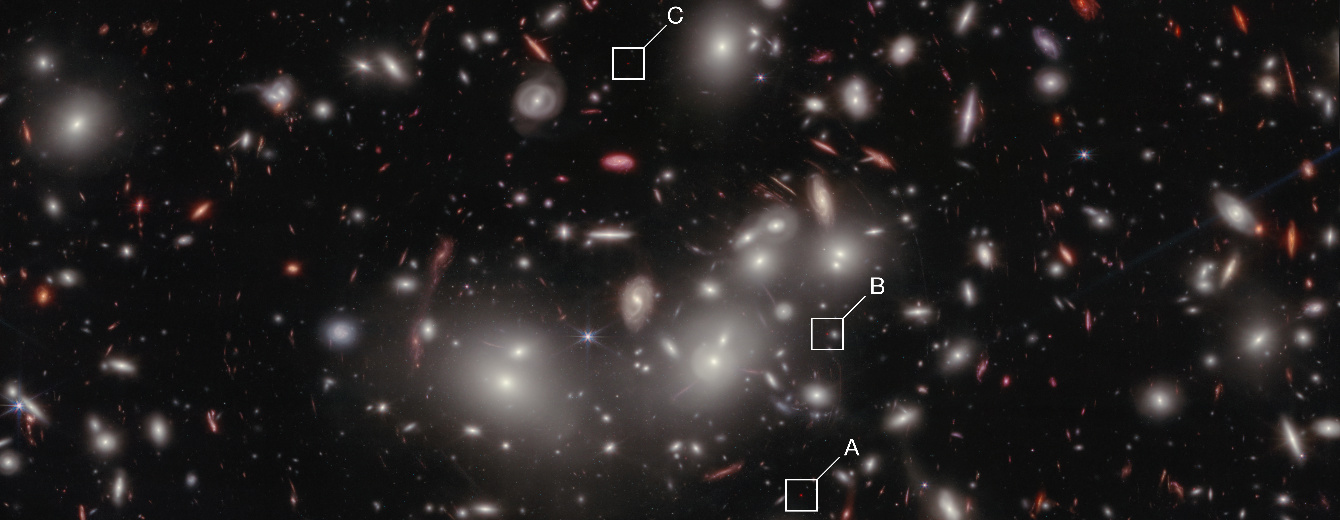
Using the unprecedented imaging and spectroscopic power of NASA’s James Webb Space Telescope, researchers have mapped the motion and composition of gas orbiting a black hole in the center of Abell2744-QSO1, a tiny galaxy more than 13 billion light-years away. The results suggest that the 50-million-solar-mass black hole predates its host galaxy, possibly forming within the first second of the big bang, and must have been immense from the start.
Find additional resources at www.stsci.edu
You are receiving this email because you are subscribed to the Inbox Astronomy mailing list.


