AMSAT News Service
ANS-151
May 31, 2026
In this edition:
* AMSAT Opens Candidate Nominations for 2026 Board of Directors Election
* 2026 AMSAT Space Symposium & Annual General Meeting
* AMSAT Field Day 2026
* RADIANT Project Aims to Bring Delay-Tolerant Networking to Amateur Radio
* SpaceX Starship V3’s First Test Flight Largely Successful
* China Launches Shenzhou 23 Spacecraft
* Changes to AMSAT-NA TLE Distribution
* Blue Origin Explosion
* ARISS News
* AMSAT Ambassador Activities
* Satellite Shorts From All Over
The AMSAT® News Service bulletins are a free, weekly news and
information service of AMSAT, The Radio Amateur Satellite Corporation.
ANS publishes news related to Amateur Radio in Space including reports
on the activities of a worldwide group of Amateur Radio operators who
share an active interest in designing, building, launching and
communicating through analog and digital Amateur Radio satellites.
The news feed on https://www.amsat.org publishes news of Amateur Radio in Space as soon as our volunteers can post it.
Please send any amateur satellite news or reports to: ans-editor [at] amsat.org
You can sign up for free e-mail delivery of the AMSAT News Service Bulletins via the ANS List; to join this list see: https://mailman.amsat.org/postorius/lists/ans.amsat.org/
AMSAT Opens Candidate Nominations for 2026 Board of Directors Election
AMSAT has officially opened the nomination period for its 2026 Board
of Directors election, which will take place during the third quarter of
the year.
Three director positions are set to expire in 2026. The current board members whose seats are up for election are:
- Mark Hammond, N8MH
- Bruce Paige, KK5DO
- Paul Stoetzer, N8HM
In addition to these three full Director roles, up to two Alternate Directors may also be elected to serve one-year terms.
To nominate a candidate, a written submission is required.
Nominations must include the nominee’s name, call sign, and contact
information, along with the same details for either five AMSAT members
in good standing or one Member Society endorsing the candidate.
Nominations should be directed to the AMSAT Secretary:
Douglas Tabor, N6UA
1133 Verlan Way
Cheyenne, WY 82009
Per AMSAT’s bylaws, all nominations must follow the format specified
by the Secretary. Doug Tabor has indicated that nominations will be
accepted in both hard copy (via postal mail) and digital formats
(including email or scanned documents). However, fax submissions are not
permitted.
Email nominations should be sent to: dtabor [at] amsat [dot] org
All nomination petitions must be received by the Secretary no later
than June 15. After the submission deadline, the Secretary will confirm
the eligibility of each candidate and the supporting members or
societies, with final notification to candidates provided by the end of
June.
[ANS thanks Doug Tabor, N6UA, AMSAT Secretary, for the above information.]
Buying from Ham Radio Outlet? Add AMSAT’s Getting Started With Amateur Satellites to your order. 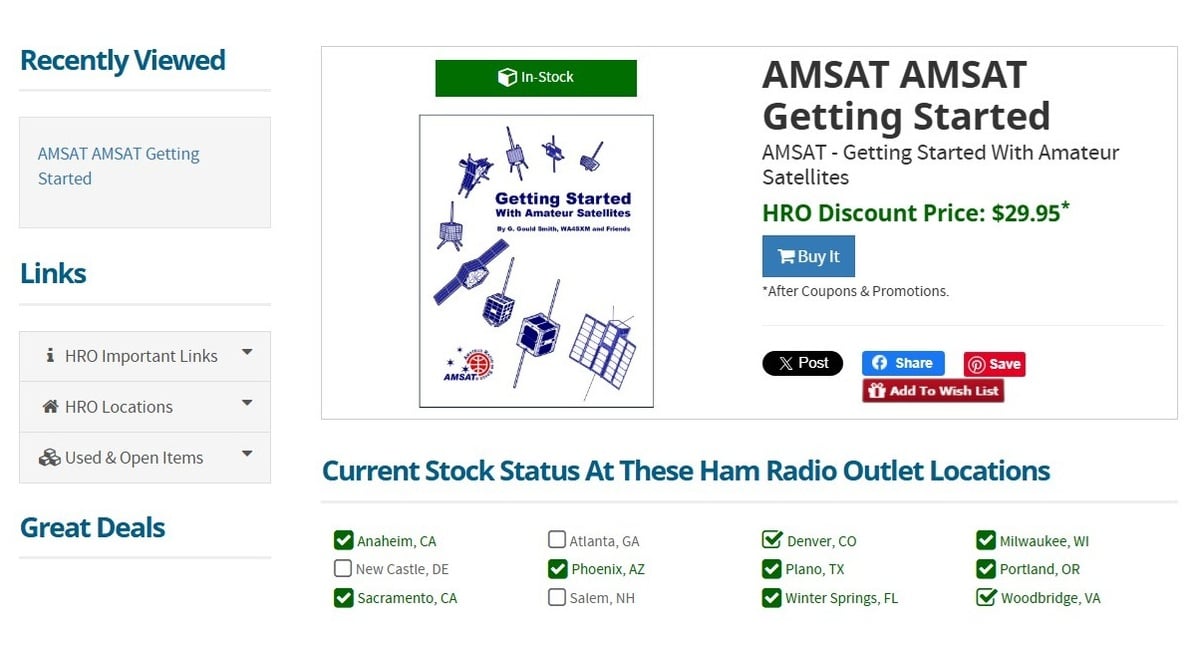
2026 AMSAT Space Symposium & Annual General Meeting
The 44th AMSAT Space Symposium & Annual General Meeting will be
held in Jacksonville, FL on October 8-11, 2026 at the Crowne Plaza
Jacksonville Airport/I-95.

Registration details and Call for Papers will be coming soon.
To book hotel rooms online, click here: AMSAT Conference Rooms
Reservations can also be made by phone at 1-800-227-6963. The group
code is AMS. The direct hotel phone number is 1-904-741-4404.
[ANS thanks AMSAT for the above information.]
AMSAT Field Day 2026
It’s that time of year again; summer and Field Day! Each year the
American Radio Relay League (ARRL) sponsors Field Day as a “picnic, a
campout, practice for emergencies, an informal contest and, most of all,
FUN!†The event takes place during a 27-hour period on the fourth
weekend of June. For 2026 the event takes place from 1800 UTC on
Saturday June 27, 2026 through 2100 UTC on Sunday June 28, 2026. Those
who set up prior to 1800 UTC on June 27 can operate only 24 hours. The
Radio Amateur Satellite Corporation (AMSAT) promotes its own version of
Field Day for operation via the amateur satellites, held concurrently
with the ARRL event.
This year should be as much fun as last year since we have more than
10 transponders and repeaters available. Users should check the AMSAT
status page at http://www.amsat.org/status/ and the pages at https://www.amsat.org/two-way-satellites/
for what is available in the weeks leading up to field day. To reduce
the amount of time to research each satellite, see the current FM
satellite table at https://www.amsat.org/fm-satellite-frequency-summary/ and the current linear satellite table at https://www.amsat.org/linear-satellite-frequency-summary/
If you are considering ONLY the FM voice satellites, there are ISS,
SO-50, AO-123, SO-125, and SONATE-2. It might be easier this year to
make that one FM contact for the ARRL bonus points with so many FM
birds. The congestion on FM LEO satellites is always so intense that we
must continue to limit their use to one-QSO-per-FM-satellite. This
includes the International Space Station. You will be allowed one QSO if
the ISS is operating Voice.
It was suggested during past field days that a control station be
allowed to coordinate contacts on the FM satellites. There is nothing in
the rules that would prohibit this. This is nothing more than a single
station working multiple QSO’s. If a station were to act as a control
station and give QSO’s to every other field day station, the control
station would still only be allowed to turn in one QSO per FM satellite
while the other station would be able to submit one QSO.
The format for the message exchange on the ISS or other digital
packet satellite is an unproto packet to the other station (3-way
exchange required) with all the same information as normally exchanged
for ARRL Field Day, e.g.:
W6NWG de KK5DO 2A STX
KK5DO de W6NWG QSL 5A SDG
W6NWG de KK5DO QSL
If you have worked the satellites on Field Day in recent years, you
may have noticed a lot of good contacts can be made on some of the
less-populated, low-earth-orbit satellites like AO-7, RS-44, AO-73, and
JO-97. During Field Day the transponders come alive like 20 meters on a
weekend. The good news is that the transponders on these satellites will
support multiple simultaneous contacts. The bad news is that you can’t
use FM, just low duty-cycle modes like SSB and CW.
The complete rules for AMSAT Field Day may be found at: https://www.amsat.org/field-day/.
[ANS thanks Bruce Paige, KK5DO, AMSAT Director Contests and Awards, for the above information.]
ÂÂ
RADIANT Project Aims to Bring Delay-Tolerant Networking to Amateur Radio
RADIANT, short for Radio Amateur Delay-tolerant Interplanetary
Networking Testbed, is an open-source project seeking to bring
NASA-inspired Delay-Tolerant Networking (DTN) concepts to amateur radio.
The effort aims to create communication systems capable of handling
intermittent, disrupted, or long-delay links ranging from terrestrial
amateur radio networks to future cislunar communication systems. Project
developers describe RADIANT as a stepping stone toward Earth-Moon
networking experiments using technologies and operating practices
accessible to the amateur radio community. The initiative is supported
by AMSAT-UK, AMSAT-DL, and Goonhilly Earth Station, and is actively
seeking collaborators.
The project is built around NASA Glenn Research Center’s High-rate
Delay Tolerant Networking software, known as HDTN, which implements
Bundle Protocol version 7 (BPv7). Rather than assuming a continuous
network path between endpoints, DTN stores and forwards data bundles
whenever communication opportunities become available. This approach
allows communication systems to survive outages, long propagation
delays, and interruptions that would break conventional internet-style
connections. Project developers say these networking methods are
essential for future deep-space operations where connectivity may be
intermittent or unpredictable.
RADIANT incorporates amateur radio techniques directly into its
design. The protocol stack uses Licklider Transmission Protocol carried
over KISS framing and conventional amateur radio hardware operating at
9600 baud G3RUH packet speeds. Callsigns are embedded into DTN Endpoint
Identifiers to preserve amateur radio regulatory compliance while
allowing efficient network routing. Current demonstrations include
store-and-forward operation, systems designed for persistent storage
through power interruptions, priority handling of traffic, and telemetry
monitoring through HDTN interfaces.
  ÂÂ
ÂÂ
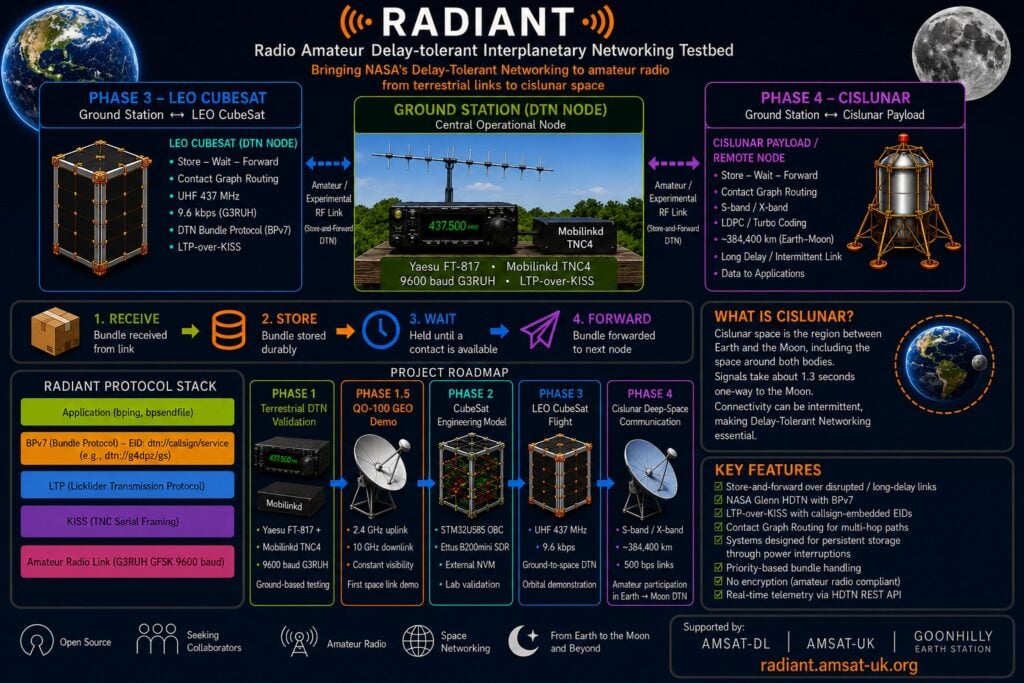
RADIANT
project infographic illustrates DTN networking concepts from
terrestrial amateur radio links to future cislunar communications.
[Credit: RADIANT]
Among the project’s early accomplishments is a functioning three-node
cislunar simulation capable of introducing realistic packet propagation
delays. Developers report demonstrations simulating Earth–Moon delays
of approximately 1.3 seconds and Earth–Mars delays ranging from three to
twelve minutes. Contact Graph Routing is used to calculate
communication paths through relay nodes, demonstrating multi-hop relay
in simulation similar to what future space networking architectures may
require. The project deliberately avoids encryption and cryptographic
methods to maintain compatibility with amateur radio regulations.
Development is planned in phases beginning with terrestrial
validation using readily available amateur radio equipment. Phase 1
testing currently uses Raspberry Pi systems, Mobilinkd TNC4 hardware,
and Yaesu FT-817 radios to validate networking functions across
ground-based links. Future plans include demonstrations through the
QO-100 geostationary satellite, a CubeSat engineering model, and
eventually an orbital Low Earth Orbit payload operating on amateur
frequencies. Longer-term ambitions include experiments supporting
amateur participation in cislunar communications, the region of space
between Earth and the Moon.
Project organizers emphasize that amateur operators possess unique
experience relevant to difficult communications environments, including
weak-signal work, scheduled links, and operation over challenging
propagation paths. RADIANT developers are seeking participation from
amateur radio clubs, universities, CubeSat teams, microwave
experimenters, and packet radio operators interested in contributing to
future testing and development. Users registering through the project
website can also access additional information and requirements
associated with each development phase. Additional information and
project details are available on the RADIANT website at https://radiant.amsat-uk.org/.
[ANS thanks Dave Johnson, G4DPZ, AMSAT-UK Hon. Secretary, and the RADIANT project for the above information.]
The 2026 Coins Are Here! Help Support GOLF-TEE and Fox-Plus.
Annual memberships start at only $120.
SpaceX Starship V3’s First Test Flight Largely Successful
SpaceX has flown Starship V3 for the first time, in a test flight
that met most of its goals. The company had to step down from a launch
attempt on the evening of May 21, due to a technical issue.
Specifically, a hydraulic pin holding the spacecraft’s tower arm in
place would not retract. But on May 22, nothing prevented SpaceX from
launching the upgraded version of its spacecraft designed for journeys
to the moon and Mars.
 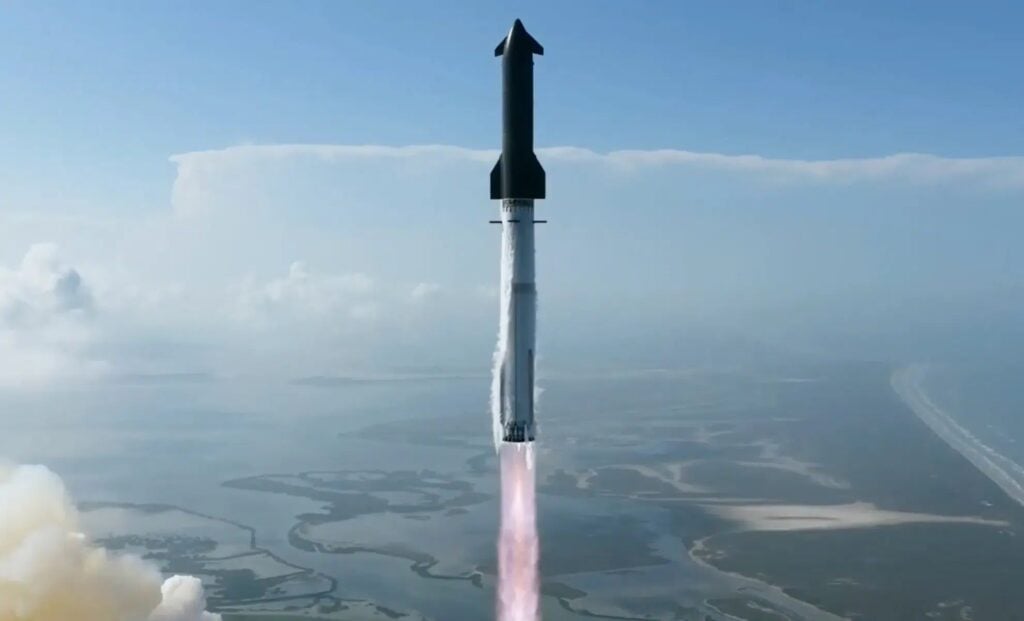
SpaceX Starship V3 Launch (Credit: SpaceX)
The launch vehicle ignited all 33 of its Super Heavy booster’s new
Raptor 3 engines and then lifted off at 22:30 UTC from Starbase, Texas.
During ascent, one of the booster’s engines shut down, but Starship
continued its flight until it was time for the stages to separate. The
booster was able to perform a directional flip maneuver, which the
company wanted to test for future missions. However, it was unable to
light all the engines needed to perform a successful boostback burn, the
other maneuver necessary for the rocket to be able to travel back
towards its landing site. It wasn’t a loss, however: SpaceX had been
catching Super Heavy boosters with its launch tower’s mechanical arms in
previous flights, but it never intended to recover this one.
Despite the engine failures, SpaceX chief Elon Musk congratulated his
team “on an epic first Starship V3 launch and landing,†telling them
they “scored a goal for humanity.†SpaceX managed to pull a largely
successful test flight, just in time for its Initial Public Offering
(IPO). The company just publicly filed its IPO paperwork with the
Securities and Exchange Commission, and Reuters has reported that SpaceX
shares are expected to start trading on June 12.
[ANS thanks Engadget for the above information. Read the full article at: https://www.engadget.com/2180020/spacex-starship-v3-first-test-flight-success/]

China Launches Shenzhou 23 Spacecraft
China launched the Shenzhou 23 spacecraft on May 24 with three
astronauts heading to its space station, including one set to stay in
space for a year. The spacecraft blasted off from the Jiuquan Satellite
Launch Center in northwestern China. The much-anticipated launch comes
as China prepares for its first crewed lunar landing by 2030.
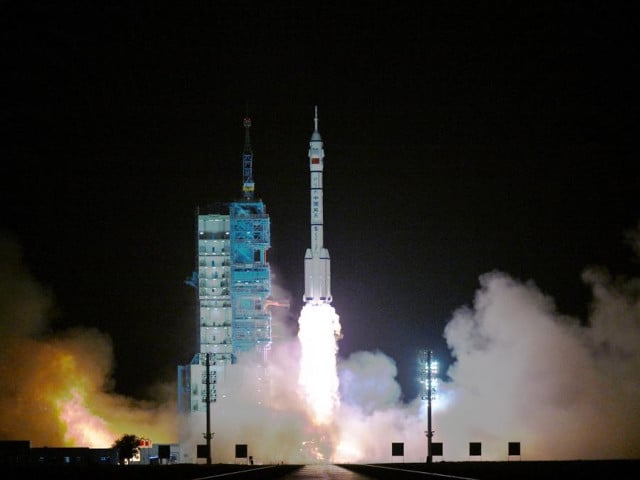
The Shenzhou-23 manned mission launches from the Jiuquan Satellite Launch Center in Jiuquan,
northwestern China on Sunday, May 24, 2026. (Credit: Xinhua/Lian Zhen)
The astronauts on the mission are Zhu Yangzhu, the commander, Zhang
Zhiyuan and Lai Ka-ying, also identified by Chinese authorities as Li
Jiaying using the Mandarin transliteration of her name. Lai, who was
born and raised in Hong Kong and has a doctoral degree in computer
forensics, is the first astronaut from the city on a space mission.
One of the three astronauts on the Shenzhou 23 mission is scheduled
to stay at the orbiting space station for a year in what would be among
the world’s longest single stays in space. The astronaut’s mission is to
“explore human adaptability and performance limits†in long-duration
spaceflight environments, state media reported.
[ANS thanks NPR News and the Associated Press for the above information. Read the full article at: https://www.npr.org/2026/05/25/g-s1-124179/china-launches-shenzhou-23-spacecraft?utm_campaign=npr&utm_source=bsky.app&utm_medium=social&utm_term=nprnews]
AMSAT Remove Before Flight Key Tags Now Available
Yes, These are the Real Thing!
Changes to AMSAT TLE Distribution for May 29, 2026
Two Line Elements or TLEs, often referred to as Keplerian elements or
keps in the amateur community, are the inputs to the SGP4 standard
mathematical model of spacecraft orbits used by most amateur tracking
programs. Weekly updates are completely adequate for most amateur
satellites. TLE bulletin files are updated daily in the first hour of
the UTC day. New bulletin files will be posted immediately after
reliable elements become available for new amateur satellites. More
information may be found at https://www.amsat.org/keplerian-elements-resources/.
The following satellites have been removed from this week’s AMSAT TLE distribution:
- SilverSat NORAD Cat ID 66909 Decayed from orbit on or about 23 April 2026
- HYDRA-W NORAD Cat ID 63490 Decayed from orbit on or about 24 April 2026
- HADES-ICM (SO-125) 63492 Decayed from orbit on or about 22 May 2026
General Perturbations Data Support
AMSAT is pleased to announce that modern forms of what are called
General Perturbations data are being disseminated via modern formats
including JSON, XML and KVN at https://newark192.amsat.org/gpdata/current/.
The reason this change is being made is that we are running out of
5-digit catalog numbers and the TLE format is not viable for satellites
launched after July of this year. See https://celestrak.org/NORAD/documentation/gp-data-formats.php for details.
These data are presently considered in beta test for the next two
months while hosted on the test server newark192.amsat.org, and we are
very open to community feedback at webmaster@amsat.org. Testers may
experience outages and errors while we make improvements. We intend to
put this into production on our main web server in July as we expect
that satellites launched after this summer will require one of the new
formats to accommodate longer object numbers. AMSAT will continue to
publish TLE bulletins for satellites launched before July 2026
indefinitely.
[ANS thanks Joe Fitzgerald, KM1P, AMSAT Orbital Elements Manager, for the above information.]
Blue Origin Explosion
A Blue Origin New Glenn rocket blew up on the launch pad in Cape
Canaveral, Fla., on Thursday night, May 28, during an engine-firing test
ahead of a satellite launch next week.
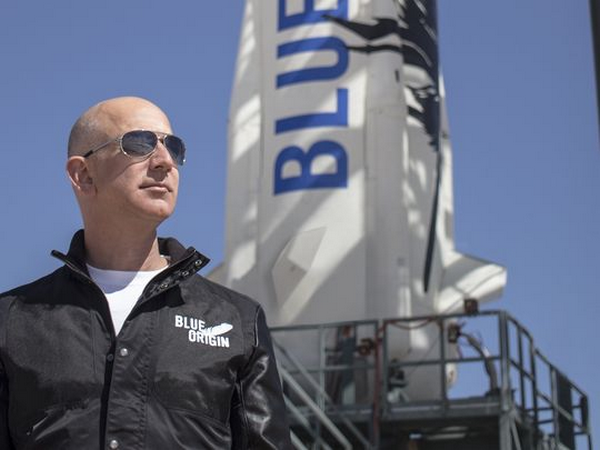
Jeff Bezos, the founder of Blue Origin and Amazon.com, at Blue Origin’s West Texas launch site. (Photo: Blue Origin)
No one was hurt. The explosion shook nearby homes and briefly painted the sky orange.
Jeff Bezos, Blue Origin’s founder, wrote on X: “It’s too early to
know the root cause but we’re already working to find it. Very rough
day, but we’ll rebuild whatever needs rebuilding and get back to flying.
It’s worth it.â€Â
[ANS thanks Axios for the above information.]
ARISS News
Amateurs and others around the world may listen in on contacts
between amateurs operating in schools and allowing students to interact
with astronauts and cosmonauts aboard the International Space Station.
The downlink frequency on which to listen is 145.800 MHz worldwide.
Scheduled Contacts
+ Recently Completed
Minamigaoka Elementary School, Tsu, Japan, direct via JJ2YJC
The ISS callsign was presently scheduled to be OR4ISS
The scheduled crewmember is Jack Hathaway KJ5NIV
The ARISS mentor is JE1MUI/JA1CJP/MØXTD
Contact was successful: Thu 2026-05-28 11:23:58 UTC 29 degrees maximum elevation
Congratulations to the Minamigaoka Elementary School students, Jack,
mentors JE1MUI, JA1CJP, and MØXTD, and ground station JJ2YJC!
+ Upcoming Contacts
Ecole Henri Clément, Saint-Rémy, France, direct via F6KMF joint
contact with Collège Jorge Semprun, Gueugnon, France direct via F6KJS
The ISS callsign is presently scheduled to be OR4ISS
The scheduled crewmember is Sophie Adenot KJ5LTN
The ARISS mentor is F6ICS
Contact is go for: Fri 2026-06-05 09:26:47 UTC 34 degrees maximum elevation
Many times, a school makes a last-minute decision to do a Livestream
or runs into a last-minute glitch requiring a change of the URL, but we
at ARISS may not get the URL in time for publication. You can always
check https://live.ariss.org/ to see if a school is Livestreaming.
As always, if there is an EVA, a docking, or an undocking; the ARISS radios are turned off as part of the safety protocol.
The crossband repeater remains configured in the Columbus Module
(145.990 MHz up {PL 67} & 437.800 MHz down). If a crewmember decides
to pick up the microphone and turn up the volume, you may hear them on
the air—so keep listening, as you never know when activity might occur.
Kenwood D710GA in the Zvezda Service Module – Call sign RSØISS.
Please note we’re still in the process of troubleshooting and testing
this radio. APRS is currently active on 437.825 MHz. Feel free to check
out status reports at https://ariss-usa.org/ARISS_APRS/.
Ham TV is currently transmitting a test signal at 2395.00 MHz.
Note, all times are approximate. It is recommended that you do your
own orbital prediction or start listening about 10 minutes before the
listed time.
The latest information on the operation mode can be found at https://www.ariss.org/current-status-of-iss-stations.html
The latest list of frequencies in use can be found at https://www.ariss.org/contact-the-iss.html
[ANS thanks Charlie Sufana, AJ9N, one of the ARISS operation team mentors for the above information.]
AMSAT Ambassador Activities
AMSAT Ambassadors provide presentations, demonstrate communicating
through amateur satellites, and host information tables at club
meetings, hamfests, conventions, maker faires, and other events.
Scheduled Events
44th AMSAT Space Symposium and Annual Membership Meeting – October 8 thru 11, 2026
Crowne Plaza JAX Airport
14670 Duval Road
Jacksonville, FL 32218
For more information go to: https://www.amsat.org/ambassador/
[ANS thanks Bo Lowrey, W4FCL, Director – AMSAT Ambassador Program, for the above information.]
Satellite Shorts from All Over
+ NASA confirmed on May 21 that the Russian segment of the
International Space Station has begun leaking atmosphere into space
again. It’s an old problem that NASA recently hoped was resolved. In
January, NASA said that after multiple inspections and sealant
applications, the pressure inside this segment, known as the PrK module,
had reached a “stable configuration.†The PrK module is essentially a
transfer tunnel attached to the Zvezda Service Module on the Russian
segment of the space station. Unfortunately, the leak returned three
weeks ago after Russian cosmonauts unloaded cargo from the Progress 95
cargo spacecraft. Although there is no impact on astronauts aboard the
station, nor any immediate concerns about the station’s health, the
returning leak issue raises new questions about the long-term viability
of the ISS. (ANS thanks Ars Technica for the above information. See the
full article at: https://arstechnica.com/space/2026/05/uh-oh-the-international-space-station-is-leaking-again/)
+ NASA has released the images Psyche space probe took when it did a
Mars flyby to get a gravity assist from the red planet on its way to the
metallic asteroid 16 Psyche. The photos are available at the main
mission site: https://solarsystem.nasa.gov/psyche-raw-images/.
After getting gravity assist from Mars, Psyche will resume using its
solar-electric propulsion system to continue its journey. The spacecraft
started its six-year trip to its namesake asteroid back in October
2023. During the flyby, it got closer to Mars than the planet’s own
moons and passed within 2,800 miles of its surface at its closest
approach. The spacecraft is expected to reach its destination in 2029,
after which it will spend two years orbiting and observing the asteroid.
16 Psyche is the largest known metallic asteroid in our solar system,
and scientists believe data from observing it could give us insight
about the formation of our own planet’s core. (ANS thanks Engadget and
NASA for the above information. Read More: https://www.engadget.com/2180093/nasa-shares-psyche-spacecraft-photos-of-mars/.)
+ New satellite tracking software by Japan’s Rymansat Group is available at https://t.co/sIYzK22XQE. (ANS thanks Yutaka Murata, JA1COU, for the above information.)
+ Don Friend, WA4MCM, has begun selling a light-duty satellite
antenna rotor kit for Arrow or Elk antennas that is designed to be
mounted on a standard camera tripod with 1/4-20 mounting bolt.
Information at https://wa4mcmkits.com/psr-100/. (ANS thanks Don Friend, WA4MCM, for the above information.)
In addition to regular membership, AMSAT offers membership to:
- Societies (a recognized group, clubs or organization).
- Students enrolled in at least half-time status are eligible for free membership to age 25.
- Memberships are available for annual and lifetime terms.
Contact info [at] amsat.org for additional membership information.
73 and remember to help Keep Amateur Radio in Space!
This week’s ANS Editor,
Mark Johns, KØJM
mjohns [at] amsat.org
ANS is a service of AMSAT, the Radio Amateur Satellite Corporation, 712 H Street NE, Suite 1653, Washington, DC 20002
AMSAT is a registered trademark of the Radio Amateur Satellite Corporation.