AMSAT News Service
ANS-158
June 7, 2026
In this edition:
- Deadline for Candidate Nominations for 2026 AMSAT Board of Directors Election is June 15
- HADES-SA / SpinnyOne Designated Spain-OSCAR 127 (SO-127)
- AMSAT Submits Letter of Intent for NASA SLS CubeSat Opportunity on Artemis III, IV, and V
- OscarWatch Tracker: A New Satellite Tracking Program from MM9SQL
- Changes to AMSAT TLE Distribution for June 5, 2026
- ARISS News
- AMSAT Ambassador Activities
- Satellite Shorts From All Over
The AMSAT® News Service bulletins are a free, weekly news and information service of AMSAT, The Radio Amateur Satellite Corporation.
ANS publishes news related to Amateur Radio in Space including reports on the activities of a worldwide group of Amateur Radio operators who share an active interest in designing, building, launching and communicating through analog and digital Amateur Radio satellites.
The news feed on https://www.amsat.org publishes news of Amateur Radio in Space as soon as our volunteers can post it.
Please send any amateur satellite news or reports to: ans-editor [at] amsat.org
You can sign up for free e-mail delivery of the AMSAT News Service Bulletins via the ANS List; to join this list see: https://mailman.amsat.org/postorius/lists/ans.amsat.org/
Deadline for Candidate Nominations for 2026 AMSAT Board of Directors Election is June 15
The nomination period for the AMSAT 2026 Board of Directors election, which will take place during the third quarter of the year, ends on June 15, 2026.
Three director positions are set to expire in 2026. The current board members whose seats are up for election are:
- Mark Hammond, N8MH
- Bruce Paige, KK5DO
- Paul Stoetzer, N8HM
In addition to these three full Director roles, up to two Alternate Directors may also be elected to serve one-year terms.
To nominate a candidate, a written submission is required. Nominations must include the nominee’s name, call sign, and contact information, along with the same details for either five AMSAT members in good standing or one Member Society endorsing the candidate.
Nominations should be directed to the AMSAT Secretary:
Douglas Tabor, N6UA
1133 Verlan Way
Cheyenne, WY 82009
Per AMSAT’s bylaws, all nominations must follow the format specified by the Secretary. Doug Tabor has indicated that nominations will be accepted in both hard copy (via postal mail) and digital formats (including email or scanned documents). However, fax submissions are not permitted.
Email nominations should be sent to: dtabor [at] amsat [dot] org
All nomination petitions must be received by the Secretary no later than June 15. After the submission deadline, the Secretary will confirm the eligibility of each candidate and the supporting members or societies, with final notification to candidates provided by the end of June.
[ANS thanks Doug Tabor, N6UA, AMSAT Secretary, for the above information]
LIMITED TIME OFFER!!!
AMSAT is offering a limited-time promotion for new and renewing members that includes a free digital copy of Getting Started with Amateur Satellites. The promotion is being offered as AMSAT begins the 2026 membership year.
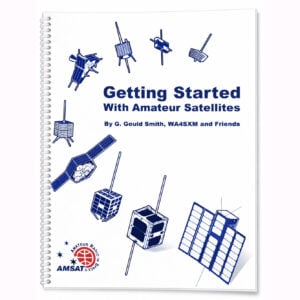
Anyone who joins or renews their AMSAT membership during the promotional period will receive a download link for the latest edition of Getting Started with Amateur Satellites in their membership confirmation email.
 JOIN TODAY at https://launch.amsat.org/ (Remember! Students join for FREE!)
HADES-SA / SpinnyOne Designated Spain-OSCAR 127 (SO-127)
On March 30th, 2026, the HADES-SA/SpinnyONE satellite was launched on a Falcon 9 launch vehicle from Vandenberg Space Force Base in California. Developed by AMSAT-EA, the satellite carries an SSDV and CODEC2 payload for reception by amateur radio enthusiasts around the world. The satellite is actively transmitting images and messages now.
At the request of AMSAT-EA, AMSAT hereby designates HADES-SA/SpinnyONE as Spain-OSCAR 127 (SO-127). We congratulate AMSAT-EA, thank them for their contribution to the amateur satellite community, and wish them continued success on this and future projects.
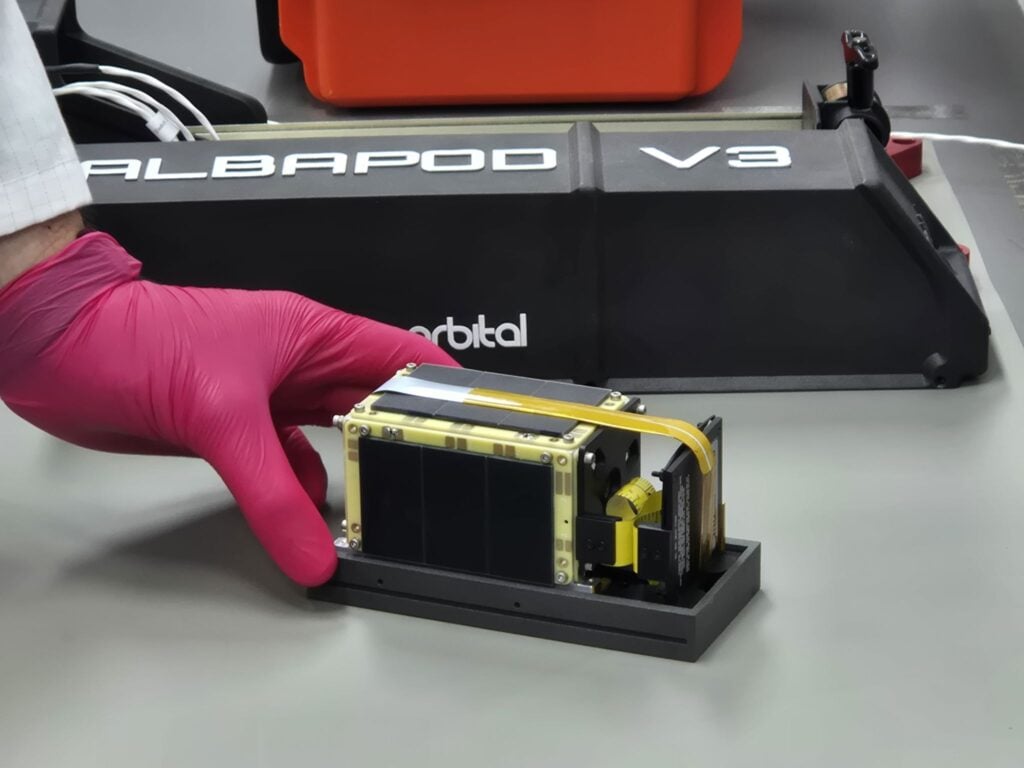
SO-127 (Courtesy AMSAT-EA)[/caption]
ÂÂ
AMSAT Remove Before Flight Key Tags Now Available Yes, These are the Real Thing!
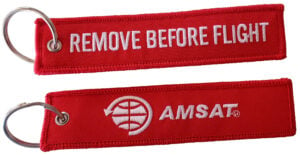
Your $20 Donation Goes to Help Fly a FoxPlus Satellite Includes First Class Postage (Sorry – U.S. Addresses Only)
Order Today at https://www.amsat.org/product/amsat-remove-before-flight-keychain
AMSAT Submits Letter of Intent for NASA SLS CubeSat Opportunity on Artemis III, IV, and V
On May 31, 2026, AMSAT submitted a Letter of Intent (LOI) to NASA Marshall Space Flight Center in response to a Sources Sought Notice for CubeSat secondary payload opportunities aboard the Space Launch System (SLS) on the Artemis III, IV, and V missions.
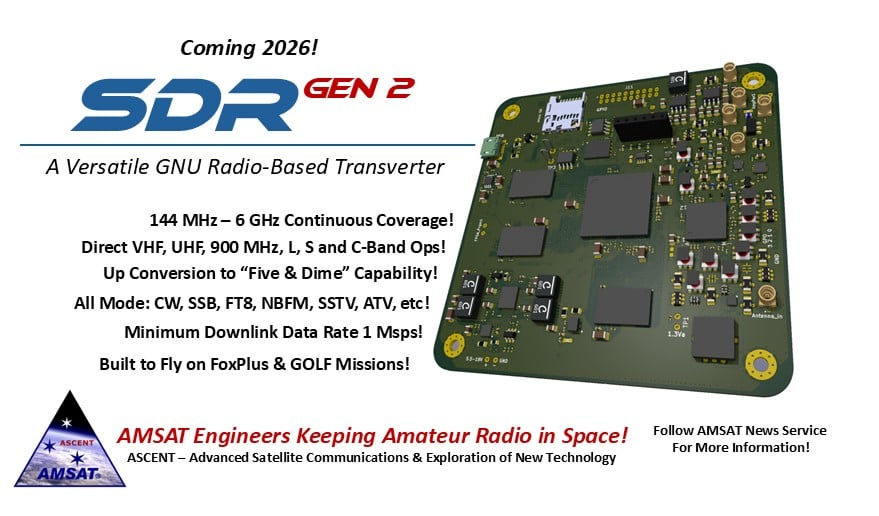
The LOI expresses strong interest in developing and flying an AMSAT-designed CubeSat payload on one or more of these missions. It highlights the strategic alignment between the opportunity and AMSAT’s ongoing GOLF (Greater Orbit, Larger Footprint) program, which is building the technologies and operational experience needed for amateur radio satellites in progressively higher orbits—from LEO through MEO to HEO.
A high-Earth deployment would provide an outstanding environment to qualify key GOLF technologies—particularly radiation-tolerant electronics, advanced Software-Defined Radio (SDR) transponders, three-axis attitude determination and control, and deployable/steerable solar arrays—in the demanding thermal, radiation, and trajectory conditions beyond low Earth orbit. Such a mission would significantly expand amateur radio’s “larger footprint,†deliver critical flight heritage, and create clear synergies with NASA’s exploration, technology demonstration, and public engagement goals.
The LOI emphasizes AMSAT’s long heritage of successful CubeSat missions (including the Fox series flown via NASA CSLI/ELaNa) and its robust portfolio of educational and university partnership programs. These include the CubeSat Simulator Program used worldwide in schools and universities, collaborations such as the radiation experiment from Vanderbilt University and imaging payloads from Virginia Tech on Fox satellites, broader STEM outreach through live satellite contacts and telemetry projects, and active mentorship of student teams and early-career professionals.
AMSAT is prepared to deliver a flight-ready CubeSat payload, leveraging its proven engineering pipeline, dedicated volunteer technical team, and sustainable funding model of membership support, targeted donations, and grants. AMSAT proposes a 6U-class spacecraft (<14 kg) featuring deployable solar arrays and an AMSAT-developed amateur radio communications system supporting VHF uplink/UHF downlink plus 5 GHz uplink and 10 GHz downlink. A precursor 3U technology demonstrator, GOLF-TEE, is under construction with completion targeted by the end of the year; if selected, AMSAT would pivot development toward the 6U configuration in collaboration with partners. Ground operations would leverage the global amateur radio community for telemetry reception via AMSAT’s analysis tools, supported by dedicated AMSAT command stations.
The organization is genuinely excited about the prospect of contributing an AMSAT-developed CubeSat to the Artemis program—advancing amateur radio’s historic role in space exploration, qualifying technologies for future HEO and lunar missions, and inspiring students and the global public through meaningful educational partnerships.
[ANS thanks AMSAT for the above information]
The 2026 President's Club Coin is Now Here! Help Support GOLF and FoxPlus.
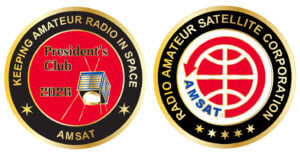
Annual memberships start at only $120
Join the AMSAT President’s Club today and help Keep Amateur Radio in Space! https://www.amsat.org/join-the-amsat-presidents-club/
OscarWatch Tracker: A New Satellite Tracking Program from MM9SQL
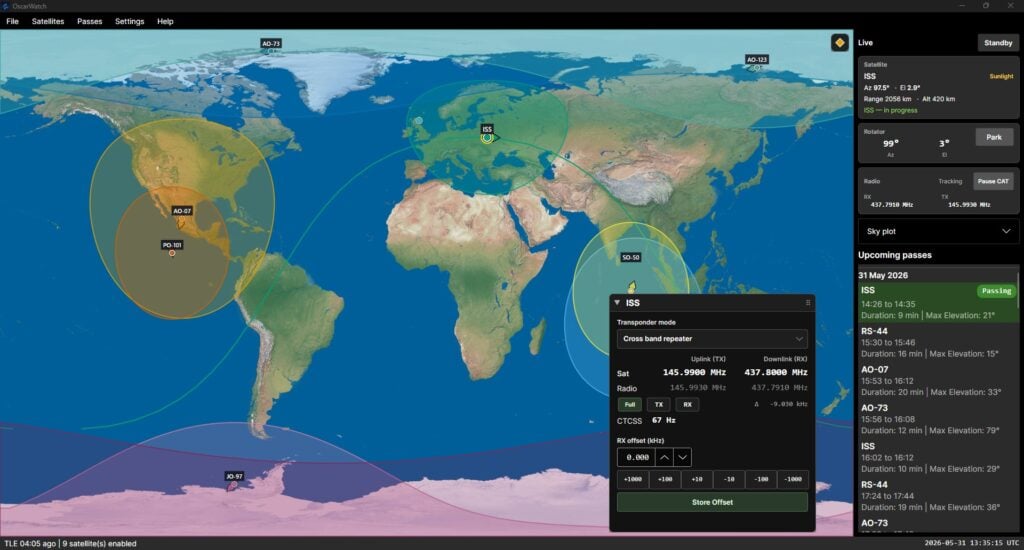
A new multi-platform desktop satellite tracking application for amateur radio operators, OscarWatch Tracker, has been released and is under active development. Developed by Peter Goodhall, MM9SQL, and hosted on GitHub, OscarWatch provides an integrated environment for tracking AMSAT and other amateur satellites, predicting passes, managing Doppler-corrected frequencies, and optionally automating rotator and radio control—all from a single map-centered interface.
Key Features
OscarWatch is tailored for VHF/UHF satellite operators working FM cubesats (e.g., SO-50, ISS), linear transponders (e.g., RS-44, FO-29), and similar modes. It assumes familiarity with basic concepts like azimuth, elevation, and Doppler but automates the calculations and hardware interactions to let operators focus on making contacts.
- Visual Tracking: World map with satellite subpoint, ground track, and footprint overlays (with optional motion arrows and greyline terminator). Includes a polar sky plot relative to your QTH. Support for time scrubbing to preview passes without affecting live hardware. Optional DX station grid marker with live Az/El from the remote location.
- Pass Predictions: List of upcoming passes with TCA (time of closest approach/max elevation), filters for minimum elevation and duration. Features include a pass planner with multi-station profiles and .ics calendar export, plus a mutual pass finder for two-station coordination.
- Frequency Management: Built-in transponder database with live Doppler-corrected uplink/downlink frequencies. Supports RX offsets (separate for Voice/CW on linear modes), CTCSS tones, and easy toggling between modes. Includes a transponder database editor for custom additions and updates from the published JSON source.
- Hardware Integration: Optional serial CAT control for supported radios (including Icom IC-910/9100/9700/705, Yaesu FT-847/817/818/991 series, Kenwood TS-2000 beta) with Doppler tracking, satellite/split modes, and CTCSS handling. Dual-radio support for full-duplex setups. Rotator control for Yaesu GS-232 and EasyComm-compatible controllers (including SPID), with manual park and smart azimuth options for 450° rotators.
- Additional Tools: Voice announcements for satellite rising, automatic pass WAV recording, Cloudlog integration for frequency logging, and live telemetry (Az/El, range, altitude).
OscarWatch does not decode telemetry or serve as primary logging software; it complements existing tools as a pass assistant for home or portable use. TLEs and the transponder database are sourced from tle.oscarwatch.org.
Getting Started
Pre-built binaries for Windows, macOS, and Linux are available on the GitHub Releases page. After installation:
- Configure your station location (lat/long/grid) in Settings.
- Select desired satellites and refresh TLEs.
- Set up radio and rotator COM ports if using automation.
- Focus a satellite via the map or pass list to view live data and frequencies.
Detailed operator guides, keyboard shortcuts, and troubleshooting are included in the app's Help menu and the repository's help/ folder. Note that macOS users may need to approve the unsigned app and bundled libraries on first launch.
Supported Hardware Highlights
Radios (serial CAT, native drivers): Icom IC-910/9100/9700/705, Yaesu FT-847/817/818/991 series, Kenwood TS-2000 (beta), with dual-radio options. Rotators: Yaesu GS-232, EasyComm II (SPID/M2/etc.).
The project emphasizes custom native drivers for reliable satellite-specific behavior over general libraries like HamLib.
OscarWatch is still evolving rapidly (recent versions added in-app updates, multi-language support including Japanese, Simplified Chinese, and Brazilian Portuguese, greyline overlays, mutual pass visualizer, and expanded rig/rotator support). Check the GitHub repository for the latest releases, source code, TODO list, and contribution opportunities.
For more information and to download: https://github.com/magicbug/OscarWatch-Tracker.
[ANS thanks Peter Goodhall, MM9SQL, for the above information]
Changes to AMSAT TLE Distribution for June 5, 2026
Two Line Elements or TLEs, often referred to as Keplerian elements or keps in the amateur community, are the inputs to the SGP4 standard mathematical model of spacecraft orbits used by most amateur tracking programs. Weekly updates are completely adequate for most amateur satellites. TLE bulletin files are updated daily in the first hour of the UTC day. New bulletin files will be posted immediately after reliable elements become available for new amateur satellites. More information may be found at https://www.amsat.org/keplerian-elements-resources/.
There are no changes to this week's TLE distribution.
General Perturbations Data Support
AMSAT is pleased to announce that modern forms of what are called General Perturbations data are being disseminated via modern formats including JSON, XML and KVN at https://newark192.amsat.org/gpdata/current/. The reason this change is being made is that we are running out of 5-digit catalog numbers and the TLE format is not viable for satellites launched after July of this year. See https://celestrak.org/NORAD/documentation/gp-data-formats.php for details.
These data are presently considered in beta test for the next two months while hosted on the test server newark192.amsat.org, and we are very open to community feedback at webmaster at amsat.org. Testers may experience outages and errors while we make improvements. We intend to put this into production on our main web server in July as we expect that satellites launched after this summer will require one of the new formats to accommodate longer object numbers. AMSAT will continue to publish TLE bulletins for satellites launched before July 2026 indefinitely.
[ANS thanks Joe Fitzgerald, KM1P, AMSAT Orbital Elements Manager, for the above information]
Buying from DX Engineering?
Add AMSAT’s Getting Started With Amateur Satellites to your order.
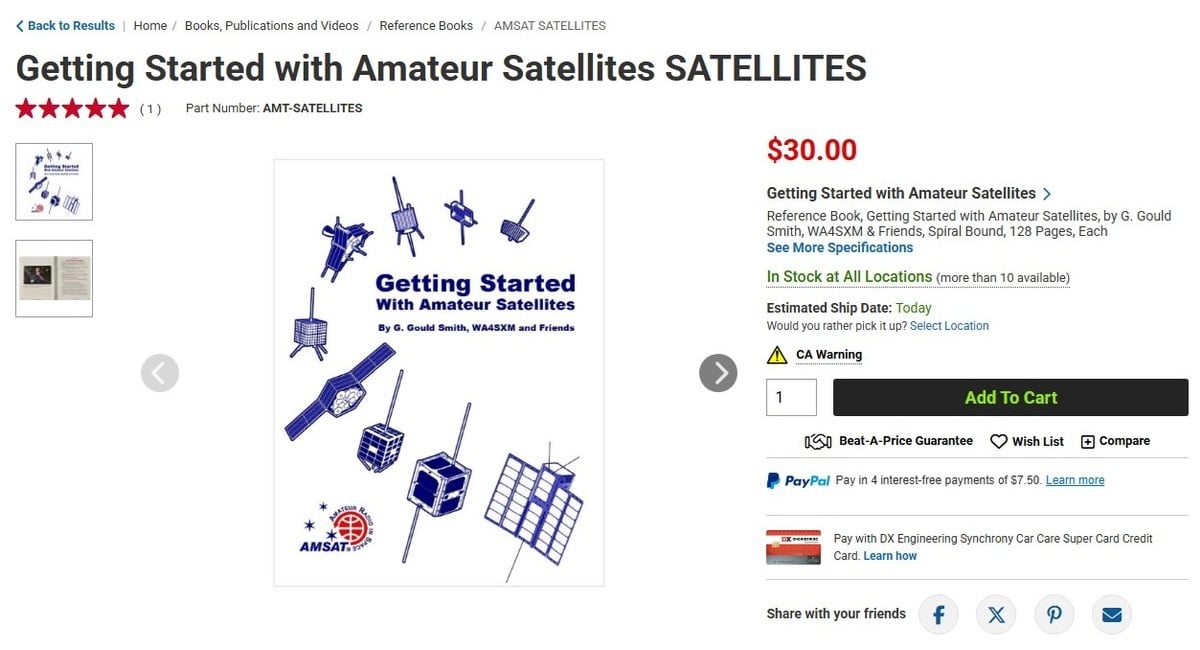
Available for $30 from DX Engineering (free shipping on most orders over $99)
https://www.dxengineering.com/parts/amt-satellites
ARISS News
Amateurs and others around the world may listen in on contacts between amateurs operating in schools and allowing students to interact with astronauts and cosmonauts aboard the International Space Station. The downlink frequency on which to listen is 145.800 MHz worldwide.
Collège Louis Aragon, Imphy, France, direct via F5KCH
The ISS callsign is presently scheduled to be OR4ISSÂÂ
The scheduled crewmember is Sophie Adenot KJ5LTN ÂÂ
The ARISS mentor is F6ICS  ÂÂ
Contact is go for: Mon 2026-06-08 13:31:48 UTC 86 deg
Geneva Christian College, Latrobe, Tasmania, Australia telebridge via VK4ISS
The ISS callsign is presently scheduled to be TBD
The scheduled crewmember is Chris Williams KJ5GEW
The ARISS mentor is VK4KHZ ÂÂ
Contact is go for: Tue 2026-06-09 08:30:56 UTC 85 deg
Many times, a school makes a last-minute decision to do a Livestream or runs into a last-minute glitch requiring a change of the URL, but we at ARISS may not get the URL in time for publication. You can always check https://live.ariss.org/ to see if a school is Livestreaming.
As always, if there is an EVA, a docking, or an undocking; the ARISS radios are turned off as part of the safety protocol.
The crossband repeater remains configured in the Columbus Module (145.990 MHz up {PL 67} & 437.800 MHz down). If a crewmember decides to pick up the microphone and turn up the volume, you may hear them on the air—so keep listening, as you never know when activity might occur.
Kenwood D710GA in the Zvezda Service Module – Call sign RSØISS. Please note we’re still in the process of troubleshooting and testing this radio. APRS is currently active on 437.825 MHz. Feel free to check out status reports at https://ariss-usa.org/ARISS_APRS/.
Ham TV is currently transmitting a test signal at 2395.00 MHz.
Note, all times are approximate. It is recommended that you do your own orbital prediction or start listening about 10 minutes before the listed time.
The latest information on the operation mode can be found at https://www.ariss.org/current-status-of-iss-stations.html
The latest list of frequencies in use can be found at https://www.ariss.org/contact-the-iss.html
[ANS thanks Charlie Sufana, AJ9N, one of the ARISS operation team mentors for the above information]
Want to fly the colors on your own grid expedition? Get an AMSAT car flag and other neat stuff from our Zazzle store!
25% of the purchase price of each product goes towards Keeping Amateur Radio in Space
AMSAT Ambassador Activities
AMSAT Ambassadors provide presentations, demonstrate communicating through amateur satellites, and host information tables at club meetings, hamfests, conventions, maker faires, and other events.
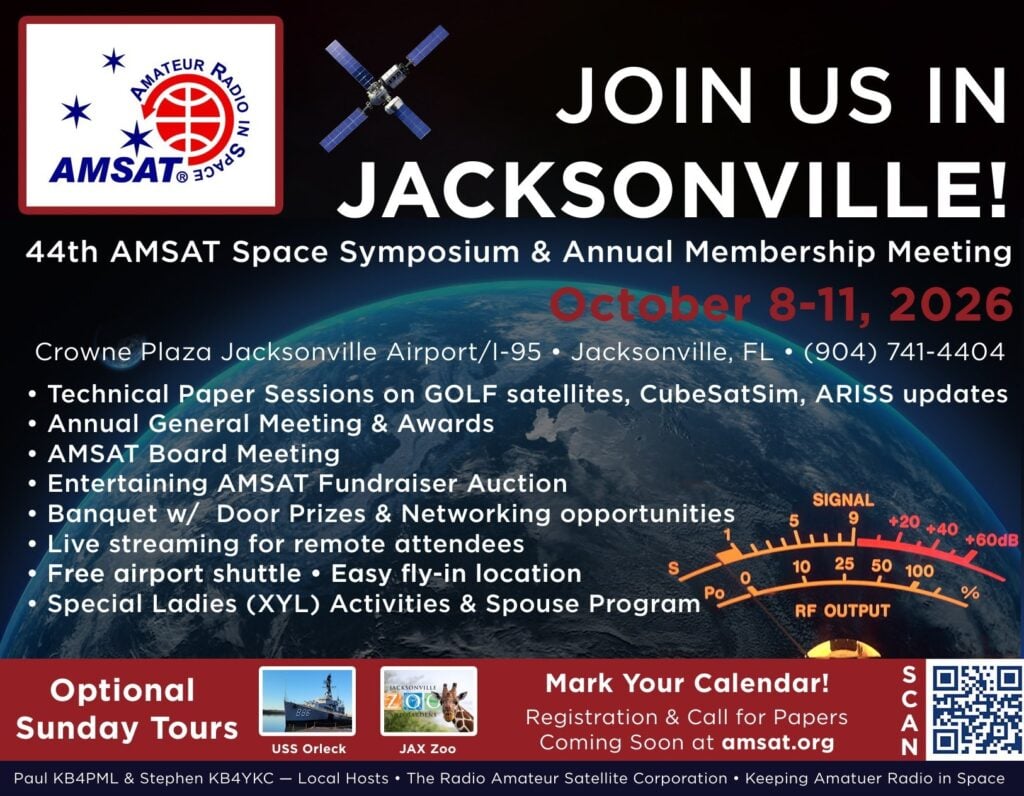
October 8-11, 2026
44th AMSAT Space Symposium and Annual Membership Meeting
Crowne Plaza JAX Airport
14670 Duval Road
Jacksonville, FL 32218
Details to follow
Interested in becoming an AMSAT Ambassador? AMSAT Ambassadors provide presentations, demonstrate communicating through amateur satellites, and host information tables at club meetings, hamfests, conventions, maker faires, and other events. For more information go to: https://www.amsat.org/ambassador/
[ANS thanks Bo Lowrey, W4FCL, Director – AMSAT Ambassador Program, for the above information]
Satellite Shorts from All Over
+ The U.S. Space Force this week awarded SpaceX a $4.16 billion contract to build a constellation of satellites designed to track airborne targets from orbit. The program is intended to detect and track airborne targets including aircraft, cruise missiles and potentially hypersonic weapons. In the same week, the U.S. Space Force awarded SpaceX a $2.29 billion contract to build a network of low Earth orbit satellites intended to function as a military internet in space. Both deals were among the largest contracts issued this year by Space Systems Command, the Space Force’s acquisition arm. (ANS thanks SpaceNews for the above information. Read the full articles at https://spacenews.com/space-force-awards-spacex-4-16-billion-to-build-satellite-network-for-airborne-target-tracking/?utm_source=ActiveCampaign&utm_medium=email&utm_content=SpaceX%20s%20%246%20billion%20week&utm_campaign=Editor%20s%20Choice%202026%2006-03 and at https://spacenews.com/spacex-wins-2-29-billion-space-force-contract-for-military-data-network/?utm_source=ActiveCampaign&utm_medium=email&utm_content=SpaceX%20s%20%246%20billion%20week&utm_campaign=Editor%20s%20Choice%202026%2006-03.)
+ NASA has officially ended the Mars Atmosphere and Volatile Evolution (MAVEN) mission, six months after it lost contact with the probe. MAVEN was the agency's first program dedicated to studying the Martian atmosphere and its evolution. It launched in 2013 from Cape Canaveral and entered the Martian orbit nearly a year later in 2014. The probe's primary science mission was scheduled to last one year, but it ended up spending more than 11 years in orbit, sending back data from Mars. NASA even used it as an antenna for the Mars 2020 mission, which brought the Perserance rover to the planet. (ANS thanks Engadget for the above information. Read More: https://www.engadget.com/2187315/nasa-ends-maven-mars-mission/.)
+ PaperSat, an satellite tracking program for the M5Stack Paper S3, an ESP32 based eink device, has been ported to the new M5Stack M5Paper Color. Due to the refresh rate limitations of the color e-ink display, the program has been reconceptualized as a eight satellite next-pass dashboard (in two pages) with alerts to pass events using the on-board RGB LEDs and speaker. PaperSatColor can be found at https://github.com/prstoetzer/PaperSatColor. (ANS thanks Paul Stoetzer, N8HM for the information)
Join AMSAT today at https://launch.amsat.org/
In addition to regular membership, AMSAT offers membership to:
- Societies (a recognized group, clubs or organization).
- Students are eligible for FREE membership up to age 25.
- Memberships are available for annual and lifetime terms.
Contact info [at] amsat.org for additional membership information.
73 and remember to help Keep Amateur Radio in Space!
This week's ANS Editor,
Paul Stoetzer, N8HM
n8hm [at] amsat.org
ANS is a service of AMSAT, the Radio Amateur Satellite Corporation, 712 H Street NE, Suite 1653, Washington, DC 20002. AMSAT is a registered trademark of the Radio Amateur Satellite Corporation.ÂÂ