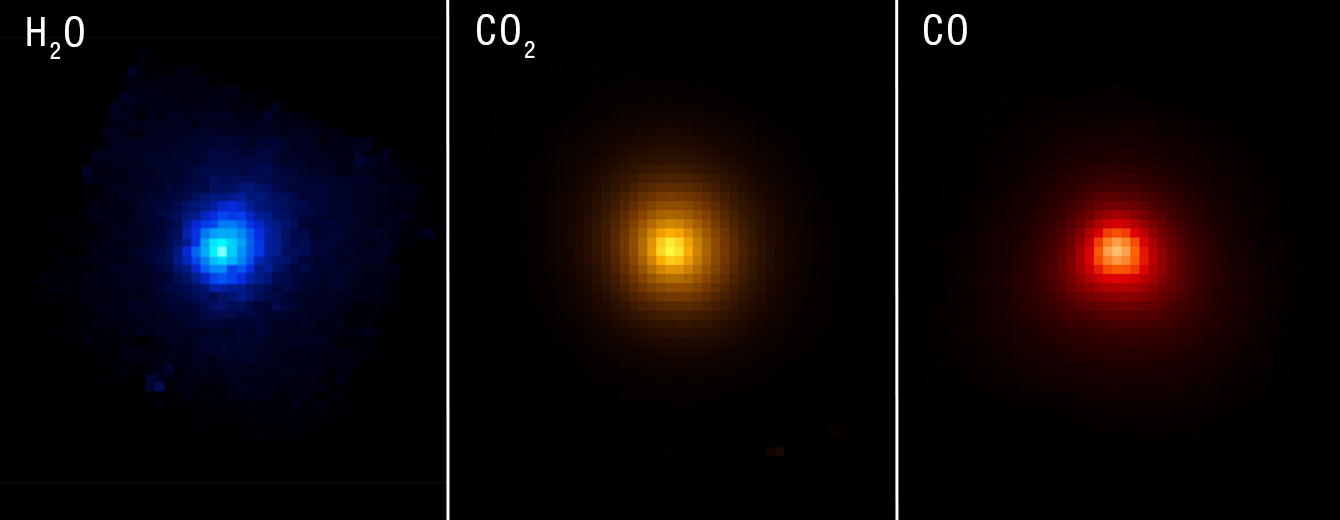
The third identified interstellar comet in human history has a surprising chemical makeup, raising questions as to how common, or unusual, conditions in our own solar system may be.
Billions of years ago in a nascent planetary system somewhere in the Milky Way galaxy, the icy fragment now known as 3I/ATLAS was getting knocked around as larger planets formed. Powerful gravitational interactions eventually catapulted it out of the system, and it began a journey through our Milky Way galaxy.
In July 2025, the comet was only the third interstellar object ever detected passing through our solar system – the meaning of the ‘3I’ in its name. Objects like 3I/ATLAS offer the unparalleled opportunity for up-close study of something from very far away. Astronomers used the NIRSpec (Near-Infrared Spectrograph) instrument on NASA’s James Webb Space Telescope to discover surprising details of 3I/ATLAS’s chemical makeup, with ratios of heavy carbon and heavy hydrogen never seen among comets in our solar system. Future study of interstellar objects will build on these findings toward a better understanding of how our solar system fits into the larger picture of our galaxy.
Find additional resources at www.stsci.edu
You are receiving this email because you are subscribed to the Inbox Astronomy mailing list.


