ANS-193
July 12, 2026
In this edition:
- May/June 2026 issue of The AMSAT Journal is now available
- AMSAT-UK ahowcase at EMF2026 – July 16th to July 17th
- Space X launches Transporter-17 among concerns about the future ÂÂ
- 14 million tracks and counting: How SATNOGS hit a new milestone and caught a spinning satelliteÂÂ
- Securing the future – The orbit stabilization of Swift Observatory
- Changes to AMSAT TLE distribution for July 10 20206
- ARISS News
- AMSAT Ambassador Activities
- Satellite Shorts From All Over
The AMSAT® News Service bulletins are a free, weekly news and information service of AMSAT, The Radio Amateur Satellite Corporation.
ANS publishes news related to Amateur Radio in Space including reports on the activities of a worldwide group of Amateur Radio operators who share an active interest in designing, building, launching and communicating through analog and digital Amateur Radio satellites.
The news feed on https://www.amsat.org publishes news of Amateur Radio in Space as soon as our volunteers can post it.
Please send any amateur satellite news or reports to: ans-editor [at] amsat.org
You can sign up for free e-mail delivery of the AMSAT News Service Bulletins via the ANS List; to join this list see: https://mailman.amsat.org/postorius/lists/ans.amsat.org/
May/June 2026 issue of The AMSAT Journal is now available
The May/June 2026 issue of The AMSAT Journal is now available to members on AMSAT’s Member Portal.
The AMSAT Journal is a bi-monthly digital magazine for amateur radio in space enthusiasts, published by the Radio Amateur Satellite Corporation (AMSAT). Each issue is your source for hardware and software projects, technical tips, STEM initiatives, operational activities, and news from around the world.
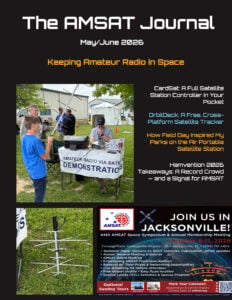
Inside the Current Issue
- Apogee View – Drew Glasbrenner, KO4MA
- Educational Relations Update – Alan Johnston, Ph.D., KU2Y
- CardSat: A Full Satellite Station Controller in Your Pocket – Paul Stoetzer, N8HM
- OrbitDeck: A Free, Cross-Platform Satellite Tracker – Paul Stoetzer, N8HM
- How Field Day Inspired My Parks on the Air Portable Satellite Station – Roger Weed, Ph.D., KV4I
- Hamvention 2026 Takeaways: A Record Crowd – and a Signal for AMSAT – Joe Kornowski, KB6IGK
- Hamvention 2026 Gallery
Not yet a member of AMSAT? Join now to access this issue, and the library of past issues of The AMSAT Journal, in addition to other member benefits.
[ANS thanks Joe Kornowski, KB6IGK, Editor-in-Chief, and The AMSAT Journal staff, for the above information.]
AMSAT-UK Showcase at Electromagnetic Field 2026 – July 16-19
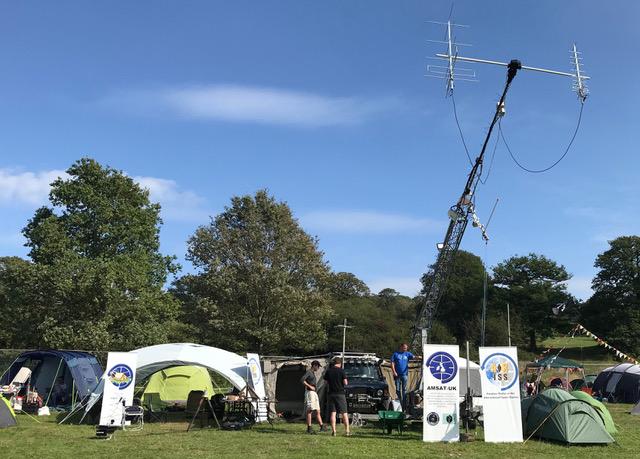
For those attending EMF 2026, the amateur radio village will be open throughout the weekend to explore everything from video-over-radio to the upper reaches of the microwave spectrum.
More details on the festival villages can be found via the EMF Camp Village Directory. Updates will also be shared throughout the weekend by @emfcamp and @AmsatUK on X.
[ANS thanks AMSAT-UK for the above information]
LIMITED TIME OFFER!!!
AMSAT is offering a limited-time promotion for new and renewing members that includesÂÂ
a free digital copy of Getting Started with Amateur Satellites.ÂÂ
The promotion is being offered as AMSAT begins the 2026 membership year.
Anyone who joins or renews their
AMSAT membership during the promotional period
 will receive a download
link for the latest edition ofÂÂ
Getting Started with Amateur Satellites in their membership confirmation email.ÂÂ
JOIN TODAY at https://launch.amsat.org/ (Remember! Students join for FREE!)
SpaceX Launches Transporter-17 Amid Concerns About the Future
SpaceX launched the latest in its Transporter series of rideshare missions July 7 as industry concerns increase about the program’s future.
A Falcon 9 lifted off from Vandenberg Space Force Base in California at 0712 UTC on the Transporter-17 mission to sun-synchronous orbit. The mission carried 81 payloads, according to SpaceX, including MarmotSat, a 3U CubeSat designed and built by students at the University of Victoria, Canada; MARINA, a cubesat built by Technical University of Košice, Slovakia; HADES-E2, a 1.5P PocketQube from AMSAT-EA; KOSTKA, a 1U Cubesat from Brno University of Technology, Czechia; and Maveric 3U CubeSat from the University of Southern California.
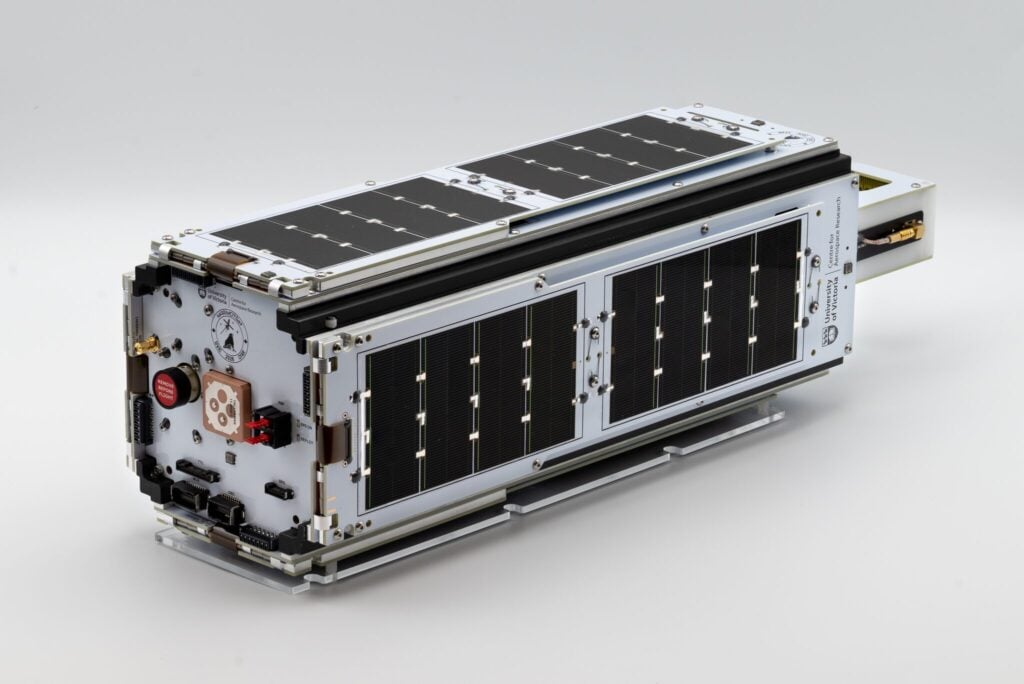
The flight model of the MARMOTSat CubeSat. (Photo: Alexander Doknjas and the University of Victoria.)
MarmotSat carries a VHF
digipeater uplink and downlink on 145.875 MHz; a CW telemetry beacon on
both 145.875 MHz and 29.410 MHz; and a DVB-S2 digital video beacon and a
linear-frequency-modulation sounding downlink, both on 29.410 MHz in
the 10-meter amateur satellite allocation. A separate telemetry,
tracking and command subsystem operates on 436.125 MHz. (See AMSAT News Service bulletins ANS-186 from July 5 for details.)
MARINA
serves as an experimental communication platform providing global HAM
operators with an active digital transponder and Earth-imaging
capabilities. The transponder supports GFSK AX.25 G3RUH 9600 Baud
communication. It also transmits Earth observation images utilizing the
robust SSDV (Slow Scan Digital Video) protocol. It has a VHF downlink at
145.925 MHz for digital transponder and telemetry, as well as a UHF
downlink at 436.680 MHz for SSDV transmissions, CW beacon, and SatNOGS
integration.
HADES-E2, also known as UNNE-1B,
was built in cooperation with Universidad de Nebrija. It carries an
SDR-based FM and FSK repeater. It also broadcasts a Codec2 digital voice
message and includes an educational “guessing game†where clues are
hidden weekly in its telemetry. Frequency coordination is in progress,
but AMSAT-EA has proposed a 145.925 MHz uplink for modes: FM voice (no
subtone) and FSK 200 bps, AFSK, AX.25, APRS 1200/2400 bps, and a 436.888
MHz downlink for modes: voice FM, CW, FSK 200bps-2400bps.
KOSTKA
has a UHF downlink at 436.870 MHz for 9k6 AX.25 G3RUH GFSK telemetry,
SSDV image transmission, a digipeater service, and a CW beacon.
Maveric carries spectral imaging experiments and has a 9k6 UHF downlink using Golay framing with GMSK at 437.575 MHz.
Like
other Transporter missions, this launch carried a mix of new and
returning customers, including those building out or refreshing
constellations. Iceye had four radar-imaging satellites on the mission,
while Spire had 10 of its Lemur satellites on the launch. Axelspace, a
Japanese Earth observation company, flew seven of its GRUS-3
medium-resolution imaging spacecraft on the mission.
These and
other companies have relied heavily on SpaceX rideshare missions for
low-cost access to space on a regular schedule. However, there are
growing concerns within the industry that SpaceX is winding down this
program, at least using its workhorse Falcon 9 rocket.
In recent
weeks, several partners and customers of those rideshare missions said
SpaceX is not accepting Transporter reservations beyond late 2028 or
early 2029. They added the missions on the manifest until then are
nearly full. That has led companies like Exolaunch and SEOPS, which have
arranged launches on Transporter missions, to buy their own Falcon 9
rideshare launches.
SpaceX has not commented on those claims, and
its webcast for the Transporter-17 launch did not discuss any changes
to the rideshare program.
However, anxiety extends to the
availability of the Falcon 9 itself. SpaceX officials said last year
they were near the peak of Falcon 9 launch activity and expected the
number of launches to start to decline as the company ramps up Starship,
its fully reusable heavy-lift vehicle.
[ANS thanks the International Amateur Radio Union (IARU) and SpaceNews for the above information. See the full article at https://spacenews.com/spacex-launches-transporter-17-amid-concerns-about-rideshare-programs-future/.]
AMSAT Remove Before Flight Key Tags Now Available Yes, These are the Real Thing!

Your $20 Donation Goes to Help Fly a FoxPlus Satellite Includes First Class Postage (Sorry – U.S. Addresses Only) Order Today at https://www.amsat.org/product/amsat-remove-before-flight-keychain
14 Million Tracks and Counting: SatNOGS Hits Huge Milestone and Spots Spinning Satellite
Satellite Networked Open Ground Station (SatNOGS) is the biggest open
network of satellite ground stations in the world. It is run by
volunteers and managed by the Libre Space Foundation. Essentially, it
gives anyone a web interface to remotely schedule and control ground
stations across the globe.ÂÂ
One of the most significant aspects
is that it relies entirely on regular people building their own setups
at home. They use cheap, easy-to-find gear like a Raspberry Pi, a simple
USB radio receiver, and basic antennas. Because the software handles
all the tracking automatically using orbital data, the stations tune in
and catch signals the exact moment a satellite flies overhead.
Big Milestones and Daily Tracking
On May 6,
2026, the network hit a massive milestone when it passed 14 million
total observations. It was fitting for the amateur radio community that
the record-breaking track happened to be LUSAT, which was Argentina’s
very first mini-satellite. The network is incredibly busy right now,
bringing in roughly 10,000 observations every single day.
Catching Anomalies in Real Time
SatNOGS does more than just routine tracking. It has turned out to be an amazing tool for spotting when things go wrong in space.
Back in May 2026, everyday users looking at SatNOGS signal charts noticed something weird with India’s Drishti satellite. By analyzing how the signal was fading in and out, independent trackers figured out that the spacecraft was actually tumbling in orbit at 3 degrees per second. This public data gave the world early proof that the satellite was in major trouble, months before official reports finally confirmed it was lost because of a solar storm.
Benefits to AMSAT Community
For AMSAT organizations, SatNOGS offers distinct advantages:
Global Backup: A dense, worldwide network ensures reliable backups if a local station misses a satellite pass.
LEOP Support: It helps teams identify and track new amateur spacecraft during the critical Launch and Early Orbit Phase (LEOP).
Asset Preservation: It ensures that historical assets like LUSAT continue to be actively monitored by enthusiasts worldwide.
Explore the Data
The community makes public observations, waterfall charts, and transmitter details completely open to the public. Real-time tracking data, along with guides on how to build a local ground station, can be found on the official website at https://satnogs.org/.
[ANS thanks Libre Space and SatNOGS website, for the above information]
The 2026 President’s Club Coin is Now Here! Help Support GOLF and FoxPlus.
Annual memberships start at only $120
Join the AMSAT President’s Club today and help Keep Amateur Radio in Space! https://www.amsat.org/join-the-amsat-presidents-club/
Securing the Future: Orbit Stabilization of Swift ObservatoryÂÂ
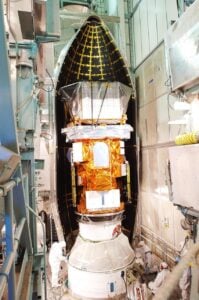
- The Objective: The Swift Observatory has operated since 2004, but after two decades, atmospheric drag has caused its orbit to decay significantly. Without intervention, there is a high probability that it would reenter the atmosphere in 2026. The mission aims to raise Swift’s orbit to approximately 600 km to preserve its unique capability for detecting gamma-ray bursts.
- The Spacecraft (LINK): LINK is a 425 kg spacecraft equipped with two 6-meter solar arrays and three xenon-fueled ion thrusters. It features autonomous navigation systems and three robotic arms specifically designed for non-cooperative capture.
- Innovative Methodology: This mission represents the first attempt to recover an “unprepared†spacecraft — one that was never designed with docking fixtures or grappling points. LINK will autonomously approach Swift, perform a visual inspection, and use its specialized robotic mechanism to secure a structural feature of the observatory without damaging its sensitive instrument.
- Current Status: LINK was launched on July 3, 2026, from Kwajalein Island aboard a Northrop Grumman Pegasus-XL rocket. Teams have successfully established communications with the spacecraft, which is currently undergoing several weeks of checkout procedures for its propulsion and navigation systems before beginning its rendezvous with Swift.
[ANS thanks NASA, NASA Official Swift Blog, and Reuters, for the above information. See the full article at https://www.reuters.com/business/aerospace-defense/space-startup-katalyst-launches-orbital-rescue-mission-aging-nasa-observatory-2026-07-03/.]

Changes to AMSAT TLE Distribution for July 10, 2026
Two Line Elements or TLEs, often referred to as Keplerian elements or keps in the amateur community, are the inputs to the SGP4 standard mathematical model of spacecraft orbits used by most amateur tracking programs. Weekly updates are completely adequate for most amateur satellites. TLE bulletin files are updated daily in the first hour of the UTC day. New bulletin files will be posted immediately after reliable elements become available for new amateur satellites. More information may be found at https://www.amsat.org/keplerian-elements-resources/.
- HORYU-4 NORAD Cat ID 41340 Decayed from orbit on or about 2026 July 2
General Perturbations Data Support
AMSAT is pleased to announce that modern forms of what are called General Perturbations data are being disseminated via modern formats including JSON, XML and KVN at https://newark192.amsat.org/gpdata/current/. The reason this change is being made is that we are running out of 5-digit catalog numbers and the TLE format is not viable for satellites launched after July of this year. See https://celestrak.org/NORAD/documentation/gp-data-formats.php for details.
These data are presently considered in beta test for the next two months while hosted on the test server newark192.amsat.org, and we are very open to community feedback at webmaster at amsat.org. Testers may experience outages and errors while we make improvements. We intend to put this into production on our main web server in July as we expect that satellites launched after this summer will require one of the new formats to accommodate longer object numbers. AMSAT will continue to publish TLE bulletins for satellites launched before July 2026 indefinitely.
[ANS thanks Joe Fitzgerald, KM1P, AMSAT Orbital Elements Manager, for the above information]
Buying from DX Engineering?
Add AMSAT’s Getting Started With Amateur Satellites to your order.
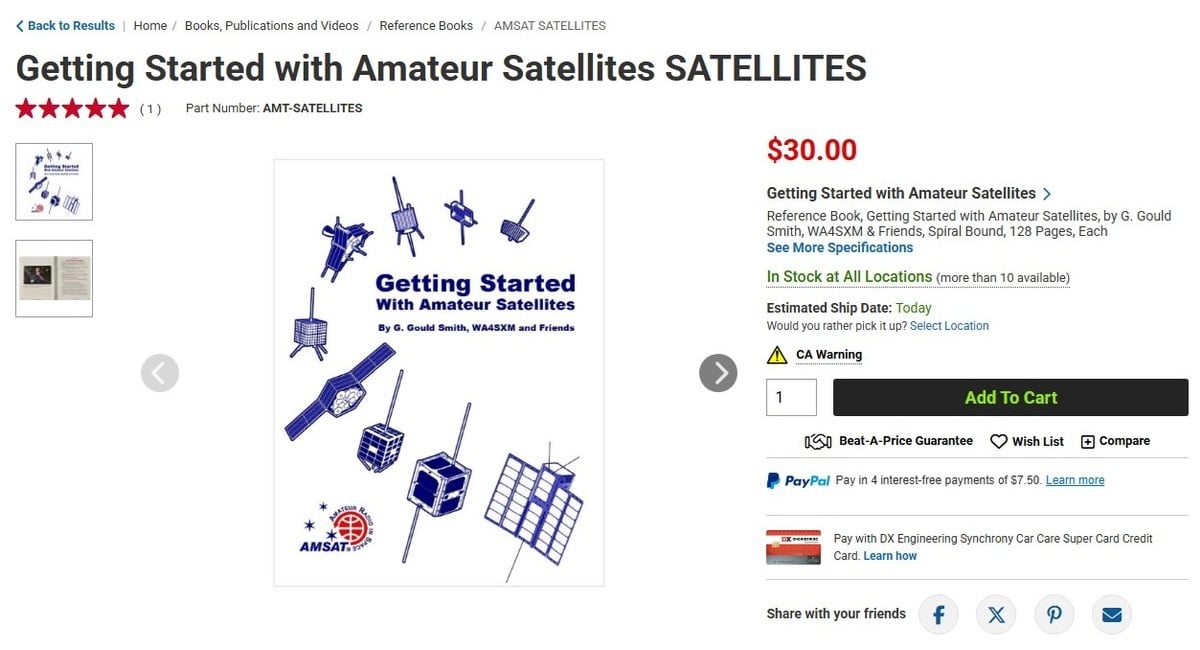
Available for $30 from DX Engineering (free shipping on most orders over $99)
https://www.dxengineering.com/parts/amt-satellites
ARISS News
Amateurs and others around the world may listen in on contacts between amateurs operating in schools and allowing students to interact with astronauts and cosmonauts aboard the International Space Station. The downlink frequency on which to listen is 145.800 MHz worldwide.
Recently completed:
The International Aerospace School named after the USSR test cosmonaut U.N. Sultanov, Ufa, Russia, direct via UD9W
The ISS callsign was RSØISS
The crewmember was Andrey Fedyaev
The ARISS mentor is RV3DR
Contact was for Fri 2026-07-10 19:29 UTC
Due to summer school vacations, no upcoming contacts currently scheduled.
As always, if there is an EVA, a docking, or an undocking; the ARISS radios are turned off as part of the safety protocol.
Radio will be powered down in support of Soyuz docking:
Power down: July 14 at 14:00 UTC
Power up: July 15 at 12:35 UTC
The crossband repeater remains configured in the Columbus Module (145.990 MHz up {PL 67} & 437.800 MHz down). If a crewmember decides to pick up the microphone and turn up the volume, you may hear them on the air—so keep listening, as you never know when activity might occur.
Kenwood D710GA in the Zvezda Service Module – Call sign RSØISS. Please note that ARISS is still in the process of troubleshooting and testing this radio. APRS is currently active on 437.825 MHz. Feel free to check out status reports at https://ariss-usa.org/ARISS_APRS/.ÂÂ
HamTV in the Columbus Module (2395.00 MHz) is currently transmitting a test signal. The color bar test generator portion of the system is experiencing technical issues, and troubleshooting is underway. For more information, visit the ARISS Ham TV Live site at https://live.ariss.org/hamtv/.
Note, all times are approximate. It is recommended that you do your own orbital prediction or start listening about 10 minutes before the listed time.
The latest information on the operation mode can be found at https://www.ariss.org/current-status-of-iss-stations.html
The latest list of frequencies in use can be found at https://www.ariss.org/contact-the-iss.html
[ANS thanks Charlie Sufana, AJ9N, one of the ARISS operation team mentors for the above information.]
Want to fly the colors on your own grid expedition? Get an AMSAT car flag and other neat stuff from our Zazzle store!
25% of the purchase price of each product goes towards Keeping Amateur Radio in Space
AMSAT Ambassador Activities

AMSAT Ambassadors provide presentations, demonstrate communicating through amateur satellites, and host information tables at club meetings, hamfests, conventions, maker faires, and other events.
July 18, 2026
Moon Day
Frontiers of Flight Museum
6911 Lemmon Avenue
Dallas, TX 75209
https://flightmuseum.com/events/moonday/
N5HYP
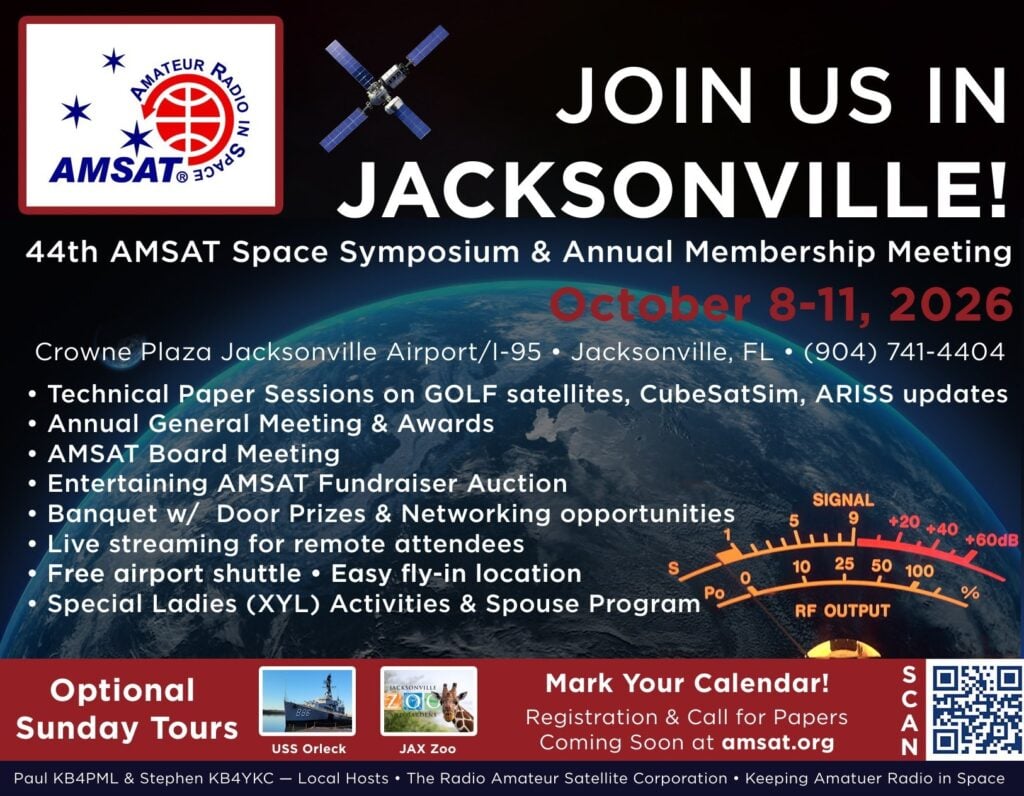
October 8-11, 2026
44th AMSAT Space Symposium and Annual Membership Meeting
Crowne Plaza JAX Airport
14670 Duval Road
Jacksonville, FL 32218
Details to follow
Interested in becoming an AMSAT Ambassador? AMSAT Ambassadors provide presentations, demonstrate communicating through amateur satellites, and host information tables at club meetings, hamfests, conventions, maker faires, and other events. For more information go to: https://www.amsat.org/ambassador/
[ANS thanks Bo Lowrey, W4FCL, Director – AMSAT Ambassador Program, for the above information]
Satellite Shorts from All Over
+ AMSAT SA 2026 Space Symposium will be held Saturday, 1 August 2026. The event is conducted online from 10:00 – 14:00 SAST (08:00 – 12:00 UTC) to enable wide attendance without incurring large travel costs. The theme is “The new Amateur Radio World in Space,†exploring practical hands-on aspects of space activities and emerging technologies. Presentations will include outcomes of proposals for new geostationary amateur satellites, including innovative ground-based systems to link LEO and GEO satellite.  Registration is free for members of IARU member societies, while non-members pay a small fee. Visit the AMSAT-SA website for registration details. (ANS thanks AMSAT-SA, for the above information.)
+ NASA’s Moon and Mars Exploration Analog (MMEA) continues to recruit research participants for its upcoming yearlong simulation season. Because the mission’s integrated habitats at the Johnson Space Center in Houston are designed to simulate deep space, participants will operate under the isolated conditions expected during crewed missions to the Moon or Mars. The current recruitment period is active for the year-long mission beginning no earlier than August 2027, during which continuous simulation operations in confined environments could be possible. The mission is HERA/CHAPEA only (HERA habitat spacecraft simulation, CHAPEA habitat base simulation). Volunteers are reminded to meet specific physical and educational requirements and to pass NASA’s physical and psychological assessments, so the mission results can be shared with the Human Research Program to help keep future astronauts safe and mission-ready. (ANS thanks NASA, the Human Research Program and the Artemis mission for the above information.)
+ NSF–DOE Vera C. Rubin Observatory (LSST) continues to reward the global scientific community as it begins its 10-year campaign to create the most comprehensive cinematic record of the Universe in history. Because the observatory’s 3200-megapixel camera—the largest digital camera ever built—has successfully completed system optimization, it is now capturing new, detailed images of the southern sky approximately every 40 seconds. The current Legacy Survey of Space and Time (LSST) runs through the next ten years, during which continuous filming of the dynamic Universe and the production of trillions of measurements should be possible. The survey is Wide-Field/Time-Lapse only (producing 10 terabytes of data and up to 7 million alerts of changes in the night sky every night). Researchers are reminded to utilize automated alert brokers to classify these changes and to ensure timely follow-up of fleeting cosmic events, so this unprecedented resource can be shared by as many scientists and members of the public as possible worldwide. (ANS thanks NSF, DOE, NOIRLab, and SLAC for the above information.)
Join AMSAT today at https://launch.amsat.org/
In addition to regular membership, AMSAT offers membership to:
- Societies (a recognized group, clubs or organization).
- Students are eligible for FREE membership up to age 25.
- Memberships are available for annual and lifetime terms.
Contact info [at] amsat.org for additional membership information.
73 and remember to help Keep Amateur Radio in Space!
This week’s ANS Editor,
Vidya Gopalakrishnan, K4VGK
ANS is a service of AMSAT, the Radio Amateur Satellite Corporation, 712 H Street NE, Suite 1653, Washington, DC 20002. AMSAT is a registered trademark of the Radio Amateur Satellite Corporation.