AMSAT News Service
ANS-200
July 19, 2026
In this edition:
* Voting Now Underway in 2026 AMSAT Board of Directors Election
* U.S. Space Force Satellite Catalog Reaches Six-Digit Numbers
* NASA's New Horizons Spacecraft Awakens from Record Hibernation
* Scientists Building Massive Deep Synoptic Array in Nevada Desert
* Updated VUCC & DXCC Satellite Standings for July 2026
* Changes to AMSAT TLE Distribution for July 17, 2026
* ARISS News
* AMSAT Ambassador Activities
* Satellite Shorts from All Over
The AMSAT® News Service bulletins are a free, weekly news and information service of AMSAT, The Radio Amateur Satellite Corporation. ANS publishes news related to Amateur Radio in Space including
reports on the activities of a worldwide group of Amateur Radio operators who share an active interest in designing, building, launching and communicating through analog and digital Amateur Radio satellites.
The news feed on
https://www.amsat.org publishes news of Amateur Radio in Space as soon as our volunteers can post it.
Please send any amateur satellite news or reports to: ans-editor [at]
amsat.org
You can sign up for free e-mail delivery of the AMSAT News Service Bulletins via the ANS List; to join this list see:
https://mailman.amsat.org/postorius/lists/ans.amsat.org/
Voting Now Underway in 2026 AMSAT Board of Directors Election
The nomination period for the 2026 AMSAT Board of Directors Election concluded on June 15, 2026. The following candidates were nominated, and their official candidate statements are available on
the AMSAT 2026 Board of Directors Election website.
-
Rich Gopstein, KD2CQ
-
Mark Hammond, N8MH
-
Bruce Paige, KK5DO
-
Paul Stoetzer, N8HM
-
Douglas Tabor, N6UA
Three seats on the AMSAT Board of Directors are being filled in this year's election. The three candidates receiving the highest number of votes will be elected to the Board. The candidates receiving
the next highest vote totals will be named First Alternate and Second Alternate, respectively. Voting opened on July 15, 2026, and will conclude on September 15, 2026. Election results will be announced no later than September 30, 2026.
Current AMSAT members may review the official candidate statements and cast their ballots on the AMSAT 2026 Board of Directors Election website:
https://launch.amsat.org/2026-BoD-Election
[ANS thanks
Douglas Tabor, N6UA, AMSAT Secretary, for the above information]
U.S. Space Force Satellite Catalog Reaches Six-Digit Numbers
The U.S. Space Force's authoritative satellite catalog entered a new era on July 11, 2026, when newly assigned catalog numbers advanced from the five-digit sequence ending at 69,999 directly to six-digit
catalog number 100,000. Space-Track announced the change and advised users to review its Alpha-5 information and frequently asked questions to ensure that Two-Line Element (TLE) and Three-Line Element (3LE) parsers, along with API queries, remain compatible
with the expanded numbering system. The milestone marks the beginning of permanent six-digit catalog numbers for newly cataloged space objects.
The milestone was reached with the cataloging of Saramago, also known as LusÃÂada 3, one of four Portuguese communications satellites developed by LusoSpace. Named in honor of Nobel Prize-winning
author José Saramago, the satellite is part of the LusÃÂada constellation, which uses Automatic Identification System (AIS) and VHF Data Exchange System (VDES) technology to improve maritime safety, vessel tracking, weather reporting, and ocean data services.
The transition occurred one day earlier than CelesTrak had predicted.
Although the traditional TLE format has served the satellite community for decades, its fixed-field design was never intended to accommodate six-digit catalog numbers. Space-Track is maintaining
compatibility through its Alpha-5 encoding system, while CelesTrak will distribute General Perturbations (GP) data for catalog numbers 100,000 and above using modern formats such as JSON, XML, CSV, and Key-Value Notation (KVN). These newer formats also eliminate
the long-standing two-digit year limitation inherited from the legacy TLE format.
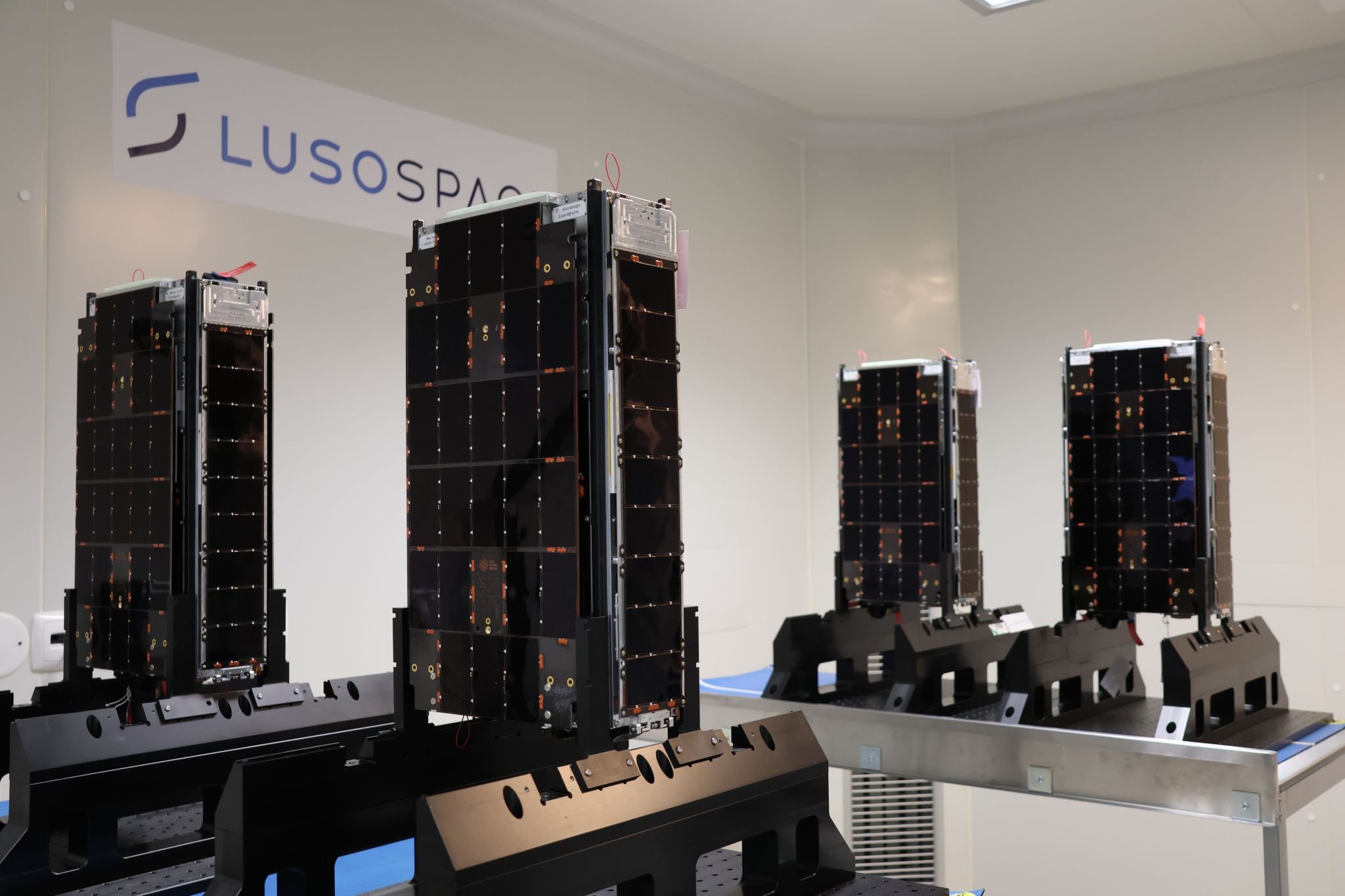
Saramago, part of Portugal's LusÃÂada constellation, received the first six-digit U.S. Space Force satellite catalog number. [Credit:
LusoSpace]
CelesTrak began supporting the modern GP formats in May 2020, giving software developers several years to prepare for the eventual transition. AMSAT likewise anticipated the change by introducing
GP data distribution through its Orbital Elements service. Joe Fitzgerald, KM1P, AMSAT Orbital Elements Manager, announced that AMSAT would provide orbital elements in JSON, XML, and KVN formats while continuing to publish traditional TLE bulletins indefinitely
for satellites cataloged before the six-digit transition.
For most amateur satellite operators, the change will be largely transparent when tracking existing satellites. However, software that assumes all catalog numbers contain no more than five numeric
digits may require updates before it can process newly cataloged spacecraft. Developers and operators of satellite tracking applications, automated ground stations, and custom scripts are encouraged to verify compatibility with Alpha-5 encoded TLEs or one
of the newer GP data formats.
While the transition may appear to be a simple numbering change, it represents one of the most significant updates to satellite orbital data distribution in decades. As launch rates continue to increase
and the number of tracked satellites and debris objects grows, six-digit catalog numbers and modern orbital data formats will ensure the U.S. Space Force's authoritative satellite catalog continues to support both the amateur and professional space communities
for years to come.
### For More Information
AMSAT General Perturbations data:
https://newark192.amsat.org/gpdata/current/
CelesTrak General Perturbations data formats:
https://celestrak.org/NORAD/documentation/gp-data-formats.php
Space-Track Alpha-5 information and frequently asked questions:
https://www.space-track.org/
[ANS thanks Joe Fitzgerald, KM1P, AMSAT Orbital Elements Manager,
Dr. T.S. Kelso of CelesTrak, and
Space-Track for the above information]
NASA's New Horizons Spacecraft Awakens from Record Hibernation
NASA's New Horizons spacecraft has awakened from its longest hibernation period ever and resumed active operations as it continues its pioneering exploration of the Kuiper Belt beyond Pluto. Flight
controllers confirmed on June 23 that the spacecraft had safely emerged from a 321-day hibernation that began on Aug. 7, 2025. Now approximately 5.9 billion miles (9.5 billion kilometers) from Earth, New Horizons remains healthy and is preparing to return
stored science data collected during its dormant period. The spacecraft continues to operate far beyond Pluto as one of humanity's most distant active planetary science missions.
The successful wake-up demonstrates the remarkable reliability of autonomous spacecraft operations across the vast distances of the outer solar system. Commands directing the spacecraft to awaken
were uploaded nearly a year earlier before New Horizons entered hibernation. Because radio signals now require approximately 8 hours and 52 minutes to travel one way between Earth and the spacecraft, confirmation of the wake-up reached mission controllers
through NASA's Deep Space Network station near Madrid, Spain, nearly nine hours after it was transmitted. Such long communication delays require the spacecraft to perform routine operations independently while awaiting instructions from Earth.
Mission teams periodically place New Horizons into hibernation during extended cruise phases to conserve onboard resources and reduce operational demands while continuing valuable scientific observations.
During hibernation, operators do not send routine commands or retrieve stored data, but the spacecraft continues collecting measurements using several science instruments. Throughout the 321-day hibernation period, New Horizons transmitted a weekly health-status
beacon indicating that all systems were functioning normally. According to Mission Operations Manager Alice Bowman, every weekly status report received during the hibernation period was "green," confirming the spacecraft remained in excellent health.
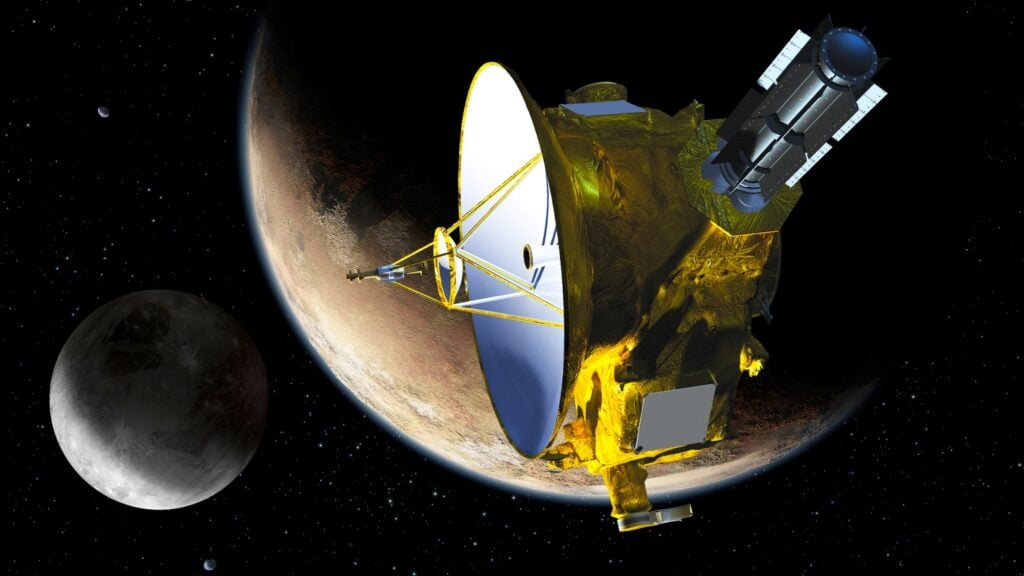
NASA's New Horizons spacecraft resumed active operations after a record 321-day hibernation. [Credit:
NASA/Johns Hopkins APL/SwRI]
With the spacecraft once again fully operational, engineers will first review spacecraft health and safety data before beginning the download of scientific observations collected during hibernation.
The Alice ultraviolet spectrograph will soon begin new observations of hydrogen gas in the outer heliosphere, while the Solar Wind Around Pluto (SWAP) instrument, the Pluto Energetic Particle Spectrometer Science Investigation (PEPSSI), and the Venetia Burney
Student Dust Counter continue monitoring the space environment in the distant reaches of the solar system. The mission team is also completing upgrades to ground-system software that will simplify long-term spacecraft operations.
Engineers have also updated the spacecraft's onboard autonomy software to support operations even farther from the Sun. The improvements account for the gradual decline in electrical power produced
by New Horizons' radioisotope power system and the steadily increasing communications delay as the spacecraft travels deeper into interstellar space. These enhancements will allow the spacecraft to continue conducting scientific observations with minimal intervention
from Earth while remaining responsive to changing mission conditions.
Launched in January 2006, New Horizons became the fastest spacecraft ever launched at the time and completed a gravity-assist flyby of Jupiter in 2007 before making humanity's first close exploration
of Pluto in July 2015. The spacecraft later performed the first flyby of a Kuiper Belt object, Arrokoth, on Jan. 1, 2019, and has continued studying the Kuiper Belt, the outer heliosphere, and the space environment beyond the planets. More than two decades
after launch, New Horizons continues expanding our understanding of the outer solar system while demonstrating the remarkable capabilities of long-duration deep-space communications and autonomous spacecraft operations.
For more information on NASA's New Horizons mission, visit:
https://science.nasa.gov/mission/new-horizons/
[ANS thanks
NASA for the above information]
Buying from Ham Radio Outlet?
Add AMSAT’s Getting Started With Amateur Satellites to your order.
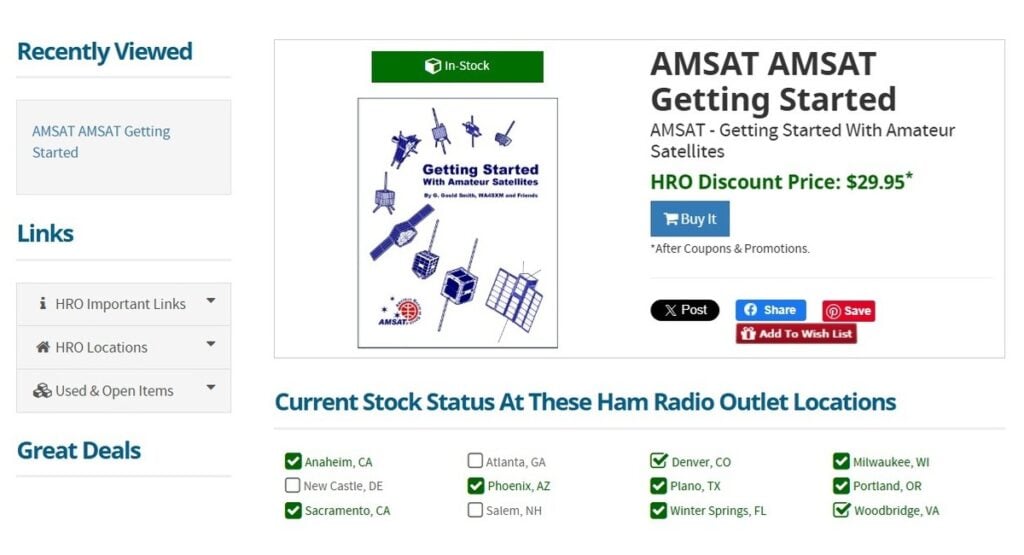
Available for $29.95 from HRO (free shipping on most orders over $100)
https://www.hamradio.com/detail.cfm?pid=H0-019238
Scientists Building Massive Deep Synoptic Array in Nevada Desert
A new radio telescope planned for Nevada could dramatically change how astronomers observe the radio universe. The Deep Synoptic Array (DSA), a project led by the California Institute of Technology
(Caltech), recently passed its final design review, clearing the way for construction of what researchers describe as the most sensitive radio telescope ever built.
When completed, the array will consist of 1,650 radio dishes spread across an area approximately 12 by 10 miles (20 by 16 kilometers). The telescope is designed to combine the sensitivity normally
associated with giant single-dish observatories with the sharp imaging capabilities of large interferometer arrays. Science operations are expected to begin near the end of the decade.
Researchers say the DSA will survey the sky at a pace far beyond existing radio observatories. Current radio telescopes have collectively identified approximately 20 million radio sources, but project
scientists estimate the DSA could detect a similar number during its first day of operation. Over the course of its initial survey, the telescope is expected to catalog nearly one billion radio-emitting objects.
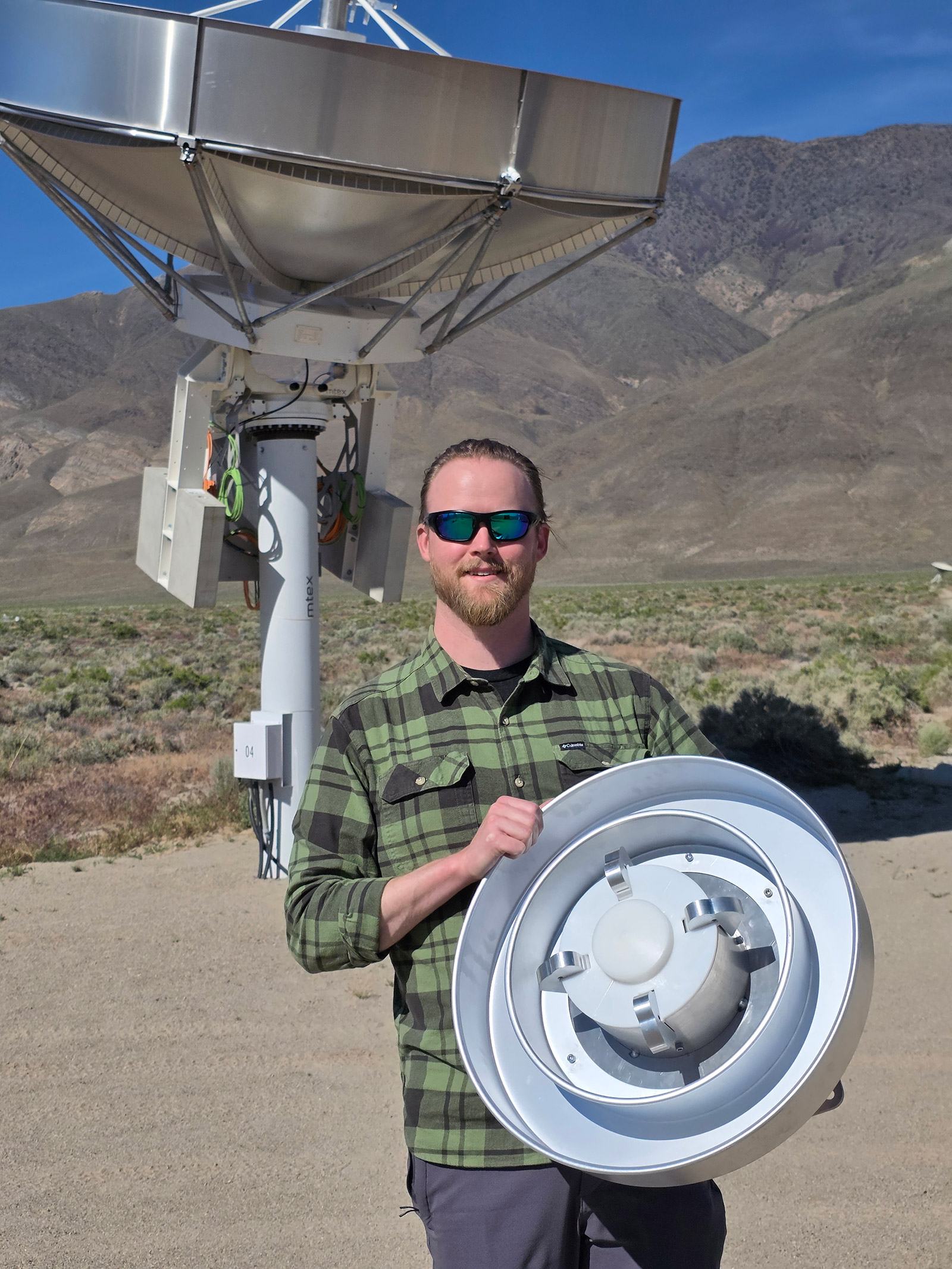
DSA engineer Jonas Flygare displays a feed assembly made from Fat Daddio’s cake pans. [Credit: Francois Kapp/Caltech
DSA Project]
Among the telescope's most ambitious goals is the study of fast radio bursts, pulsars, black holes, and other transient phenomena. The system will continuously monitor large portions of the sky,
allowing astronomers to rapidly locate brief events that might otherwise be missed. The telescope is also expected to support follow-up observations of gravitational-wave detections and could discover more than 20,000 previously unknown pulsars.
A key feature of the project is a real-time processing system that developers describe as a "radio camera." Rather than recording massive quantities of raw data for later analysis, the system will
create science-ready radio images as observations are collected. This approach dramatically reduces storage requirements while allowing observations to be shared quickly with researchers around the world.
The Deep Synoptic Array also incorporates several unusual engineering solutions aimed at reducing costs while maintaining performance. Among them is the use of specially modified aluminum cake pans
manufactured by the bakeware company Fat Daddio's as components within the antenna feed system. Combined with room-temperature receivers, GPU-based processing, and a high-speed fiber-optic network, the innovations demonstrate how modern radio astronomy increasingly
relies on advances in both computing and manufacturing to explore the universe.
Read the full article at:
https://www.caltech.edu/about/news/caltech-readies-to-build-worlds-most-sensitive-radio-telescope
[ANS thanks Whitney Clavin,
Caltech, for the above information]
Updated VUCC & DXCC Satellite Standings for July 2026
VUCC Satellite Award/Endorsement Changes for June 01, 2026 to July 01, 2026.
|
Callsign |
Previous VUCC Grids |
Updated VUCC Grids |
|
DF2ET |
1801 |
1902 |
|
DL2GRC |
1650 |
1800 |
|
F4BKV |
1300 |
1502 |
|
VU2LBW |
1000 |
1111 |
|
UW7LL |
754 |
1009 |
|
N0GVK |
871 |
899 |
|
LU3FCA |
684 |
734 |
|
A65BR |
701 |
733 |
|
JI5USJ |
526 |
551 |
|
SV8CKM |
285 |
417 |
|
K5WO |
350 |
365 |
|
N8HRZ |
343 |
361 |
|
WA8ZID |
230 |
233 |
|
KG5IPA |
135 |
201 |
|
WB5TX |
170 |
175 |
|
M0AQM |
New |
105 |
|
N4ERZ |
New |
101 |
Congratulations to
MØAQM and N4ERZ on earning their VUCC Satellite Awards! MØAQM is the first VUCC Satellite award holder from Maidenhead grid IO83.
DXCC Satellite Award/Endorsement Changes for June 01, 2026 to July 01, 2026.
|
Callsign |
Previous DXCC Entities |
Updated DXCC Entities |
|
OE9DGV |
217 |
221 |
|
DL2GRC |
201 |
203 |
|
SP8NR |
177 |
194 |
|
I3BUI |
180 |
189 |
|
G4GIR |
176 |
185 |
|
HB9RYZ |
173 |
175 |
|
EA2AA |
172 |
174 |
|
F6AOJ |
153 |
162 |
|
LA6OP |
160 |
162 |
|
IK5CBE |
154 |
160 |
|
DL4ZAB |
139 |
159 |
|
LA7XK |
119 |
132 |
|
K8DP |
129 |
131 |
|
I4DOR |
113 |
130 |
|
I4MKN |
101 |
130 |
|
TF1A |
117 |
119 |
|
K8LG |
New |
116 |
|
OH3DP |
101 |
110 |
|
SV8CKM |
100 |
109 |
|
HB9BIN |
104 |
105 |
|
YL2KF |
New |
100 |
Congratulations to new DXCC Satellite award holders
K8LG and
YL2KF!
[ANS thanks
Jon Goering, N7AZ, for the above information]
The 2026 Coins Are Here! Help Support GOLF-TEE and Fox-Plus.
Annual memberships start at only $120.
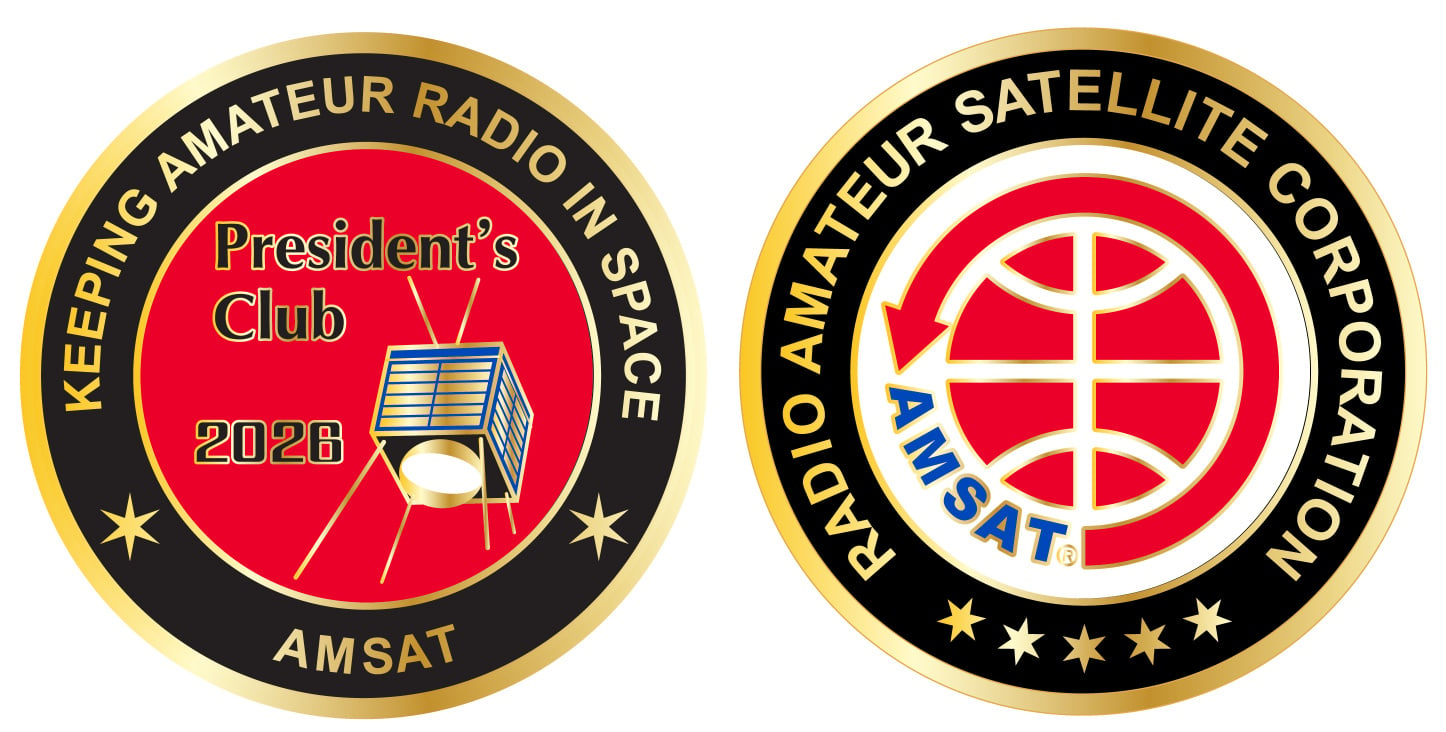
Join the AMSAT President's Club today and help Keep Amateur Radio in Space!
https://www.amsat.org/join-the-amsat-presidents-club/
Changes to AMSAT TLE Distribution for July 17, 2026
Two Line Elements or TLEs, often referred to as Keplerian elements or keps in the amateur community, are the inputs to the SGP4 standard mathematical model of spacecraft orbits used by most amateur
tracking programs. Weekly updates are completely adequate for most amateur satellites. TLE bulletin files are updated daily in the first hour of the UTC day. New bulletin files will be posted immediately after reliable elements become available for new amateur
satellites. More information may be found at https://www.amsat.org/keplerian-elements-resources/.
+ This week there are no additions or deletions to the AMSAT TLE distribution.
General Perturbations Data Support
AMSAT is pleased to announce that modern forms of what are called General Perturbations data are being disseminated via modern formats including JSON, XML and KVN at
https://newark192.amsat.org/gpdata/current/. The reason this change is being made is that we are running out of 5-digit catalog numbers and the TLE format is not viable for satellites launched after
July of this year. See
https://celestrak.org/NORAD/documentation/gp-data-formats.php for details.
These data are presently considered in beta test for the next two months while hosted on the test server
newark192.amsat.org, and we are very open to community feedback at webmaster [at]
amsat.org. Testers may experience outages and errors while we make improvements. We intend to put this into production on our main web server in July as we expect that satellites launched after this summer will require one of
the new formats to accommodate longer object numbers. AMSAT will continue to publish TLE bulletins for satellites launched before July 2026 indefinitely.
[ANS thanks Joe Fitzgerald, KM1P, AMSAT Orbital Elements Manager, for the above information]
ARISS News
Amateurs and others around the world may listen in on contacts between amateurs operating in schools and allowing students to interact with astronauts and cosmonauts aboard the International Space
Station. The downlink frequency on which to listen is 145.800 MHz worldwide.
Scheduled Contacts
+ Recently Completed
Pacific State University, Khabarovsk, Russia, direct via TBD
The ISS callsign was RSØISS
The crewmember was Pyotr Dubrov
The ARISS mentor was RV3DR
Contact was successful: Fri 2026-07-17 09:15 UTC
Congratulations to the Pacific State University students, Pyotr, and ARISS mentor RV3DR!
+ Upcoming Contacts
Planetario de Orizaba, Orizaba, Veracruz, Mexico, telebridge via ON4ISS
The ISS callsign is presently scheduled to be OR4ISS
The scheduled crewmember is Sophie Adenot KJ5LTN
The ARISS mentor is VE3TBD
Contact is go for: Thu 2026-07-23 17:07:12 UTC
POIC at Marshall Space Flight Center, Huntsville, AL, telebridge via ON4ISS
The ISS callsign is presently scheduled to be TBD
The scheduled crewmember is Williams KJ5GEW
The ARISS mentor is KI5SDP
Contact is go for: Fri 2026-07-24 17:56:30 UTC
Many times, a school makes a last-minute decision to do a Livestream or runs into a last-minute glitch requiring a change of the URL, but we at ARISS may not get the URL in time for publication.
You can always check https://live.ariss.org/ to see if a school is Livestreaming.
As always, if there is an EVA, a docking, or an undocking; the ARISS radios are turned off as part of the safety protocol.
The crossband repeater remains configured in the Columbus Module (145.990 MHz up {PL 67} & 437.800 MHz down). If a crewmember decides to pick up the microphone and turn up the volume, you may hear
them on the air—so keep listening, as you never know when activity might occur.
Kenwood D710GA in the Zvezda Service Module - Call sign RS0ISS. Please note we're still in the process of troubleshooting and testing this radio. APRS is currently active on 437.825 MHz. Feel free
to check out status reports at https://ariss-usa.org/ARISS_APRS/.
HamTV in the Columbus Module (2395.00 MHz) is currently transmitting a test signal. The color bar test generator portion of the system is experiencing technical issues, and troubleshooting is underway.
For more information, visit the ARISS Ham TV Live site at
https://live.ariss.org/hamtv/.
Note, all times are approximate. It is recommended that you do your own orbital prediction or start listening about 10 minutes before the listed time.
The latest information on the operation mode can be found at https://www.ariss.org/current-status-of-iss-stations.html
The latest list of frequencies in use can be found at https://www.ariss.org/contact-the-iss.html
[ANS thanks Charlie Sufana, AJ9N, one of the ARISS operation team mentors for the above information]
AMSAT Ambassador Activities
AMSAT Ambassadors provide presentations, demonstrate communicating through amateur satellites, and host information tables at club meetings, hamfests, conventions, maker faires, and other events.
AMSAT Ambassador Clint Bradford, K6LCS, says,
“Think a 75-minute presentation on “working the easy satellites” would be appropriate for your club or event? Let me know by emailing me at k6lcsclint [at] gmail [dot] com or calling me at 909-999-SATS
(7287)!”
Clint has NEVER given the exact same show twice: EACH of the 150+ presentations so far has been customized/tailored to their audiences.
Scheduled Events
44th AMSAT Space Symposium and Annual Membership Meeting - October 8 thru 11, 2026
Crowne Plaza JAX Airport
14670 Duval Road
Jacksonville, FL 32218
https://www.amsat.org/2026-amsat-symposium/
For more information go to:
https://www.amsat.org/ambassador/
[ANS thanks Bo Lowrey, W4FCL, Director – AMSAT Ambassador Program, for the above information]

Satellite Shorts from All Over
+ Bird Chaser Bingo Summer 2026 has added two more operators to its list of Full Eclipse achievers, with Nestor, N6CKC, of Phoenix, Arizona, and Endaf, N6UTC, of Long Beach, California, completing
every square on the challenge card. A Full Eclipse is awarded to participants who complete the entire Bird Chaser Bingo operating card, the event's most demanding achievement. Bird Chaser Bingo encourages amateur radio satellite operators to complete a variety
of operating objectives involving contacts, grids, satellites, and special operating situations throughout the summer. Operators may also earn recognition by completing traditional bingo patterns while working toward a Full Eclipse. The event continues through
August 31, 2026, with completed cards due by September 15, 2026. Additional information and downloadable bingo cards are available at
https://borgersons.com/. (ANS thanks
Sean Borgerson, KK7OVF, for the above information)
+ A new satellite tracking application for iPhone and iPad,
AllMySat, is now available for amateur radio operators and satellite enthusiasts. The app combines live satellite tracking with pass predictions, antenna alignment tools, and customizable alerts to assist operators in the
field. It includes a 3D globe, a 2D map, and augmented reality viewing modes, along with a catalog of more than 34,000 satellites, rocket bodies, and debris objects. According to the developer, orbital data is updated every six hours using recognized space
data sources, and additional features include Doppler correction, satellite frequency information, and launch tracking. A free version is available, with an optional premium subscription offering expanded capabilities such as extended prediction windows and
data export. Additional information is available at
https://allmysat.com and the application can be downloaded from Apple's App Store. (ANS thanks
AllMySat for the above information)
+ NASA astronaut Anil Menon and Roscosmos cosmonauts Pyotr Dubrov and Anna Kikina launched aboard the Soyuz MS-29 spacecraft from the Baikonur Cosmodrome in Kazakhstan on July 14. The Soyuz rocket
lifted off at 1447 UTC and successfully placed the crew into orbit for a fast rendezvous with the International Space Station. The spacecraft docked with the ISS after a two-orbit flight, where the trio joined the station's Expedition crew. Menon is making
his first spaceflight, while Dubrov and Kikina are each beginning their second missions to the orbiting laboratory. The crew is expected to spend approximately eight months aboard the ISS conducting scientific research and supporting station operations. Menon's
research will include experiments in semiconductor crystal growth and AI-assisted medical ultrasound techniques that could benefit future long-duration space missions. (ANS thanks
Space.com for the above information)
+ The U.S. Federal Communications Commission (FCC) has authorized Reflect Orbital to launch its experimental Eärendil-1 satellite, which will test the use of a large reflective film to redirect sunlight
onto selected areas of Earth during nighttime. Operating from a planned 625-kilometer low Earth orbit, the technology demonstration will evaluate whether an 18-meter reflector can briefly illuminate areas several kilometers across. Reflect Orbital says the
concept could eventually support emergency response, remote construction projects, and nighttime solar energy applications. The proposal has drawn criticism from astronomy organizations and dark-sky advocates, who warn that reflected sunlight could increase
light pollution, interfere with astronomical observations, and affect wildlife. The FCC noted that the authorization applies only to a single experimental satellite and that any future constellation would require additional regulatory approval. If successful,
the mission could open the door to a new class of space-based illumination systems while renewing debate over their impact on the night sky. (ANS thanks
WIRED for the above information)
Join AMSAT today at
https://launch.amsat.org/
In addition to regular membership, AMSAT offers membership to:
-
Societies (a recognized group, clubs or organization).
-
Students enrolled in at least half-time status are eligible for free membership to age 25.
-
Memberships are available for annual and lifetime terms.
Contact info [at]
amsat.org for additional membership information.
73 and remember to help Keep Amateur Radio in Space!
This week's ANS Editor,
Mitch Ahrenstorff, ADØHJ
mahrenstorff [at]
amsat.org
ANS is a service of AMSAT, the Radio Amateur Satellite Corporation, 712 H Street NE, Suite 1653, Washington, DC 20002
AMSAT is a registered trademark of the Radio Amateur Satellite Corporation.