AMSAT News Service
ANS-270
September 27, 2026
In this edition:
- ARISS SSTV Series 33 to Feature Student Education Images October 2-6
- UNNE-1B Coordinated as Transporter-18 Prepares to Loft New Amateur Payloads
- AMSAT-DL's ERMINAZ-2 PocketQube Trio Set for October 1 Launch on Transporter-18
- OrbitDeck for iOS Brings Full-Featured Satellite Tracking to iPhone and iPad
- Recent IARU Amateur Satellite Frequency Coordination Activity
- IARU Region 1 General Conference Concludes in Vienna; New Executive Committee Elected
- 44th AMSAT Space Symposium Less Than Two Weeks Away
- ARICA-2 Opens Amateur Message-Relay Mission September 29
- Jim Hart, WD5RGW, Earns AMSAT Reverse VUCC Award #21
- Changes to AMSAT TLE Distribution for September 25, 2026
- ARISS News
- AMSAT Ambassador Activities
- Satellite Shorts From All Over
The AMSAT® News Service bulletins are a free, weekly news and information service of AMSAT, The Radio Amateur Satellite Corporation.
ANS publishes news related to Amateur Radio in Space including reports on the activities of a worldwide group of Amateur Radio operators who share an active interest in designing, building, launching and communicating through analog and digital Amateur Radio satellites.
The news feed on https://www.amsat.org publishes news of Amateur Radio in Space as soon as our volunteers can post it.
Please send any amateur satellite news or reports to: ans-editor [at] amsat.org
You can sign up for free e-mail delivery of the AMSAT News Service Bulletins via the ANS List; to join this list see: https://mailman.amsat.org/postorius/lists/ans.amsat.org/
ARISS SSTV Series 33 to Feature Student Education Images October 2-6
Get the SSTV decoders ready. ARISS has announced that its next Slow Scan Television event, SSTV Series 33, will be transmitted from the International Space Station beginning Friday, October 2, at 09:00 UTC and concluding on Tuesday, October 6, at a time to be determined. This special Expedition 75 event will feature a series of images focused on the theme of student education.
Images will be transmitted on 437.550 MHz FM using the Robot 36 mode, on a schedule of 36 seconds of transmission followed by a two-minute pause. Because the downlink is on 70 centimeters, Doppler shift is significant - stations should expect the signal to sweep from approximately 437.560 MHz at acquisition of signal down to 437.540 MHz at loss of signal - and should plan to tune accordingly. A Doppler correction summary sheet for the 437.550 MHz SSTV system is available at https://ariss-usa.org/ARISS_SSTV/SSTV_Event_437.550_MHz.pdf
As with previous events, SSTV transmissions may be paused briefly to accommodate scheduled ARISS school contacts, and the schedule remains subject to change based on station operations. The event's dates overlap the start of World Space Week, October 4-10, whose theme this year is "Rocket Revolution."
Received images may be posted to the ARISS SSTV gallery, and participants who receive and submit images are eligible for a commemorative electronic award certificate. Details on the gallery, the award, and any schedule updates will be posted at https://www.ariss.org/upcoming-sstv-events.html and on the ARISS social media channels.
[ANS thanks ARISS for the above information]
LIMITED TIME OFFER!!!
AMSAT is offering a limited-time promotion for new and renewing members that includes a free digital copy of Getting Started with Amateur Satellites. The promotion is being offered as AMSAT begins the 2026 membership year.
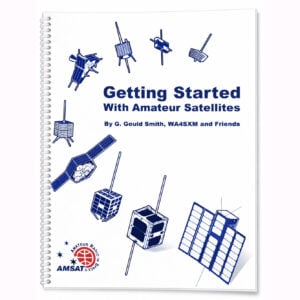
Anyone who joins or renews their AMSAT membership during the promotional period will receive a download link for the latest edition of Getting Started with Amateur Satellites in their membership confirmation email. JOIN TODAY at https://launch.amsat.org/ (Remember! Students join for FREE!)
UNNE-1B Coordinated as Transporter-18 Prepares to Loft New Amateur Payloads
AMSAT-EA's UNNE-1B (also known as HADES-E2) has moved to the list of completed coordinations on the IARU Satellite Frequency Coordination Panel's status pages, with a downlink on 436.888 MHz and an uplink on 145.925 MHz now coordinated - just in time for a launch that could put three new amateur payloads in orbit next month.
Last covered in ANS-214, UNNE-1B is a 1.5P PocketQube built on the same hardware and software as the original UNNE-1, which continues to await a Rocket Factory Augsburg launch from the United Kingdom. The satellite provides an SDR-based FM voice and FSK digital repeater, opened by squelch level with no tone required, along with FSK data at 50-1200 bps, telemetry at up to 1600 bps, a CW beacon, and a CODEC2 digital voice message. AMSAT-EA has positioned it as the successor to the FM repeater service of SO-124 and SO-125, both of which have since re-entered the atmosphere. An educational payload developed by students at Universidad de Nebrija in Madrid will send one clue per week in the telemetry as part of a guessing game for amateurs to solve.
UNNE-1B is manifested on SpaceX's Transporter-18 dedicated rideshare mission from Vandenberg Space Force Base, with the launch brokered by UARX. Transporter-18 is currently scheduled to launch on Thursday, October 1, at 18:18 UTC.
Two more amateur payloads are planning to share the ride. AMSAT-EA's HADES-L, an experimental 10 x 5 x 5 cm PocketQube reported in ANS-214, proposes a transponder with an uplink at 28.472 MHz USB - or alternatively on 145 MHz - and a 436.665 MHz FM downlink, capable of carrying a single FM voice channel or multiple simultaneous CW, FT4, or FT8 signals. And UTNH-Sat, from the Universidad Tecnologica Nacional Regional Haedo in Argentina, will transmit LoRa telemetry and a CW beacon on 436.850 MHz and offer an automatic LoRa ping-response service: amateurs who transmit a ping request to the satellite will receive a reply containing their own callsign. Both remain in the coordination process (see the coordination roundup below).
[ANS thanks AMSAT-EA, the IARU Satellite Frequency Coordination Panel, and Exolaunch for the above information]
AMSAT-DL's ERMINAZ-2 PocketQube Trio Set for October 1 Launch on Transporter-18
It's official: AMSAT-DL's three ERMINAZ-2 PocketQubes - ERMINAZ-2U, ERMINAZ-2V, and ERMINAZ-2X - are set to launch aboard SpaceX's Transporter-18 rideshare mission from Vandenberg Space Force Base on Thursday, October 1, at 18:18 UTC (20:18 CEST), AMSAT-DL announced on September 25. The three spacecraft will be deployed from UARX's OSSIE mission using a PocketQube deployer provided by the Libre Space Foundation into a 500 x 600 km polar orbit.
The trio shares an identical design derived from AMSAT-DL's ERMINAZ-1 spacecraft, which were built on the Libre Space Foundation's QUBIK platform and still await the first flight of Rocket Factory Augsburg's RFA One from SaxaVord Spaceport in the United Kingdom. That makes the ERMINAZ-2 satellites the first of the ERMINAZ family to reach orbit. AMSAT-DL describes the build as its shortest satellite campaign to date: when the launch opportunity arose in early 2025, the flight models had to be ready for integration into the deployer within a matter of weeks. The satellites were originally manifested on Transporter-14, then Transporter-16, before settling on Transporter-18.
The ERMINAZ program is a syndicated multi-PocketQube mission led by AMSAT-DL in collaboration with AMSAT-EA, ESERO-Germany at the Bochum Observatory, and the Libre Space Foundation, with the goal of promoting, advancing, and developing knowledge about space and amateur radio. Each of the three ERMINAZ-2 spacecraft will transmit telemetry and science data from onboard radiation sensors and triaxial accelerometers, gyroscopes, and magnetometers, downlink SSDV images, and provide a digipeater and store-and-forward function allowing licensed amateurs to use the satellites as relays to communicate with one another worldwide. Only non-proprietary, open-source, and documented protocols will be used, including CCSDS telemetry, a CW beacon with callsign identification, SSDV, and AX.25, along with in-flight experiments using GFSK, GMSK, and BPSK modulation at data rates from 600 to 19,200 bps and both CCSDS and IEEE 802.15.4 framing.
The IARU has coordinated the following frequencies: ERMINAZ-2U will operate in the UHF amateur satellite band on 435.900 MHz, while ERMINAZ-2V and ERMINAZ-2X will operate in the VHF band on 145.920 MHz and 145.960 MHz, respectively. AMSAT-DL notes that these frequencies are to be used only for amateur purposes. Operators wishing to decode the satellites will find that Daniel Estevez, EA4GPZ, added a decoder for the ERMINAZ family's QUBIK-derived communications stack to gr-satellites in 2024, and telemetry reports via the SatNOGS network will be welcomed.
Transporter-18 is shaping up as a banner flight for amateur radio: AMSAT-EA's UNNE-1B and HADES-L and Argentina's UTNH-Sat are also manifested on the mission (see story above). Further details on the ERMINAZ program are available at https://amsat-dl.org/en/erminaz/
[ANS thanks AMSAT-DL and the IARU Satellite Frequency Coordination Panel for the above information]
OrbitDeck for iOS Brings Full-Featured Satellite Tracking to iPhone and iPad
OrbitDeck for iOS, a comprehensive amateur satellite tracking application for iPhone and iPad, is now available on the Apple App Store. Developed by Paul Stoetzer, N8HM, the app runs natively on both iPhone and iPad with iOS 17 or later, and its source code is published on GitHub.
At its core, OrbitDeck computes live look angles, range, range rate, sub-point, and footprint for any satellite, along with next-pass predictions featuring quality scoring and elevation profiles, a daily schedule of every favorite satellite's passes ordered by AOS, multi-day pass progressions, a full ground-track map, an all-sky radar showing every favorite at once, an animated 3D globe, and a polar sky plot marking AOS, LOS, and direction of travel. Orbital elements are pulled from CelesTrak and AMSAT and refreshed automatically, with cached data keeping core tracking features working offline.
For operating, the app offers a four-dial DX Doppler display and a single-station Doppler playbook, per-satellite calibration shared across every Doppler screen with CSV import and export, a link budget with a per-elevation margin curve, the SatNOGS transponder database, an AO-7 Mode A/B timer, and mutual-visibility windows with paired sky plots for those chasing distance records. Full rig control lets the app Doppler-tune a transceiver over a BLE serial adapter or an Icom network connection, supporting Icom CI-V, Yaesu, and Kenwood radios - including the TS-2000 and TS-790 satellite modes and the TH-D74 and TH-D75 via the B.B. Link - as well as any Hamlib radio via rigctld, in single full-duplex, single uplink/downlink, or two-radio configurations. Rotator control follows the pass with support for GS-232, Easycomm, SPID Rot2Prog, SAEBRTrack, rotctld, PstRotator, and OZ9AAR URC protocols, complete with pre-positioning before AOS, slew lead, park on LOS, flip mode, alignment offsets, and magnetic correction.
Logging is built in, with an on-device QSO log, LoTW uploads signed directly on the device from the operator's own certificate, Cloudlog and Wavelog uploads, and ADIF import and export with automatic LoTW satellite naming. The app can also record a pass, decode SSTV images into an exportable gallery, and work full-duplex FT4 over USB or network audio, decoding the downlink while transmitting with a live Doppler readout, automatic transponder calibration, and PTT via CAT.
Rovers will find the station and grid tools especially handy: the app can operate from a fixed site or follow the device's GPS, recognizes VUCC grid lines and corners per ARRL rules so that every claimable grid is shown, and includes a Live Grid Finder that guides the operator onto a line or corner with a compass arrow, along with a display of the current DXCC entity, state, and county.
Rounding out the package are an orbital analysis suite covering J2 nodal and apsidal rates, beta angle, eclipse fraction, LTAN, conjunction awareness, and state-vector-to-element recovery; live space weather from NOAA SWPC and N0NBH's hamqsl.com; a MUF and HF path tool; a classic OSCARLOCATOR simulator with printable overlays and a reference-orbit schedule; more than 60 antenna, feedline, RF, and orbit calculators; a receipt-tape scientific calculator and a graphing calculator; a Tiny BASIC interpreter; and PDF, CSV, and XLSX exports.
OrbitDeck for iOS is available on the App Store at https://apps.apple.com/app/orbitdeck/id6802070968. Documentation, including guides to rig control, rotator control, logging, and digital modes, is available at https://orbitdeckios.n8hm.radio/, and the source code may be found at https://github.com/prstoetzer/OrbitDeckiOS. The app encourages users to support AMSAT, which builds and operates many of the satellites OrbitDeck is made to track.

[ANS thanks Paul Stoetzer, N8HM, AMSAT Executive Vice President, for the above information]
Recent IARU Amateur Satellite Frequency Coordination Activity
September has been an unusually eventful month on the IARU Satellite Frequency Coordination Panel's status pages, hosted by AMSAT-UK at https://iaru.amsat-uk.org/index.php. In addition to the UNNE-1B coordination reported above, the panel completed four coordinations, declined four requests in a single day, and posted six new applications during the month.
Newly Coordinated (September 7)
+ FramSat-1.5 - Orbit NTNU, Norway. ANS-235 reported that the panel had declined coordination for this 1U CubeSat on August 17. The request now appears on the list of completed coordinations, with a downlink on 435.060 MHz coordinated for its 2FSK 9k6 telemetry. Built by the student organization at the Norwegian University of Science and Technology, FramSat-1.5 is planning an Isar Aerospace launch from Andoya in Q4 2026, following its predecessor FramSat-1, which reached orbit on Isar's "Onward and Upward" mission on September 5.
+ Qubesat-2 - Space Technologies at Cal, University of California, Berkeley. A 2U CubeSat carrying a store-and-forward digipeater that will accept packets of amateurs' own data and retransmit them at a time of the operator's choosing, with the open-source TinyGS ground station network used for broad accessibility. Its science payload is a proof-of-concept quantum gyroscope using nitrogen-vacancy center diamonds. The team proposed a UHF LoRa downlink at 1025 baud, with launch arranged through Voyager.
+ UTNH-SAJILO-SAT (SanoSat-3) - AMSAT Nepal. The follow-on to SanoSat-1 (NO-116) and SanoSat-2 carries an amateur digipeater for short messages, a 5-megapixel camera downlinking SSDV images via GFSK, a Morse code identification beacon, and a magnetorquer-based detumbling system, with telemetry openly available through SatNOGS.
+ Solar Flare and Ionosphere Explorer (SoFIE) - Saint Francis University, Pennsylvania. A 3U CubeSat that will observe HF radio bursts from the Sun while collecting ground-based transmissions with a broadband 3-30 MHz receiver, in collaboration with the University of Scranton's HamSCI initiative, with a 9k6 BPSK AX.25 UHF downlink and a 1 Mbps S-band downlink.
Coordination Declined (September 17)
Four requests were declined on the same day, in each case with the panel's reasoning noted on the request:
+ AlMunther - Bahrain Space Agency. A 3U CubeSat carrying a camera system, an in-house avionics board with encryption and AI image-processing experiments, and a beacon transmitting the Bahraini national anthem and a quote from the King of Bahrain for amateurs to collect. The satellite was launched on SpaceX's Transporter-14 mission in March 2025; coordination was not requested until July of that year.
+ MOI-1 - K J Somaiya Institute of Technology, India. A 6U CubeSat intended to provide AI computation infrastructure in space, with an "OrbitRadio" amateur-band downlink broadcasting telemetry and user-uploaded messages. The panel declined coordination as a commercial project.
+ GenexSat - Genex Space (Space Shaala Pvt. Ltd.), India. A 4P PocketQube proposing a LoRa digipeater and a lab-on-chip biological experiment. The panel declined coordination as a commercial project.
+ MRZN - Universidad Nacional Autonoma de Honduras. A 1U CubeSat measuring hydrometeorological variables to provide flood early warnings for Central American river basins, with SSTV images promised for amateurs in the summer months. The panel declined coordination as an Earth exploration mission.
New Applications
+ SCALAR - Washington University in St. Louis (applied September 6). The student club's first satellite mission, a 1U CubeSat demonstrating three-axis attitude control using custom magnetorquers and torque rods, with members obtaining amateur licenses and building their own ground station along the way.
+ Nyansat - Oakwood School, California (applied September 13). A 2U CubeSat designed, built, and operated by high school students, carrying acoustic structural measurement, radio-based orbit determination, distributed ledger, embedded Ethernet, imaging, and student artwork payloads, plus a materials science experiment that students at approximately 30 schools will follow with control observations. The team proposes a UHF GFSK downlink and a NASA launch to the ISS in June 2027. The responsible operator is Michael Lyle, AE6XM.
+ UTNH-Sat - Universidad Tecnologica Nacional Regional Haedo, Argentina (applied September 15). LoRa telemetry and a CW beacon on 436.850 MHz, an automatic LoRa ping-response service that returns the requesting station's callsign, and an onboard radiation counter for educational study of the space environment. The team is planning a SpaceX launch from Vandenberg in October 2026. The responsible operator is Gustavo Carpignano, LW2DTZ.
+ RSP-P00 - Rymansat PocketQube, Japan (applied September 16). A 1P PocketQube intended to demonstrate an ultra-small, rapidly iterated satellite platform whose hardware designs and protocols will be open-sourced to the amateur community. The satellite will transmit telemetry, CODEC2 digital voice (FreeDV 2400B), and SSDV images, and will offer an AX.25 echo-back practice mode for newcomers and an APRS repeater, with a downlink combining CW, GMSK at up to 19k2, AFSK, and ME-2FSK. A SpaceX launch from Vandenberg is planned for early 2028. The responsible operator is Takafumi Shimamura, JI1YSC.
+ Space-Ranger 1 and Space-Ranger 2 - Beihang University, China (applied September 22). A pair of 28 kg microsatellites developed from winning projects of the second Space Universities CubeSat Challenge, each carrying an optical camera, a deployable membrane demonstration, a neutron detector, and electric propulsion. Telemetry is to be open to radio amateurs worldwide upon application for authorization, with a UHF BPSK downlink at 4096 bps and an S-band QPSK downlink at 200 kbps proposed. Launch from Jiuquan is planned for January 2027.
Finally, the Slipper2Sat-2 entry from Antarikchya Pratisthan Nepal, reported as a new application in ANS-214, no longer appears on the panel's status pages.
Developers planning a mission are reminded to request coordination as early in the design process as possible - and, as this month's declines illustrate, well before launch.
[ANS thanks the IARU Satellite Frequency Coordination Panel and AMSAT-UK for the above information]
AMSAT Remove Before Flight Key Tags Now Available Yes, These are the Real Thing!
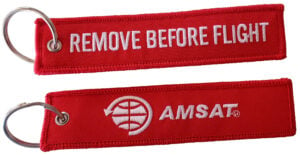
Your $20 Donation Goes to Help Fly a FoxPlus Satellite Includes First Class Postage (Sorry â U.S. Addresses Only) Order Today at https://www.amsat.org/product/amsat-remove-before-flight-keychain
IARU Region 1 General Conference Concludes in Vienna; New Executive Committee Elected
The 27th General Conference of IARU Region 1 concluded on Wednesday, September 23, at the Parkhotel Schoenbrunn in Vienna, Austria, after five days of committee sessions, working group meetings, and plenary votes. Hosted by the Oesterreichischer Versuchssenderverband (OeVSV), the Austrian national society, in the year of its 100th anniversary, the conference drew more than 120 delegates representing 38 member societies, along with the IARU Administrative Council, including representatives from Regions 2 and 3.
In addition to adopting a new budget and a slate of recommendations, the conference elected the region's officers for the coming three years. Hans Blondeel Timmerman, PB2T, was elected President, with Dennis Green, ZS4BS, as Vice President, Achraf "Ash" Chaabane, 3V9A, as Secretary, and Elvira "Vera" Hardmeier Balmer, HB9EYH, as Treasurer. Rounding out the new Executive Committee are Ahmad AlHoli, 9K2DB; Ana Canizares Bejarano, EI5IXB; Joseph Msallam, 5B4APB; Markus Grosser, DL8GM; and Florian Zwingl, OE3FTA. The chairs of the region's committees and working groups were re-elected.
Delegations worked through roughly 100 conference papers, with proposals debated and refined in the committees and working groups before advancing to the plenary session, where each member society cast its vote. Belgium's UBA, reporting from Vienna, described the debates as particularly lively.
Satellite spectrum was squarely on the agenda. The RSGB's paper "UHF Spectrum Situation" (VI26_C5_11) highlighted the increasing international pressures on the 430-440 MHz band, including satellite systems and competing uses, and the need for member societies and IARU specialists to identify threats early and coordinate their response - an issue, as the RSGB noted, that no single country can effectively address alone. The paper's backdrop is AST SpaceMobile's plan, disclosed by the FCC in April, to operate 248 satellites of its cellular-broadband constellation in the band on center frequencies of 430.5, 432.3, 434.1, 435.9, and 439.5 MHz. Delegates also received the report of the ARSPEX Working Group (VI26_C3_45), the region's specialized body for Amateur Radio Space Exploration, and considered the ratification of the Youth Working Group's elevation to a Permanent Committee along with a proposed new Constitution and Bylaws intended to modernize the region's governance. IARU Region 1 Satellite Coordinator Graham Shirville, G3VZV, was among the volunteers contributing to the RSGB delegation's work.
Held every three years, the General Conference sets Region 1's policy, work agenda, and budget for the following three years. A full report of the final plenary's decisions is expected to be published on the IARU Region 1 website at https://www.iaru-r1.org/, and the RSGB has said a fuller write-up will follow in RadCom. The complete set of conference papers remains available at https://conf.iaru-r1.org/documents/
[ANS thanks IARU Region 1, the RSGB, and the UBA for the above information]
44th AMSAT Space Symposium Less Than Two Weeks Away
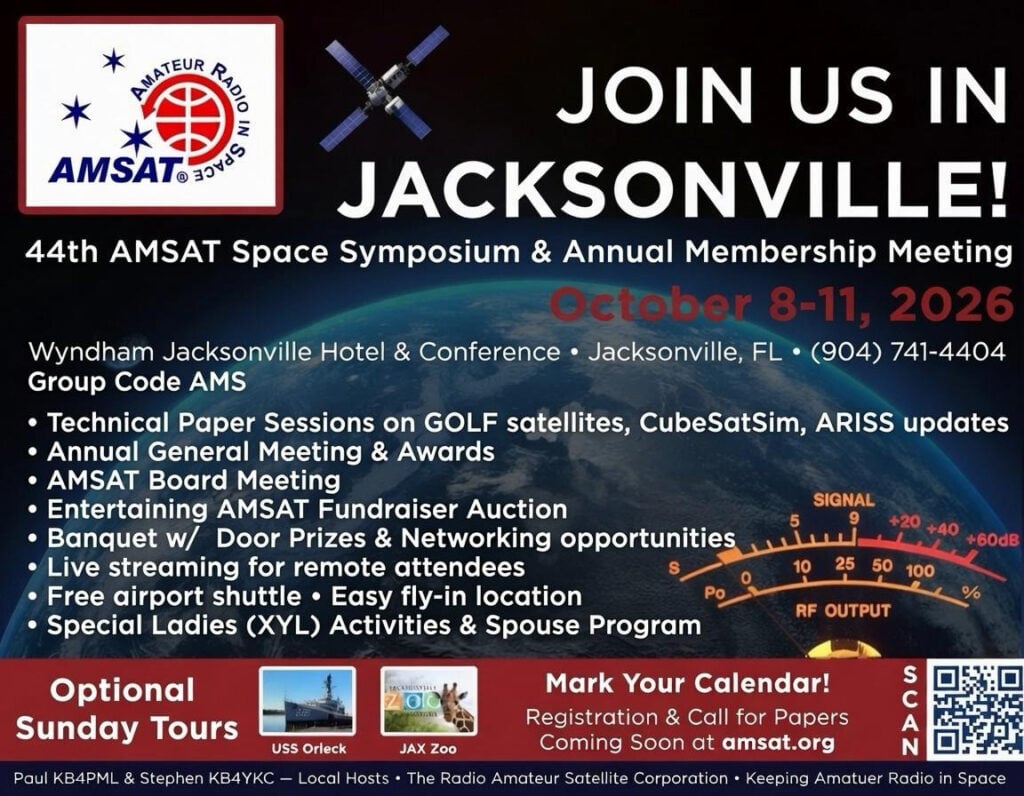
The 44th AMSAT Space Symposium and Annual General Meeting is now less than two weeks away, October 8-11, 2026, at the Wyndham Jacksonville Hotel & Conference Center in Jacksonville, Florida - the property formerly known as the Crowne Plaza Jacksonville Airport/I-95 - an easy fly-in location with a free airport shuttle.
Registration remains open at https://launch.amsat.org/event-6789663. Symposium registration is $90 and includes all presentation sessions, the Friday night social and auction, the Sunday morning AMSAT Members Breakfast, and a digital copy of the Symposium Proceedings; the Saturday banquet is $70, and an all-events package is available for $160.
The weekend opens with the AMSAT Board of Directors meeting on Thursday, October 8, continuing Friday morning, at which the Directors elected in the recently concluded election (see ANS-263) will take their seats. Symposium presentations begin Friday afternoon and continue through Saturday, capped by the Annual General Meeting at 3:00 p.m. Saturday and the evening banquet, complete with ham radio door prizes. Sunday brings the Members Breakfast and optional tours of the USS Orleck and the Jacksonville Zoo, with admission paid at the door. Live streaming will be available for members unable to attend in person.
Although AMSAT's group code has expired, attendees may still make direct hotel reservations at the Wyndham Jacksonville may be made through the booking link on the Symposium page at https://www.amsat.org/2026-amsat-symposium/ or by phone at 1-800-227-6963.
[ANS thanks ARRL and the Huntsville Hamfest for the above information]
It's August! Time is running out for the 2026 President's Club Coin!
Help Support GOLF and FoxPlus.
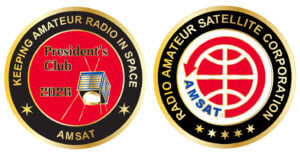
Annual memberships start at only $120
Join the AMSAT Presidentâs Club today and help Keep Amateur Radio in Space! https://www.amsat.org/join-the-amsat-presidents-club/
ARICA-2 Opens Amateur Message-Relay Mission September 29
The ARICA-2 CubeSat will begin the first full operational phase of its amateur radio mission on Tuesday, September 29, giving radio amateurs an opportunity to exchange messages through the spacecraft.
The Aoyama Gakuin University Sakamoto Laboratory announced September 24 that the mission will run from September 29 through October 13. ARICA-2 operates under the amateur radio call sign JS1YSD. For the first phase of the amateur mission, participants will be able to transmit messages to the spacecraft for subsequent relay.Â
Both uplink and downlink are on 436.830 MHz, using 4800 bps GMSK and AX.25. The university notes that transmitted data uses a mission-specific format. Detailed operating software, packet-format information, and a reception-report form are expected to be made available or updated on the ARICA-2 project website as the operating period approaches.
The message-relay experiment is the first of multiple planned amateur radio activities aboard ARICA-2. A later phase is expected to make images taken by the spacecraft available through the amateur radio system. The project continues to encourage reception reports from amateur satellite operators around the world.
Operators interested in taking part should watch the projectâs announcements for final operating instructions before transmitting.
[ANS thanks JAMSAT and the Aoyama Gakuin University Sakamoto Laboratory ARICA-2 team for the above information]
Â
Jim Hart, WD5GRW, Earns AMSAT Reverse VUCC Award #21
One hundred grids is the goal. Jim Hart, WD5GRW, kept driving. Bruce Paige, KK5DO, AMSAT Director of Contests and Awards, has announced that Jim has earned AMSAT Reverse VUCC (VUCC/r) Award #21, with confirmed satellite contacts made from 111 different Maidenhead grid squares other than his home grid. "That is a lot of driving," Bruce noted in announcing the award.
The Reverse VUCC turns the familiar ARRL VUCC award on its head. Where a fixed station earns VUCC by confirming contacts with 100 grids, a rover earns VUCC/r by making confirmed contacts from 100 grids, packing up the station and moving on after every activation. The award was created by the Central States VHF Society, through the efforts of Bill Wageman, K5MAT, to recognize the work rovers put into activating grids for everyone else, and AMSAT has administered the satellite version since September 2021. ARRL VUCC rules apply with a few exceptions, contacts dated January 1, 1983 or later qualify, QSL confirmations are required and verified by the program administrator, and each certificate carries a unique serial number, with endorsement stickers available above the basic 100-grid level.
Complete rules and application details for the Reverse VUCC Award are available at https://www.amsat.org/reverse-vucc-or-vucc-r-award/. Upcoming rover operations may be found, and publicized, at https://hams.at.
Congratulations, Jim. In Bruce's words, "Rovers Keep on Rov'in."
[ANS thanks Bruce Paige, KK5DO, AMSAT Director of Contests and Awards, for the above information]
Changes to AMSAT TLE Distribution for September 25, 2026
Two Line Elements or TLEs, often referred to as Keplerian elements or keps in the amateur community, are the inputs to the SGP4 standard mathematical model of spacecraft orbits used by most amateur tracking programs. Weekly updates are completely adequate for most amateur satellites. TLE bulletin files are updated daily in the first hour of the UTC day. New bulletin files will be posted immediately after reliable elements become available for new amateur satellites. More information may be found at https://www.amsat.org/keplerian-elements-resources/.
This week there are no additions or deletions to the AMSAT Keps distribution.
General Perturbations Data Support
AMSAT is pleased to announce that modern forms of what are called General Perturbations data are being disseminated via modern formats including JSON, XML and KVN at https://newark192.amsat.org/gpdata/current/. The reason this change is being made is that we are running out of 5-digit catalog numbers and the TLE format is not viable for satellites launched after July of this year. See https://celestrak.org/NORAD/documentation/gp-data-formats.php for details.
These data are presently considered in beta test for the next two months while hosted on the test server newark192.amsat.org, and we are very open to community feedback at webmaster at amsat.org. Testers may experience outages and errors while we make improvements. We intend to put this into production on our main web server in July as we expect that satellites launched after this summer will require one of the new formats to accommodate longer object numbers. AMSAT will continue to publish TLE bulletins for satellites launched before July 2026 indefinitely.
[ANS thanks Joe Fitzgerald, KM1P, AMSAT Orbital Elements Manager, for the above information]
Buying from DX Engineering?
Add AMSATâs Getting Started With Amateur Satellites to your order.
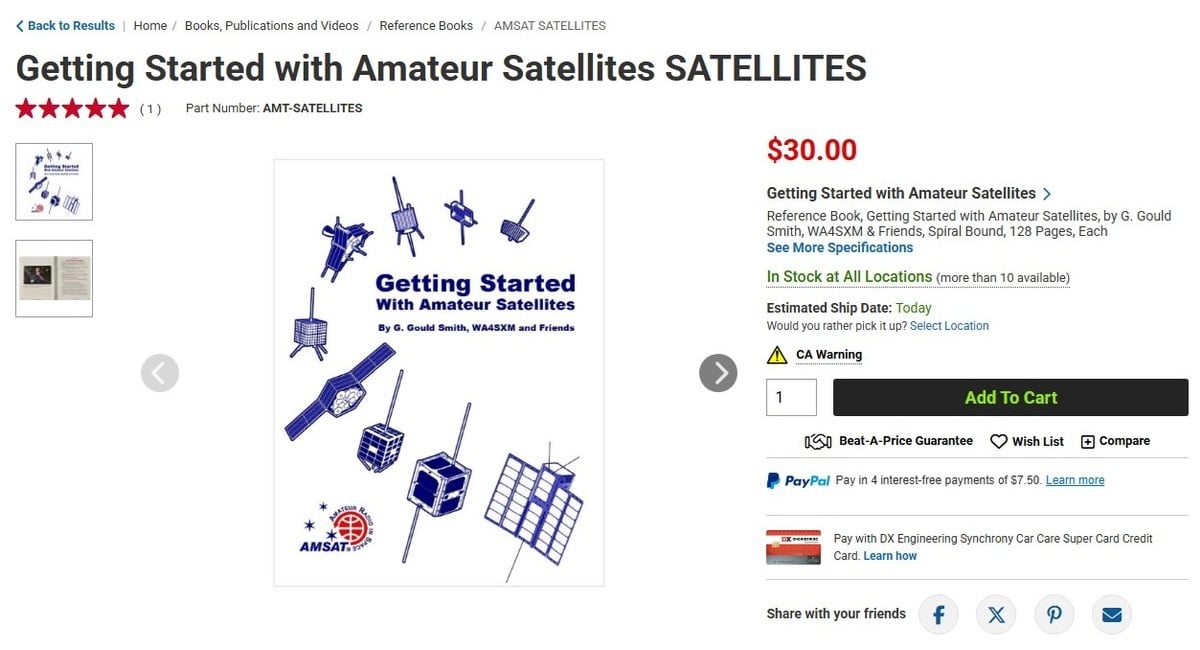
Available for $30 from DX Engineering (free shipping on most orders over $99)
https://www.dxengineering.com/parts/amt-satellites
ARISS News
Amateurs and others around the world may listen in on contacts between amateurs operating in schools and allowing students to interact with astronauts and cosmonauts aboard the International Space Station. The downlink frequency on which to listen is 145.800 MHz worldwide.
Scheduled Contacts
Liceo Bicentenario Mary Graham, ValparaÃso, Chile, direct via CE2CQÂ
The ISS callsign is presently scheduled to be NA1SSÂ
The scheduled crewmember is Jack Hathaway KJ5NIV Â
The ARISS mentor is VE3TBDÂ Â
Contact is go for: Mon 2026-09-28 12:24:10 UTC 48 deg
Scuola Media Pio X Artigianelli, Firenze, Italy, direct via IW5CWC, joint contact with Istituto Comprensivo Statale Rita Levi Montalcini Campolongo Maggiore e Campagna Lupia, Campolongo Maggiore - Venezia, Italy, direct via IQ3RW
The ISS callsign is presently scheduled to be OR4ISSÂ
The scheduled crewmember is Sophie Adenot KJ5LTN Â
The ARISS mentor is IKÃWGFÂ Â
Contact is go for: Tue 2026-09-29 10:28:57 UTC 27 deg
Watch for Livestream at:
Venezia: http://www.youtube.com/@SezioneARIRivieraDelBrenta
Firenze: https://www.youtube.com/@scuolepercrescere1068
City of Bolgar, Republic of Tatarstan, Russia direct via TBD
The ISS callsign is presently scheduled to be RSÃISSÂ
The scheduled crewmember is Anna Kikina
The ARISS mentor is RV3DRÂ Â Â
Contact is go for Wed 2026-09-30 11:25 UTC
Schedule of radio power downs and power ups
COL=Columbus module SM=Service Module HamTV is also known as Ham-Video
Mon 2026-09-28 12:20 UTC Â Â Â Â Ham-Video power up
Fri 2026-10-02 09:00 UTC     Expedition 75 - ARISS Series 33 Student Education SSTV Event start
Tue 2026-10-06 TBD UTC       Expedition 75 - ARISS Series 33 Student Education SSTV Event end
Frequency is 437.550 MHz (+/- Doppler)
Mode is Robot36Â
Transmission 36 seconds on 2 minutes off
The crossband repeater remains configured in the Columbus Module (145.990 MHz up {PL 67} & 437.800 MHz down). If a crewmember decides to pick up the microphone and turn up the volume, you may hear them on the airâso keep listening, as you never know when activity might occur.
Kenwood D710GA in the Zvezda Service Module â Call sign RSÃISS. Please note weâre still in the process of troubleshooting and testing this radio. APRS is currently active on 437.825 MHz. Feel free to check out status reports at https://ariss-usa.org/ARISS_APRS/.
Ham TV is currently transmitting a test signal at 2395.00 MHz.
Note, all times are approximate. It is recommended that you do your own orbital prediction or start listening about 10 minutes before the listed time.
The latest information on the operation mode can be found at https://www.ariss.org/current-status-of-iss-stations.html
The latest list of frequencies in use can be found at https://www.ariss.org/contact-the-iss.html
[ANS thanks Charlie Sufana, AJ9N, one of the ARISS operation team mentors for the above information]
Want to fly the colors on your own grid expedition? Get an AMSAT car flag and other neat stuff from our Zazzle store!
25% of the purchase price of each product goes towards Keeping Amateur Radio in Space
AMSAT Ambassador Activities
AMSAT Ambassadors provide presentations, demonstrate communicating through amateur satellites, and host information tables at club meetings, hamfests, conventions, maker faires, and other events.
Bored Net uExpo and ARRL Santa Barbara Section Convention - October 3, 2026
Cal State University Channel Islands
1 University Drive
Camarillo, CA 93010
https://www.theborednet.net/index.php/2026/06/22/2026-microexpo-is-on/
K6KH
Tucson Area Autumn Hamfest - October 3, 2026
Radio Society of Tucson
Immanuel Presbyterian Church
9252 East 22nd Street
Tucson, AZ
https://k7rst.club
N1UW
44th AMSAT Space Symposium and Annual Membership Meeting - October 8-11, 2026
Wyndham Jacksonville Hotel and Conference Center
14670 Duval Road
Jacksonville, FL 32218
https://www.amsat.org/2026-amsat-symposium/
Southern Arizona Fall Hamfest - November 14, 2026
Oro Valley Amateur Radio Club
Marana Middle School
11285 W. Grier Rd.
Marana, AZ
Interested in becoming an AMSAT Ambassador? AMSAT Ambassadors provide presentations, demonstrate communicating through amateur satellites, and host information tables at club meetings, hamfests, conventions, maker faires, and other events. For more information go to:Â https://www.amsat.org/ambassador/
[ANS thanks Bo Lowrey, W4FCL, Director â AMSAT Ambassador Program, for the above information]
REGISTRATION IS NOW OPEN
For the 44th AMSAT Space Symposium and Annual General Meeting, October 8-11, 2026, in Jacksonville!
https://launch.amsat.org/event-6789663
Satellite Shorts from All Over
+ Amateur Radio Newsline reports that students at India's Military College of Electronics and Mechanical Engineering have completed flight-ready builds of EagleSat A and EagleSat B, the pair of 1U CubeSats whose IARU coordination request was reported in ANS-214. Part of the first batch of India's 75 Student Satellites Mission, the EagleSats will each carry a real-time AX.25 digipeater with a 435.170 MHz uplink and 436.547 MHz downlink, command-activated Robot36 SSTV demonstrations, and a beacon on 436.645 MHz, with a launch planned aboard a Skyroot Vikram launch vehicle from Sriharikota. [ANS thanks Amateur Radio Newsline for the above information]
+ Papers for the second annual Zero Retries Digital Conference are due Monday, September 28, at 23:59 UTC. The one-day conference, which lists digital satellite communication among its topic areas, takes place Friday, October 16, in San Ramon, California, on the eve of Pacificon. Submission details and registration are at https://www.zeroretries.org/p/conference. [ANS thanks Zero Retries for the above information]
+ Jamboree on the Air and Jamboree on the Internet (JOTA-JOTI), the annual worldwide Scouting event promoting friendship and global citizenship via amateur radio and the internet, will be held October 16-18, 2026. Satellite demonstrations have long been a crowd favorite at JOTA stations - a handheld, an Arrow antenna, and a pass of an FM bird can introduce a whole troop to amateur radio in space in under fifteen minutes. Details are at https://www.jotajoti.info/. [ANS thanks ARRL for the above information]
+ Amateur Radio Daily's "DXing at Galactic Scale" (September 22) looks at a new testable hypothesis dubbed Behavioral SETI, which seeks to explain the apparent radio silence of the cosmos through the behavior of hypothetical civilizations rather than their absence - food for thought for anyone who has spent a long night listening to noise on a quiet band. Read it at https://daily.hamweekly.com/. [ANS thanks Amateur Radio Daily for the above information]
+ The next AMSAT Students on the Air activity day is Tuesday, October 6. StOTA encourages licensed student operators to make satellite contacts on the first and third Tuesdays of each month and asks the wider amateur satellite community to make a special effort to welcome young operators onto the satellites. Â [ANS thanks AMSAT for the above information]
Join AMSAT today at https://launch.amsat.org/
In addition to regular membership, AMSAT offers membership to:
- Societies (a recognized group, clubs or organization).
- Students are eligible for FREE membership up to age 25.
- Memberships are available for annual and lifetime terms.
Contact info [at] amsat.org for additional membership information.
73 and remember to help Keep Amateur Radio in Space!
This week's ANS Editor,
Paul Stoetzer, N8HM
n8hm [at] amsat.org
ANS is a service of AMSAT, the Radio Amateur Satellite Corporation, 712 H Street NE, Suite 1653, Washington, DC 20002. AMSAT is a registered trademark of the Radio Amateur Satellite Corporation.Â