AMSAT News Service
ANS-284
October 11, 2026
In this edition:
* AMSAT Board of Directors Re-Elects Senior Officers for 2027
* AMSAT Organizations Launch Six Satellites on Transporter-18
* KENSAT Showcases Individual-Built Amateur Radio CubeSat
* Google’s Project Suncatcher Begins Testing AI Computing in Orbit
* Blue Origin Unveils 65-Foot Solar Power Tower for Lunar Operations
* Augusta University Amateur Radio Club, WA4AUG, Earns AMSAT Rover Award
* Changes to AMSAT TLE Distribution for October 9, 2026
* ARISS News
* AMSAT Ambassador Activities
* Satellite Shorts from All Over
The AMSAT® News Service bulletins are a free, weekly news and information service of AMSAT, The Radio Amateur Satellite Corporation. ANS publishes news related to Amateur Radio in Space including
reports on the activities of a worldwide group of Amateur Radio operators who share an active interest in designing, building, launching and communicating through analog and digital Amateur Radio satellites.
The news feed on
https://www.amsat.org publishes news of Amateur Radio in Space as soon as our volunteers can post it.
Please send any amateur satellite news or reports to: ans-editor [at]
amsat.org
You can sign up for free e-mail delivery of the AMSAT News Service Bulletins via the ANS List; to join this list see:
https://mailman.amsat.org/postorius/lists/ans.amsat.org/
AMSAT Board of Directors Re-Elects Senior Officers for 2027
Meeting in Jacksonville, Florida, on Thursday, October 8, ahead of the 44th AMSAT Space Symposium and Annual General Meeting, the AMSAT Board of Directors re-elected the organization's senior officers
for the coming year.
Drew Glasbrenner, KO4MA, was re-elected President. Also returning are Paul Stoetzer, N8HM, as Executive Vice President; Mark Hammond, N8MH, as Vice President - Operations; Jerry Buxton, N0JY, as
Vice President - Engineering; Alan Johnston, KU2Y, as Vice President - Educational Relations; Frank Karnauskas, N1UW, as Vice President - Development; Steve Belter, N9IP, as Treasurer; and Douglas Tabor, N6UA, as Secretary.
The vote came at the first meeting of the Board following the 2026 Board of Directors election, in which members elected three Directors to seats expiring this year (see ANS-263). The Board now consists
of Jerry Buxton, N0JY; Drew Glasbrenner, KO4MA; Rich Gopstein, KD2CQ; Mark Hammond, N8MH; Frank Karnauskas, N1UW; Paul Stoetzer, N8HM; and Douglas Tabor, N6UA, with Bruce Paige, KK5DO, serving as First Alternate.
The re-elected team will lead AMSAT through a busy year, including continued development of the GOLF and Fox-Plus satellite programs, the CubeSatSim educational program, and the organization's partnership
with ARISS. The Board continued its meeting Friday morning before the Symposium's technical sessions began on Friday afternoon.
A complete list of AMSAT's officers, Directors, and senior volunteer leaders is available at
https://www.amsat.org/amsat-officers-and-board-members/.
[ANS thanks
Douglas Tabor, N6UA, AMSAT Secretary, for the above information]
AMSAT Organizations Launch Six Satellites on Transporter-18
Six satellites from three AMSAT organizations reached orbit following the launch of SpaceX’s Transporter-18 rideshare mission from Vandenberg Space Force Base in California on October 1. The international
group included three ERMINAZ-2 PocketQubes from AMSAT-DL in Germany, HADES-L and UNNE-1B from AMSAT-EA in Spain, and SanoSat-2 from AMSAT Nepal. The spacecraft traveled aboard OSSIE-D, the first orbital transfer vehicle developed by Spanish space transportation
company UARX Space. Following separation from the Falcon 9 upper stage, OSSIE-D began deploying its collection of small satellites, giving the worldwide AMSAT community a particularly strong presence on the mission.
AMSAT-DL’s ERMINAZ-2U, ERMINAZ-2V, and ERMINAZ-2X are 1P PocketQubes measuring just 5 cm on each side and were developed and prepared for flight at AMSAT-DL’s satellite laboratory at the Bochum Observatory.
The three educational spacecraft are intended to promote amateur radio and space technology through open-source communications, telemetry, and other experiments. ERMINAZ-2U transmits on 435.900 MHz, while ERMINAZ-2V and ERMINAZ-2X transmit on 145.920 MHz and
145.960 MHz, respectively. The trio traveled inside Libre Space Foundation’s open-source PICOBUS v2 PocketQube deployer aboard OSSIE-D. AMSAT-DL reported on October 5 that the ERMINAZ-2 satellites were transmitting their first signals, with receptions also
recorded through the worldwide SatNOGS ground station network.
AMSAT-EA contributed two satellites offering voice communication capabilities. UNNE-1B, also known as HADES-E2, carries a VHF-to-UHF FM/FSK repeater with a 145.925 MHz uplink and 436.888 MHz downlink.
The spacecraft also carries an Arduino-based educational experiment developed by Universidad Nebrija. HADES-L takes a more unusual approach, providing a 29.472 MHz USB uplink to a 436.665 MHz FM downlink, giving amateur operators an opportunity to experiment
with a 10-meter uplink. Because HADES-L carries only three solar panels, available power is limited and its repeater is designed to operate intermittently rather than continuously. The OSSIE-D payload deployment sequence began on October 2 at 11:48 UTC, earlier
than originally planned.

AMSAT Nepal’s five-centimeter SanoSat-2 PocketQube undergoes pre-launch testing ahead of its Transporter-18 mission. [Credit:
ORION Space Pvt. Ltd.]
AMSAT Nepal’s SanoSat-2, also known as UTNH-SAJILO-SAT, continues the work begun with SanoSat-1 and adds several capabilities intended specifically for participation by amateur radio operators. The
5 cm PocketQube carries a camera capable of transmitting images as SSDV packets using GFSK modulation, allowing amateurs to receive and reconstruct imagery from orbit. SanoSat-2 can also operate as a digital store-and-forward repeater through which amateur
operators can upload messages for later transmission. A six-axis inertial measurement unit and sun sensors will collect attitude data to support development of an active attitude determination and control system for a future mission. The spacecraft also transmits
Morse code identification, and its coordinated amateur downlink is on 436.650 MHz.
Libre Space Foundation also had a significant presence aboard OSSIE-D through its open-source PICOBUS v2 deployer. In addition to the three ERMINAZ-2 spacecraft and Kazakhstan’s NIS-PQ educational
satellite, PICOBUS carried four Libre Space SIDLOC PocketQubes designated SIDLOC-PQ-03 through SIDLOC-PQ-06. SIDLOC, short for Spacecraft Identification and Localization, is being developed by Libre Space Foundation and the Foundation for Research and Technology–Hellas
as an ESA-funded ARTES activity. The project is exploring an open standard for identifying and locating spacecraft, while PICOBUS itself demonstrates an open-source approach to deploying very small satellites. Together, the eight PocketQubes aboard PICOBUS
represented another demonstration of the open hardware and software ecosystem Libre Space has developed around small-satellite missions and its SatNOGS network.
Transporter-18 carried an unusually broad collection of spacecraft of interest to the amateur satellite community. In addition to the six satellites from AMSAT-DL, AMSAT-EA, and AMSAT Nepal, IARU-coordinated
amateur spacecraft aboard the mission included GUARANISAT-2 from the Paraguayan Space Agency, KENSAT from Swordholder Technologies, and SPRITE from the University of Colorado Boulder. The launch therefore placed at least nine IARU-coordinated amateur satellites
into orbit while also carrying Libre Space’s four SIDLOC technology demonstrators. With spacecraft representing AMSAT organizations in Europe and Asia, university and educational projects, independent amateur development, and open-source space technology,
Transporter-18 provided a particularly diverse addition to the growing amateur satellite fleet.
[ANS thanks
AMSAT-DL, AMSAT-EA,
AMSAT-NP, and Libre Space Foundation for the above information]
KENSAT Showcases Individual-Built Amateur Radio CubeSat
KENSAT, a 2U CubeSat developed by Malaysian radio amateur Guan Hao Chan, KO6IKZ, was launched aboard SpaceX’s Transporter-18 rideshare mission on October 1. The spacecraft represents an unusual achievement
in the CubeSat community, with Chan describing KENSAT as an end-to-end project developed largely by a single individual. “Everything from the satellite hardware, firmware, and ground software is the product of an individual,” Chan wrote following the launch.
While he credited several organizations and individuals with helping bring the project to space, Chan designed and developed the spacecraft and its supporting systems himself.
The project began as an effort to demonstrate how increasingly accessible satellite technology and launch opportunities can allow individuals to undertake projects once limited primarily to governments,
universities, and large organizations. Chan has described KENSAT as the first Malaysian satellite built and launched by a private individual and, to his knowledge, the first CubeSat developed end-to-end by an individual. The completed spacecraft was integrated
into an Exolaunch deployer ahead of Transporter-18, and Chan subsequently reported successful separation of KENSAT following the October 1 launch.
KENSAT also carries an unusual artificial-intelligence experiment. An NVIDIA Jetson Orin Nano computer aboard the spacecraft is intended to run a large language model and perform AI inference in
space. The satellite's primary PIC24 flight computer remains powered continuously while the considerably more power-hungry Jetson is normally switched off. When an AI inference is requested, the flight computer powers the Jetson, waits for it to boot, sends
a prompt to it over a serial connection, receives the generated response, and then powers the Jetson down again. Results can subsequently be transmitted to stations on the ground.

Ken, KO6IKZ, stands with the Exolaunch deployer carrying his KENSAT 2U CubeSat ahead of launch. (Awesome job, Ken!) [Credit:
Guan Hao Chan]
Amateur radio is an integral part of the KENSAT mission. The International Amateur Radio Union (IARU) coordinated a 437.080 MHz UHF downlink for the spacecraft on October 7, 2025. KENSAT uses the
amateur radio call sign KO6IKZ and is intended to transmit spacecraft telemetry and experimental data, including results from its onboard AI system, for reception by radio amateurs. Mission documentation describes the downlink as using GFSK modulation with
AX.25/G3RUH framing. Telemetry formats and decoding information are being made publicly available so amateur operators can receive, decode, analyze, and share KENSAT data.
In keeping with that open approach, Chan released the KENSAT project publicly on GitHub in June 2026. The repository includes spacecraft firmware, electrical schematics, printed circuit board designs,
ground-station software, and documentation covering many of the satellite's subsystems. The material provides an unusually detailed look inside a privately developed CubeSat and gives other experimenters an opportunity to study both the spacecraft and its
ground infrastructure. Chan said his goal in releasing the project was to make the technology accessible to anyone interested in learning how a satellite can be designed, built, and operated.
Following KENSAT's deployment, Chan reflected on how rapidly access to space has changed. He noted that an individually developed satellite would have been extraordinarily difficult only a few years
ago and said he hopes projects such as KENSAT eventually make building and launching a satellite achievable even for young experimenters. For the amateur radio community, KENSAT offers both an opportunity to follow an unusual independently developed spacecraft
and, as commissioning progresses, to listen for its IARU-coordinated UHF transmissions.
### For More Information
KENSAT project website:
https://www.kensat.com/
KENSAT open-source GitHub repository:
https://github.com/kenchangh/kensat
KENSAT entry in the SatNOGS Database:
https://db.satnogs.org/satellite/VIOO-5580-9038-4016-1832/
[ANS thanks
Guan Hao Chan, KO6IKZ, for the above information]
The 2026 Coins Are Here! Help Support GOLF-TEE and Fox-Plus.
Annual memberships start at only $120.
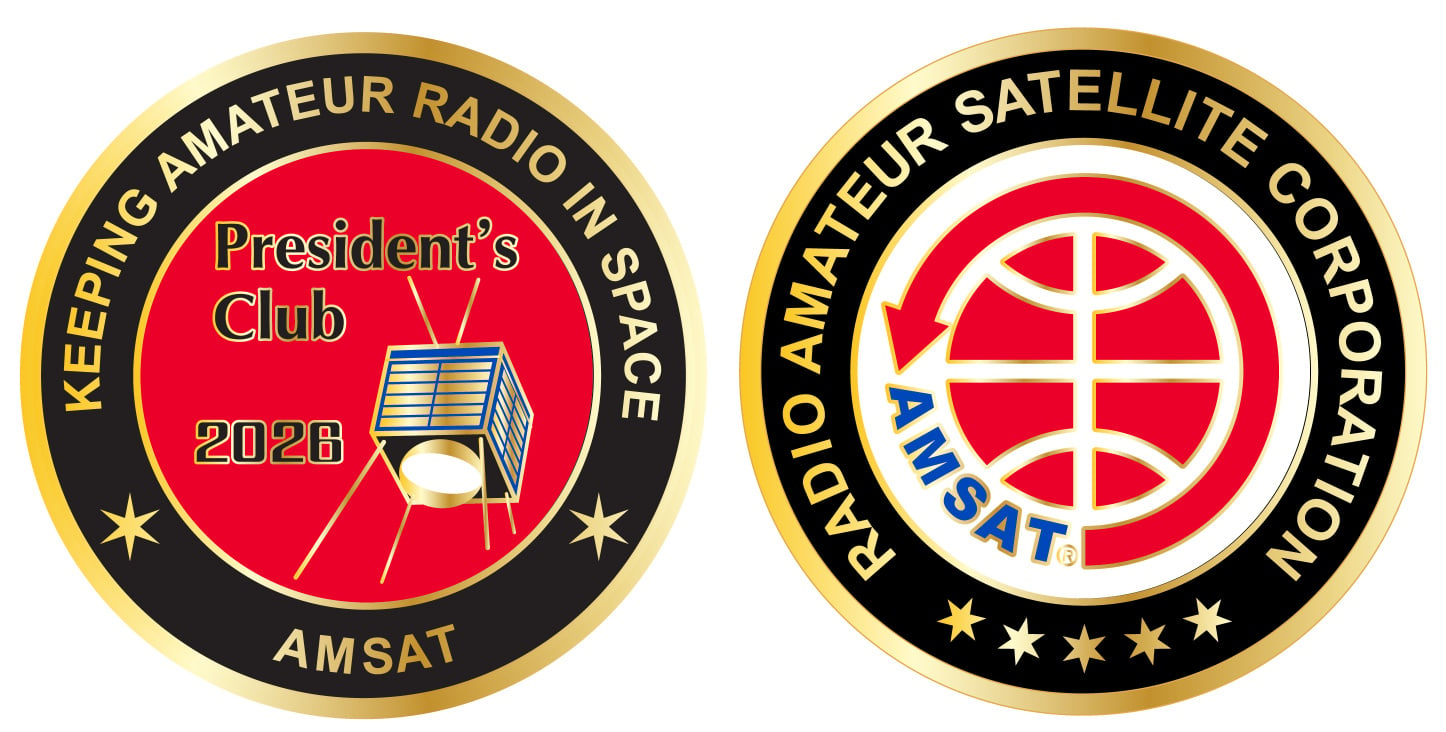
Join the AMSAT President's Club today and help Keep Amateur Radio in Space!
https://www.amsat.org/join-the-amsat-presidents-club/
Google’s Project Suncatcher Begins Testing AI Computing in Orbit
Google has taken its first step toward testing whether artificial intelligence computing could someday move beyond terrestrial data centers and into space. A refrigerator-sized satellite called MVP
reached low-Earth orbit on October 1 aboard SpaceX’s Transporter-18 rideshare mission from Vandenberg Space Force Base in California. The spacecraft is the first real-world test of Project Suncatcher, Google’s research effort exploring whether solar-powered
satellites carrying artificial intelligence hardware could eventually support large-scale computing in orbit. Rather than demonstrating a functioning orbital data center, MVP is deliberately modest, with Google describing the spacecraft as a minimal test intended
to answer some of the basic engineering questions behind the concept.
MVP carries four of Google’s Tensor Processing Units, or TPUs, specialized processors developed to accelerate artificial intelligence and machine-learning workloads. Together, the four processors
provide computing capability roughly comparable to a single data-center server, making the spacecraft far smaller than the thousands of interconnected processors used in terrestrial AI facilities. The primary objective is to determine whether the processors
can survive launch vibration and continue operating reliably amid the radiation and other environmental challenges encountered in low-Earth orbit. The experiment will provide Google with real-world data before the company attempts more ambitious demonstrations.
The motivation behind Project Suncatcher is the enormous amount of electrical power required by increasingly large AI computing systems. Google’s long-term concept would place computing hardware
where abundant solar energy is directly available, potentially reducing dependence on terrestrial electrical grids and the infrastructure required to supply large data centers. The idea differs from traditional space-based solar power proposals, which envisioned
collecting energy in orbit and transmitting it to Earth. Instead, Suncatcher would perform the computing in space and transmit the resulting data back to users on the ground.

Google and Planet are developing two Project Suncatcher demonstration satellites based on Planet’s Owl satellite platform. [Credit:
Planet]
One of the largest technical challenges will be connecting processors distributed among multiple spacecraft. Google envisions using free-space optical communications, employing laser links between
satellites rather than conventional radio links. Large AI systems require enormous amounts of data to move rapidly between processors, something accomplished in terrestrial data centers through short fiber and copper connections. SpaceX has already demonstrated
that inter-satellite laser communications can operate across large constellations with Starlink, but Project Suncatcher would need optical links capable of supporting the particularly demanding communication requirements of tightly interconnected AI processors.
The space environment presents other significant challenges. Commercial AI processors were not originally designed for long-term exposure to space radiation, where energetic particles can corrupt
data or eventually damage electronic components. Thermal management is another concern because spacecraft cannot use conventional air cooling and must ultimately radiate excess heat into space. Any future orbital computing constellation would also need to
operate reliably for long periods without the routine repairs and hardware replacements possible inside terrestrial data centers. MVP is intended to begin determining whether these obstacles can be overcome before Google commits to substantially larger systems.
Google has already identified a more ambitious follow-on experiment. The next Project Suncatcher milestone is expected to involve two prototype satellites developed in cooperation with Planet, allowing
researchers to explore technologies needed for multiple computing spacecraft to operate together. Ultimately, Google’s concept could involve clusters of solar-powered satellites linked optically to create distributed computing systems in orbit, although the
company has not announced plans for an operational constellation. For now, MVP represents a much smaller first step: placing four AI processors in space and determining whether the fundamental hardware can survive and operate there.
Read the full article at:
https://shattered.io/google-suncatcher-planet-2-satellites-2027-2026/
[ANS thanks Marcus Bell,
Shattered.io, for the above information]
Blue Origin Unveils 65-Foot Solar Power Tower for Lunar Operations
Blue Origin has unveiled a towering solar power system designed to help provide electricity for future operations near the Moon's south pole. Called the Power Tower, the vertically deployed solar
array stands approximately 20 meters (65 feet) tall and is designed to generate more than 10 kilowatts of electrical power. The company envisions the system supporting future lunar surface infrastructure, where reliable electrical power will be needed for
scientific instruments, communications equipment, rovers, thermal control systems and eventually crewed facilities.
Generating solar power near the lunar south pole presents challenges unlike those encountered by conventional solar installations on Earth. The Sun remains low on the horizon in the polar regions,
while crater rims, ridges and other terrain can cast long shadows across nearby areas. By raising its solar arrays high above the lunar surface, the Power Tower is designed to reach sunlight that could otherwise be blocked by surrounding terrain. The vertical
arrangement also reduces the amount of valuable surface area occupied by the power system.
Blue Origin released an animation showing how the system could deploy after reaching the lunar surface. A central mast extends vertically from its base before supporting structures unfold to deploy
the solar arrays. The company has also demonstrated deployment hardware on Earth, including a successful test conducted earlier this year. Blue Origin says the system's modular architecture could eventually distribute electricity beyond the lander itself,
allowing multiple surface assets to draw power as part of a larger lunar power network.

Blue Origin’s 20-meter-tall Power Tower could provide more than 10 kilowatts of power for future lunar surface operations. [Credit:
Blue Origin]
Technology behind the Power Tower builds on work performed by Honeybee Robotics, a Blue Origin company, on the Lunar Array Mast and Power System, or LAMPS. Developed through NASA's Vertical Solar
Array Technology program, LAMPS uses a deployable mast and flexible solar arrays that can rotate to track the Sun. In 2024, Honeybee successfully completed thermal-vacuum testing of the 20-meter system at NASA's Johnson Space Center in Houston. The prototype
was designed to produce up to 10 kilowatts of continuous power and collapse into a package roughly the size of a refrigerator for transportation.
Vertical solar arrays could become particularly valuable as NASA and its commercial partners develop infrastructure near the lunar south pole. NASA is working with companies including Blue Origin,
Firefly Aerospace, Intuitive Machines and Voyager Lunar Systems on cargo landers and other systems intended to establish the foundation for sustained lunar operations. Blue Origin's Blue Moon Mark 1 cargo lander is among the vehicles being developed to deliver
science, technology and infrastructure to the region.
For now, the Power Tower remains a developing technology rather than an operational lunar power system, and Blue Origin has not announced when the system will first be deployed on the Moon. Nevertheless,
the project illustrates how lunar exploration is beginning to move beyond the challenge of simply reaching the Moon toward the infrastructure needed to remain there. Reliable power generation and distribution will be essential to that transition, and towering
solar arrays may eventually become part of the landscape of sustained operations near the lunar south pole.
Read the full article at:
https://www.techspot.com/news/114093-blue-origin-reveals-65-foot-solar-tower-designed.html
[ANS thanks Skye Jacobs,
TechSpot, for the above information]
Augusta University Amateur Radio Club, WA4AUG, Earns AMSAT Rover Award
The AMSAT Rover Award has gone to the head of the class. Bruce Paige, KK5DO, AMSAT Director of Contests and Awards, has announced that AMSAT Rover Award #97 has been earned by the Augusta University
Amateur Radio Club, WA4AUG, of Augusta, Georgia - with the points racked up by the club's professor, Anthony, NR1Z, who took the club callsign on the road to activate grid squares for satellite operators.
It is a welcome twist on the usual rover story. The Rover Award is issued to the station that makes the contacts, so a club callsign operating from a sought-after grid earns credit just as an individual's
does - and in this case, a faculty member chose to spend his roving miles building up the club's award rather than his own. Founded by students in 2019, the Augusta University club has spent the years since introducing a campus to amateur radio; now its callsign
is in the logs of grid chasers across the eastern United States, and a university station has a satellite award on the wall to show new members what the hobby can do.
The Rover Award recognizes operators who take their satellite stations on the road, and is granted upon accumulating 25 points from grid squares activated outside the rover's home grid: one point
per grid via a single-channel FM transponder, two points via a linear SSB/CW transponder, and three points via a digital transponder, with a bonus point for each grid activated in a state, province, or DX entity other than the rover's own. Five-point bonuses
reward publicizing an activation at least 24 hours in advance - by tagging @amsat or #amsat on social media, or via the AMSAT-BB or this bulletin - and posting photos of the operation afterward, while activating a grid maritime mobile is worth ten points and
a /MM endorsement on the certificate.
Award #97 continues a remarkable run at the AMSAT awards desk: it is the fifth Rover Award issued since August, following recipients in Brazil, the United Kingdom, Colombia, and Wisconsin by way
of Hawaii. In announcing the award, Paige offered his congratulations along with his customary encouragement to rovers everywhere to keep on rovin'.
College and university clubs looking to follow Augusta's lead will find complete rules and application details for the AMSAT Rover Award at
https://www.amsat.org/amsat-rover-award/, and upcoming rover operations may be found - and publicized - at
https://hams.at.
Congratulations to Anthony and the Augusta University Amateur Radio Club!
[ANS thanks
Bruce Paige, KK5DO, AMSAT Director of Contests and Awards, for the above information]
Give Your Next Rove a Payload — Put Your Lunch into Orbit!
Pack the rover dogs and hit the grid line with an all-new
AMSAT Round Logo Metal Lunchbox.
Keep Amateur Radio in Space — and your lunch in the box!
https://www.zazzle.com/amsat_round_logo_metal_lunchbox-256761530568368967
Changes to AMSAT TLE Distribution for October 9, 2026
Two Line Elements or TLEs, often referred to as Keplerian elements or keps in the amateur community, are the inputs to the SGP4 standard mathematical model of spacecraft orbits used by most amateur
tracking programs. Weekly updates are completely adequate for most amateur satellites. TLE bulletin files are updated daily in the first hour of the UTC day. New bulletin files will be posted immediately after reliable elements become available for new amateur
satellites. More information may be found at https://www.amsat.org/keplerian-elements-resources/.
This week there are no additions or deletions to the AMSAT TLE distribution.
General Perturbations Data Support
AMSAT is pleased to announce that modern forms of what are called General Perturbations data are being disseminated via modern formats including JSON, XML and KVN at
https://newark192.amsat.org/gpdata/current/. The reason this change is being made is that we are running out of 5-digit catalog numbers and the TLE format is not viable for satellites launched after
July of this year. See
https://celestrak.org/NORAD/documentation/gp-data-formats.php for details.
These data are presently considered in beta test for the next two months while hosted on the test server
newark192.amsat.org, and we are very open to community feedback at webmaster [at]
amsat.org. Testers may experience outages and errors while we make improvements. We intend to put this into production on our main web server in July as we expect that satellites launched after this summer will require one of
the new formats to accommodate longer object numbers. AMSAT will continue to publish TLE bulletins for satellites launched before July 2026 indefinitely.
[ANS thanks Joe Fitzgerald, KM1P, AMSAT Orbital Elements Manager, for the above information]
ARISS News
Amateurs and others around the world may listen in on contacts between amateurs operating in schools and allowing students to interact with astronauts and cosmonauts aboard the International Space
Station. The downlink frequency on which to listen is 145.800 MHz worldwide.
Scheduled Contacts
+ Recently Completed
University Heights School of Medical Arts, Jonesboro, AR, telebridge via IK1SLD
The ISS callsign was OR4ISS
The crewmember was Joshua Kutryk KJ5BFU
The ARISS mentor was AJ9N
Contact was successful: Mon 2026-10-05 15:30:13 UTC
Congratulations to the University Heights School of Medical Arts, Joshua, mentor AJ9N, and telebridge station IK1SLD!
This was Joshua’s first ever ARISS contact.
Watch the livestream at https://live.ariss.org/
Wick High School, Wick, United Kingdom, direct via GB4WHS
The ISS callsign was NA1SS
The crewmember was Joshua Kutryk KJ5BFU
The ARISS mentor was MÃXTD
Contact was successful: Thu 2026-10-08 11:30 UTC
Congratulations to Wick High School, Joshua, mentor MÃXTD, and direct station GB4WHS!
+ Upcoming Contacts
EcoTarium, Worcester, MA telebridge via AB1OC
The ISS callsign is presently scheduled to be TBD
The scheduled crewmember is Luke Delaney KJ5PPF
The ARISS mentor is AB1OC
Contact is go for: Thu 2026-10-15 15:25:33 UTC
Watch for Livestream at https://youtube.com/live/F04UKyV1LIA
Ecole Internationale PACA de Manosque, Manosque, France, direct via F4KKM
The ISS callsign is presently scheduled to be OR4ISS
The scheduled crewmember is Joshua Kutryk KJ5BFU
The ARISS mentor is F6ICS
Contact is go for: Fri 2026-10-16 11:37:19 UTC
Many times, a school makes a last-minute decision to do a Livestream or runs into a last-minute glitch requiring a change of the URL, but we at ARISS may not get the URL in time for publication.
You can always check https://live.ariss.org/ to see if a school is Livestreaming.
As always, if there is an EVA, a docking, or an undocking; the ARISS radios are turned off as part of the safety protocol.
The crossband repeater remains configured in the Columbus Module (145.990 MHz up {PL 67} & 437.800 MHz down). If a crewmember decides to pick up the microphone and turn up the volume, you may hear
them on the air—so keep listening, as you never know when activity might occur.
Kenwood D710GA in the Zvezda Service Module - Call sign RS0ISS. Please note we're still in the process of troubleshooting and testing this radio. APRS is currently active on 437.825 MHz. Feel free
to check out status reports at https://ariss-usa.org/ARISS_APRS/.
HamTV in the Columbus Module (2395.00 MHz) is currently transmitting a test signal. For more information, visit the ARISS Ham TV Live site at
https://live.ariss.org/hamtv/.
Note, all times are approximate. It is recommended that you do your own orbital prediction or start listening about 10 minutes before the listed time.
The latest information on the operation mode can be found at https://www.ariss.org/current-status-of-iss-stations.html
The latest list of frequencies in use can be found at https://www.ariss.org/contact-the-iss.html
[ANS thanks Charlie Sufana, AJ9N, one of the ARISS operation team mentors for the above information]
AMSAT Ambassador Activities
AMSAT Ambassadors provide presentations, demonstrate communicating through amateur satellites, and host information tables at club meetings, hamfests, conventions, maker faires, and other events.
AMSAT Ambassador Clint Bradford, K6LCS, says,
“I have three satellite presentations lined up for this month …
#196 Oregon
#197 Central California
#198 Boston
Didn’t think I was going to hit TWO HUNDRED before the holidays, but …
Think a 75-minute presentation on 'working the easy satellites' would be appropriate for your club or event? Let me know by emailing me at k6lcsclint [at] gmail [dot] com or calling me at 909-999-SATS
(7287)!”
Clint has NEVER given the exact same show twice: EACH of the 150+ presentations so far has been customized/tailored to their audiences.
Scheduled Events
Southern Arizona Fall Hamfest - November 14, 2026
Oro Valley Amateur Radio Club
Marana Middle School
11285 W. Grier Rd.
Marana AZ
www.tucsonhamradio.org/hamfest
N1UW
For more information go to:
https://www.amsat.org/ambassador/
[ANS thanks Bo Lowrey, W4FCL, Director – AMSAT Ambassador Program, for the above information]
Buying from DX Engineering?
Add AMSAT’s Getting Started With Amateur Satellites to your order.
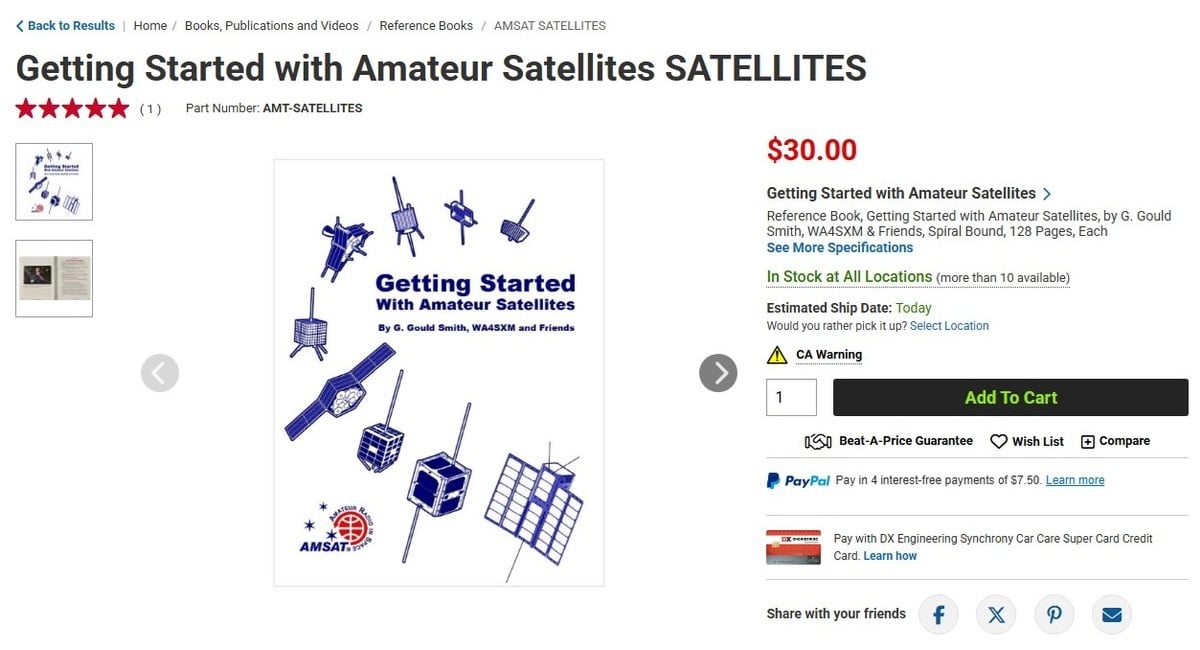
Available for $30 from DX Engineering (free shipping on most orders over $99)
https://www.dxengineering.com/parts/amt-satellites
Satellite Shorts from All Over
+ Orbital Space is conducting a special activation of the QMR-KWT-2 (RS95S) amateur radio FM voice repeater on October 10–11, 2026, in celebration of World Space Week. The satellite, a 1U CubeSat
launched aboard a Russian Soyuz-2.1b rocket on December 28, 2025, carries an Earth-imaging camera and an amateur radio FM repeater. QMR-KWT-2 follows Kuwait's first satellite, QMR-KWT, which launched in 2021, and continues the project's emphasis on amateur
radio communications and educational outreach. During the special activation, amateur radio operators can access the satellite's FM repeater using an uplink frequency of 145.920 MHz with a 67.0 Hz CTCSS tone and a downlink frequency of 436.950 MHz. The satellite
also supports telemetry reception and slow-scan television (SSTV) image transmissions, providing additional opportunities for amateur radio operators and students to participate in satellite communications. The two-day event offers satellite enthusiasts an
opportunity to make contacts through the spacecraft while celebrating the role of space technology in connecting people around the world. (ANS thanks
Orbital Space for the above information)
+ NASA’s SpaceX Crew-13 mission arrived at the International Space Station on October 1, completing the fastest launch-to-docking flight by a U.S. spacecraft in the station’s history. The Dragon
spacecraft docked with the orbiting laboratory just 7 hours and 55 minutes after launching from Cape Canaveral Space Force Station in Florida. NASA astronauts Jessica Watkins and Luke Delaney, Canadian Space Agency astronaut Joshua Kutryk, and Roscosmos cosmonaut
Sergey Teteryatnikov joined Expedition 75 for a six-month mission aboard the station. Their arrival allowed the outgoing Crew-12 astronauts to complete their mission handover and prepare for their return to Earth. NASA astronauts Jessica Meir and Jack Hathaway,
ESA astronaut Sophie Adenot, and Roscosmos cosmonaut Andrey Fedyaev undocked aboard their Dragon spacecraft on October 7. Crew-12 successfully splashed down in the Pacific Ocean off the California coast on October 8, completing a 237-day mission in space.
(ANS thanks NASA for the above information)
+ ESA’s Jupiter Icy Moons Explorer (Juice) completed a close Earth flyby on September 28, using the planet’s gravity to refine its trajectory toward Jupiter while conserving spacecraft propellant.
Juice passed just 8,640 km (5,369 miles) above the Indian Ocean at 11:45 UTC, with the gravity assist deflecting its trajectory by 20 degrees and increasing its velocity by 3.5 km/s (7,830 mph). Precise navigation allowed controllers to use only one small
trajectory correction during the four weeks leading up to the encounter, despite six correction opportunities having been reserved. The flyby also provided an opportunity to calibrate several of Juice’s ten science instruments, while the spacecraft spent several
days traversing Earth’s magnetotail and measuring magnetic fields and charged particles. Juice will return to Earth for one final gravity assist in January 2029, placing the spacecraft on its final trajectory for arrival at Jupiter in 2031. Once there, the
spacecraft will conduct 35 flybys of the ocean-bearing moons Ganymede, Callisto, and Europa before ultimately entering orbit around Ganymede. (ANS thanks
ESA for the above information)
+ Margaret Hamilton, the pioneering computer scientist who led development of NASA's Apollo flight software at the Massachusetts Institute of Technology (MIT), died September 30 at age 90. Joining
MIT's Instrumentation Laboratory in 1965, Hamilton eventually led teams responsible for developing the onboard guidance software used by the Apollo Command and Service Module and Lunar Module spacecraft. Her most famous contribution came during the Apollo
11 lunar landing in July 1969, when the Lunar Module's guidance computer triggered several program alarms as astronauts Neil Armstrong and Buzz Aldrin approached the Moon's surface. The priority-driven software developed by Hamilton's team allowed the computer
to shed less important tasks while continuing the critical calculations needed for a safe landing. Hamilton helped establish software engineering as a recognized discipline, emphasizing error prevention, fault tolerance, and reliable operation in mission-critical
systems. Her contributions earned numerous honors, including NASA's Exceptional Space Act Award in 2003 and the Presidential Medal of Freedom in 2016. (ANS thanks
MIT News for the above information)
+ The U.S. Department of War’s Defense Innovation Unit (DIU) and Honeywell Aerospace have successfully demonstrated a quantum magnetic navigation system that allowed an aircraft to navigate for more
than four hours without relying on GPS. The MagNav system uses quantum sensors to measure subtle variations in Earth’s natural magnetic field, comparing those signatures with magnetic maps to determine the aircraft’s position without signals from navigation
satellites. Installed aboard an Embraer 170, the system was tested on a flight over the Pacific Ocean from the Seattle area to southern Alaska and back, operating without GPS for four hours and 23 minutes. DIU reported that MagNav improved position accuracy
by 89% compared with traditional backup navigation methods, with navigation information streamed directly to the pilots in real time using standard tablets. Because Earth’s magnetic signatures cannot be jammed or spoofed like satellite signals, the technology
could provide an important navigation backup for military and civilian aircraft operating where GPS is unavailable or deliberately disrupted. Honeywell and DIU plan to demonstrate the technology aboard a U.S. military C-17 Globemaster III cargo aircraft later
this year. (ANS thanks the Defense Innovation Unit for the above information)
Join AMSAT today at
https://launch.amsat.org/
In addition to regular membership, AMSAT offers membership to:
-
Societies (recognized groups, clubs or organization).
-
Students enrolled in at least half-time status are eligible for free membership to age 25.
-
Memberships are available for annual and lifetime terms.
Contact info [at]
amsat.org for additional membership information.
73 and remember to help Keep Amateur Radio in Space!
This week's ANS Editor,
Mitch Ahrenstorff, ADÃHJ
mahrenstorff [at]
amsat.org
ANS is a service of AMSAT, the Radio Amateur Satellite Corporation, 712 H Street NE, Suite 1653, Washington, DC 20002
AMSAT is a registered trademark of the Radio Amateur Satellite Corporation.