AMSAT News Service
ANS-298
October 25, 2026
In this edition:
* AMSAT Youth Initiative Featured in Florida News
* ERMINAZ-2 Satellites Receive OSCAR Numbers
* Where Does Space Begin?
* Falcon 9 Launches Bandwagon-5 Rideshare Mission
* Greek-Built Satellite Launched for Kazakh School
* San Diego Balloon Launch Draws in High School Students
* OsTrax Now Available for Windows, macOS, and Ubuntu
* Changes to AMSAT TLE Distribution for Oct. 23, 2026
* ARISS SSTV Event in Progress
* ARISS News
* AMSAT Ambassador Activities
* Satellite Shorts from All Over
The AMSAT® News Service bulletins are a free, weekly news and information service of AMSAT, The Radio Amateur Satellite Corporation.
ANS publishes news related to Amateur Radio in Space including reports on the activities of a worldwide group of Amateur Radio operators who share an active interest in designing, building, launching and communicating through analog and digital Amateur Radio satellites.
The news feed on https://www.amsat.org publishes news of Amateur Radio in Space as soon as our volunteers can post it.
Please send any amateur satellite news or reports to: ans-editor [at] amsat.org
You can sign up for free e-mail delivery of the AMSAT News Service Bulletins via the ANS List; to join this list see: https://mailman.amsat.org/postorius/lists/ans.amsat.org/
AMSAT Youth Initiative Featured in Florida NewsÂ
The following article was published in the Main Street Daily News of Gainesville, Florida on October 12, 2026 under the headline, â2 Alachua County schools develop student-built technology to communicate with satellitesâ:
Two Alachua County schools are developing hands-on science, technology, engineering and mathematics (STEM) programs that could give students the opportunity to communicate with satellites orbiting Earth and, potentially, astronauts aboard the International Space Station (ISS).
At the 44th annual conference of the Radio Amateur Satellite Corporation (AMSAT), held in Jacksonville, local educator Gordon Gibby presented the schoolsâ efforts on Oct. 9, according to a North Florida Amateur Radio Club (NFARC) press release. Students at Gainesville Christian Community School (GCCS) and The Rock School are learning the technical skills needed to build satellite-tracking systems and establish radio communications with spacecraft.

Frank Karnauskas, N1UW, AMSAT Vice President â Development, who heads up the youth educational initiatives, giving a talk about their free available materials for youth.
(Photo courtesy of the North Florida Amateur Radio Club.)
AMSAT is a nonprofit, volunteer organization dedicated to advancing amateur radio satellite technology and education. Its resources and activities help make satellite communications a practical learning opportunity for students.
Gainesville Christian Community School Expands Technology Curriculum
At GCCS, mathematics teacher John Seppala is teaching a class of 16 students, primarily at the middle-school level, using a textbook developed by the school that covers a broad range of practical technologies.
The curriculum explores systems and skills used to maintain a home and vehicle, including electricity, electronics, 3D printing, small engines, plumbing, amateur radio and computers.
Seppala is preparing to take the multiple-choice examination required to obtain his Federal Communications Commission (FCC) amateur radio license. Many of his students are expected to pursue licenses as well, potentially allowing them to participate in radio communications experiments and satellite operations.
The Rock School Students Build Satellite-Tracking Station
At The Rock School, 10 high school students have formed an Amateur Radio Satellite Club. Organized into six overlapping teams, the students are developing a robotic antenna-control system and radio station designed to track and communicate with low-Earth-orbit satellites and the ISS.
The project combines electronics, mechanical engineering, computer programming and fabrication. Students are assembling a robotic control board, learning to solder electronic components and preparing to use a 3D printer to manufacture gears for the antennaâs elevation and rotation mechanism.
Future steps include building the antenna support system with aluminum masts, U-bolts and high-gain antennas. Students are also studying independently for the FCC examinations required to obtain amateur radio licenses.
âThis is exciting!â said Lacy Basford, the schoolâs academic adviser, in the release.
Rather than purchasing a commercial antenna-rotator controller, students plan to build their own system using an Arduino Nano microcomputer and a custom-designed printed circuit board. They will adapt open-source software written by a U.S. amateur radio operator, manufacture mechanical components and assemble the system themselves.
The project will bring together mathematics, electronics, software and mechanical design, allowing students to see how those disciplines work together in a functioning system.
Potential Opportunity to Communicate With Astronauts
Gibby hopes both schools will eventually be ready to apply to host a scheduled radio contact through Amateur Radio on the International Space Station (ARISS), an international educational initiative that connects students with astronauts through amateur radio.
If selected, students could have the opportunity to ask questions of crew members aboard the ISS through a radio link. The process requires an educational proposal, technical preparation and formal selection, and both schools are in the early stages of developing their programs.
Preparing for a potential contact involves more than learning to operate a radio. Students must understand orbital motion, radio-wave propagation, antenna direction, electronics and the challenges of maintaining a reliable communications link with a fast-moving spacecraft.
Students Learn to Track Satellites and Account for Doppler Shift
At the Jacksonville conference, participants demonstrated a life-sized, operational simulator of small amateur radio satellites. The simulator replicates aspects of a satellite radio system, including the Doppler shift that changes a signalâs apparent frequency as a satellite approaches and moves away from a ground station.
The equipment can simulate several types of amateur radio satellites, including those that handle digital data, repeat voice transmissions and relay Morse code.
The simulator could help students learn to recognize and compensate for Doppler shifts while tracking satellites overhead, maintaining communications as their apparent signal frequencies change. The experience connects classroom physics to a practical engineering challenge in satellite communications.
Looking Beyond the International Space Station
The conference also featured a presentation by Frank Bauer, an engineer and geologist who serves as ARISS executive director. Bauer discussed the organizationâs work supporting educational radio contacts with the ISS and its engagement with the future of human spaceflight.
Communications with future space stations and, eventually, lunar facilities offer a longer-term source of inspiration for students learning radio technology. AMSAT Vice President Frank Karnauskas also discussed educational materials developed by AMSAT for young people.
For students in Alachua County, the immediate goals are to build a functioning satellite-tracking station, earn amateur radio licenses and develop the technical and educational foundation needed to pursue an ARISS contact.
Resources Available for Other Schools
According to the release, Gibby said the projects could serve as models for other schools interested in incorporating practical engineering and space communications into their STEM programs.
With volunteer support, open-source software, affordable microcomputers and student-built components, schools can offer meaningful technical experiences without relying entirely on expensive commercial systems.
Resources for schools interested in amateur radio satellite communications and ARISS educational opportunities are available through the local Amateur Radio Emergency Service website at https://www.nf4rc.club/ariss-satellite-resources/.
[ANS thanks the Main Street Daily News of Gainsville, Florida for their kind permission to re-publish this article. See the original at https://www.mainstreetdailynews.com/education/alachua-county-schools-develop-student-built-technology.]
ERMINAZ-2 Satellites Receive OSCAR Numbers
Three Pocket Qubes built by teams from AMSAT-DL in Germany were successfully launched on October 1 on a SpaceX Falcon 9 rideshare from Vandenberg Space Force Base in California. Developed by AMSAT-DL, the satellites, ERMINAZ-2V, -2U and -2X, carry pre-stored SSTV images and digipeater payloads. Two of the three satellites have now been officially designated as OSCARs â Orbiting Satellites Carrying Amateur Radio!
Unexpectedly, the deployment sequence from UARX OSSIE-D Space Tug began on October 2, 2026, at 11:48 UTC. This was a big surprise, as UARX had stated that this was to be expected somewhere between 7 or 31 days after launch and not earlier. Worse, the AMSAT-DL team was only informed on the evening of October 3 and thus lost two days of tracking and telemetry because nobody was listening. UARX later explained the early deployment as due to a technical problem.

The PocketQubes ERMINAZ-2V, ERMINAZ-2X, and ERMINAZ-2U from AMSAT-Deutschland (AMSAT-DL for short)
prior to their October 1 launch. (Photo credit: AMSAT-DL)
Nevertheless, ERMINAZ-2U and ERMINAZ-2V are now active and under control. On October 23, Drew Glasbrenner, KO4MA, AMSAT President and OSCAR Number Administrator, issued the following statement: âAt the request of AMSAT-DL, AMSAT hereby designates ERMINAZ-2U and ERMINAZ-2V as AMSAT-OSCAR 129 (AO-129) and as AMSAT-OSCAR 130 (AO-130). We congratulate AMSAT-DL, thank them for their contribution to the amateur satellite community, and wish them continued success on this and future projects.â
Unfortunately, ERMINAZ-2X remains silent. It might be stuck in the deployer or failed after deployment. Because of the important time missed after deployment, the cause of the failure is unknown.
The team has been able to perform several tests on ERMINAZ-2U (AO-129) including activating the digipeater. See https://amsat-dl.org/en/erminaz-2-satellites-are-transmitting-their-first-signals for details.
[ANS thanks Peter Gülzow, DB2OS, President of AMSAT-Deutschland e.V. and Drew Glasbrenner, KO4MA, AMSAT President and OSCAR Number Administrator for the above information.]
Where Does Space Begin?
There is no line where the atmosphere stops. It thins the way a beach gets wetter towards the sea, until at some point you are in the water and nobody can say exactly when that happened. So the edge of space is not something anyone discovered. It is something people chose, and they chose differently.
For decades that disagreement cost almost nobody anything. It is starting to. Tourist rockets fly into the disputed band with paying passengers and come back down. Hypersonic military vehicles pass through it. The question of which number is right has turned into a question about astronaut wings, ticket sales and, eventually, sovereign airspace.
Three numbers
The familiar figure is 100 kilometres, the Kármán line. The FAI, the world air sports records body, uses it to separate aviation records from astronautics records. A 2023 FAI presentation by Nicolas Bérend says the federation set it in 1960, with a group of scientists that included Theodore von Kármán, âfor separating aeronautics and astronautics recordsâ. The name came slightly earlier: Andrew G. Haley coined âKármán lineâ in a 1957 paper after discussions with Kármán. That is what the 100 kilometre figure is, a records-keeping convention with a date on it.
The American figure is 50 miles, about 80 kilometres. The US Air Force used it for its astronaut wings, and the Federal Aviation Administration used the same threshold for the commercial astronaut wings it handed out until it ended that programme after 2021. In 2005 NASA gave civilian astronaut wings to three X-15 pilots, retired NASA pilot Bill Dana and the families of the late John B. McKay and Joseph A. Walker, acknowledging âtheir flights above 264,000 feet altitudeâ. That is 50 miles. When those flights happened only the military had wings to hand out, so civilian pilots flew just as high and got no badge. Danaâs first flight into space took him 58.13 miles above the Mojave Desert on 1 November 1966.
The legal figure does not exist. The 1944 Chicago Convention gives every state complete and exclusive sovereignty over the airspace above its territory. The 1967 Outer Space Treaty says outer space is not subject to national appropriation. Neither treaty says where one ends and the other begins, a gap a 2017 briefing to the UN space committeeâs legal subcommittee lays out plainly. The committee has had the item on its agenda since 1966. Inside it the USSR repeatedly proposed 100 or 110 kilometres and the United States rejected any definition at all. The subcommitteeâs 2026 draft report still carries âMatters relating to the definition and delimitation of outer spaceâ, sixty years on.
What the physics says
The scientific answer depends on what question is actually being asked. Kármán himself was blunt about this. In 1961 lectures quoted in the FAI presentation he said that where atmosphere ends and space begins âis a judiciary rather than a scientific problem,â and he proposed a range, 300,000 to 400,000 feet, roughly 91 to 122 kilometres, rather than a line. The 100 kilometre figure was a round number inside that range.
Jonathan McDowell, an astronomer who has worked at the Harvard-Smithsonian Center for Astrophysics, made the satellite case in a 2018 paper in Acta Astronautica, âThe edge of space: Revisiting the Karman Lineâ, free to read on arXiv. He looked at the orbits of real satellites. An elliptical orbit whose lowest point sits at 100 kilometres can survive for long periods. A satellite whose lowest point drops below 80 kilometres is âhighly unlikely to complete its next orbitâ. That lowest point is the perigee. McDowell argues that this makes roughly 80 kilometres a useful boundary.
Two other things happen to land in the same place. Meteors, moving much faster than satellites, usually break apart somewhere in the 70 to 100 kilometre range, a sign that the atmosphere starts to bite there. The mesopause, a boundary layer in the upper atmosphere, lies in the same broad region, though its height varies with latitude and season and is not fixed at 80 kilometres. McDowell also notes that 80 kilometres falls within 500 metres of the old 50-mile astronaut wings line. Those are separate ideas that land in roughly the same place. He suggests adopting exactly 80 kilometres as a better convention, one that fits what satellites actually do.
Why the 20 kilometres now matter
On 11 July 2021 Richard Branson flew on Virgin Galacticâs Unity 22 to an apogee of about 86 kilometres. Nine days later Jeff Bezos flew on Blue Originâs New Shepard past 100. Two days before Bransonâs flight, Blue Origin posted that New Shepard was designed to fly above the Kármán line âso none of our astronauts have an asterisk next to their nameâ. By McDowellâs number, and by the US number, Bransonâs passengers went to space. By the FAIâs, they did not. Virgin Galactic has kept selling tickets in that gap ever since, even through its current pause in flights while it builds its next ships. The dispute is no longer about an X-15 pilotâs badge. It is about what a company can truthfully print on a brochure.
The military version is less visible and more serious. For a vehicle passing over another country at 90 kilometres, an agreed boundary could help determine whether it had entered sovereign airspace. Neither an astronaut-wings rule nor an air sports convention settles that question. Nor would being in space put a weapon beyond the law: the Outer Space Treaty says activities there are carried out in accordance with international law, including the UN Charter. An agreed boundary could clarify the sovereignty question, although it would not by itself settle the legality of a weaponâs passage or use. It is the piece that is missing.
[ANS thanks Space Daily and author Lachlan Brown for the above information. Read the full article at https://spacedaily.com/karman-line-100km-vs-50-miles/.]
Help Support GOLF and FoxPlus.
Annual memberships start at only $120
Join the AMSAT Presidentâs Club today and help
Keep Amateur Radio in Space!
https://www.amsat.org/join-the-amsat-presidents-club/
Falcon 9 Launches Bandwagon-5 Rideshare Mission
Following on from the successful Transporter 18 mission at the beginning of the month, SpaceXâs Falcon 9 vehicle launched an additional 32 rideshare payloads for the Bandwagon-5 mission on Tuesday, Oct. 20, delayed by a day due to unfavorable recovery weather. Falcon 9 lifted off from Space Launch Complex 40 (SLC-40) at the Cape Canaveral Space Force Station in Florida. A one-hour launch window opens at 10:30 UTC, with the vehicle following a southeasterly trajectory to low-Earth orbit.
SpaceXâs Transporter and Bandwagon rideshare missions allow small satellite companies and government and educational institutions to launch payloads of up to 50 kg for $350,000, significantly cheaper than a full Falcon 9 launch. This offers a more affordable and straightforward route to space for many companies. Alongside the rideshare payloads, SpaceX is launching the second of its Starfall capsules, which is mounted atop the satellite stack.
SpaceX included its second Starfall capsule on the Bandwagon 5 mission. The disk-shaped reentry vehicle can remain in space indefinitely and can reenter and be recovered by SpaceX at any time. The capsule measures 3.1 m in diameter and 0.75 m in height, has a mass of 2,100 kg, and can carry up to 1,000 kg of payload. SpaceX will use the vehicle for point-to-point cargo delivery and for transporting goods manufactured in microgravity. SpaceX will ultimately launch the capsules aboard its super-heavy-lift Starship, with multiple capsules likely to launch aboard the vehicle at one time.
Exolaunch, a launch services and mission management provider, is manifesting 22 customer satellites on Bandwagon-5. Other payloads include multiple synthetic aperture radar (SAR) Earth observation satellites from ICEYE, two high-resolution SAR satellites from Capella Space, and two commercial SAR payloads from Umbra Space. SAR satellites use remote sensing to produce high-resolution imagery in any weather conditions, at any time of day. In addition to supporting military applications, SAR can also measure and observe Earthâs surface features in extreme detail.
[ANS thanks the NASASpaceflight for the above information. Read the full article at https://www.nasaspaceflight.com/2026/10/bandwagon-5/.]
LIMITED TIME OFFER!!!
AMSAT is offering a limited-time promotion for new and renewing members
that includes a free digital copy of Getting Started with Amateur Satellites.
The promotion is being offered as AMSAT begins the 2026 membership year.
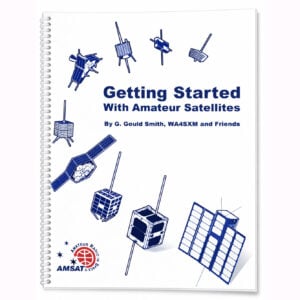
Anyone who joins or renews their AMSAT membership during the promotional period
will receive a download link for the latest edition of
Getting Started with Amateur Satellites in their membership confirmation email.
JOIN TODAY at https://launch.amsat.org/ (Remember! Students join for FREE!)
Greek-Built Satellite Launched for Kazakh School
It is past midnight in Kazakhstan when, 10,392 kilometres away, a SpaceX rocket lifts off through dense morning fog from Vandenberg Space Force Base in California carrying a satellite payload.
Despite the late hour, some children in Kazakhstanâs capital Astana remain wide awake with excitement. The following day, the rocket will deploy an orbital system carrying a tiny Greek-built satellite on their behalf.
Measuring just 5 x 5 x 5 centimetres â roughly the size of a Rubikâs Cube â the satellite was developed in Athens by programmers and engineers at the non-profit Libre Space Foundation (LSF).
Founded by nine people in 2015, LSF develops open-source space technology and designs. It now employs around 25 people, about one-quarter of them women, as well as young people undertaking internships. The organisation has so far sent more than 10 microsatellites, nanosatellites and picosatellites into space.
One of its picosatellites launched on October 1 for a school in Astana, the capital and second-largest city of Kazakhstan.
LSF was surprised when Kazakhstanâs Space Agency approached it directly after learning about its work at international conferences.
âThey wanted an estimate of how much a âpocket-classâ satellite would cost for use in a school in Kazakhstan,â LSF vice president Eleftherios Kosmas told the Athens-Macedonian News Agency (AMNA).
He said Kazakhstan appeared keen to gradually develop an independent space programme but had a limited budget, so officials decided to start with a school.
LSF initially provided an engineering model designed only for laboratory testing and used it to train the students. It then built the satellite that eventually launched into orbit.
âAs the father of a young girl, I understand how these children feel now that something of their own is travelling through space,â Kosmas said. The students will also be able to communicate with the satellite and observe how a ground station receives its signal under different signal configurations.
The SpaceX rocket that launched during the early hours of October 1-2 carried more than the tiny school satellite. It transported eight satellites in total, all of which carried the LSFâs signature in one way or another.
Four additional SIDLOC picosatellites â part of a system for identifying and locating satellites and other space objects â were registered as Greek satellites.
Three others belonged to AMSAT Deutschland, the German Amateur Radio Satellite Association. They used LSFâs open-source software and designs to build their own pocket satellites.

LSF staff work in the clean room in Athens, Greece. (Photo credit: Greek City Times.)
Until a few years ago, LSF operated from Abatiellou Street in Athens, in a former printing house that once produced maps.
The organisation has since moved to Lenorman Street, near the Plato Academy, where it has again taken over a former printing facility.
The new premises house the organisationâs offices as well as a clean room, where temperature, pressure, humidity and cleanliness remain under controlled conditions.
The facility allows LSF to assemble circuit boards destined for space while protecting them from microscopic particles of dust that could compromise their operation.
[ANS thanks the Greek City Times and author Kosta Papadopoulos for the above information. Read the full article at https://greekcitytimes.com/2026/10/08/greek-space-technology-sends-kazakh-school-into-space/.]
AMSAT Remove Before Flight Key Tags Now Available
Yes, These are the Real Thing!
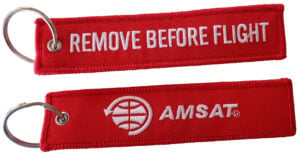
Your $20 Donation Goes to Help Fly a FoxPlus Satellite
Includes First Class Postage (Sorry â U.S. Addresses Only)
Order Today at https://www.amsat.org/product/amsat-remove-before-flight-keychain
San Diego Balloon Launch Draws in High School Students
Members of the Mt. Carmel High School Amateur Radio Club in San Diego, California, used a high-altitude balloon launch October 17 to generate interest among their fellow students and the community in amateur radio, science, technology, engineering and math. Members of the public were encouraged to track the balloon flight in real time using an app called Sondehub-Amateur, which displays telemetry from amateur radio high altitude balloon launches.

Gayle Olson, K6GO, holding the weather balloon that would carry her call sign to an altitude of more
than 17 miles from its launch at the San Diego Repeater Associationâs Hamtastic event on October 17.
[Photo courtesy of Gayle Olson, K6GO]
This flight, which carried the call sign K6GO, belonging to Gayle Olson, a volunteer for the ARRL Foundation Scholarship Committee and Maxim Society member, flew to an altitude of 17-1/2 miles before the balloon burst and the payload parachuted back to the ground in Julian, California, some 60 miles inland from its launch point on Fiesta Island.
The launch was part of the San Diego Repeater Associationâs annual âHamtasticâ event, which brings together hams and clubs from throughout the region to get on the air, socialize, and demonstrate amateur radio to the public. The San Diego Repeater Association is an ARRL Affiliated Club.
[ANS thanks The ARRL Letter for the above information.]

OsTrax Now Available for Windows, macOS, and Ubuntu
Avinstar, LLC has announced the general availability of OsTrax, an orbiting satellite tracking and operating platform for Windows, macOS and Ubuntu.
Satellite communication presents one of the more interesting and involved opportunities using radio. The need to know when and where a satellite is at a given time, while carefully coordinating radios and antennas to communicate using the satellite presents many challenges.
OsTrax addresses these challenges by incorporating a fresh, modern approach combined with a central satellite information repository to eliminate problems associated with obtaining accurate and timely satellite information. The result is more operating time with less effort.
OsTrax is user customizable to create a personalized operating experience with full control of satellite selection and satellite pass control.
OsTrax controls radios and antenna rotors based on the requirements of a satellite pass and communication type. Radios and rotor selections extend from legacy to current.
Automatic updating of orbital elements and satellite profile information ensure the latest operating information is always available.
User defined orbital elements and satellite profiles provide access opportunities for new or exploratory satellites and features.
OsTrax enhances operating with simplified contact logging and advanced tools to determine future satellite pass predictions and perform satellite pass modeling.
In addition to satellite tracking, OsTrax tracks the Sun and Moon with antenna rotor control.

(Image credit: Jim McCullers, WA4CWI)
Publication images are available at https://www.avinstar.com/ostrax/media/images
The User Guide can be viewed at https://www.avinstar.com/ostrax/docs
A fully functional trial license is available for 15 days for each operating system version.
For more information, please view the OsTrax web site at https://www.ostrax.com or contact Jim McCullers at jmccullers@avinstar.com.
OsTrax was created by Jim McCullers, WA4CWI, an Extra Class amateur radio operator licensed since 1961. OsTrax combines his interest and experience in satellite operation with his professional programming experience. He is the developer of SigTrax, the signal tracking toolkit available on the Apple App Store for iOS devices and the Google Play Store for Android devices.
[ANS thanks Jim McCullers, WA4CWI, for the above information.]
Changes to AMSAT TLE Distribution for Oct. 23, 2026
Two Line Elements or TLEs, often referred to as Keplerian elements or keps in the amateur community, are the inputs to the SGP4 standard mathematical model of spacecraft orbits used by most amateur tracking programs. Weekly updates are completely adequate for most amateur satellites. TLE bulletin files are updated daily in the first hour of the UTC day. New bulletin files will be posted immediately after reliable elements become available for new amateur satellites. More information may be found at https://www.amsat.org/keplerian-elements-resources/.
Bulletin format elements for all satellites of interest to radio amateurs. This file is updated at least every 24 hours.
Bare elements are derived from the bulletin, but contain no header or footer. These data are used as input to the AMSAT Pass Predictions page.
This week there are no additions or deletions to the AMSAT TLE distribution.
General Perturbations Data Support
AMSAT is pleased to announce that modern forms of what are called General Perturbations data are being disseminated via modern formats including JSON, XML and KVN at https://newark192.amsat.org/gpdata/current/. The reason this change is being made is that we are running out of 5-digit catalog numbers and the TLE format is not viable for satellites launched after July of this year. See https://celestrak.org/NORAD/documentation/gp-data-formats.php for details.
These data are presently considered in beta test for the next two months while hosted on the test server newark192.amsat.org, and we are very open to community feedback at webmaster at amsat.org. Testers may experience outages and errors while we make improvements. We intend to put this into production on our main web server in July as we expect that satellites launched after this summer will require one of the new formats to accommodate longer object numbers. AMSAT will continue to publish TLE bulletins for satellites launched before July 2026 indefinitely.
[ANS thanks Joe Fitzgerald, KM1P, AMSAT Orbital Elements Manager, for the above information.]
ARISS SSTV Event in Progress
A series Slow-Scan Television (SSTV) transmissions from the International Space Station (ISS) is currently taking place, and will continue until Monday. Persons who upload images they have received to the SSTV gallery at https://ariss-usa.org/ARISS_SSTV/ will receive an event certificate. Because this activity does not involve transmitting to the ISS, but only receiving, no amateur radio license is required to participate. More information is available at https://ariss-usa.org/ARISS_SSTV/.

[ANS thanks the ARISS for the above information.]
Buying from DX Engineering?
Add AMSATâs Getting Started With Amateur Satellites to your order.
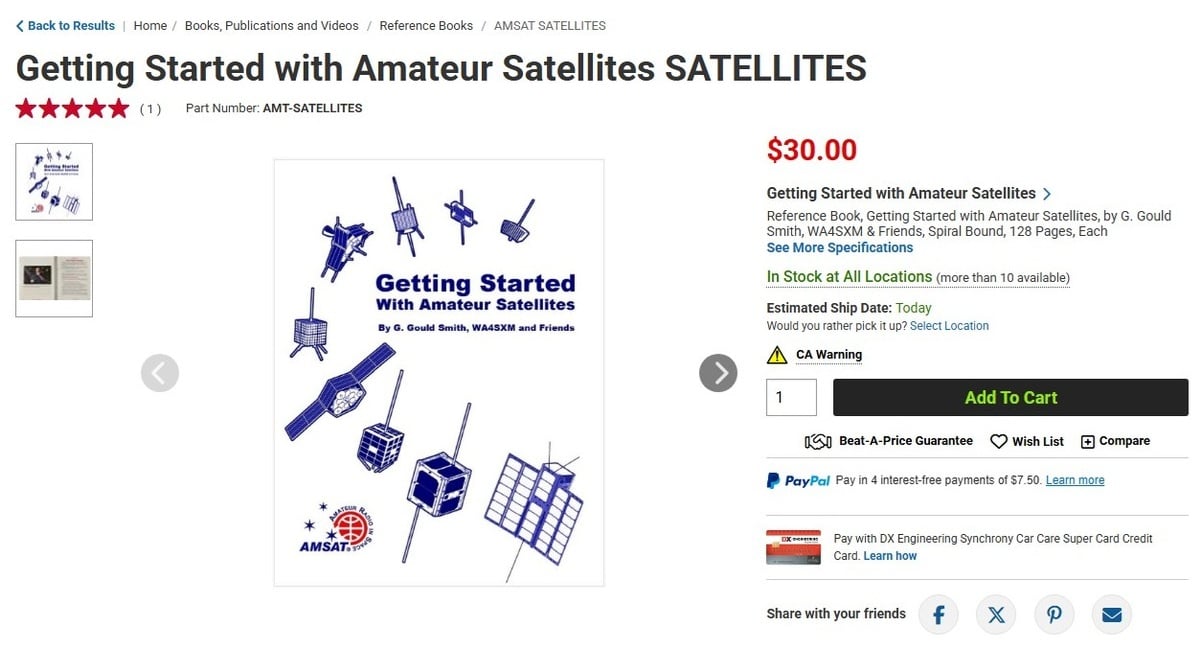
Available for $30 from DX Engineering (free shipping on most orders over $99)
https://www.dxengineering.com/parts/amt-satellites
ARISS News
Amateurs and others around the world may listen in on contacts between amateurs operating in schools and allowing students to interact with astronauts and cosmonauts aboard the International Space Station. The downlink frequency on which to listen is 145.800 MHz worldwide.
Recently Completed Contacts
Sarasota Military Academy, Sarasota, FL, direct via W4SMA
The ISS callsign was scheduled to be NA1SS
The scheduled crewmember was Luke Delaney, KJ5PPF
The ARISS mentors are KM4YHZ are W4NTR
Contact was successful: Thu 2026-10-22 16:25:17 UTC 23 degrees maximum elevation
Watch for Livestream at https://www.facebook.com/SarasotaMilitaryAcademy/Â
Congratulations to the Sarasota Military Academy, Luke, mentors KM4YHZ and W4NTR, and ground station W4SMA!
Upcoming Contacts
Paul Duke STEM High School, Norcross, GA, direct via KN4SIE
The ISS callsign is presently scheduled to be NA1SS
The scheduled crewmember is Joshua Kutryk, KJ5BFU
The ARISS mentor is K4RGK
Contact is go for Option #4: Mon 2026-10-26 13:11:42 UTC 39 degrees maximum elevation
Smile Of The Child â Smile Academy, Attica, Greece, telebridge via AB1OC
The ISS callsign is presently scheduled to be OR4ISS
The scheduled crewmember is Luke Delaney, KJ5PPF
The ARISS mentor is IKÃWGF
Contact is go for: Fri 2026-10-30 10:01:41 UTC 61 degrees maximum elevation
Watch for possible Livestream at:
Â
Greek https://www.hamogelo.gr/gr/el/ta-nea-mas/to-chamogelo-tou-paidiou-sindeei-mathites-me-ton-diethni-diastimiko-stathmo-iss/
English https://www.hamogelo.gr/gr/en/ta-nea-mas/to-chamogelo-tou-paidiou-sindeei-mathites-me-ton-diethni-diastimiko-stathmo-iss/
**********************************
Many times, a school makes a last-minute decision to do a Livestream or runs into a last-minute glitch requiring a change of the URL, but we at ARISS may not get the URL in time for publication. You can always check https://live.ariss.org/ to see if a school is Livestreaming.
As always, if there is an EVA, a docking, or an undocking; the ARISS radios are turned off as part of the safety protocol.
Also, some of the activities listed below are suspended until the completion of the SSTV event currently underway (see article above).
The crossband repeater remains configured in the Columbus Module (145.990 MHz up {PL 67} & 437.800 MHz down). If a crewmember decides to pick up the microphone and turn up the volume, you may hear them on the airâso keep listening, as you never know when activity might occur.
Kenwood D710GA in the Zvezda Service Module â Call sign RSÃISS. Please note weâre still in the process of troubleshooting and testing this radio. APRS is currently active on 437.825 MHz. Feel free to check out status reports at https://ariss-usa.org/ARISS_APRS/.
Ham TV is currently transmitting a test signal at 2395.00 MHz. For more information, see https://live.ariss.org/hamtv/
Note, all times are approximate. It is recommended that you do your own orbital prediction or start listening about 10 minutes before the listed time.
The latest information on the operation mode can be found at https://www.ariss.org/current-status-of-iss-stations.html
The latest list of frequencies in use can be found at https://www.ariss.org/contact-the-iss.html
[ANS thanks Charlie Sufana, AJ9N, one of the ARISS operation team mentors for the above information]
Give Your Next Rove a Payload â Put Your Lunch into Orbit!
Pack the rover dogs and hit the grid line with an all-new
AMSAT Round Logo Metal Lunchbox.
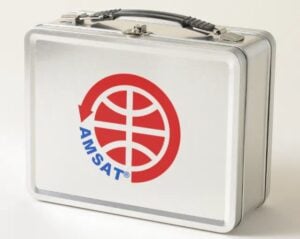
Keep Amateur Radio in Space â and your lunch in the box!
https://www.zazzle.com/amsat_round_logo_metal_lunchbox-256761530568368967
Â
AMSAT Ambassador Activities
AMSAT Ambassadors provide presentations, demonstrate communicating through amateur satellites, and host information tables at club meetings, hamfests, conventions, maker faires, and other events.
November 7, 2026
JARSfest (Johnston Amateur Radio Society Hamfest)
The Farm at 95
215 Batten Rd.
Selma, NC 27576
https://jars.net/jarsfest-2026
KF4EAG
November 14, 2026
Southern Arizona Fall Hamfest
Oro Valley Amateur Radio Club
Marana Middle School
11285 W. Grier Rd.
Marana AZ
https://www.tucsonhamradio.org/hamfest
N1UW
Interested in becoming an AMSAT Ambassador? AMSAT Ambassadors provide presentations, demonstrate communicating through amateur satellites, and host information tables at club meetings, hamfests, conventions, maker faires, and other events. For more information go to:Â https://www.amsat.org/ambassador/
[ANS thanks Bo Lowrey, W4FCL, Director â AMSAT Ambassador Program, for the above information]
Satellite Shorts from All Over
+ A Russian satellite just took a very close look at an American spacecraft in low Earth orbit. The snooping satellite, Kosmos 2612, rendezvoused with ICEYE-X36, a commercial craft that observes our planet using synthetic aperture radar (SAR). The close encounter, which occurred between Oct. 15 and Oct. 19, was reported by Marco Langbroek and other satellite trackers, with Langbroek calling it âa worrisome cat-and-mouse gameâ in orbit. The rendezvous has garnered a lot of attention in space circles, because it was non-consensual and startlingly close; at one point, the two spacecraft may have been separated by just a few meters. There are about 80 ICEYE spacecraft in LEO at the moment. At least some ICEYE satellites provide imagery to Ukraine, which Russia invaded in February 2022 and continues to assault with ground troops and missile and drone attacks. (ANS thanks Space.com for the above information. See the full story at https://www.space.com/space-exploration/satellites/russian-satellite-plays-cat-and-mouse-with-a-commercial-us-satellite-likely-used-by-ukraine-but-why-the-risky-close-encounter.)
+ NASA finally released its Request for Proposals (RFP) for the next phase of its Commercial LEO Destinations (CLD) program on October 9, about ten days later than promised. The CLD is the program to replace the International Space Station (ISS) with a privately developed orbiting platform. Seeking proposals from industry by December 8, the agency said it would select at least two companies by next April for initial awards to continue work on their stations, with at least one later selected for full development. Companies developing commercial space stations have an array of challenges to overcome, from the ongoing NASA competition to securing outside investment and non-NASA customers to the technical issues of building a commercial space station. (ANS thanks The Space Review for the above information. Read the full story at https://www.thespacereview.com/article/5340/1.)
+ The space around Earth is turning into a junkyard. Researchers think a refundable deposit scheme could force satellite operators to clean up their act before a tipping point is reached. In a paper published last month in the journal Nature Communications, a group of scientists propose a scheme that would require satellite operators to post a bond of $200,000 before launch, refundable with interest upon the completion of a successful deorbit. Companies that fail to remove their junk would lose the money, which could go toward a shared pool funding active debris-removal missions. (ANS thanks Space.com for the above information. Read the full story at https://www.space.com/space-exploration/satellites/could-satellite-deorbit-deposits-prevent-a-space-debris-disaster.)
+ Online marketplace eBay has imposed new restrictions on listings of radio transmitting equipment in response to new FCC rules that took effect last week, but responded to ARRL, The National Association for Amateur Radio®, that its new policy will not apply to gear that operates exclusively on amateur radio frequencies. The FCCâs rules are intended to use its equipment authorization program to protect against ânational security threats to the communications supply chainâ and cover a wide variety of products. However, in response to a request from ARRL for a clarification relating to amateur radio equipment that does not require FCC authorization, an eBay spokesperson indicated that the marketplace will not restrict sales of equipment that does not require an FCC ID. Amateur radio equipment, except for commercial HF amplifiers, continues to not require FCC authorization. (ANS thanks ARRL for the above information. Read the full story at https://www.arrl.org/news/ebay-restricts-listings-of-radio-equipment-but-exempts-ham-band-only-gear.)
Join AMSAT today at https://launch.amsat.org/
In addition to regular membership, AMSAT offers membership to:
- Societies (recognized groups, clubs or organization).
- Students are eligible for FREE membership up to age 25.
- Memberships are available for annual and lifetime terms.
Contact info [at] amsat.org for additional membership information.
73 and remember to help Keep Amateur Radio in Space!
This weekâs ANS Editor,
Mark Johns, KÃJM
mjohns [at] amsat.org
ANS is a service of AMSAT, the Radio Amateur Satellite Corporation, 712 H Street NE, Suite 1653, Washington, DC 20002. AMSAT is a registered trademark of the Radio Amateur Satellite Corporation.