AMSAT News Service
ANS-319
November 15, 2026
In this edition:
* AMSAT Files FCC Comments on Proposed 2.4 and 5.8 GHz Satellite Use
* UNNE-1B and HADES-L Receive OSCAR Designations SO-131 and SO-132
* September/October 2026 Issue of The AMSAT Journal Now Available
* OSCAR Watch Tracker v1.1.7 Builds on Earth View with SSTV Enhancements
* Houston AMSAT Net Ends After More Than Four Decades on the Air
* GridMasterMap Satellite Top 100 Rovers November 2026 Rankings
* Changes to AMSAT TLE Distribution for November 13, 2026
* ARISS News
* AMSAT Ambassador Activities
* Satellite Shorts from All Over
The AMSAT® News Service bulletins are a free, weekly news and information service of AMSAT, The Radio Amateur Satellite Corporation. ANS publishes news related to Amateur Radio in Space including
reports on the activities of a worldwide group of Amateur Radio operators who share an active interest in designing, building, launching and communicating through analog and digital Amateur Radio satellites.
The news feed on
https://www.amsat.org publishes news of Amateur Radio in Space as soon as our volunteers can post it.
Please send any amateur satellite news or reports to: ans-editor [at]
amsat.org
You can sign up for free e-mail delivery of the AMSAT News Service Bulletins via the ANS List; to join this list see:
https://mailman.amsat.org/postorius/lists/ans.amsat.org/
AMSAT Files FCC Comments on Proposed 2.4 and 5.8 GHz Satellite Use
On November 9, AMSAT filed comments with the Federal Communications Commission (FCC) on a proposal to let unlicensed devices communicate directly with satellites in two bands shared with the amateur
and amateur-satellite services. AMSAT asked the Commission to keep the new satellite uplinks out of the 2400-2450 MHz amateur-satellite segment and not to add a satellite downlink allocation in the 2.4 GHz band.
The Notice of Proposed Rulemaking (NPRM), "Unleashing Unlicensed Spectrum for Direct-to-Device" (ET Docket No. 26-169, FCC 26-51), was adopted August 6 and released August 7. It would allow devices
certified under Part 15 of the FCC's rules, such as Wi-Fi and Bluetooth equipment, to transmit to authorized satellites in the 2400-2483.5 MHz and 5725-5850 MHz bands. A new footnote to the Table of Frequency Allocations, NG36, would permit mobile-satellite
service uplinks in both bands on an unprotected, non-interference basis. Devices would remain within the existing Part 15 limits of up to 4 watts EIRP, although the FCC asks whether different limits are warranted for satellite links. The 902-928 MHz band,
included in the draft released in July, was dropped before adoption.
The NPRM proposes no rules for satellite downlinks, but it asks whether they should be permitted at 5725-5850 MHz and whether a downlink allocation should be added at 2400-2483.5 MHz. It also proposes
to confirm that Part 15 devices may be used inside spacecraft, seeks comment on their use during spacewalks and for links between spacecraft, and asks whether limits are needed on unintended radio emissions from satellite electronics.
In the United States, the amateur service is primary at 2400-2417 MHz and secondary at 2417-2450 MHz and across 5725-5850 MHz. The amateur-satellite service may operate at 2400-2450 MHz in both directions
on a non-interference basis and has a secondary downlink allocation at 5830-5850 MHz.
In its 20-page filing, AMSAT said it does not oppose innovation in direct-to-device connectivity, but noted that the 2400-2450 MHz segment has hosted amateur satellite links for decades, from the
S-band downlinks of AO-40 and AO-51 to the 2400-2410 MHz uplink of the QO-100 geostationary transponder. It described the 5830-5850 MHz segment as an important option for higher-rate microwave downlinks. The comments explain that amateur satellite links are
often weak-signal links with margins that may be only a few decibels.
Terrestrial Part 15 emissions generally arrive from directions that a ground station's antenna attenuates while tracking a satellite, but a co-frequency satellite in or near the antenna's main beam
may be received at high gain. For a reference ground station with a 60 cm dish, AMSAT's technical appendix finds a difference of about 35 dB between the signal level an illustrative consumer downlink would need and the level that would protect the amateur
receiver. AMSAT called this a serious warning about compatibility at 2400-2450 MHz rather than a complete sharing study, and said the whole 2400-2483.5 MHz band should be excluded from any downlink framework absent a convincing demonstration of compatibility.
On the uplink side, AMSAT noted that links to orbit could favor outdoor, skyward transmissions, while many Wi-Fi and Bluetooth links today operate indoors or below maximum power. Its bounding calculations
show that a single device at the maximum permitted power spectral density could approach the interference allowance of a narrowband transponder channel on a low Earth orbit amateur satellite passing overhead, and that roughly 10 to 30 co-channel devices transmitting
skyward at full power at once could raise the satellite receiver's noise floor by about 3 dB in 1 MHz. Calling these figures stress tests rather than forecasts, AMSAT asked the Commission to require realistic aggregate interference studies that treat amateur
satellite receivers as victims.
Among other things, AMSAT asked the Commission to:
-
Add no satellite downlink allocation at 2400-2483.5 MHz, and issue a further notice with specific rule text and technical analysis before adopting downlink rules in any band.
-
Exclude the 5830-5850 MHz amateur-satellite downlink segment from any 5725-5850 MHz downlink framework, or protect it with limits based on the needs of amateur ground stations.
-
Allow no increase in Part 15 power, antenna gain, or emission limits for transmissions to satellites, and cap direct-to-device earth stations at 36 dBm (4 watts) EIRP.
-
Revise footnote NG36 to bar operations under it from causing harmful interference to, or claiming protection from, the amateur and amateur-satellite services; to include those technical limits; and
to confine the 2.4 GHz uplink allocation to 2450-2483.5 MHz, where there is no amateur allocation.
-
Require an individual license or U.S. market access grant for every satellite operating under the new framework, a public point of contact for interference reports, prompt investigation and mitigation
of harmful interference, and a public database of authorized operations.
-
Apply radiated emission limits at least as strict as the Part 15 Class B limits, as an initial benchmark, to unintended emissions from spacecraft in bands used by the amateur-satellite and passive services,
measured before launch, with stricter narrowband or aggregate limits where needed.
On the last point, AMSAT noted that the reported unintended emissions, at 40-70 MHz and 110-188 MHz, overlap the 50-54 MHz amateur band and the 144-146 MHz amateur-satellite band, including the 145.8-146.0
MHz segment that carries ARISS downlinks and the downlinks of amateur and university satellites. Its analysis found that a Class B-level limit offers substantial protection against a single spacecraft's emissions but cannot by itself guarantee protection against
narrowband emissions from large constellations.
AMSAT supported confirming that Part 15 devices may be used inside spacecraft, citing the long-standing use of crew Wi-Fi and Bluetooth devices aboard the International Space Station alongside ARISS.
It urged greater caution about spacewalk and spacecraft-to-spacecraft use of 2400-2450 MHz, where no hull shields amateur satellites sharing the band.
***For More Information***
The FCC NPRM (FCC 26-51) is available at:
https://docs.fcc.gov/public/attachments/FCC-26-51A1.pdf
AMSAT's comments are available at:
https://www.fcc.gov/ecfs/document/26110084235/1
Reply comments are due December 7, 2026, and may be filed at
https://www.fcc.gov/ecfs/
[ANS thanks
AMSAT for the above information]
UNNE-1B and HADES-L Receive OSCAR Designations SO-131 and SO-132
AMSAT has officially assigned OSCAR numbers to two amateur radio satellites developed by AMSAT-EA in Spain. UNNE-1B has been designated Spain-OSCAR 131 (SO-131), while HADES-L has received the designation
Spain-OSCAR 132 (SO-132). The designations were announced by AMSAT President and OSCAR Number Administrator Drew Glasbrenner, KO4MA, following a request from AMSAT-EA.
Both satellites were launched on October 1, 2026, aboard a SpaceX Falcon 9 rocket as part of the Transporter-18 rideshare mission from Vandenberg Space Force Base in California. The spacecraft were
carried aboard OSSIE-D, an orbital transfer vehicle developed by the Spanish company UARX, and deployed into orbit on October 2.
UNNE-1B carries a VHF/UHF FM repeater with an uplink on 145.925 MHz and a downlink on 436.888 MHz. HADES-L features an experimental 10-meter USB to 70-centimeter FM voice repeater, with an uplink
on 29.472 MHz and a downlink on 436.665 MHz. Both satellites transmit FSK telemetry, which amateur radio operators can decode using software developed by N6RFM, available at
https://github.com/N6RFM/HADESx-Decoder/releases/tag/v1.2.0.
In announcing the new designations, Glasbrenner congratulated AMSAT-EA and thanked the organization for its contributions to the amateur satellite community. He also expressed his wishes for continued
success with these satellites and future projects.
[ANS thanks
Drew Glasbrenner, KO4MA, AMSAT President and OSCAR Number Administrator, for the above information]
September/October 2026 Issue of The AMSAT Journal Now Available
AMSAT members can now download the September/October 2026 issue of The AMSAT Journal (Volume 49, Number 5) from the member portal at
https://launch.amsat.org/.
Have a project, an operating story, or photos to share with fellow members? The Journal staff welcomes submissions at journal [at]
amsat.org.

The September/October 2026 issue of
The AMSAT Journal is now available for AMSAT members to download. [Credit:
AMSAT]
This issue features a variety of technical articles and project updates covering AMSAT's educational initiatives, satellite operations, and developments in amateur radio technology.
Features in the September/October issue include:
* Apogee View – Drew Glasbrenner, KO4MA, recaps the AMSAT Space Symposium in Jacksonville, including a new High Orbit Committee and
LTM partnerships with JoanSat, Embry-Riddle, and Rice University, shares news of the ARISS/AMSAT AREx Lunar Team, and recruits volunteers for both the committee and the treasurer.
* Educational Relations Update – Alan Johnston, KU2Y, on the Symposium's CubeSatSim demo room, upgrading to the September v2.3 software
release, a microSD card trade-in for 2026 AMSAT Store customers, and how to borrow a CubeSatSim Loaner at no cost.
* AMSAT Education and CubeSat Simulator Project Update – Alan Johnston, KU2Y, reviews a year of CubeSatSim progress, from the new
Flash Drive Ground Station and NASA F Prime integration work to the Youth on the Air camp, university classrooms, and a University of Texas at Dallas workshop that irradiated a live CubeSatSim with X-rays until it failed.
* AMSAT CubeSatSim New Features – Alan Johnston, KU2Y, details the v2.2 and v2.3 software releases, including a store-and-forward
PacSat mode, simulated Doppler shift that draws the classic "S" curve on an SDR waterfall, a browser-based Dashboard, a Wi-Fi hotspot, and eleven simulated hardware failures that show up in telemetry.
* What the Fox-1 Batteries Were Telling Us – Mario Gómez Ballesteros of Spain's Apsia replays AMSAT's public Fox-1 telemetry archive
month by month, as if in real time, to answer one question: could the NiCd battery failures on AO-85, AO-91, AO-92, and AO-95 have been seen coming before a fixed voltage alarm would have fired?
* Ground Station: An Integrated Web-Based Platform for Satellite Tracking, SDR Reception, and Automated Observations – Omar Ãlvarez-Cárdenas,
XE1AO, Margarita G. Mayoral-Baldivia, XE1BMG, Gilles Arfeuille, VE7VOL, and Fernando Pech-May examine the open-source software from Efstratios Goudelis, including how a single SDR stream feeds the waterfall, decoders, and recorder at once, and how SigMF recordings
replay as a virtual SDR so a pass can be reprocessed later.
The AMSAT Journal is published bi-monthly as a benefit of AMSAT membership. Not yet a member? Join today at
https://launch.amsat.org/. Students join for free!
[ANS thanks Joe Kornowski, KB6IGK, Editor-in-Chief of The AMSAT Journal, for the above information]
Buying from DX Engineering?
Add AMSAT’s Getting Started With Amateur Satellites to your order.
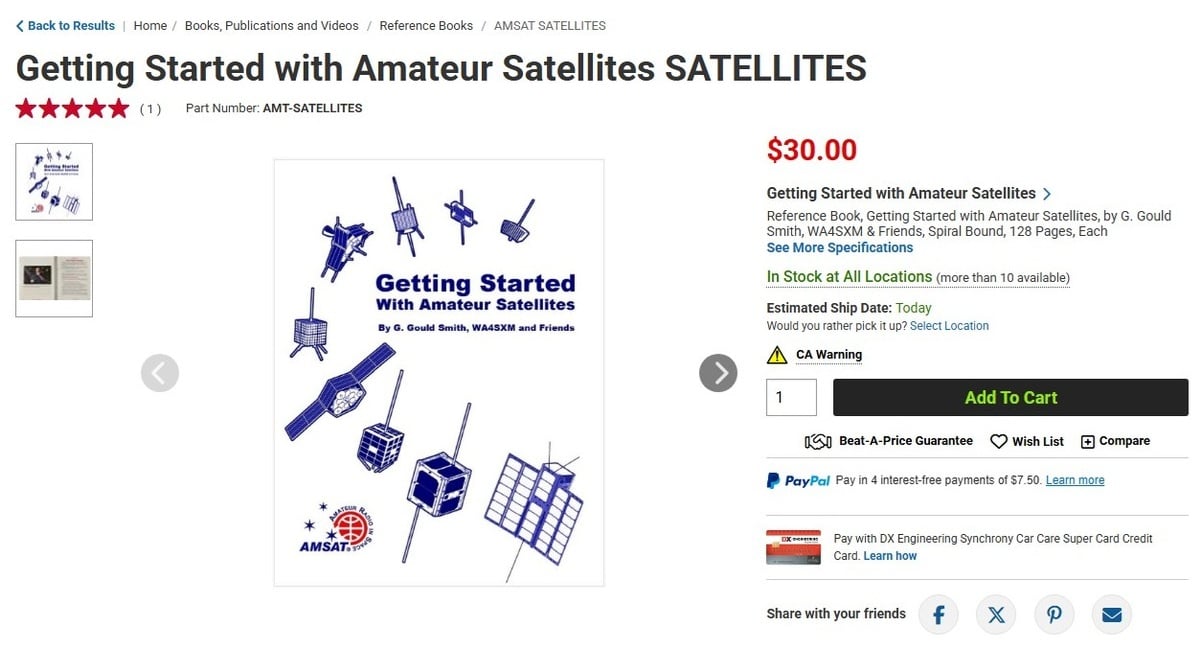
Available for $30 from DX Engineering (free shipping on most orders over $99)
https://www.dxengineering.com/parts/amt-satellites
OSCAR Watch Tracker v1.1.7 Builds on Earth View with SSTV Enhancements
Peter Goodhall, MM9SQL, has released version 1.1.7 of OSCAR Watch Tracker, his free, open-source satellite tracking and station control application for amateur radio operators. Released November
11, the latest update builds on the recently introduced Earth View display with further improvements to slow-scan television (SSTV) decoding, expanded FT4 digital-mode capabilities, network radio control, and antenna rotator support. OSCAR Watch combines satellite
pass predictions, Doppler correction, radio and antenna rotator control, and operating tools in a single application designed for both home stations and portable satellite operations.
Introduced in version 1.1.6, the new Earth View window displays a globe centered on the point directly beneath the selected satellite. Unlike conventional flat-map projections, Earth View represents
ground distances accurately, allowing operators to visualize the satellite's coverage footprint without the distortion associated with rectangular world maps. The display includes the satellite's ground track, direction-of-travel arrows, the operator's station
location, and a dashed ring showing the coverage boundary at the configured minimum elevation. The view updates as the satellite moves along its orbit and can also display coverage for geostationary satellites such as QO-100.
Version 1.1.7 brings additional improvements to OSCAR Watch's integrated SSTV decoder, particularly useful during amateur radio image transmissions from the International Space Station. Building
on the previous release's ability to recover damaged image headers, repair noisy lines, and combine repeated receptions, the latest update improves synchronization and image recovery when satellite signals fade during a pass. The decoder can maintain synchronization
through interruptions lasting up to 45 seconds, use satellite Doppler information to assist image alignment, and recover mode identification signals buried in noise. Additional improvements address soundcard audio buffering, reduce memory usage following long
image transmissions, and offer optional filtering to remove isolated noise speckles from received pictures.

OSCAR Watch Tracker's Earth View displays DISCO-2's position, orbital ground track, and satellite coverage footprint. [Credit:
Jan PE0SAT]
Digital-mode operators will find several enhancements to OSCAR Watch's built-in FT4 capabilities. The updated waterfall display offers three selectable scrolling speeds, improved visibility of weak
signals alongside stronger stations, and optional frequency-response flattening to compensate for receiver filter characteristics. Operators can now double-click a signal trace to tune to its audio frequency and attempt another decode using the software's
deeper decoding process. The display also identifies individual 7.5-second FT4 transmission periods with UTC timestamps, while an optional advanced layout separates general band activity from stations calling the operator.
Radio and antenna control receive significant attention in the latest release. OSCAR Watch now supports ICOM CI-V network control over LAN or Wi-Fi for compatible radios, including the IC-9700, eliminating
the need for a USB CI-V connection when network control is configured. Additional support allows several Kenwood HF transceivers to serve as uplink or downlink radios in dual-radio satellite configurations. New rotator capabilities include direct control of
the MuseLab AntRunner and improved handling of azimuth-only GS-232 controllers. Version 1.1.7 also introduces a separate OSCAR Watch Troubleshooter application that helps operators diagnose startup failures, inspect device connections, recover settings, and
collect diagnostic information for technical support.
OSCAR Watch Tracker is available for Windows, macOS, and Linux, including 64-bit Raspberry Pi systems, with precompiled downloads that do not require users to build the software themselves. Beyond
its tracking capabilities, the application includes satellite pass planning, GPS integration, a built-in satellite logbook with ADIF export, and support for numerous radio and antenna rotator controllers. Goodhall continues to develop the project as free,
open-source software, with community contributions and voluntary financial support helping sustain ongoing improvements.
***For More Information***
OSCAR Watch website:
https://oscarwatch.org/
GitHub project and source code:
https://github.com/magicbug/OscarWatch-Tracker
Version 1.1.7 release and downloads:
https://github.com/magicbug/OscarWatch-Tracker/releases/tag/v1.1.7
Support OSCAR Watch development:
https://github.com/sponsors/magicbug
[ANS thanks
Peter Goodhall, MM9SQL, for the above information]
Houston AMSAT Net Ends After More Than Four Decades on the Air
The Houston AMSAT Net concluded more than four decades of service to the amateur radio community with its final transmission on October 13, 2026. The weekly net provided satellite and balloon news,
technical information, and opportunities for amateur radio operators around the world to stay connected. The final broadcast was designated net number 1,677, although the program's history extends considerably further back. According to longtime contributor
and host Bruce Paige, KK5DO, the numbering began on February 2, 1994, when he started maintaining records of the broadcasts.
The net's long history was shaped by the dedication of several amateur radio operators, including Andy MacAllister, W5ACM (SK), Bruce Paige, KK5DO, and Marty, WV5Y. Paige became involved shortly
after receiving his amateur radio license in 1993 and developed a longstanding partnership with MacAllister in providing satellite news and technical information. Marty was also a regular participant and eventually assumed hosting responsibilities. Following
MacAllister's passing in May 2021, the net continued under the leadership of its remaining volunteers, preserving a tradition that had already served generations of satellite enthusiasts.
Throughout its history, the Houston AMSAT Net employed an evolving collection of communications technologies to reach listeners beyond the Houston area. Early broadcasts were distributed through
commercial communications satellites, beginning with documented Telstar links in 1994 and later using spacecraft including ANIK E2, SBS 6, GE-1, and GE-4. The net reached its 300th satellite-distributed broadcast in December 1999 and continued using satellite
audio networks into the following decade. These arrangements allowed amateur radio operators across North America and beyond to receive the program through interconnected networks.
The net also embraced Internet-based distribution as new technologies became available. RealAudio delivery began in July 1996, followed by recorded programs in August 1997 and the first live Internet
stream on August 19, 1997. The Internet Radio Linking Project (IRLP) was introduced in September 2001, with 31 check-ins from across North America during its first use. Podcast distribution began in April 2008, making recorded programs available through iTunes
and other podcast services. The net celebrated its 1,000th recorded broadcast on May 21, 2013, and reached number 1,500 on February 28, 2023.
Changes in leadership and operating circumstances eventually presented challenges to the program's continuation. Paige relocated in 2016 and could no longer reliably access the Houston repeater,
while Marty subsequently assumed greater responsibility for conducting the broadcasts. After Marty became unable to continue in April 2026, Paige returned as host using EchoLink and the RFD audio stream to participate remotely. Despite these adaptations, the
decision was made to conclude the program six months later. The October 13 broadcast brought the longstanding weekly tradition to an end.
In announcing the closure, Paige expressed appreciation for the many loyal listeners and volunteers who supported the Houston AMSAT Net over the decades. He specifically recognized Vern, WA0RCR,
who regularly retransmitted the program on the 160-meter amateur band, and Craig, formerly WD5BDX and now K1BDX, who helped establish its early satellite distribution links. Their contributions, along with those of the program's hosts and technical supporters,
helped extend the net's reach far beyond its Texas origins. After more than 40 years of sharing satellite news, technical knowledge, and amateur radio fellowship, the Houston AMSAT Net leaves a lasting legacy of service to the amateur satellite community.
[ANS thanks
Bruce Paige, KK5DO, AMSAT Director of Contests and Awards, for the above information]
GridMasterMap Satellite Top 100 Rovers November 2026 Rankings
The November 2026 rankings for the Top 100 Rovers (Mixed LEO/MEO/GEO) in satellite operations, as determined by
@GridMasterMap on Twitter, has been released. The ranking is determined by the number of grids and DXCC entities activated, taking into account only those grids where a minimum number of QSOs have been logged on the
gridmaster.fr website and validated by a third party. Grid numbers do not directly reflect the exact number of activations. Satellite operators are encouraged to upload their LoTW satellite contacts to
https://gridmaster.fr in order to provide more accurate data.
Updated: 2026-11-10:
|
1 |
ND9M |
26 |
N4AKV |
51 |
PU6JBN |
76 |
AD7DB |
|
2 |
NJ7H |
27 |
ND0C |
52 |
VK5DG |
77 |
AA5PK |
|
3 |
UT1FG |
28 |
KG5CCI |
53 |
N7AGF |
78 |
KM4LAO |
|
4 |
JA9KRO |
29 |
KX9X |
54 |
K7TAB |
79 |
M1DDD |
|
5 |
F5VMJ |
30 |
DJ8MS |
55 |
LU4JVE |
80 |
PS8BR |
|
6 |
N5UC |
31 |
N5BO |
56 |
VE7PTN |
81 |
N8RO |
|
7 |
DL6AP |
32 |
LA9XGA |
57 |
W1AW |
82 |
VA7LM |
|
8 |
LU5ILA |
33 |
WD5GRW |
58 |
KE0WPA |
83 |
N6UTC |
|
9 |
DP0POL |
34 |
K8BL |
59 |
HB9GWJ |
84 |
DL4EA |
|
10 |
BA1PK |
35 |
ON4AUC |
60 |
KE0PBR |
85 |
HB9AOF |
|
11 |
K5ZM |
36 |
BI1NJI |
61 |
XE3DX |
86 |
SP5XSD |
|
12 |
WI7P |
37 |
KE4AL |
62 |
JK2XXK |
87 |
N4UFO |
|
13 |
OE3SEU |
38 |
DF2ET |
63 |
EA4NF |
88 |
BH6AAP |
|
14 |
WY7AA |
39 |
KB5FHK |
64 |
PP2KR |
89 |
VE1VOX |
|
15 |
N6UA |
40 |
AC0RA |
65 |
W8LR |
90 |
PT2AP |
|
16 |
BA8AFK |
41 |
JO2ASQ |
66 |
PR8KW |
91 |
JI5RPT |
|
17 |
HA3FOK |
42 |
PA3GAN |
67 |
W7WGC |
92 |
AA8CH |
|
18 |
OH2UDS |
43 |
VA3VGR |
68 |
EB1AO |
93 |
KB2YSI |
|
19 |
W5PFG |
44 |
F4BKV |
69 |
XE1ET |
94 |
KI7UXT |
|
20 |
AK8CW |
45 |
KI0KB |
70 |
N6DNM |
95 |
AF5CC |
|
21 |
N9IP |
46 |
VE3HLS |
71 |
KI7QEK |
96 |
KJ7NDY |
|
22 |
DL2GRC |
47 |
KI7UNJ |
72 |
SM3NRY |
97 |
BI1MHK |
|
23 |
AD0HJ |
48 |
JL3RNZ |
73 |
VE1CWJ |
98 |
PT9BM |
|
24 |
AD0DX |
49 |
BG7QIW |
74 |
KE9AJ |
99 |
FG8OJ |
|
25 |
WD9EWK |
50 |
HJ5LVR |
75 |
F4DXV |
100 |
BG5CZD |
[ANS thanks
@GridMasterMap for the above information]
The 2026 Coins Are Here! Help Support GOLF-TEE and Fox-Plus.
Annual memberships start at only $120.
Join the AMSAT President's Club today and help Keep Amateur Radio in Space!
https://www.amsat.org/join-the-amsat-presidents-club/
Changes to AMSAT TLE Distribution for November 13, 2026
Two Line Elements or TLEs, often referred to as Keplerian elements or keps in the amateur community, are the inputs to the SGP4 standard mathematical model of spacecraft orbits used by most amateur
tracking programs. Weekly updates are completely adequate for most amateur satellites. TLE bulletin files are updated daily in the first hour of the UTC day. New bulletin files will be posted immediately after reliable elements become available for new amateur
satellites. More information may be found at https://www.amsat.org/keplerian-elements-resources/.
This week there are no additions or deletions to the AMSAT TLE distribution.
General Perturbations Data Support
AMSAT is pleased to announce that modern forms of what are called General Perturbations data are being disseminated via modern formats including JSON, XML and KVN at
https://newark192.amsat.org/gpdata/current/. The reason this change is being made is that we are running out of 5-digit catalog numbers and the TLE format is not viable for satellites launched after
July of this year. See
https://celestrak.org/NORAD/documentation/gp-data-formats.php for details.
These data are presently considered in beta test for the next two months while hosted on the test server
newark192.amsat.org, and we are very open to community feedback at webmaster [at]
amsat.org. Testers may experience outages and errors while we make improvements. We intend to put this into production on our main web server in July as we expect that satellites launched after this summer will require one of
the new formats to accommodate longer object numbers. AMSAT will continue to publish TLE bulletins for satellites launched before July 2026 indefinitely.
[ANS thanks Joe Fitzgerald, KM1P, AMSAT Orbital Elements Manager, for the above information]
ARISS News
Amateurs and others around the world may listen in on contacts between amateurs operating in schools and allowing students to interact with astronauts and cosmonauts aboard the International Space
Station. The downlink frequency on which to listen is 145.800 MHz worldwide.
Scheduled Contacts
+ Recently Completed
Pinecrest Academy of Northern Nevada, Sparks, NV, telebridge via IK1SLD
The ISS callsign used during the contact was OR4ISS
The participating crewmember was Luke Delaney KJ5PPF
The ARISS mentor was AJ9N
Contact was successful: Tue 2026-11-10 18:17:23 UTC
Congratulations to the Pinecrest Academy of Northern Nevada students, Luke, mentor AJ9N, and telebridge IK1SLD
Watch for Livestream at https://www.youtube.com/@pinecrestnnvSS
Ãcole Secondaire du Sommet, Halifax, Nova Scotia, Canada, telebridge via VK4ISS
The ISS callsign used during the contact was NA1SS
The participating crewmember was Joshua Kutryk KJ5BFU
The ARISS mentor was VE1WPH
Contact was successful: Fri 2026-11-13 18:08:06 UTC
Congratulations to the Ãcole Secondaire du Sommet students, Joshua, mentor VE1WPH, and telebridge VK4ISS
Watch for Livestream at https://vimeo.com/event/6020835
+ Upcoming Contacts
Lead Deadwood High School, Lead, SD, telebridge via IK1SLD
The ISS callsign is presently scheduled to be OR4ISS
The scheduled crewmember is Joshua Kutryk KJ5BFU
The ARISS mentor is K4RGK
Contact is go for: Mon 2026-11-16 16:43:13 UTC
Watch for Livestream at
https://youtube.com/@lead-deadwoodschooldistric5330?si=wFdg-LDq0yWvoYsJ
Archdiocese of Atlanta Catholic Schools, Smyrna, Georgia, multi-point telebridge via VK4ISS
The ISS callsign is presently scheduled to be TBD
The scheduled crewmember is Luke Delaney KJ5PPF
The ARISS mentor is K4RGK
Contact is go for: Thu 2026-11-19 16:34:09 UTC
Watch for Livestream at https://youtube.com/live/j011ubJS54k
Many times, a school makes a last-minute decision to do a Livestream or runs into a last-minute glitch requiring a change of the URL, but we at ARISS may not get the URL in time for publication.
You can always check https://live.ariss.org/ to see if a school is Livestreaming.
As always, if there is an EVA, a docking, or an undocking; the ARISS radios are turned off as part of the safety protocol.
ARISS SSTV Series 35 is currently underway, transmitting images on 437.550 MHz using Robot 36 mode, with approximately two minutes between images. The event is scheduled to conclude on November 16
at 08:15 UTC.
The crossband repeater remains configured in the Columbus Module (145.990 MHz up {PL 67} & 437.800 MHz down). If a crewmember decides to pick up the microphone and turn up the volume, you may hear
them on the air—so keep listening, as you never know when activity might occur.
Kenwood D710GA in the Zvezda Service Module - Call sign RS0ISS. Please note we're still in the process of troubleshooting and testing this radio. APRS is currently active on 437.825 MHz. Feel free
to check out status reports at https://ariss-usa.org/ARISS_APRS/.
HamTV in the Columbus Module (2395.00 MHz) is currently transmitting a test signal. For more information, visit the ARISS Ham TV Live site at
https://live.ariss.org/hamtv/.
Note, all times are approximate. It is recommended that you do your own orbital prediction or start listening about 10 minutes before the listed time.
The latest information on the operation mode can be found at https://www.ariss.org/current-status-of-iss-stations.html
The latest list of frequencies in use can be found at https://www.ariss.org/contact-the-iss.html
[ANS thanks Charlie Sufana, AJ9N, one of the ARISS operation team mentors for the above information]
AMSAT Ambassador Activities
AMSAT Ambassadors provide presentations, demonstrate communicating through amateur satellites, and host information tables at club meetings, hamfests, conventions, maker faires, and other events.
AMSAT Ambassador Clint Bradford, K6LCS, says,
“Think a 75-minute presentation on 'working the easy satellites' would be appropriate for your club or event? Let me know by emailing me at k6lcsclint [at] gmail [dot] com or calling me at 909-999-SATS
(7287)!”
Clint has NEVER given the exact same show twice: EACH of the 150+ presentations so far has been customized/tailored to their audiences.
Scheduled Events
No events currently scheduled.
For more information go to:
https://www.amsat.org/ambassador/
[ANS thanks Bo Lowrey, W4FCL, Director – AMSAT Ambassador Program, for the above information]
Give Your Next Rove a Payload — Put Your Lunch into Orbit!
Pack the rover dogs and hit the grid line with an all-new
AMSAT Round Logo Metal Lunchbox.
Keep Amateur Radio in Space — and your lunch in the box!
https://www.zazzle.com/amsat_round_logo_metal_lunchbox-256761530568368967
Satellite Shorts from All Over
+ NASA is inviting the public to celebrate Voyager 1's approach to a historic milestone as the spacecraft nears a distance of one light-day from Earth, farther than any human-made object has ever
traveled. On Tuesday, November 17, NASA will host a worldwide "Shine Bright for Voyager's Light-Day" celebration, encouraging participants to shine lights skyward after sunset. Anyone can participate by flashing the letters V-G-R in Morse code using a flashlight
or other light source. NASA has also provided an automated Morse code flasher that can be operated from a smartphone or tablet. Launched in 1977, Voyager 1 entered interstellar space in 2012 and continues operating nearly five decades after beginning its journey.
Additional information and instructions for participating are available at:
https://science.nasa.gov/mission/voyager/voyager-1/shine-bright-for-voyagers-light-day/. (ANS thanks
NASA/JPL-Caltech for the above information)
+ Scientists studying NASA's Artemis II mission have discovered that its April 1, 2026, launch and subsequent engine burns produced three unusually powerful disturbances in Earth's ionosphere. Researchers
at National Cheng Kung University in Taiwan found that the disturbances were stronger than those recorded during previous rocket launches. The first occurred during liftoff from Kennedy Space Center, while two additional disturbances resulted from the spacecraft's
apogee-raising and trans-lunar injection maneuvers. The apogee-raising burn produced particularly large shock waves and ionospheric disturbances extending across approximately 50 degrees of longitude over North America. Although researchers found no widespread
GPS disruption associated with the initial launch, they warned that similar disturbances from future heavy-lift rockets could affect satellite navigation and radio communications. The preliminary findings highlight the growing importance of understanding how
increasingly powerful rocket launches interact with Earth's ionosphere. (ANS thanks
BBC Sky at Night Magazine for the above information)
+ NASA's Glenn Research Center announced on November 4 that researchers successfully transmitted single particles of light, known as photons, between an aircraft in flight and a ground station over
a quantum communications channel, marking the first such demonstration in the United States. The October 21 experiment used NASA's PC-12 research aircraft, with the team successfully locking onto a quantum signal and recording data during flight. Quantum communications
use the properties of individual photons to enable highly secure information exchange, since attempts to measure quantum states can disturb them and reveal potential eavesdropping. NASA described the achievement as a major first step toward incorporating airborne
systems into nationwide quantum communications networks. NASA Glenn is also developing quantum technologies for long-distance communications through Earth's atmosphere and space, potentially enabling future networks connecting ground stations, aircraft, and
satellites. Although NASA has not yet released detailed performance measurements from the experiment, the demonstration could help lay the groundwork for future space-based quantum communications infrastructure. (ANS thanks
NASA's Glenn Research Center for the above information)
+ Former U.S. Air Force nuclear missile operator Daniel Frenkel has launched a website at
https://missileer.watch/ that allows visitors to monitor and review military Emergency Action Messages (EAMs) transmitted over shortwave radio. Frenkel served with the 321st Missile Squadron at F.E. Warren Air Force Base
from 2012 to 2016, working in underground launch control centers responsible for Minuteman III intercontinental ballistic missiles. After leaving the military, he discovered that coded military communications could be heard by anyone with a suitable shortwave
receiver, inspiring him to develop an automated monitoring system. The website uses two publicly accessible KiwiSDR receivers, located at Point Reyes, California, and in Iceland, to monitor transmissions on 11175 kHz using upper sideband (USB). Incoming messages
are recorded along with waterfall displays and processed through speech-to-text software, allowing visitors to review recordings, examine automated transcriptions, and submit corrections. Although the messages are encoded and their contents cannot be interpreted
by the public, visitors can listen to the transmissions and explore the fascinating intersection of military communications, software-defined radio, and shortwave monitoring. (ANS thanks Daniel Frenkel,
Missileer Watch, for the above information)
Join AMSAT today at
https://launch.amsat.org/
In addition to regular membership, AMSAT offers membership to:
-
Societies (recognized groups, clubs or organization).
-
Students enrolled in at least half-time status are eligible for free membership to age 25.
-
Memberships are available for annual and lifetime terms.
Contact info [at]
amsat.org for additional membership information.
73 and remember to help Keep Amateur Radio in Space!
This week's ANS Editor,
Mitch Ahrenstorff, ADÃHJ
mahrenstorff [at]
amsat.org
ANS is a service of AMSAT, the Radio Amateur Satellite Corporation, 712 H Street NE, Suite 1653, Washington, DC 20002
AMSAT is a registered trademark of the Radio Amateur Satellite Corporation.