Â
AMSAT News Service
ANS-326
November 22, 2026
In this edition:
* AMSAT Releases Edited Videos from 2026 Symposium
* Amateur Radio Operators Command Satellite to Run Doom by Voice
* DFW AMSAT Information Net-East Invites Operators to Continue Tuesday Tradition
* 102nd Edition of The ARRL Handbook Now Available
* NASA Explores Commercial Servicing Options for Hubble Space Telescope
* Voyager 1 Reaches One Light-Day from EarthÂ
* AMSAT India Organizes SATCOM Antenna Workshop at Hamfest India 2026
* AMSAT Ambassador Clint Bradford, K6LCS, Reaches 200th Satellite Presentation Milestone
* Changes to AMSAT TLE Distribution for November 22, 2026
* ARISS News
* AMSAT Ambassador Activities
* Satellite Shorts from All Over
The AMSAT® News Service bulletins are a free, weekly news and information service of AMSAT, The Radio Amateur Satellite Corporation. ANS publishes news related to Amateur Radio in Space including reports on the activities of a worldwide group of Amateur Radio operators who share an active interest in designing, building, launching and communicating through analog and digital Amateur Radio satellites.
The news feed on https://www.amsat.org publishes news of Amateur Radio in Space as soon as our volunteers can post it.
Please send any amateur satellite news or reports to: ans-editor [at] amsat.org
You can sign up for free e-mail delivery of the AMSAT News Service Bulletins via the ANS List; to join this list see: https://mailman.amsat.org/postorius/lists/ans.amsat.org/
AMSAT Releases Edited Videos from 2026 Symposium
Thanks to the efforts of Albert Dupont, W5AFD, amateur satellite enthusiasts can now directly access edited videos presentation of all speakers at the 44th AMSAT Space Symposium and Annual General Meeting held October 2026 in Jacksonville, Florida. No more sifting through twelve hours of unedited streaming. The videos are accessible at https://www.amsat.org/2026-amsat-symposium-papers-and-presentations/.
Also included on the page are the complete sets of PowerPoint slide decks created by the presenters as well as papers submitted by several authors.
This pages can always be found on the AMSAT website under the Events tab. This tab also includes similar collections of papers, PowerPoint slides and video presentations for the 2023 and 2025 Symposiums, also edited by Dupont.
Dupont teaches at Loyola University, New Orleans and has assisted Frank Karnauskas, N1UW, Director and Vice President of Development at AMSAT, with video projects for several years. Over the next few weeks, AMSAT plans to promote individual presentations through ANS, the BB, and other amateur radio news outlets in order to make the amateur radio community more aware of the work AMSAT is doing.
[ANS thanks Frank Karnauskas, N1UW, for the above information.]
Amateur Radio Operators Command Satellite to Run Doom by Voice

OPS-SAT CubeSat in orbit (illustration) and screenshot of the game Doom [Credit: Space.com, ESA/Tanagra Space]
DFW AMSAT Information Net-East Invites Operators to Continue Tuesday Tradition
Schuessler founded the East net and serves as its primary net control. The net has run for at least four years as an offshoot of the longtime Wednesday-evening DFW AMSAT Information Net-West on the Arlington ARC's 147.14 MHz repeater. Like the Houston net, it shares ANS bulletins and satellite status news, and it welcomes check-ins and satellite updates from Houston-area and global participants.
102nd Edition of The ARRL Handbook Now Available
The American Radio Relay League (ARRL) released the 102nd edition of The ARRL Handbook, celebrating a century of amateur radio reference material since its first publication in 1926. The book is edited by Gregory D. Lapin, Ph.D., P.E., N9GL. The updated volume covers radio electronics, circuit design, antennas, propagation, digital communications, testing, and troubleshooting.

Handbook-102 six volume set [Credit: arrl.org]
This edition expands its coverage of satellite communications, microwave technology, and software-defined radio (SDR). It also introduces new material on weak-signal operation below the noise floor, AI and Free DV, digital mesh networks, compact and stealth antennas, and Nano VNA applications.
The 102nd edition is shipping now in three formats from the ARRL Store and ARRL dealers:
-
Six-volume book set (Item No. 2462, ISBN 978-1-62595-246-2) â $69.95
-
Softcover edition (Item No. 2455, ISBN 978-1-62595-245-5) â $69.95
-
Digital edition (Item No. 2455D) â $49.95
Both print editions include access to the digital version and more than 350 supplemental files, including projects, software, PC board templates, and reference articles. Readers can order online or by phone at 1-888-277-5289 (toll-free in the U.S.) or 860-594-0200 outside the U.S.
[ANS thanks ARRL for the above information.]
NASA Explores Commercial Servicing Options for Hubble Space Telescope
On October 29, 2026, NASA issued a Request for Information (RFI) to evaluate commercial industry capabilities for in-space servicing of the Hubble Space Telescope. The agency is looking for proposals to either boost Hubble to a higher orbit to extend its scientific mission and upgrade its capabilities, or to carry out a controlled atmospheric reentry or orbital disposal when its operational life ends.

Hubble Space Telescope in February 1997 After Second Servicing [Credit: NASA]
Hubble could reenter Earthâs atmosphere between 2033 and 2034 as atmospheric drag slowly decays its low Earth orbit. Because the telescope has no propulsion system to boost itself, NASA estimates a commercial servicing mission would need to launch by 2032 to keep it operating or guide a controlled reentry.
NASA Administrator Jared Isaacman said the agency should pursue every reasonable option to keep Hubble producing science as long as it still has valuable discoveries ahead. Nicky Fox, associate administrator for NASAâs Science Mission Directorate, said that NASA wants to explore options for boosting the telescope to a higher orbit as the agency builds its next flagship mission, pointing to rapid commercial advances in in-space satellite capture and servicing.
Operating for more than 35 years as a joint project between NASA and the European Space Agency (ESA), Hubble is managed by NASAâs Goddard Space Flight Center with science operations led by the Space Telescope Science Institute. Responses to the RFI are due by 3:00 PM EST on Monday, November 30, 2026. More information about the Hubble mission is available at https://www.nasa.gov/hubble.
[ANS thanks NASA for the above information.]
Voyager 1 Reaches One Light-Day from EarthÂ

Model of Voyager Spacecraft [Credit: NASA]
NASA's Voyager 1 remains the farthest human-made object in history. The spacecraft reached one light-day from Earth on November 18, 2026, at 2:16:07 a.m. PST. That distance equals about 16.094 billion miles (25.9 billion kilometers). Even a radio signal moving at light speed (186,282 miles or 299,792 kilometers per second) takes 24 hours to reach the probe. For amateur radio operators, that delay shows the scale of deep-space links: a round-trip message takes roughly 48 hours, even with an instant reply. NASA marked the milestone on Tuesday, November 17, 2026, by inviting people worldwide to send Morse code messages into the sky.

Mounting of Voyager Golden Record in 1977 [Credit: NASA]
Voyager 1 was launched on September 5, 1977Â to explore the outer planets. It launched after its twin, Voyager 2, yet took a faster path. The spacecraft cleared the asteroid belt first and passed Voyager 2 on December 15, 1977. At Jupiter, Voyager 1 spotted a thin ring and discovered the moons Thebe and Metis. It then visited Saturn, where it found the G-ring and five new moons.

Earth, the Pale Blue Dot, first ever family portrait of the solar system, Voyager 1 [Credit: NASA]
Voyager 1 crossed the heliopause into interstellar space in August 2012. Here, the interstellar forces overpower the Sun's solar wind and magnetic field. More than 49 years into its extended mission, the probe still sends back science data. You can track light-speed signal travel times to the craft using NASA's Eyes on the Solar System tool. Find more details and resources at https://science.nasa.gov/mission/voyager/voyager-1/.
[ANS thanks NASA for the above information.]
Give Your Next Rove a Payload â Put Your Lunch into Orbit!
Pack the rover dogs and hit the grid line with an all-new
AMSAT Round Logo Metal Lunchbox.
Keep Amateur Radio in Space â and your lunch in the box!
https://www.zazzle.com/amsat_round_logo_metal_lunchbox-256761530568368967
AMSAT India Organizes SATCOM Antenna Workshop at Hamfest India 2026
Hamfest India 2026 will take place on November 28â29, 2026, at the National Institute of Technology Karnataka (NITK) in Surathkal, India. The two-day gathering brings together amateur radio operators, experimenters, and students for technical sessions, exhibits, and community events.

Logo for Hamfest India 2026 [ Credit: Hamfest India]
On November 29, the program features a hands-on SATCOM Antenna: DIY Workshop led by AMSAT India and the Indian Institute of HAMS (IIH). Participants will build and tune a Yagi antenna designed for satellite communications. Other announced activities across the weekend include a Build-a-Thon on November 28, exhibitor displays across both days, and a Beach Bash on November 28.
Additional event updates, schedules, and registration details are available at https://hfi2026.nitk.ac.in/updates.
[ANS thanks AMSAT India, the Indian Institute of HAMS (IIH), and the Hamfest India 2026 organizing team at NITK Surathkal for the above information.]
AMSAT Ambassador Clint Bradford, K6LCS, Reaches 200th Satellite Presentation Milestone
AMSAT Ambassador Clint Bradford, K6LCS, will deliver his 200th amateur satellite presentation on Tuesday, January 19, 2027, at 7:00 PM. Victor Valley Amateur Radio Club, K6QWR, will host this event at its clubhouse located at 22241 Nisqually Rd in Apple Valley, California. The live, in-person session is titled How to Work Amateur Satellites with Your Handheld Radio.

Clint Bradford, K6LCS, AMSAT Ambassador, 200th Presentation [Credit: VVARC, K6QWR]
Designed for both newcomers to satellite operating and experienced hams looking for practical tips, the program covers techniques for making contacts through amateur satellites using portable handheld equipment. Bradford, of Jurupa Valley, California, has been licensed since 1994 and serves as an AMSAT Ambassador, ARRL instructor, and ARISS volunteer, presenting his satellite programs to clubs, conventions, and hamfests across North America and beyond.
Additional event details are available on the Victor Valley Amateur Radio Club website at https://VVARC.org.
[ANS thanks Clint Bradford, K6LCS, and the Victor Valley Amateur Radio Club (K6QWR) for the above information.]
Time is Running Out! Help Support GOLF-TEE and Fox-Plus.
Annual memberships start at only $120.
Â
Join the AMSAT President's Club today and help Keep Amateur Radio in Space!
https://www.amsat.org/join-the-amsat-presidents-club/
Changes to AMSAT TLE Distribution for November 22, 2026
Two-Line Elements or TLEs, often referred to as Keplerian elements or keps in the amateur community, are the inputs to the SGP4 standard mathematical model of spacecraft orbits used by most amateur tracking programs. Weekly updates are completely adequate for most amateur satellites. TLE bulletin files are updated daily in the first hour of the UTC day. New bulletin files will be posted immediately after reliable elements become available for new amateur satellites. More information may be found at https://www.amsat.org/keplerian-elements-resources/.
This week there are no additions or deletions to the AMSAT TLE distribution.
General Perturbations Data Support
AMSAT is pleased to announce that modern forms of what are called General Perturbations data are being disseminated via modern formats including JSON, XML and KVN at https://newark192.amsat.org/gpdata/current/. The reason this change is being made is that we are running out of 5-digit catalog numbers and the TLE format is not viable for satellites launched after July of this year. See https://celestrak.org/NORAD/documentation/gp-data-formats.php for details.
These data are presently considered in beta test for the next two months while hosted on the test server newark192.amsat.org, and we are very open to community feedback at webmaster [at] amsat.org. Testers may experience outages and errors while we make improvements. We intend to put this into production on our main web server in July as we expect that satellites launched after this summer will require one of the new formats to accommodate longer object numbers. AMSAT will continue to publish TLE bulletins for satellites launched before July 2026 indefinitely.
[ANS thanks Joe Fitzgerald, KM1P, AMSAT Orbital Elements Manager, for the above information]
ARISS News
Amateurs and others around the world may listen in on contacts between amateur radio operators at schools and astronauts and cosmonauts aboard the International Space Station. The downlink frequency on which to listen is 145.800 MHz worldwide.
Scheduled Contacts
+ Recently Completed
Lead Deadwood High School, Lead, SD, telebridge via IK1SLD
The ISS callsign used during the contact was OR4ISS.
The scheduled crewmember was Joshua Kutryk, KJ5BFU.
The ARISS mentor was K4RGK.
Contact was successful: Mon 2026-11-16 16:43:13 UTC.
Congratulations to the students of Lead Deadwood High School, crewmember Joshua Kutryk, KJ5BFU, and mentor K4RGK.
Archdiocese of Atlanta Catholic Schools, Smyrna, Georgia, multi-point telebridge via VK4ISS
The ISS callsign was VK4ISS.
The scheduled crewmember was Luke Delaney, KJ5PPF.
The ARISS mentor was K4RGK.
Contact was successful: Thu 2026-11-19 16:34:09 UTC
Congratulations to the students at Archdiocese of Atlanta Catholic Schools, crewmember Luke Delaney, KJ5PPF, and mentor K4RGK.
MBU DO Center For The Development Of Creativity For Child and Youth in Pugachev, Saratov Region, Russia, direct via R4DSÂ
The ISS callsign was RSÃISS.
The scheduled crewmember was Anna Kikina.
The ARISS mentor was RV3DR.
Contact was successful: Mon 2026-11-16 16:45 UTC.
Congratulations to the MBU DOÂ Center For The Development Of Creativity For Child and Youth in Pugachev students, Anna, mentor RV3DR, and R4DS!
+Â Upcoming Contacts
Lyceum No. 35, public secondary school in Kazan, Russia direct via TBD
The ISS callsign is scheduled to be RSÃISS.
The downlink frequency is scheduled to be 145.800 MHz.
The scheduled crewmember is Sergey Teteryatnikov.
The ARISS mentor is RV3DR.
Contact is go for Fri 2026-11-20 15:15 UTC.
The latest information on the operation mode can be found at https://www.ariss.org/current-status-of-iss-stations.html
Many times, a school makes a last-minute decision to do a Livestream or runs into a last-minute glitch requiring a change of the URL, but ARISS may not get the URL in time for publication. You can always check https://live.ariss.org/ to see if a school is Livestreaming.
As always, if there is an EVA, a docking, or an undocking, the ARISS radios are turned off as part of the safety protocol.
Many times, a school makes a last-minute decision to do a Livestream or runs into a last-minute glitch requiring a change of the URL, but we at ARISS may not get the URL in time for publication. You can always check https://live.ariss.org/ to see if a school is Livestreaming.
As always, if there is an EVA, a docking, or an undocking; the ARISS radios are turned off as part of the safety protocol.
ARISS SSTV Series 35 is currently underway, transmitting images on 437.550 MHz using Robot 36 mode, with approximately two minutes between images. The event is scheduled to conclude on November 16 at 08:15 UTC.
The crossband repeater remains configured in the Columbus Module (145.990 MHz up {PL 67} & 437.800 MHz down). If a crewmember decides to pick up the microphone and turn up the volume, you may hear them on the airâso keep listening, as you never know when activity might occur.
Kenwood D710GA in the Zvezda Service Module - Callsign RS0ISS. Please note we're still in the process of troubleshooting and testing this radio. APRS is currently active on 437.825 MHz. Feel free to check out status reports at https://ariss-usa.org/ARISS_APRS/.
HamTV in the Columbus Module (2395.00 MHz) is currently transmitting a test signal. For more information, visit the ARISS Ham TV Live site at https://live.ariss.org/hamtv/.
Note, all times are approximate. It is recommended that you do your own orbital prediction or start listening about 10 minutes before the listed time.

Scheduled ARISS Outage for Progress 96 Docking [Credit: ARISS]
The latest information on the operation mode can be found at https://www.ariss.org/current-status-of-iss-stations.html
The latest list of frequencies in use can be found at https://www.ariss.org/contact-the-iss.html
[ANS thanks Dave Jordan, AA4KN and Charlie Sufana, AJ9N, ARISS operation team mentors for the above information.]
AMSAT Ambassador Activities
AMSAT Ambassadors provide presentations, demonstrate communicating through amateur satellites, and host information tables at club meetings, hamfests, conventions, maker fairs, and other events.
AMSAT Ambassador Clint Bradford, K6LCS, says,
âThink a 75-minute presentation on 'working the easy satellites' would be appropriate for your club or event? Let me know by emailing me at k6lcsclint [at] gmail [dot] com or calling me at 909-999-SATS (7287)!â
Clint has NEVER given the same show twice: EACH of the 150+ presentations so far has been customized to its audiences.
Scheduled Events
No events currently scheduled.
For more information go to: https://www.amsat.org/ambassador/
[ANS thanks Bo Lowrey, W4FCL, Director â AMSAT Ambassador Program, for the above information]
                       Â
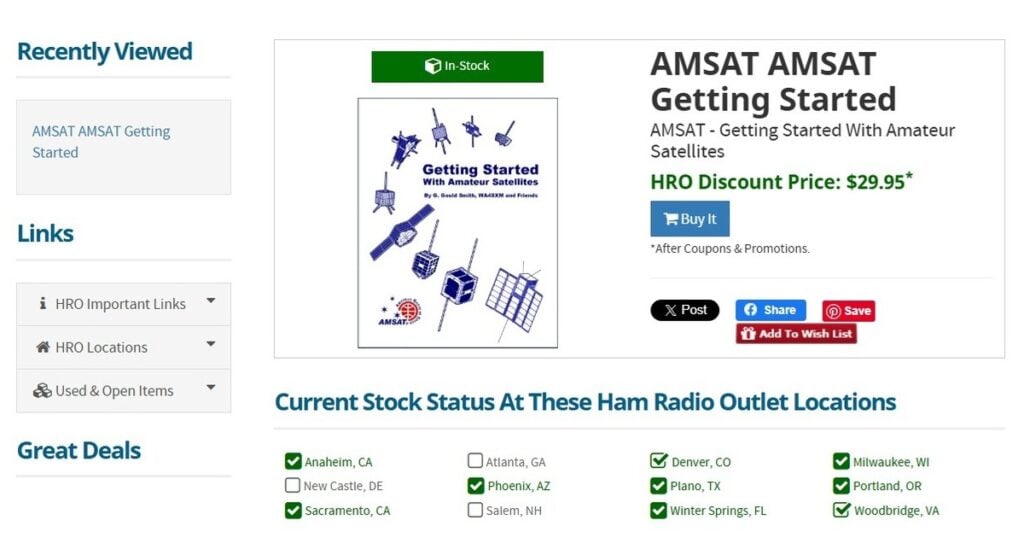
Buying from Ham Radio Outlet?
Add AMSATâs Getting Started With Amateur Satellites to your order.
Available for $29.95 from HRO (free shipping on most orders over $100)
https://www.hamradio.com/detail.cfm?pid=H0-019238
Satellite Shorts from All Over
+ Amazon has suffered a major setback in its plans to offer a viable Starlink rival, after 40 satellites destined for low Earth orbit (LEO) were destroyed. Just ten minutes after the Vulcan vehicle launched from Space Launch Complex 41 in Cape Canaveral, Florida, on November 15, there was an anomaly, meaning that the rocket failed to deliver the Amazon mission to orbit. [ANS thanks Tom's Hardware for the above information. See the full story at https://www.tomshardware.com/tech-industry/space/amazons-starlink-rival-sees-major-setback-after-40-satellites-destroyed-in-rocket-failure-anomaly-occurred-10-minutes-after-the-vulcan-launch-on-sunday.]
+ Cyprus unveiled its first locally built satellite, Kyrenia 3, on November 16, marking a significant step in the countryâs ambitions to establish itself in the international space industry, as a new space weather operations centre also began operating in Nicosia. Although Kyrenia 3 has been unveiled, its launch date has yet to be finalized. Beyond its scientific and commercial ambitions, the project also aims to bring space exploration closer to children. Officials announced an educational initiative through which students will be encouraged to build satellite receivers and antennas capable of receiving messages from space. The initiative will allow children to compete for equipment kits and assemble receivers at their schools, with support from the Cyprus Amateur Radio Society. Students will be able to receive signals from the Kyrenia satellites, including messages from the President of the Republic and messages created by children themselves. [ANS thanks Cyprus Mail for the above information. See the full story at https://cyprus-mail.com/2026/11/16/cyprus-unveils-first-locally-built-satellite-marking-new-era-in-space-exploration.]
+ The South African Radio League (SARL) and AMSAT-SA are promoting amateur radio and amateur satellite technology at Science Forum South Africa 2026 (SFSA 2026), co-hosted by South Africa's Department of Science, Technology and Innovation (DSTI) and the Science Diplomacy Capital for Africa (SDCfA) initiative. Listed among more than 127 exhibitors at the event, AMSAT-SA and SARL are showcasing amateur radio's role in science, technology, engineering, and space communications to students, researchers, and visitors. [ANS thanks SARL, AMSAT-SA, and Science Forum South Africa for the above information. More information about the event and exhibitors is available at https://www.sfsa.co.za/exhibitors/. ]
+ Currently, an estimated 17,776 satellites reside in low Earth orbitâa giant network supporting critical civilian and military infrastructure. Hereâs a chilling thought experiment. What if someone threw a nuclear bomb in low Earth orbit? Thatâs the premise behind new research by physicists at the University of Wisconsin-Madison and Princeton University. The paper, which has yet to be peer-reviewed, considers a scenario in which a one-megaton nuclear detonation occurs at 311 miles (500 kilometers) above the South Atlantic. The team developed a framework based on multiple collision and debris models, as well as calculations on the spread of radioactive fission products. A single nuclear explosion would disable roughly 98% of satellites within one weekâat least according to the model. In 2024, Russia vetoed a United Nations Security Council resolution reaffirming a nuclear weapons ban in Earthâs orbit. This has sparked concerns that a nuclear weapon could be used against orbital infrastructure. [ANS thanks Gizmodo for the above information. See the full story at https://gizmodo.com/scientists-simulated-a-nuclear-blast-in-orbit-and-nearly-every-satellite-died-2000841217.]
Â
Join AMSAT today at https://launch.amsat.org/
In addition to regular membership, AMSAT offers membership to:
- Societies (a recognized group, club, or organization).
- Students enrolled in at least half-time status are eligible for free membership to age 25.
- Memberships are available for annual and lifetime terms.
Contact info [at] amsat.org for additional membership information.
73 and remember to help Keep Amateur Radio in Space!
This week's ANS Editor,
Vidya Gopalakrishnan, K4VGK
ANS is a service of AMSAT, the Radio Amateur Satellite Corporation, 712 H Street NE, Suite 1653, Washington, DC 20002
AMSAT is a registered trademark of the Radio Amateur Satellite Corporation.