SB PROP @ ARL $ARLP026 ARLP026 Propagation de K7RA
ZCZC AP26 QST de W1AW Propagation Forecast Bulletin 26 ARLP026 From Tad Cook, K7RA Seattle, WA June 20, 2008 To all radio amateurs
SB PROP ARL ARLP026 ARLP026 Propagation de K7RA
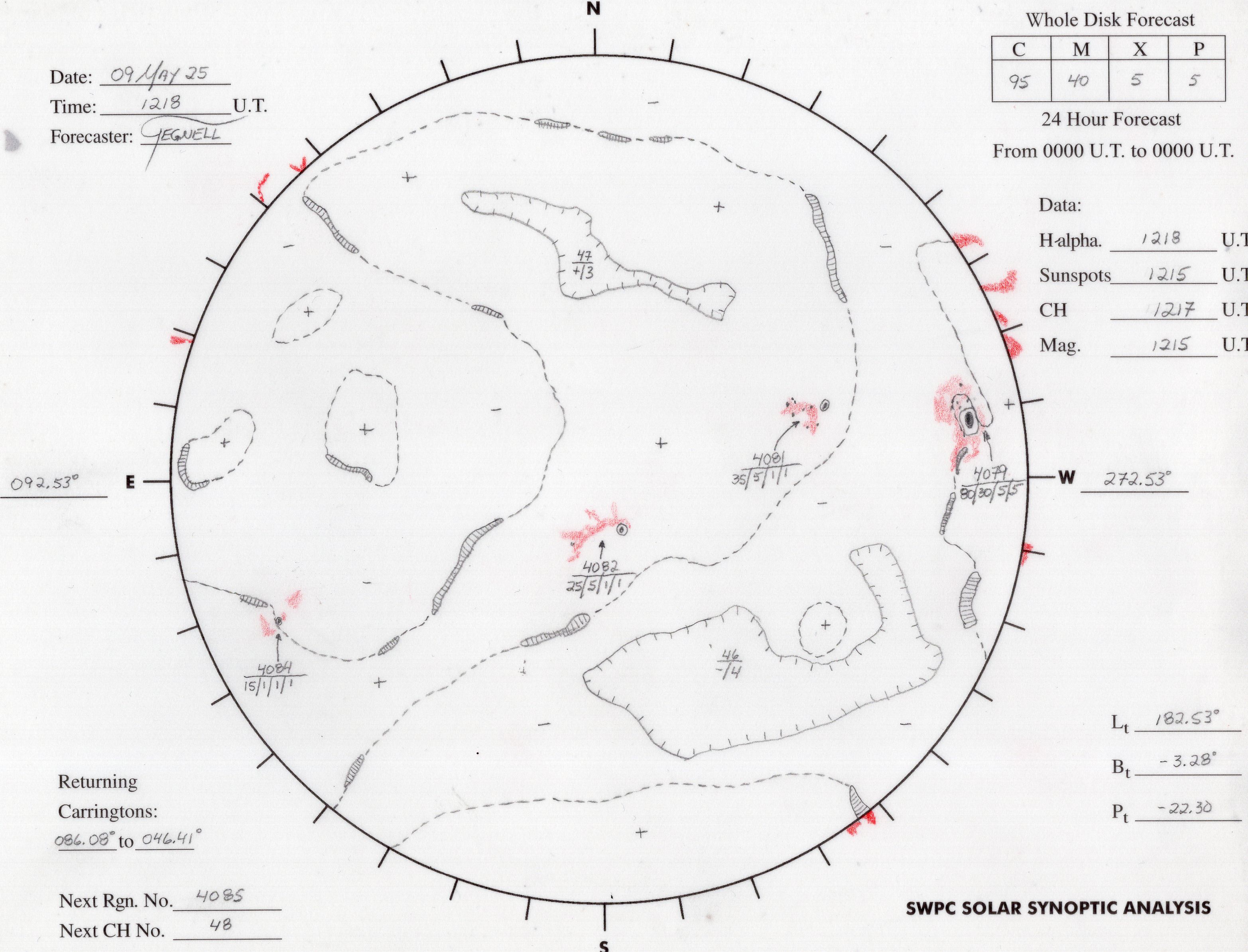
We are lucky to see at least one sunspot this week, although it is only one. Sunspot 999 is currently in its most geo-effective position, near the center of the sun, as we see it. This is another old cycle 23 spot. The sunspot number for the last few days has been 11, which is the minimum non-zero sunspot number. A value of ten is assigned because there is just one cluster of sunspots, although in this case it is a cluster of just one. A value of one is added to that for the single spot. A week ago the sunspot number was 13, which means one cluster, three spots, although the judgment of the number of spots inside sunspot 999 is somewhat subjective.
Let's compare a couple of solar photos from last summer which illustrate the subtle difference between a sunspot number of 12, and sunspot number of 14.
The August photo looks like 969 might have three dark areas, but a daily sunspot number of 14 means there were four spots in one region.
The July photo appears to show two dark areas, which is consistent with a daily sunspot number of 12.
Next week is ARRL Field Day. On June 28-29 there are no predicted geomagnetic upsets. The predicted planetary A index for June 27-29 is 8, 5 and 5. Maybe we'll get lucky and see a sunspot or two. There is a very good chance that conditions could be much as they were last year, with fairly low geomagnetic activity (although the predicted activity for this year is lower) and no sunspots.
A Portuguese group, Associacao de Radioamadores da Vila de Moscavide sent a link (http://www.arvm.org/index_fd2008.html) to their recent Field Day photos. In Europe Field Day is held earlier than the ARRL Field Day. Note that on the page at the bottom there are links to past Field Day images (see page bottom) and links at the top of the page go to photos taken by a number of different hams.
Mike Williams, W4DL of Pompano Beach, Florida (EL96) mentioned that last weekend's ARRL June VHF QSO Party produced great results for him. He said the spectrum scope on his rig made 6 meters look like 20 meters. He wrote, ''It was incredible; I worked numerous stations from here in EL96 on CW and also SSB, and AM. I checked 2 meters and snagged K8GP there and 10 minutes later on 6. The 6 meter band was open early in the morning on Saturday and was still going strong at 0000Z that evening. Love the QRM on 6 meter CW!''
Ken Sturgill of Marion, Virginia sent in a tip about 6 meter activity on June 13. Go to http://www.vhfdx.net/spots/index.php and set variable 1 to 50 MHz, variable 3 to Reported from 13 June to 14 June 2008 and Show Only QSO above 5000 km, variable 4 to 1000, then hit Submit Query. This shows a slew of six meter contacts over long distances, mostly via multi-hop e-layer propagation. Of course you can vary the parameters however you want, and if you lower the Show Only variable you will see more e-skip that is not multihop. Looks like a dramatic six meter opening that day.
Jon Jones, N0JK sent in some six meter spots from last weekend, and also some info on six meter sporadic-e propagation.
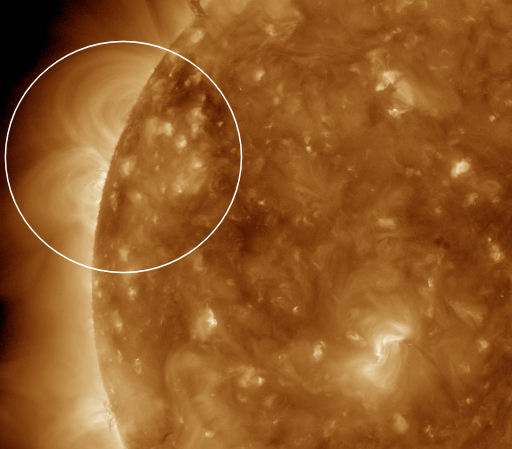
Steve Lybarger, NU7T of Sparks, Nevada sent in this link to an interesting article about dipole patterns in solar coronagraphs at solar activity minimum:
If you would like to make a comment or have a tip for our readers, email the author at, k7ra@arrl.net.
Sunspot numbers for June 12 through 18 were 13, 13, 0, 0, 11, 11, and 11 with a mean of 8.4. 10.7 cm flux was 67.1, 66.5, 67.1, 66.5, 65.3, 65.9, and 65.4 with a mean of 66.3. Estimated planetary A indices were 3, 3, 16, 20, 13, 9 and 9 with a mean of 10.4. Estimated mid-latitude A indices were 2, 1, 16, 14, 10, 8 and 8, with a mean of 8.4. NNNN /EX
Copyright 1996 - 2026 by David Cottle. Designed by David Bate Jr. All Rights Reserved.
By using this forum, the user agrees not to transfer any data or technical information received under this agreement to any other entity without the express approval of the AUS-CITY Forum Admins and/or authors of individual posts (Forum Admins and DoD/USSPACECOM for the analysis of satellite tracking data).
Two-line elements (TLE) and all other satellite data presented and distributed via this forum and AUS-CITY mailing lists are distributed with permission from DoD/USSTRATCOM.