|
0 members (),
810
guests, and
23
robots. |
|
Key:
Admin,
Global Mod,
Mod
|
|
S |
M |
T |
W |
T |
F |
S |
|
|
|
|
1
|
2
|
3
|
4
|
|
5
|
6
|
7
|
8
|
9
|
10
|
11
|
|
12
|
13
|
14
|
15
|
16
|
17
|
18
|
|
19
|
20
|
21
|
22
|
23
|
24
|
25
|
|
26
|
27
|
28
|
29
|
30
|
31
|
|
|
There are no members with birthdays on this day. |
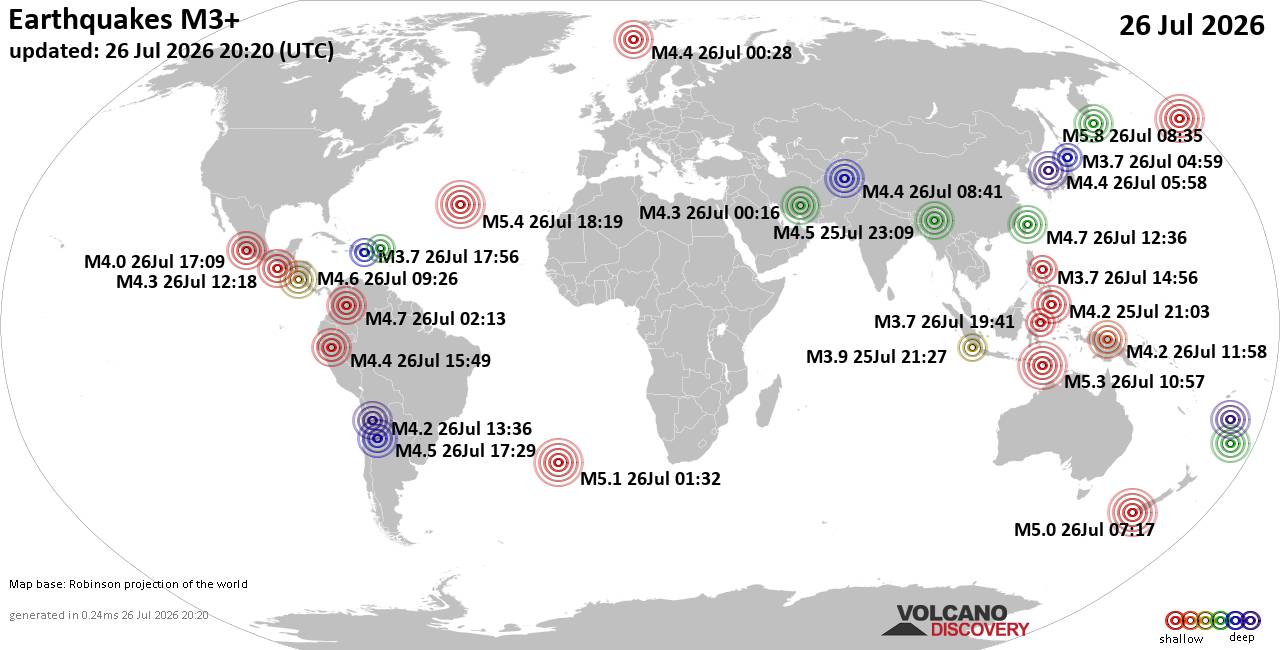
World Earthquake Report for Sunday, 26 July 2026
• Moderate mag. 4.5 earthquake - Estado de Veracruz-Llave, Mexico, on 2026-07...
• Volcano earthquake report for Sunday, 26 Jul 2026
• Moderate mag. 4.0 earthquake - Kabupaten Kepulauan Talaud, 148 km northeast...
• Light mag. 3.9 earthquake - North Pacific Ocean, 65 km south of Puerto San ...
• Strong mag. 5.4 earthquake - Northern Mid-Atlantic Ridge on Sunday, Jul 26,...
|

#34522
Sat 04 Aug 2007 10:59:PM
|
Joined: Feb 2001
Posts: 678,976
Launch Director
|
OP

Launch Director
Joined: Feb 2001
Posts: 678,976 |
HUBBLE SPACE TELESCOPE - Continuing to collect World Class Science
DAILY REPORT # 4414
PERIOD COVERED: UT July 27,28,29, 2007 (DOY 208,209,210)
OBSERVATIONS SCHEDULED NIC1/NIC2/NIC3 8794
NICMOS Post-SAA calibration - CR Persistence Part 5
A new procedure proposed to alleviate the CR-persistence problem of
NICMOS. Dark frames will be obtained immediately upon exiting the SAA
contour 23, and every time a NICMOS exposure is scheduled within 50
minutes of coming out of the SAA. The darks will be obtained in parallel
in all three NICMOS Cameras. The POST-SAA darks will be non-standard
reference files available to users with a USEAFTER date/time mark. The
keyword 'USEAFTER=date/time' will also be added to the header of each
POST-SAA DARK frame. The keyword must be populated with the time, in
addition to the date, because HST crosses the SAA ~8 times per day so
each POST-SAA DARK will need to have the appropriate time specified, for
users to identify the ones they need. Both the raw and processed images
will be archived as POST-SAA DARKs. Generally we expect that all NICMOS
science/calibration observations started within 50 minutes of leaving an
SAA will need such maps to remove the CR persistence from the science
images. Each observation will need its own CRMAP, as different SAA
passages leave different imprints on the NICMOS detectors.
WFPC2 11314
Calibration of MARCI UV using WFPC2
Ultraviolet imaging is a major unique component of the MARCI experiment
on MRO. Unfortunately the calibration of the UV, especially of the 260
nm filter, on MARCI is uncertain due to various unexpected problems
during laboratory calibration. Two orbits of WFPC2 observations are
requested to properly calibrate the UV using simultaneous MRO / HST
observations in a favorable geometry where HST is "looking over the
shoulder" of MRO.
WFPC2 11307
Completing the ACS Nearby Galaxy Survey with WFPC2
We are requesting 25 orbits of Director's Discretionary Time to complete
the primary science goals of our highly-ranked ACS Nearby Galaxy Survey
Treasury program {ANGST}. Our program lost ~2/3 of its orbits due to the
ACS failure. Roughly half of these were restored as a result of an
appeal to the Telescope Time Review Board which re-scoped the program.
The Board's response to our appeal was explicit in terms of which
targets were to be observed and how. We were directed to request
Director's discretionary time for the components of the appeal which
were not granted by the Review Board, but which were vital to the
success of the program. The observing strategy for ANGST is two-fold: to
obtain one deep field per galaxy which enables derivation of an accurate
ancient star formation history, and to obtain radial tilings sufficient
for recovering the full star formation history. The Review Board granted
WFPC2 observations for deep fields in 7 galaxies, but no time for radial
tilings. However, recovering the full star formation history of a galaxy
is not possible without additional radial coverage. We have searched the
archives for observations which may be used in place of the tilings
{conceding some of the Treasury goals, but providing significant
constraints on the full star formation history}, and have identified
suitable observations for all but two of the galaxies. Here we request
DD time for radial tilings for those last two galaxies.
NIC2 11219
Active Galactic Nuclei in nearby galaxies: a new view of the origin of
the radio-loud radio-quiet dichotomy?
Using archival HST and Chandra observations of 34 nearby early-type
galaxies {drawn from a complete radio selected sample} we have found
evidence that the radio-loud/radio-quiet dichotomy is directly connected
to the structure of the inner regions of their host galaxies in the
following sense: [1] Radio-loud AGN are associated with galaxies with
shallow cores in their light profiles [2] Radio-quiet AGN are only
hosted by galaxies with steep cusps. Since the brightness profile is
determined by the galaxy's evolution, through its merger history, our
results suggest that the same process sets the AGN flavor. This
provides us with a novel tool to explore the co-evolution of galaxies
and supermassive black holes, and it opens a new path to understand the
origin of the radio-loud/radio-quiet AGN dichotomy. Currently our
analysis is statistically incomplete as the brightness profile is not
available for 82 of the 116 targets. Most galaxies were not observed
with HST, while in some cases the study is obstructed by the presence of
dust features. We here propose to perform an infrared NICMOS snapshot
survey of these 82 galaxies. This will enable us to i} test the reality
of the dichotomic behavior in a substantially larger sample; ii} extend
the comparison between radio-loud and radio-quiet AGN to a larger range
of luminosities.
WFPC2 11202
The Structure of Early-type Galaxies: 0.1-100 Effective Radii
The structure, formation and evolution of early-type galaxies is still
largely an open problem in cosmology: how does the Universe evolve from
large linear scales dominated by dark matter to the highly non-linear
scales of galaxies, where baryons and dark matter both play important,
interacting, roles? To understand the complex physical processes
involved in their formation scenario, and why they have the tight
scaling relations that we observe today {e.g. the Fundamental Plane}, it
is critically important not only to understand their stellar structure,
but also their dark-matter distribution from the smallest to the largest
scales. Over the last three years the SLACS collaboration has developed
a toolbox to tackle these issues in a unique and encompassing way by
combining new non-parametric strong lensing techniques, stellar
dynamics, and most recently weak gravitational lensing, with
high-quality Hubble Space Telescope imaging and VLT/Keck spectroscopic
data of early-type lens systems. This allows us to break degeneracies
that are inherent to each of these techniques separately and probe the
mass structure of early-type galaxies from 0.1 to 100 effective radii.
The large dynamic range to which lensing is sensitive allows us both to
probe the clumpy substructure of these galaxies, as well as their
low-density outer haloes. These methods have convincingly been
demonstrated, by our team, using smaller pilot-samples of SLACS lens
systems with HST data. In this proposal, we request observing time with
WFPC2 and NICMOS to observe 53 strong lens systems from SLACS, to obtain
complete multi-color imaging for each system. This would bring the total
number of SLACS lens systems to 87 with completed HST imaging and
effectively doubles the known number of galaxy-scale strong lenses. The
deep HST images enable us to fully exploit our new techniques, beat down
low-number statistics, and probe the structure and evolution of early-
type galaxies, not only with a uniform data-set an order of magnitude
larger than what is available now, but also with a fully coherent and
self-consistent methodological approach!
WFPC2/NIC3 11188
First Resolved Imaging of Escaping Lyman Continuum
The emission from star-forming galaxies appears to be responsible for
reionization of the universe at z>6. However, the models that attempt to
describe the detailed impact of high- redshift galaxies on the
surrounding inter-galactic medium {IGM} are strongly dependent upon
several uncertain parameters. Perhaps the most uncertain is the fraction
of HI-ionizing photons produced by young stars which escape into the
IGM. Most attempts to measure this "escape fraction" {f_esc} have
produced null results. Recently, a small subset of z~3 Lyman Break
Galaxies {LBGs} has been found exhibiting large escape fractions. It
remains unclear however, what differentiates them from other LBGs.
Several models attempt to explain how such a large fraction of ionizing
continuum can escape through the HI and dust in the ISM {eg. "chimneys"
created by SNe winds, globular cluster formation, etc.}, each producing
unique signatures which can be observed with resolved imaging of the
escaping Lyman continuum. We propose a deep, high resolution WFPC2 image
of the ionizing continuum {F336W} and the rest-frame 1500 Angstrom
continuum {F606W} of five of the six known LBGs with large escape
fractions. These LBGs all fit within a single WFPC2 pointing, yielding
high observing efficiency. Additionally, they all have z~3.1 or higher,
the optimal redshift range for probing the Lyman Continuum region with
available WFPC2 filters. These factors make our proposed sample
especially suitable for follow- up. With these data we will discern the
mechanisms responsible for producing large escape fractions, and
therefore gain insight into the process of reionization.
WFPC2 11176
Location and the Origin of Short Gamma-Ray Bursts
During the past decade extraordinary progress has been made in
determining the origin of long- duration gamma-ray bursts. It has been
conclusively shown that these objects derive from the deaths of massive
stars. Nonetheless, the origin of their observational cousins,
short-duration gamma-ray bursts {SGRBs} remains a mystery. While SGRBs
are widely thought to result from the inspiral of compact binaries, this
is a conjecture. A number of hosts of SGRBs have been identified, and
have been used by some to argue that SGRBs derive primarily from an
ancient population {~ 5 Gyr}; however, it is not known whether this
conclusion more accurately reflects selection biases or astrophysics.
Here we propose to employ a variant of a technique that we pioneered and
used to great effect in elucidating the origins of long-duration bursts.
We will examine the degree to which SGRB locations trace the red or blue
light of their hosts, and thus old or young stellar populations. This
approach will allow us to study the demographics of the SGRB population
in a manner largely free of the distance dependent selection effects
which have so far bedeviled this field, and should give direct insight
into the age of the SGRB progenitor population.
NIC2 11152
Probing the compact dust disk of a nearby Classical T Tauri Star
BP Psc is a high Galactic latitude {b = -57}, bright, IRAS source that
generally has been classified as a T Tauri star but little studied to
date. We have carried out a multiwavelength ground-based study of this
object and find that it is most likely a ~10 Myr classical T Tauri star
surrounded by a gas and dust disk, and less than 100 pc from Earth,
making it one of the oldest and closest such stars known. Near-IR AO
images and IR photometry show it is surrounded by an compact {0.2"},
almost-edge-on, optically thick disk of dust with a wide range of
temperatures. We propose a multiwavelength polarimetric study of the
compact disk to support quantitative modeling to recover disk and dust
parameters. We also propose coronagraphic imaging to search for larger-
scale dust structures invisible in ground-based images, and narrowband
imaging of an outflow jet and associated Herbig-Haro objects to study
their structure and determine a kinematic distance of the system. A
massive compact disk surrounding an isolated 10 Myr star is a unique
environment for planet formation, and its proximity to Earth allows HST
to study it in detail.
WFPC2 11118
Investigating Near-Equinox Atmospheric Change on Uranus
Uranus is approaching its 7 December 2007 equinox, when we will be able
to observe the entire northern hemisphere for the first time with modern
cameras. The large seasonal phase shift expected from its long radiative
time constant implies that it should now exhibit nearly maximal
hemispheric contrast, and should be in the process of reversing. Many
changes already observed, such as the development of the first
visible-wavelength dark spot, discovered in Cycle 15, and the fading of
the south polar cap may be indicative of the expected reversal. We
propose a detailed characterization of Uranus' current seasonal response
with a 7-orbit program consisting of 1 orbit of NICMOS imaging of cloud
bands and 6 orbits of WFPC2 imaging using both broadband and narrow-band
filters capable of tracking dark and bright discrete cloud features.
Filters between 0.467 and 1.87 microns will provide vertical sensing
depths scanning through the pressure range where the putative methane
and deeper H2S clouds might plausibly exist and provide strong
constraints on their contributions and parent gas mixing ratios. These
observations have unique combinations of spectral range and resolution
with needed temporal and spatial resolution not available from
groundbased observations. Only HST is capable of investigating the
Uranus dark spot.
WFPC2 11100
Two new `bullets' for MOND: revealing the properties of dark matter in
massive merging clusters
The principal objective of this proposal is to study the physical nature
of dark matter by using two, massive, newly-identified merging clusters
of galaxies. As shown by the pioneering example of the ``bullet
cluster'' {1E0657-56}, such systems are ideal laboratories for detecting
dark matter and distinguishing between cold dark matter {CDM} and other
scenarios {e.g. self- interacting dark matter}. Our limit on the
self-interaction cross-section of dark matter relies on the assumption
of a normal pre-merger mass-to-light ratios, and a small impact
parameter during the collision of the two clusters. In order to mitigate
any possible systematic effects, it is vital to extend this work to
other, similar systems. With detailed observations of new systems, the
systematic uncertainties in the dark matter cross section calculations
can be improved substantially, allowing us to move from rough order of
magnitude estimates to measurements with quantifiable uncertainties that
can be compared usefully with the predictions from numerical
simulations. Our targets are two extraordinary, high-redshift, merging
galaxy clusters recently discovered by the Massive Cluster Survey
{MACS}. This survey is by far the best matched to this study, since it
selects medium redshift {optimal for gravitational lensing studies} and
X-ray luminous {hence massive} objects. We have selected the best
candidates with clear evidence for considerable offsets between the hot
X-ray emitting gas and optically luminous stellar material. The two most
striking examples are the targets of this proposal. To pin down the
position of the dark matter component we require high resolution,
absolutely calibrated mass maps. The combination of weak and strong
lensing measurements is needed to attain this goal. This can only be
achieved with the excellent resolving power of the HST {in combination
with wide-field, multicolor Subaru data already in hand}. We therefore
request multicolor HST/WFPC2 observations of the two merging clusters.
The combination of constraints from multiply lensed images {identified
via morphology and color information} and high-resolution weak lensing
data will allow us to construct, self-consistently, their mass
distribution from the very centers to the outskirts. Gravitational
lensing thus provides a unique tool transforming these clusters into
dark matter laboratories. They will supply us with answers as to the
nature and properties of dark matter, and how it shapes galaxies and
galaxy clusters and their evolution through cosmic time.
WFPC2 11079
Treasury Imaging of Star Forming Regions in the Local Group:
Complementing the GALEX and NOAO Surveys
We propose to use WFPC2 to image the most interesting star-forming
regions in the Local Group galaxies, to resolve their young stellar
populations. We will use a set of filters including F170W, which is
critical to detect and characterize the most massive stars, to whose hot
temperatures colors at longer wavelengths are not sensitive. WFPC2's
field of view ideally matches the typical size of the star-forming
regions, and its spatial resolution allows us to measure individual
stars, given the proximity of these galaxies. The resulting H-R diagrams
will enable studies of star- formation properties in these regions,
which cover largely differing metallicities {a factor of 17, compared to
the factor of 4 explored so far} and characteristics. The results will
further our understanding of the star-formation process, of the
interplay between massive stars and environment, the properties of dust,
and will provide the key to interpret integrated measurements of
star-formation indicators {UV, IR, Halpha} available for several
hundreds more distant galaxies. Our recent deep surveys of these
galaxies with GALEX {FUV, NUV} and ground-based imaging {UBVRI, Halpha,
[OIII] and [SII]} provided the identification of the most relevant SF
sites. In addition to our scientific analysis, we will provide catalogs
of HST photometry in 6 bands, matched corollary ground-based data, and
UV, Halpha and IR integrated measurements of the associations, for
comparison of integrated star-formation indices to the resolved
populations. We envisage an EPO component.
WFPC2 11033
Full Moon Earth Flats Closeout
Flat field exposures will be obtained by observing the moonlit Earth
with the broadband WFPC2 filters F606W and F814W, which saturate in the
minimum exposure time on the sunlit Earth. These observations will be
used to improve the flats currently in the pipeline and are part of the
WFPC2 closeout operations. Because CTE effects are large for star flats
and small for full field illumination, Earth flats are the superior
technique.
WFPC2 10583
Resolving the LMC Microlensing Puzzle: Where Are the Lensing Objects ?
We are requesting 32 HST orbits to help ascertain the nature of the
population that gives rise to the observed set of microlensing events
towards the LMC. The SuperMACHO project is an ongoing ground-based
survey on the CTIO 4m that has demonstrated the ability to detect LMC
microlensing events in real-time via frame subtraction. The improvement
in angular resolution and photometric accuracy available from HST will
allow us to 1} confirm that the detected flux excursions arise from LMC
source stars rather than extended objects {such as for background
supernovae or AGN}, and 2} obtain reliable baseline flux measurements
for the objects in their unlensed state. The latter measurement is
important to resolve degeneracies between the event timescale and
baseline flux, which will yield a tighter constraint on the microlensing
optical depth.
FLIGHT OPERATIONS SUMMARY:
Significant Spacecraft Anomalies: (The following are preliminary reports
of potential non-nominal performance that will be investigated.)
HSTARS:
#10918 REacq(1,2,1) failed to RGA Control (Gyro Control).
REacq(1,2,1) scheduled at 209/13:56:20 - 14:04:25 failed to RGA Hold due
to (QF1STOPF) stop flag indication on FGS-1. Pre-acq OBADs showed (RSS)
attitude correction values of 888.95 and 17.77 arcseconds. Prior
GSAcq(1,2,1) of 209/12:40:12 was successful. Post-acq OBAD/MAP had (RSS) value of 10.04 arcseconds.
REacq(1,2,1) at 209/15:33:00 was successful. Upon acquisition of signal
at 209/17:23:59, HST was in Gyro Control with QF1STOPF and STOP flags
set. REacq(1,2,1) at 209/17:08:53 failed to RGA Hold.
#10919 GSAcq(1,3,3) results in fine lock backup (1,0,1).
Upon acquisition of signal at 209/19:08:11, the GSAcq(1,3,3) scheduled
at 209/18:49:46 - 18:57:51 had resulted in fine lock backup (1,0,1)
using FGS-1 due to (QF3STOPF) stop flag indication on the secondary
FGS-3. Pre-acq OBADs (RSS) attitude correction values not available due
to LOS. Post-acq OBAD/MAP showed (RSS) value of 13.60 arcseconds.
Subsequent REacq(1,3,3) scheduled at 209/20:24:07 resulted in fine lock
backup (1,0,1) using FGS-1 due to QF3STOPF stop flag indication on
FGS-3. Pre-acq OBADs were successful.
#10920 GSAcq (1,2,1) failed to RGA Hold (Gyro Control)
AT AOS 209/22:27:15 GSAcq (1,2,1) had failed to RGA Hold (Gyro Control)
with stop flags "QSTOP & QF1STOPF".
OBAD #1 & 2 data unavailable until engineering data dump is
accomplished. OBAD MAP: v1 6.30, V2 -0.41, V3 1.11, RSS 6.41.
At AOS 210/01:04:16 REAcq (1,2,1) scheduled from 209/23:32:20-23:39:50
had failed to RGA Hold (Gyro Control) with stop flags "QSTOP &
QF1STOPF". OBAD data unavailable due to LOS.
REAcq (1,2,1) scheduled from 210/01:08:14-01:15:44 failed to RGA Hold
(Gyro Control) with stop flags "QSTOP & QF1STOPF". FGS 1 reached a PMT
count high of 6393.00244.
OBAD #1: V1 -71.68, V2 -770.33, V3 -15.23, RSS 773.81 OBAD #2: V1 2.32,
V2 0.99, V3 -12.84, RSS 13.08 OBAD MAP: not scheduled
Note: The same guide star pair used in HSTAR 10918
COMPLETED OPS REQUEST: (None)
SCHEDULED SUCCESSFUL
FGS GSacq 22 21
FGS REacq 20 16
OBAD with Maneuver 84 84
COMPLETED OPS NOTES: (None)
SIGNIFICANT EVENTS: (None)
David Cottle
UBB Owner & Administrator
|
|



CMS The Best Conveyancing solicitors conveyancing quotes throughout the UK
For any webhosting enquiries please email webmaster@aus-city.com
|
|
Entire Thread
|
 Daily Report # 4414
|
Webmaster
|
Sat 04 Aug 2007 10:59:PM
|
|
Forums60
Topics793,396
Posts828,179
Members2,960
| |
Most Online102,106
Jul 10th, 2026
|
|
|