|
1 members (Alisa),
2,530
guests, and
26
robots. |
|
Key:
Admin,
Global Mod,
Mod
|
|
S |
M |
T |
W |
T |
F |
S |
|
|
|
1
|
2
|
3
|
4
|
5
|
|
6
|
7
|
8
|
9
|
10
|
11
|
12
|
|
13
|
14
|
15
|
16
|
17
|
18
|
19
|
|
20
|
21
|
22
|
23
|
24
|
25
|
26
|
|
27
|
28
|
29
|
30
|
|
|
|
|
There are no members with birthdays on this day. |
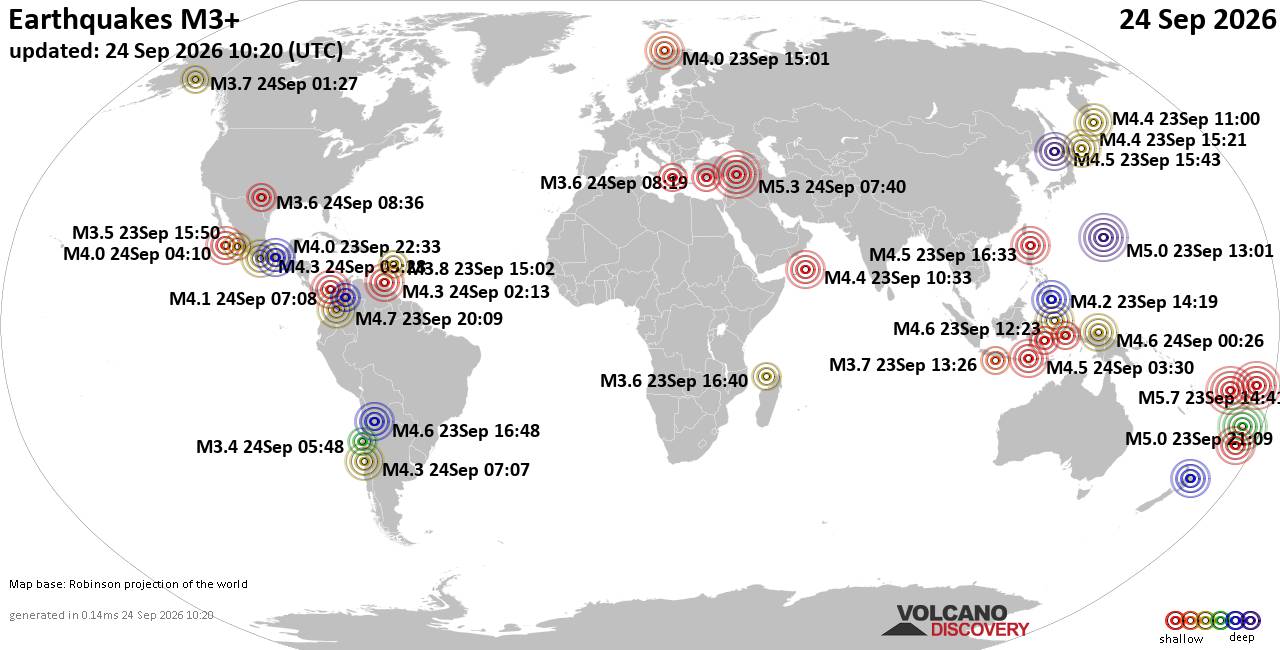
World Earthquake Report for Thursday, 24 September 2026
• Moderate mag. 4.3 earthquake - Madagascar: Mozambique Channel on Thursday, ...
• Small magnitude 3.9 earthquake hits near Hastings, Hastings District, Hawke...
• Volcano earthquake report for Thursday, 24 September 2026
• Light mag. 3.9 earthquake - South Pacific Ocean, 10.2 km south of Hastings,...
• Moderate magnitude 4.1 quake hits 31 miles southeast of Midland, Texas, Uni...
|

#3909
Sat 24 Aug 2002 04:50:PM
|
Joined: Feb 2001
Posts: 678,977
Launch Director
|
|
Launch Director
Joined: Feb 2001
Posts: 678,977 |
HUBBLE SPACE TELESCOPE<br /><br />DAILY REPORT # 3185<br /><br />PERIOD COVERED: DOY 234<br /><br />OBSERVATIONS SCHEDULED [see HSTARS below for possible observation problems]<br /><br />NICMOS 8790<br /><br />NICMOS Post-SAA calibration - CR Persistence Part 1.<br /><br />A new procedure proposed to alleviate the CR-persistence problem of NICMOS. Dark<br />frames will be obtained immediately upon exiting the SAA contour 23, and every<br />time a NICMOS exposure is scheduled within 50 minutes of coming out of the SAA.<br />The darks will be obtained in parallel in all three NICMOS Cameras. The POST-SAA<br />darks will be non-standard reference files available to users with a USEAFTER<br />date/time mark.<br /><br />STIS/CCD 8902<br /><br />Dark Monitor-Part 2.<br /><br />The Space Telescope Imaging Spectrograph [CCD] was used to monitor the darks.<br /><br />STIS/CCD 8904<br /><br />Bias Monitor-Part 2.<br /><br />The Space Telescope Imaging Spectrograph [CCD] was used to monitor the bias in<br />the 1x1, 1x2, 2x1, and 2x2 bin settings at gain=1, and 1x1 at gain = 4 in order<br />to build up high-S/N superbiases and track the evolution of hot columns.<br /><br />WFPC2 8938<br /><br />WFPC2 CYCLE 9 SUPPLEMENTAL DARKS pt3/3.<br /><br />characterizing the evolution of hot pixels.<br /><br />NICMOS 8984<br /><br />NICMOS Coronagraphic Performance Assessment<br /><br />scattered energy rejection of occulted targets to improve the target/background<br />contrast ratios by use of the NICMOS coronagraph. The performance levels of<br />system will be assessed while exploring the observational parameter spaces and<br />execution strategies which undoubtedly will be proposed for use in HST Cycle 11.<br />This test is constructed in four parts with different, but complementary, Taken<br />together they will provide critical information needed to re-evaluate the<br />coronagraphic systemic performance from which flight {and possibly ground} S/W<br />updates, and advisories to observers defining Phase 2 proposals will be issued.<br /><br />STIS/CCD 9066<br /><br />Closing in on the Hydrogen Reionization Edge of the Universe.<br /><br />edge in emission that marks the transition from a neutral to a fully ionized IGM<br />at a predicted redshifts.<br /><br />STIS/CCD 9110<br /><br />A Search for Kuiper Belt Object Satellites.<br /><br />The Space Telescope Imaging Spectrograph [CCD] was used to investigate whether<br />the large number of collisions thought to have taken place in the primordial<br />Kuiper belt suggest that many Kuiper belt objects {KBOs} could have suffered<br />binary-forming collisions similar to that which formed the Pluto -- Charon<br />binary. Detection of such KBO satellites would allow measurement of KBO masses,<br />would help to understand the past collisional environment of the Kuiper belt,<br />and would give a context to the otherwise unique-seeming formation of the Pluto<br />-- Charon binary.<br /><br />WF/PC-2 9180<br /><br />Gamma-ray Burst Progenitors: Probing Their Environment.<br /><br />The WF/PC-2 was used to perform a target of opportunity observation of gamma ray<br />burster [GRB], GRB-011121. GRB astronomy is a field maturing at a phenomenal<br />rate. Three important new observational and theoretical discoveries, formulated<br />over the last twelve months, allow the proposer to address new, and in many<br />cases, more sophisticated questions than could have been posed previously. These<br />developments: the discovery of X-ray lines in GRB 991216; the observation that<br />N_H as deduced from X-ray afterglow are one to two orders of magnitude larger<br />than the dust extinction inferred from optical afterglow; and the growing<br />realization that the afterglow emission may exhibit features of dust echoes,<br />appear to offer unexpected and new diagnostics that will directly inform us<br />about the progenitor, the circum-progenitor material and the immediate<br />interstellar environs.<br /><br />STIS/CCD 9317<br /><br />Pure Parallel Imaging Program: Cycle 10.<br /><br />program for STIS during cycle 10.<br /><br />FGS 9347<br /><br />FGS Astrometry of the Extrasolar Planet of Epsilon Eridani<br /><br />{perturbation orbit semimajor axis and inclination} of the candidate extra-solar<br />planet around the K2 V star Epsilon Eridani that has been detected by Doppler<br />spectroscopy. These observations will also permit us to determine the actual<br />mass of the planet by providing the sin{i} factor which can not be determined<br />with the radial velocity method. High precision radial velocity {RV}<br />measurements spanning the years 1980.8--2000.0 for the nearby {3.22 pc} star<br />Epsilon Eri show convincing variations with a period of ~ 7 yrs. These data<br />represent a combination of six independent data sets taken with four different<br />telescopes. A least squares orbital solution using robust estimation yields<br />orbital parameters of period, P = 6.9 yrs, velocity K- amplitude = 19 m/s,<br />eccentricity e = 0.6, projected companion mass M_B sin{i} = 0.83 M_Jupiter. An<br />estimate of the inclination yields a perturbation semi-major axis, Alpha =<br />0arcs0022, easily within the reach of HST/FGS astrometry.<br /><br />ACS 9425<br /><br />The Great Observatories Origins Deep Survey: Imaging with ACS<br /><br />We propose a Treasury program of ACS imaging as part of the Great Observatories<br />Origins Deep Survey {GOODS}, covering 320{square}', or 32* the area of the two<br />original WFPC2 HDFs, to within 0.5--0.8 mag of their depth in four ACS bands,<br />BViz. The two GOODS fields, the Hubble Deep Field North and Chandra Deep Field<br />South, are the premier deep survey areas from X-- ray to radio wavelengths. ACS<br />data will provide unique angular resolution, sensitivity, and wavelength<br />coverage to close the gap between the deepest Chandra and SIRTF observations.<br />Supported by extensive imaging and spectroscopy from the VLT, Keck, Subaru,<br />NOAO, Gemini, VLA, JCMT, and other facilities, the combined GOODS data set will<br />make it possible to map the evolution of the Hubble sequence with redshift,<br />reconstruct the history of galaxy mass assembly, star formation and nuclear<br />activity from the epoch of reionization to the present, trace the growth of<br />density perturbations via cosmic shear, and, with properly phased z--band<br />observations, detect ~ 12 Type Ia supernovae at 1.2<z<1.8 to test the cosmic<br />acceleration and the presence of dark energy. All HST, SIRTF, Chandra, and<br />supporting GOODS data are non-- proprietary, with science--quality images and<br />catalogs released on a timescale of months. This will constitute the deepest,<br />largest, and most uniform panchromatic data set ever assembled to study the<br />distant universe.<br /><br />SNAP/STIS 9434<br /><br />A SNAPSHOT Survey of the Hot Interstellar Medium<br /><br />We propose to obtain SNAPSHOT STIS echelle observations of key tracers of hot<br />interstellar gas {CIV, NV and SiIV} for selected FUSE Team OVI survey targets<br />with known UV fluxes. By taking advantage of the SNAPSHOT observing mode we will<br />efficiently obtain a large number of spectra suitable for the study of the<br />highly ionized hot component of the interstellar medium {ISM}. Our goals are to<br />explore the physical conditions in and distribution of such gas, as well as to<br />explore the nature of the interfaces between the hot ISM and the other<br />interstellar gas phases. Using inter--comparisons of the various ionic ratios<br />for CIV, NV, OVI and SiIV, we will be able to discriminate between the various<br />models for the production of the highly ionized gas in the Galactic ISM. The<br />survey will also enable detailed studies of regions already known to contain hot<br />gas through X-ray emission measurements {e.g., SNRs and radio loops}. The<br />proposed SNAPSHOT observations will extend our previous Cycle 9 survey {which<br />was compromised by the STIS side 1 failure}, and should roughly double the<br />number of stars for which high quality STIS observations of the important hot<br />gas tracers are available, enabling us to derive a truly global view of the hot<br />ISM.<br /><br />Note: Proposal 9434 maybe degraded because the Fine Guidance Sensors could only<br />acquire a single guide star at August 22, 2002 14:31<br /><br />ACS 9480<br /><br />Cosmic Shear With ACS Pure Parallels<br /><br />Small distortions in the shapes of background galaxies by foreground mass<br />provide a powerful method of directly measuring the amount and distribution of<br />dark matter. Several groups have recently detected this weak lensing by<br />large-scale structure, also called cosmic shear. The high resolution and<br />sensitivity of HST/ACS provide a unique opportunity to measure cosmic shear<br />accurately on small scales. Using 260 parallel orbits in Sloan textiti {F775W}<br />we will measure for the first time: beginlistosetlength sep0cm setlengthemsep0cm<br />setlength opsep0cm em the cosmic shear variance on scales <0.7 arcmin, em the<br />skewness of the shear distribution, and em the magnification effect. endlist Our<br />measurements will determine the amplitude of the mass power spectrum<br />sigma_8Omega_m^0.5, with signal-to-noise {s/n} ~ 20, and the mass density<br />Omega_m with s/n=4. They will be done at small angular scales where non-linear<br />effects dominate the power spectrum, providing a test of the gravitational<br />instability paradigm for structure formation. Measurements on these scales are<br />not possible from the ground, because of the systematic effects induced by PSF<br />smearing from seeing. Having many independent lines of sight reduces the<br />uncertainty due to cosmic variance, making parallel observations ideal.<br /><br />ACS/WFPC2 9481<br /><br />Pure Parallel Near-UV Observations with WFPC2 within High-Latitude ACS Survey<br />Fields<br /><br />the default pure parallel program for those WFPC2 parallels that fall within the<br />ACS survey field. Rather than duplicate the red bands which will be done much<br />better with ACS, we propose to observe in the near-ultraviolet F300W filter.<br />These data will enable study of the rest-frame ultraviolet morphology of<br />galaxies at 0<z<1. We will determine the morphological k-correction, and the<br />location of star formation within galaxies, using a sample that is likely to be<br />nearly complete with multi-wavelength photometry and spectroscopic redshifts.<br />The results can be used to interpret observations of higher redshift galaxies by<br />ACS.<br /><br />ACS/WFPC2 9488<br /><br />Cosmic Shear - with ACS Pure Parallel Observations<br /><br />The ACS, with greater sensitivity and sky coverage, will extend our ability to<br />measure the weak gravitational lensing of galaxy images caused by the large<br />scale distribution of dark matter. We propose to use the ACS in pure parallel<br />{non- proprietary} mode, following the guidelines of the ACS Default Pure<br />Parallel Program. Using the HST Medium Deep Survey WFPC2 database we have<br />measured cosmic shear at arc-min angular scales. The MDS image parameters, in<br />particular the galaxy orientations and axis ratios, are such that any residual<br />corrections due to errors in the PSF or jitter are much smaller than the<br />measured signal. This situation is in stark contrast with ground-based<br />observations. We have also developed a statistical analysis procedure to derive<br />unbiased estimates of cosmic shear from a large number of fields, each of which<br />has a very small number of galaxies. We have therefore set the stage for<br />measurements with the ACS at fainter apparent magnitudes and smaller, 10<br />arc-second scales corresponding to larger cosmological distances. We will adapt<br />existing MDS WFPC2 maximum likelihood galaxy image analysis algorithms to work<br />with the ACS. The analysis would also yield an online database similar to that<br />in archive.stsci.edu/mds/<br /><br />ACS/CAL 9558<br /><br />ACS weekly Test<br /><br />This program consists of basic tests to monitor, the read noise, the development<br />of hot pixels and test for any source of noise in ACS CCD detectors. This<br />programme will be executed once a day for the entire lifetime of ACS.<br /><br />ACS 9564<br /><br />ACS Cycle 11: UV Earth Flats<br /><br />This proposal will obtain sequences of UV flats by observing the bright Earth.<br />The HRC UV filters were chosen for modes which were not obtained in the lab.<br />Since the UV transmission is likely to vary as a function of position on the<br />Pol_UV filters and on the coronograph, and since this behavior is currently<br />unconstrained by measurement, a good estimate for the missing UV flats cannot be<br />made. Although POL_UV and CORON transmissions change little at long wavelengths,<br />the UV transmission may change by amounts larger than can be estimated in the<br />absence of actual UV transmission measurements<br /><br />WFPC2 9676<br /><br />POMS Test Proposal: WFII parallel archive proposal<br /><br />This is the generic target version of the WFPC2 Archival Pure Parallel program.<br />The program will be used to take parallel images of random areas of the sky,<br />following the recommendations of the 2002 Parallels Working Group.<br /><br />FLIGHT OPERATIONS SUMMARY:<br /><br />HSTARS [For details see ]http://hst-sers.hst.nasa.gov/SERS/HST/HSTAR.nsf]<br /><br />HSTARs: 8767 GS Acquisition [1,2,2] @ 234/14:26:52Z resulted in FL<br /> back-up on FGS 1 due to SSLE on FGS 2 @ 234/14:31:19Z. Under<br /> investigation.<br /><br />COMPLETED OPS REQs:<br />16833-1 - Battery 1 Capacity Test Script completed @ 234/2115z..<br /><br />OPS NOTES EXECUTED:<br />1031-0 Update Pressure-Based Batt. Capacity Eqns [Aug 2002] @ 234/2045z<br />1025-4 CCC K51, K52 Level 2 @ 234/2126z<br />1032-0 CCC/VIK K51 Level Change [Level 5] @ 234/2200z.<br /><br /> SCHEDULED SUCCESSFUL FAILURE TIMES<br />FGS GSacq 9 9<br />FGS REacq 8 8<br />FHST Update 18 18<br />LOSS of LOCK<br /><br />Operations Notes: The battery 1 capacity test is completed, and all batteries<br />are on line.<br /><br />SIGNIFICANT EVENTS:<br /><br />Successfully completed Battery 1 Capacity Test. Battery 1 sufficiently recovered<br />its discharge to 15 Volts. Voltage, pressure and loadshare are in family with<br />the other batteries. Returned Battery 1 to a 6-battery FSW configuration<br />@ 234/19:27Z [OR 16833-1]. The +D SPA [Battery 1 K2 relay] was masked from<br />the TRSWCC command stack earlier in the test to aid Battery 1 recovery,<br />unmasked +D SPA @ 234/21:08Z and included in FSW charging scheme. Safing<br />tests, SOC 1, and Full ROC successfully changed to represent a 6-battery<br />system. Battery 1 capacity currently 69.7 Ahr.<br /><br />HST On-Orbit Checkout of real-time WSC interface scheduled daily 231 - 238<br />with GDOC, STOCC Ops [SIMOR], HITT, and CCS using CCS "G" String with CCS<br />Release 4.0.1 and PRD O06100Q1. The purpose of this testing is to verify<br />CCS Release 4.0.1 [IP] capability to interface through the IP Packet Filters<br />to WSC for real-time telemetry and commands.<br /><br />NBL 02.3 [RSUs, ASCS Radiator, SSRF - Parazynski, Williams, Smith], Day<br />5 of 5, 7 am - pm @ JSC NBL.
|
|



CMS The Best Conveyancing solicitors conveyancing quotes throughout the UK
For any webhosting enquiries please email webmaster@aus-city.com
|
|
Entire Thread
|
 HST DAILY REPORT # 3185
|
Webmaster
|
Sat 24 Aug 2002 04:50:PM
|
|
Forums60
Topics840,505
Posts875,300
Members2,960
| |
Most Online102,106
Jul 10th, 2026
|
|
|