|
|
|
0 members (),
2,771
guests, and
25
robots. |
|
Key:
Admin,
Global Mod,
Mod
|
|
S |
M |
T |
W |
T |
F |
S |
|
|
|
|
|
1
|
2
|
3
|
|
4
|
5
|
6
|
7
|
8
|
9
|
10
|
|
11
|
12
|
13
|
14
|
15
|
16
|
17
|
|
18
|
19
|
20
|
21
|
22
|
23
|
24
|
|
25
|
26
|
27
|
28
|
29
|
30
|
31
|

#687213
Mon 17 Apr 2023 06:03:AM
|
Joined: Feb 2001
Posts: 381,904
Launch Director
|
OP

Launch Director
Joined: Feb 2001
Posts: 381,904 |
SPC Apr 17, 2023 0600 UTC Day 2 Convective OutlookSPC 0600Z Day 2 Outlook 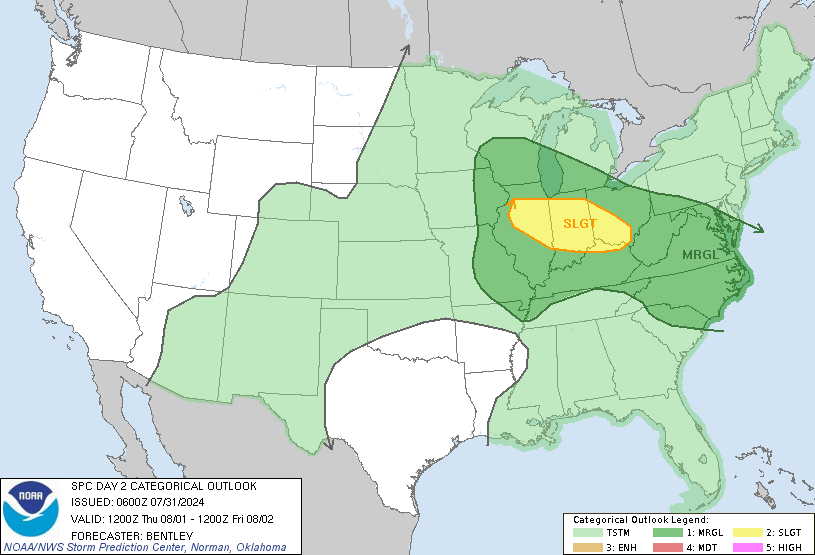
Day 2 Convective Outlook
NWS Storm Prediction Center Norman OK
0100 AM CDT Mon Apr 17 2023

Valid 181200Z - 191200Z

...THERE IS A MARGINAL RISK OF SEVERE THUNDERSTORMS ACROSS PARTS OF
THE GREAT PLAINS...

...SUMMARY...
Thunderstorms associated with hail, and perhaps a few strong wind
gusts will be possible in parts of the Great Plains Tuesday and
Tuesday night.

...Central and Northern Plains/Mid Missouri Valley...
An upper-level ridge will shift eastward from the central and
northern Plains on Tuesday to the mid to upper Mississippi Valley on
Tuesday night. At the surface, a lee trough in the High Plains will
deepen during the day, with a low consolidating and moving eastward
into the central Plains during the afternoon and evening. In
response to southwesterly mid-level flow, a broad low-level jet will
gradually strengthen in the central and northern Plains. Instability
in the central and northern Plains will increase, especially in the
mid-levels. By early to mid evening, convective initiation will be
possible on the western edge of the low-level jet across western
South Dakota and western Nebraska. This convection is forecast to
move eastward into strengthening low-level flow during the evening
into the overnight. Forecast soundings at 06Z from Sioux Falls to
Omaha have MUCAPE around 2000 J/kg, with effective shear generally
from 40 to 50 knots, and 700-500 mb lapse rates in the 8.5 to 9.5
C/km range. This should be favorable for isolated large hail with
elevated rotating storms. Due to a relatively strong boundary-layer
temperature inversion, the wind-damage threat is expected to be
minimal.

...Southern Plains...
An upper-level ridge in the southern Plains on Tuesday will move
eastward into the lower to mid Mississippi Valley Tuesday night. At
the surface, a dryline will become well-defined during the day, as
low-level moisture increases across much of the southern Plains. A
strong capping inversion (CIN near -200 J/kg) during the morning and
early afternoon will likely prevent convective initiation for most
of the day. The cap may weaken enough to allow a cell or two to
initiate in the 23Z to 01Z time-frame. NAM forecast soundings to the
east of the dryline at 00Z, have MLCAPE mostly in the 1000 to 2000
J/kg range, with 0-6 km shear of 30 to 40 knots, and 700-500 mb
lapse rates in the 8.0 to 8.5 C/km range. This would be favorable
for a severe threat, if deep convection can develop. Isolated large
hail and wind-damage would be the primary threats. The isolated
severe threat would likely diminish quickly in the evening, as the
cap strengthens.

..Broyles.. 04/17/2023
Read morehttps://www.spc.noaa.gov/products/outlook/day2otlk_0600.html
|
|



CMS The Best Conveyancing solicitors conveyancing quotes throughout the UK
For any webhosting enquiries please email webmaster@aus-city.com
|
|
Entire Thread
|
 SPC Apr 17, 2023 0600 UTC Day 2 Convective Outlook
|
Webmaster
|
Mon 17 Apr 2023 06:03:AM
|
|
Forums60
Topics759,367
Posts794,082
Members2,958
| |
Most Online17,963
Jan 15th, 2026
|
|
|
|
|
Copyright 1996 - 2026 by David Cottle. Designed by David Bate Jr. All Rights Reserved.
By using this forum, the user agrees not to transfer any data or technical information received under the agreement, to any other entity without the express approval of the AUS-CITY Forum Admins and/or authors of individual posts (Forum Admins and DoD/USSPACECOM for the analysis of satellite tracking data).
Two-line elements (TLE) and all other satellite data presented and distributed via this forum and e-mail lists of AUS-CITY are distributed with permission from DoD/USSTRATCOM.

Reprise Hosting

|

|