|
0 members (),
826
guests, and
27
robots. |
|
Key:
Admin,
Global Mod,
Mod
|
|
S |
M |
T |
W |
T |
F |
S |
|
|
|
|
1
|
2
|
3
|
4
|
|
5
|
6
|
7
|
8
|
9
|
10
|
11
|
|
12
|
13
|
14
|
15
|
16
|
17
|
18
|
|
19
|
20
|
21
|
22
|
23
|
24
|
25
|
|
26
|
27
|
28
|
29
|
30
|
31
|
|
|
There are no members with birthdays on this day. |
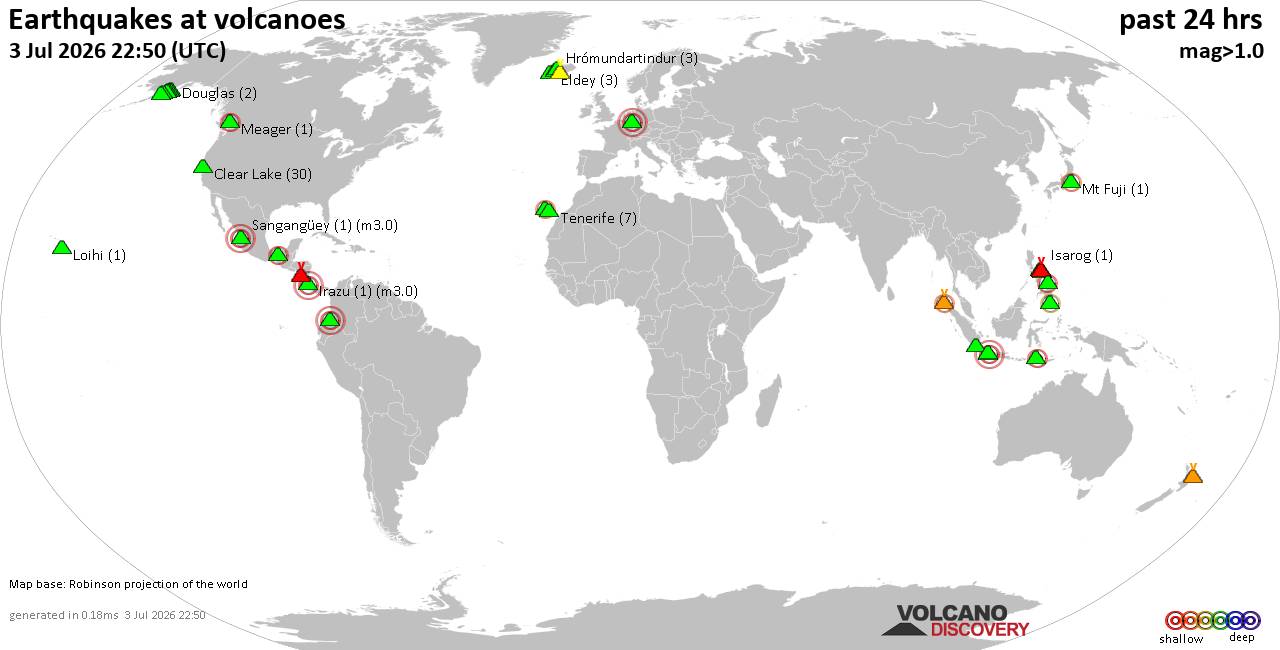
Volcano earthquake report for Friday, 3 Jul 2026
• World Earthquake Report for Friday, 3 July 2026
• Light mag. 3.9 earthquake - South Pacific Ocean, 14 km southwest of Huasco,...
• Significant magnitude 5.5 earthquake 38 km northwest of Valparaiso, Chile
• Strong mag. 5.5 earthquake - South Pacific Ocean, 38 km north of Valparaiso...
• Strong mag. 5.3 earthquake - Balleny Islands Region on Saturday, Jul 4, 202...
|

#1073
Sun 20 Jul 2003 10:00:PM
|
Joined: Feb 2001
Posts: 3,536
Mission Commander
|
OP

Mission Commander
Joined: Feb 2001
Posts: 3,536 |
ISS On-Orbit Status 18 Jul 2003<br /><br />All ISS systems continue to function nominally, except as noted previously<br />or below. Day 85 in space for the Increment 7 crew.<br /><br />CDR Yuri Malenchenko performed the scheduled search for the missing cables<br />and T-connector for the Regul-OS antenna feeder unit (AFU) connection to the<br />antenna feed in the SM. The search for the cables and WE1 coupler was video<br />recorded for the ground. [The Regul equipment is being run in its old<br />configuration until the system can be upgraded.]<br /><br />For FE/SO Ed Lu, it was another day with the MSG (Microgravity Science<br />Glovebox) and the installed CSLM-2 (Coarsening in Solid/Liquid Mixtures-2)<br />payload.. After activation of the rack, two vacuum vent tests with the<br />Lab's VES (vacuum exhaust system) were to be conducted on the MSG, which<br />subsequently was to be powered down again. [This was the first time a<br />payload used the VES, and the test was intended to verify that there are no<br />leaks in the MSG vent lines or in the CSLM-2 vacuum hose QDs (quick<br />disconnects) before long duration venting of the CSLM-2 sample chamber<br />begins. This activity required the use of the MSG conditioner box, to allow<br />a pressure decay test. The first part of the procedure checks for leaks<br />between the MSG Vent QD and the shutoff valve, the second part connects the<br />CSLM-2 vacuum hose and checked its leak tightness. Ed was to record several<br />millivolt readings for both parts and call them down to the ground for<br />evaluation.]<br /><br />Ed Lu performed another weekly ppCO2 (carbon dioxide partial pressure) data<br />take from the new CSA-CP (compound specific analyzer-combustion products)<br />brought up on 11P. (Last time done: 7/11). [CSA-CP is a toxicology<br />monitoring device for early CO detection/warning and post-fire<br />decontamination. It also checks for hydrogen chloride (HCl) and other<br />combustion products and contaminants. Data takes are regularly collected<br />for downlink.] . Yuri Malenchenko completed the periodic functional closure<br />test of the Vozdukh CO2 removal system's emergency vacuum valves (AVK, last<br />time done: 6/23). [The AVKs are critical because they close the Vozdukh's<br />vacuum access lines in the event of a malfunction in the regular vacuum<br />valves (BVK) or a depressurization in the Vozdukh valve panel (BOA). Access<br />to vacuum is required to vent carbon dioxide during the regeneration of the<br />absorbent cartridges (PP). During nominal operation, the AVK valves remain<br />open.]<br /><br />Yuri also started another regeneration cycle on the BMP harmful impurities<br />filtration system in the Service Module (SM), today switching absorbent bed<br />#1 to Regeneration mode. [The "bakeout" cycle in the filter beds is<br />repeated every 20 days. Each bakeout of the two filter beds to space vacuum<br />takes about 24 hours.]<br /><br />Ed Lu transferred data files from the physical exercise equipment (TVIS and<br />RED) to the MEC (medical equipment computer) via memory card and RED log<br />entries, for downlink on OCA comm.<br /><br />Later, he also performed the periodic transfer of accumulated data files<br />from the wrist-band HRM (heart rate monitor) receiver stations to the MEC<br />for downlink, then deleted them on the HRM.<br /><br />Ed was scheduled to start a new round of troubleshooting on the failed<br />EMU/spacesuit (#3013), using the newly developed and uplinked procedure.<br />[By draining and filling the EMU backpack's water tanks, it is believed that<br />the postulated gas bubble in the tanks can be eliminated and with it the<br />coolant stoppage.]<br /><br />On the operational PCS (portable computer system) laptops in the station, Ed<br />performed the regular once-a-week maintenance reboot.<br /><br />MCC-H reported that the crew's work on the File Server (FS) transition to<br />the NGL (next generation laptop) and the SSC (station support computer)<br />laptop reloads were successful, restoring all functionality. This amounts<br />to a new LAN (local area network) for the USOS. [The crew commented<br />favorably on the magnitude of thespeed increasefor applications that access<br />the FS (the NGL, an IBM ThinkPad A31p, uses a Pentium IV/2 GHz<br />microprocessor). More NGLs are in the pipeline and they will be brought up<br />as soon as possible.]<br /><br />The CDR conducted the daily routine maintenance of SOZh life support systems<br />(including toilet facility, food containers, water containers and solid<br />waste containers) and the preparation of the daily IMS (inventory management<br />system) update file, while the Science Officer attended to the regular<br />routine checkup of Increment 7 payloads running in the Lab.<br /><br />Malenchenko had his weekly tag-up with IMS (inventory management system)<br />specialists at MCC-Moscow/TsUP. The continuing issue is to maintain the<br />timely update of the IMS database to reflect the real stowage situation on<br />board.<br /><br />Yuri also performed his regular daily inspection of the BIO-5 Rasteniya-2<br />("Plants-2") experiment which researches growth and development of plants<br />under spaceflight conditions in the Lada-2 greenhouse. [The experimental<br />seeds of two types of peas (a flagellate variety with reds flowers, up to 27<br />cm high, and an acacia-leaf variety with white flowers ,up to 20 cm high)<br />are planted between wicks in a root tray, with environmental control powered<br />on. Regular daily maintenance of the experiment involves monitoring of<br />seedling growth, humidity measurements, moistening of the substrate if<br />necessary, and photo/video recording.]<br /><br />The crew was thanked for their successful workon the Plug-in Plan (PiP)<br />audit on 7/14. [The information they called down was very helpful in<br />improving the ground's understanding of the onboard configuration, and<br />specialists are busy working onthe hardware labeling discrepancies which the<br />audit surfaced. A few follow-on questions were uplinked for this purpose.]<br /><br />Today's CEO (crew earth observation) targets, no longer limited in the<br />current LVLH attitude and including the targets of the Lewis & Clark<br />200-year memorial locations, were Congo basin (Dynamic event. Weather<br />"remarkably clear". The crew was advised to take images looking left toward<br />the sunglint disc to show river patterns of the Congo River and its<br />tributaries), Congo-Zimbabwe Biomass Burning (ideal visibility for fires and<br />smoke plumes. ISS passed over Zambia's "Copper Belt" towns at nadir),<br />Angolan Biomass Burning (cloud structures offshore of the Namib Desert show<br />interesting linear shear lines. These could relate to daily wind fields<br />that are under active research. Crew trying oblique views left of track<br />towards the coast. Cloud masses related to these daily wind shifts are<br />poorly understood), Industrialized SE Africa (major "Santa Ana" wind event<br />taking place along the south coast of South Africa. Temperatures have<br />warmed locally to 80 deg in the middle of winter. Looking for fires with<br />smoke plumes blowing offshore. Otherwise, obliques left and right of the<br />Cape Mountain belt should have been spectacular), Lower Amazon River Basin<br />(looking left for detailed views of the shoreline and islands of the Amazon<br />River estuary), and Paraguay River basin, Paraguay (Dynamic event. Very<br />clear skies. Suggested sunglint images left of track to characterize<br />drainage patterns. ISS/CEO images of the major Beni River, southern<br />Bolivia, taken in the last couple of weeks, show major changes of river<br />pattern, in a 40-mile long stretch, compared with maps made from 30-year-old<br />data). CEO images can be viewed at the websites<br /><br /> http://eol.jsc.nasa.gov<br /> http://earthobservatory.nasa.gov<br /><br />See also the website "Space Station Challenge" at<br /> http://voyager.cet.edu/iss/<br /><br />ISS Orbit (as of this morning, 6:32am EDT [= epoch]): Mean altitude --<br />386.1 km Apogee -- 391.8 km Perigee -- 380.4 km Period -- 92.28 min.<br />Inclination (to Equator) -- 51.63 deg Eccentricity -- 0.0008438 Orbits per<br />24-hr. day -- 15.60 Mean altitude loss in last 24 hours -- 60 m Revolutions<br />since FGB/Zarya launch (Nov. '98) -- 26588 For more on ISS orbit and<br />worldwide naked-eye visibility dates/times, see<br /> http://www.hq.nasa.gov/osf/station/viewing/issvis.html
|
|



CMS The Best Conveyancing solicitors conveyancing quotes throughout the UK
For any webhosting enquiries please email webmaster@aus-city.com
|
|
Forums60
Topics786,868
Posts821,640
Members2,960
| |
Most Online22,463
May 9th, 2026
|
|
|