|
0 members (),
1,404
guests, and
28
robots. |
|
Key:
Admin,
Global Mod,
Mod
|
|
S |
M |
T |
W |
T |
F |
S |
|
|
|
|
|
|
|
1
|
|
2
|
3
|
4
|
5
|
6
|
7
|
8
|
|
9
|
10
|
11
|
12
|
13
|
14
|
15
|
|
16
|
17
|
18
|
19
|
20
|
21
|
22
|
|
23
|
24
|
25
|
26
|
27
|
28
|
29
|
|
30
|
31
|
|
|
|
|
|
|
There are no members with birthdays on this day. |
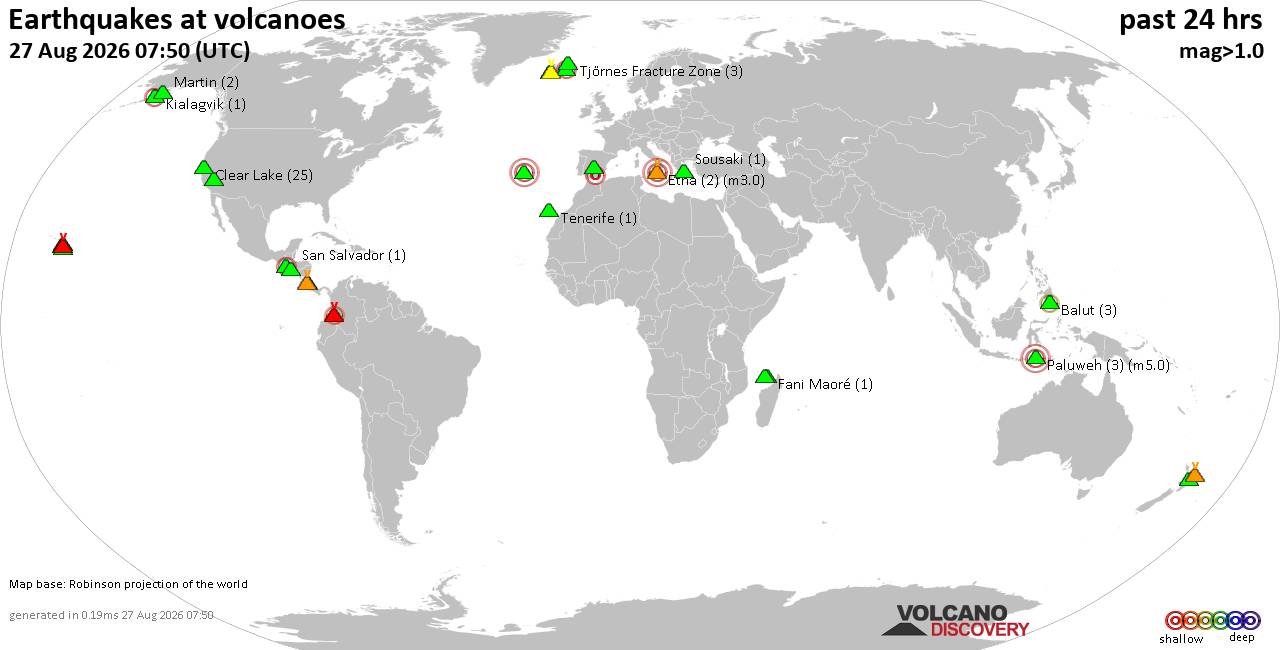
Volcano earthquake report for Thursday, 27 Aug 2026
• Strong mag. 5.2 earthquake - 334 km south of Ogasawara, Tokyo, Japan, on Th...
• Seismic-like event, possible earthquake, reported minutes ago near Granada,...
• World Earthquake Report for Thursday, 27 August 2026
• Possible earthquake reported near Acapulco de Juárez, Guerrero, Mexico, a ...
• Moderate mag. 4.3 earthquake - 16 km southeast of Acapulco de Juárez, Esta...
|

#1107
Sat 06 Sep 2003 03:52:PM
|
Joined: Feb 2001
Posts: 3,536
Mission Commander
|
|
Mission Commander
Joined: Feb 2001
Posts: 3,536 |
ISS On-Orbit Status 4 Sep 2003<br /><br /> All ISS systems continue to function nominally, except as noted previously<br />or below.<br /><br />Progress 11P undocked from the DC-1 nadir port today at 3:40pm EDT without<br />issues. At separation, the trash-filled cargo ship still contained 25 kg of<br />unused gaseous oxygen (O2). [After the spacecraft backed away from the<br />station, its docking interfaces were visually inspected from SM window #7,<br />to observe the condition of both rubber seals and any angular attitude<br />deviation during departure. Later today, the cargo ship will maneuver in<br />its own orbit to observe targets in northern Russia with the Klest-M TV<br />camera for several days before deorbiting. Progress vehicles have been used<br />before for such observational activities, the last time in September 2002 by<br />M-46/8P, which orbited Earth separately for 21 days.]<br /><br />CDR Yuri Malenchenko continued integration of the newly arrived Progress<br />M-48/12P into the ISS/Service Module (SM) systems, today installing the<br />US-21 matching unit which he had taken out of Progress 11P two days ago.<br />[After bolting down the container with the US-21 electronics, which provides<br />the interface between the SM MCS (motion control system) and the Progress<br />propulsion system, in the cargo module, Yuri mated the connectors of the<br />BITS2-12 onboard telemetry measurement subsystem to the box.]<br /><br />In preparation for their return on Soyuz 6S next month, the two crewmembers<br />conducted the scheduled fit check of the "Kazbeks", the contoured<br />shock-absorbing seats in the Soyuz descent capsule (SA). This required them<br />to don their Sokol pressure suits, get in their seats and use a ruler to<br />measure the gap between the top of the head and the top edge of the<br />structure facing the head. The results were reported to MCC-M. [The<br />Kazbek-U couches are designed to withstand g-loads during launch and orbital<br />insertion as well as during reentry and brake-rocket-assisted landing. Each<br />seat has two positions: cocked (armed) and noncocked. In the cocked<br />position, they are raised to allow the shock absorbers to function during<br />touchdown. The fit check assures that the crew, whose bodies gain in length<br />during longer-term stay in zero-G, will still be adequately protected by the<br />seat liners for their touchdown in Kazakhstan on 10/20. The third<br />passenger, Soyuz 7S Flight Engineer Pedro Duque from Spain, will bring his<br />own form-fitted seat liner.]<br /><br />FE/SO Ed Lu worked on the MSG (Microgravity Science Glovebox), which had<br />successfully completed sample 13 of the PFMI (Pore Formation & Mobility<br />Investigation) experiment. [Ed removed the sample from the thermal chamber<br />and returned it to its polycarbonate tube and plastic bag. The MSG was then<br />powered down. The next run, with sample #6, is scheduled for 9/11.]<br /><br />The crew had time scheduled to print out and review the uplinked procedures<br />and instructions for tomorrow's planned EMU/spacesuit #3005 troubleshooting<br />and mid-term checkout, a 4 hr. task for both crewmembers. [Certification<br />of the U.S. EMUs (extravehicular mobility units) is dependent on regular<br />maintenance. While on orbit this is defined as a modified (mid-term)<br />checkout within 369 days of the latest EVA, last mid-term checkout or<br />ground-based PIA (pre-installation acceptance test). EMU #3013 was used<br />last time in April this year and is not due for its checkout at this time,<br />although more troubleshooting on its cooling system is required.]<br /><br />Ed also completed his 16th weekly filling-out of the FFQ (food frequency<br />questionnaire), which keeps a log of his nutritional intake over time on<br />special medical equipment computer (MEC) software.<br /><br />Yuri Malenchenko conducted a functional test of the Russian BSMM onboard<br />payload controller, using the ISS Wiener laptop for a BSMM connectivity<br />check via Ethernet. [The BSMM controller, which had experienced problems,<br />was activated by Moscow at about 12:11am EDT for this purpose.]<br /><br />Ed Lu conducted the routine maintenance of the SM's SOZh environment control<br />& life support system and prepared the daily IMS (inventory management<br />system) "delta" file for automatic export/import to update the database.<br /><br />Yuri had his weekly tagup with IMS planners at TsUP, today discussing the<br />status of Progress 12P unloading (officially scheduled for next week but<br />already started by the crew early), and the location of various equipment<br />items.<br /><br />At 9:35am, Ed Lu set up and conducted a ham radio session with students at<br />Cornell University, Ithaca, NY. [Amateur radio has been active at Cornell,<br />a member of the Ivy League, since 1913, continuing into the present as<br />W2CXM, The Cornell Amateur Radio Club.]<br /><br />Later, the Science Officer downlinked a message of greetings to the 2003<br />World Championship of Freestyle Wrestling, to be played on 9/12 at the<br />three-day event at Madison Square Garden, New York City. [Ed Lu himself is<br />a long-time wrestler and former wrestling coach. In the current Astronaut<br />Corps, there are 11 wrestlers, 7 of whom have competed at the collegiate<br />level, and 5 who had served as high school wrestling coaches at some time.]<br /><br />Yuri had another observation session for the Diatomeya ocean research<br />program on his optional task list, to collect photo and video imagery<br />depicting highly bioproductive waters of the Atlantic and North Pacific<br />oceans. [Both visual observations and photo/video shooting were to be done<br />in nadir, using the NIKON F5 digital still camera with 80-mm lens to shoot<br />1-2 frames per each target, and the DVCAM 150 digital camcorder for video<br />imagery, while recording running voice commentary using the camcorder's<br />mike. For the still photography, Yuri was to use SM window #8, for the<br />continually running camcorder window #7. Specific targets included the<br />highly bioproductive waters of the Atlantic along the W coast of Africa<br />(Canary and Benguela upwellings near Dakar and large commercial fishing<br />areas near the Orange River mouth of South Africa).]<br /><br />Preparatory to Progress 11P undocking, the crew installed IWIS (internal<br />wireless instrumentation system) data recorders in the Lab, Node and SM<br />modules, configuring the radio-linked RSUs (remote sensor units) plus their<br />radio antennae for recording of structural dynamics (vibratory) resulting<br />from the Progress undocking. [Ground engineers use data of the IWIS<br />accelerometers and strain gauges in the modules, via RSUs to obtain<br />acceleration (force) and strain (elongation) measurements during many<br />dynamic activities, such as today's undocking.]<br /><br />Also in preparation for the undocking, Malenchenko installed the geophysical<br />GFI-1 Relaksatsiya ("relaxation") experiment, reconfiguring the Russian<br />payload laptop 3 for the experiment and mounting the UV (ultraviolet) camera<br />with spectrometer unit at SM window #9. Purpose: to observe the Progress<br />259/11P thruster plumes during the separation maneuvers and, if possible,<br />the emission layer of the atmosphere at the Earth's limb. [Relaksatsiya<br />deals with the study of the chemoluminescent chemical reactions and<br />atmospheric light phenomena (emissions, i.e., molecular relaxation<br />processes) that occur during high-velocity interaction between the exhaust<br />products from space vehicles and the atmosphere at orbital altitude and<br />during the entry of space vehicles into the Earth's upper atmosphere.<br />Objective of the current experiment is to record the Progress thruster<br />plumes (by UV-video). After 11P has moved out of sight, the equipment will<br />be left in place for tomorrow's "Fialka" experiment.]<br /><br />The station's cabin atmosphere is now periodically refreshed with gaseous<br />oxygen (O2) from Progress 12P O2 tanks (no repress required today).<br /><br />The crew was congratulated on yesterday's successful deployment of the four<br />new New Generation Laptop (NGL) machines brought up by 12P, and both<br />crewmembers expressed their great delight with the increased performance and<br />speed of the ThinkPad A31p machines. [Two of the NGLs have been installed<br />in the Lab as SSC-4 and SSC-5 clients, one in the Node as new MPSD<br />(multi-purpose support drive) with functions like IP Phone and photo editing<br />and storage, and the fourth, in the Lab, is awaiting testing next week as<br />new SSC VT (videoconference terminal) machine.] MCC-H ballistics<br />specialists continue keeping watch on a possible conjunction with orbital<br />debris tomorrow at a TCA (time of closest approach) of ~10:22am EDT.<br />Currently predicted radial miss distance is above 800 m and the probability<br />of collision 1.9 x 10⁻¹⁶, i.e., extremely small. The TCA timeframe closely<br />coincides with the planned maneuver to the XPOP attitude.<br /><br />Today's CEO (crew earth observation) targets, taking into account the<br />current LVLH attitude, and including the targets of the Lewis & Clark<br />200-year memorial locations, were Temple of Artemis at Ephesus (nadir pass),<br />Tel Aviv, Israel (nadir pass), Amman, Jordan (nadir pass), Nairobi, Kenya<br />(looking left for the city. Also, the crew was to try for an oblique shot<br />of Mt. Kilimanjaro, the other formal site in Kenya that is seldom cloud<br />free. This peak was further off track left beyond Nairobi. Any image with<br />a long lens would be welcome as scientists track the shrinking of its ice<br />cap), Great Falls, MT (LEWIS & CLARK SITE: The Missouri River drops more<br />than 400 feet in ten miles here. The explorers spent more than a month here<br />in June-July 1805, and noted the value of this site for hydro-power<br />generation. Now the Ryan Dam occupies the site. The site lies on the<br />river, at the city of Great Falls, where the highway crosses the river, all<br />at nadir), Mouth of Marias River (LEWIS & CLARK SITE: The Marias is the<br />large, meandering river that joins the Missouri from the northwest about 80<br />miles northeast of the city of Great Falls), Fort Ramon, MT (LEWIS & CLARK<br />SITE: Nadir pass. A trading post of the St. Louis Missouri Fur Co. located<br />at the confluence of the Yellowstone and Bighorn rivers), Hurricane Fabian,<br />W Atlantic (Dynamic event. High category 3 storm threatening Bermuda.<br />Although a few degrees left of track, this storm was well formed and should<br />have been photogenic), and La Paz, Bolivia ( nadir pass). CEO images can be<br />viewed at the websites<br /><br /> http://eol.jsc.nasa.gov<br /> http://earthobservatory.nasa.gov<br /><br />See also the website "Space Station Challenge" at<br /> http://voyager.cet.edu/iss/<br /><br />U.S. and Russian Segment Status (as of 1:25pm EDT).<br /><br />Environmental Control and Life Support (ECLSS) and Thermal Control (TCS):<br /><br />Elektron O2 generator is powered Off (O2 being supplied by Progress 12P).<br />Vozdukh CO2 scrubber is On (in Manual Mode 5/3). U.S. CDRA CO2 scrubber is<br />Off. TCCS (trace contaminant control subsystem) is operating. MCA (major<br />constituents analyzer) is operating. BMP Harmful Impurities unit: absorbent<br />bed #1 in Purify mode, bed #2 in Purify mode. RS air conditioner SKV-1 is<br />Off; SKV-2 is Off.<br /><br /><br />SM Working Compartment: Pressure (mmHg) -- 742; temperature (deg C) --<br />26.9; ppO2 (mmHg) -- data invalid; ppCO2 (mmHg) -- data invalid.<br />SM Transfer Compartment: Pressure (mmHg) -- 761; temperature (deg C) --<br />19.1.<br />FGB Cabin: Pressure (mmHg) -- 752; temperature (deg C) -- 21.3.<br />Node: Pressure (mmHg) -- 744.52; temperature (deg C) -- 22.4 (shell); ppO2<br />(mmHg) -- n/a; ppCO2 (mmHg) -- n/a.<br />U.S. Lab: Pressure (mmHg) -- 746.84; temperature (deg C) -- 23.0; ppO2<br />(mmHg) -- 170.1; ppCO2 (mmHg) -- 4.1.<br />Joint Airlock (Equip. Lock): Pressure (mmHg) -- 746.94; temperature (deg<br />C) -- 24.5; shell heater temp (deg C) -- 22.8, ppO2 (mmHg) -- n/a; ppCO2<br />(mmHg) -- n/a.<br />PMA-1: Shell heater temp (deg C) -- 23.4<br />PMA-2: Shell heater temp (deg C) -- 19.6.<br /><br />(n/a = data not available)<br /><br />Electrical Power Systems (EPS):<br /><br />Both P6 channels fully operational. BGA (beta gimbal assembly) 2B and 4B<br />both in AutoTrack mode (solar tracking).<br />SM batteries: Battery #2 is failed and off; battery #7 is in Discharge<br />mode; all other batteries (6) are in "Partial Charge" mode (battery #1 is<br />degraded).<br />FGB batteries: Battery #1 is disconnected; battery #2 is in "Cycle" mode;<br />all other batteries (4) are in "Partial Charge" mode.<br />Plasma Contactor Unit PCU-1 in Standby mode; PCU-2 in Standby mode.<br /><br />Command & Data Handling Systems:<br /><br />C&C-1 MDM is prime, C&C-2 is back-up, and C&C-3 is in standby.<br />GNC-1 MDM is prime; GNC-2 is Backup.<br />INT-2 is operating; INT-1 is Off.<br />EXT-2 is On (primary), EXT-1 is Off (both now upgraded to R3).<br />LA-1, LA-2 and LA-3 MDMs are all operating.<br />PL-2 MDM is Off; PL-1 MDM is Operational.<br />APS-1 (automated payload switch #1) and APS-2 are both On.<br />SM Terminal Computer (TVM): 3 redundant lanes (of 3) operational.<br />SM Central Computer (TsVM): 3 redundant lanes (of 3) operational.<br /><br />Propulsion System (PS):<br /><br />Total propellant load available: 3657 kg (8062 lb) as of 8/28 [SM(755) +<br />FGB(2902) + Progress M(0) +Progress M-1(0)]. (Capability: SM -- 860 kg;<br />FGB -- 6120 kg).<br /><br />Attitude Control Systems:<br /><br />3 CMGs on-line (CMG-1 failed).<br />State vector source -- U.S. SIGI-1 (GPS)<br />Attitude source -- U.S. SIGI-1 (GPS)<br />Angular rate source -- RGA-1<br /><br />Flight Attitude:<br /><br />LVLH -YVV (local vertical/local horizontal = "earth-fixed": z-axis in local<br />vertical, -y-axis in velocity vector [yaw: -10 deg, pitch: -9.4 deg, roll: 0<br />deg]), with CMG/TA (thruster assist) Momentum Management.<br /><br />Communications & Tracking Systems:<br /><br />FGB MDM-1 is powered Off; FGB MDM-2 is operational.<br />All other Russian communications & tracking systems are nominal.<br />S-band is operating nominally (on string 2).<br />Ku-band is operating nominally.<br />Audio subsystem is operating nominally (IAC-2 is prime).<br />Video subsystem operating nominally.<br />HCOR (high-rate communications outage recorder) is operating nominally.<br /><br />Robotics:<br /><br />SSRMS/Canadarm2 based at MBS PDGF #1 with Keep Alive (KA) power on both<br />strings.<br />MBS: KA power on both strings.<br />MT: latched and mated at WS4.<br />POA: KA power on both strings.<br />RWS (robotics workstations): Lab RWS is On (DCP connected); Cupola RWS is<br />Off.<br /><br />ISS Orbit (as of this morning,4:57am EDT [= epoch]):<br /><br />Mean altitude -- 381.8 km<br />Apogee 386.0 km<br />Perigee -- 377.7 km<br />Period -- 92.2 min.<br />Inclination (to Equator) -- 51.63 deg<br />Eccentricity -- 0.000619<br />Orbits per 24-hr. day -- 15.62<br />Mean altitude loss in last 24 hours -- 120 m<br />Revolutions since FGB/Zarya launch (Nov. '98) -- 27337<br />For more on ISS orbit and worldwide naked-eye visibility dates/times, see<br /> http://www.hq.nasa.gov/osf/station/viewing/issvis.html
|
|



CMS The Best Conveyancing solicitors conveyancing quotes throughout the UK
For any webhosting enquiries please email webmaster@aus-city.com
|
|
Forums60
Topics813,588
Posts848,381
Members2,960
| |
Most Online102,106
Jul 10th, 2026
|
|
|