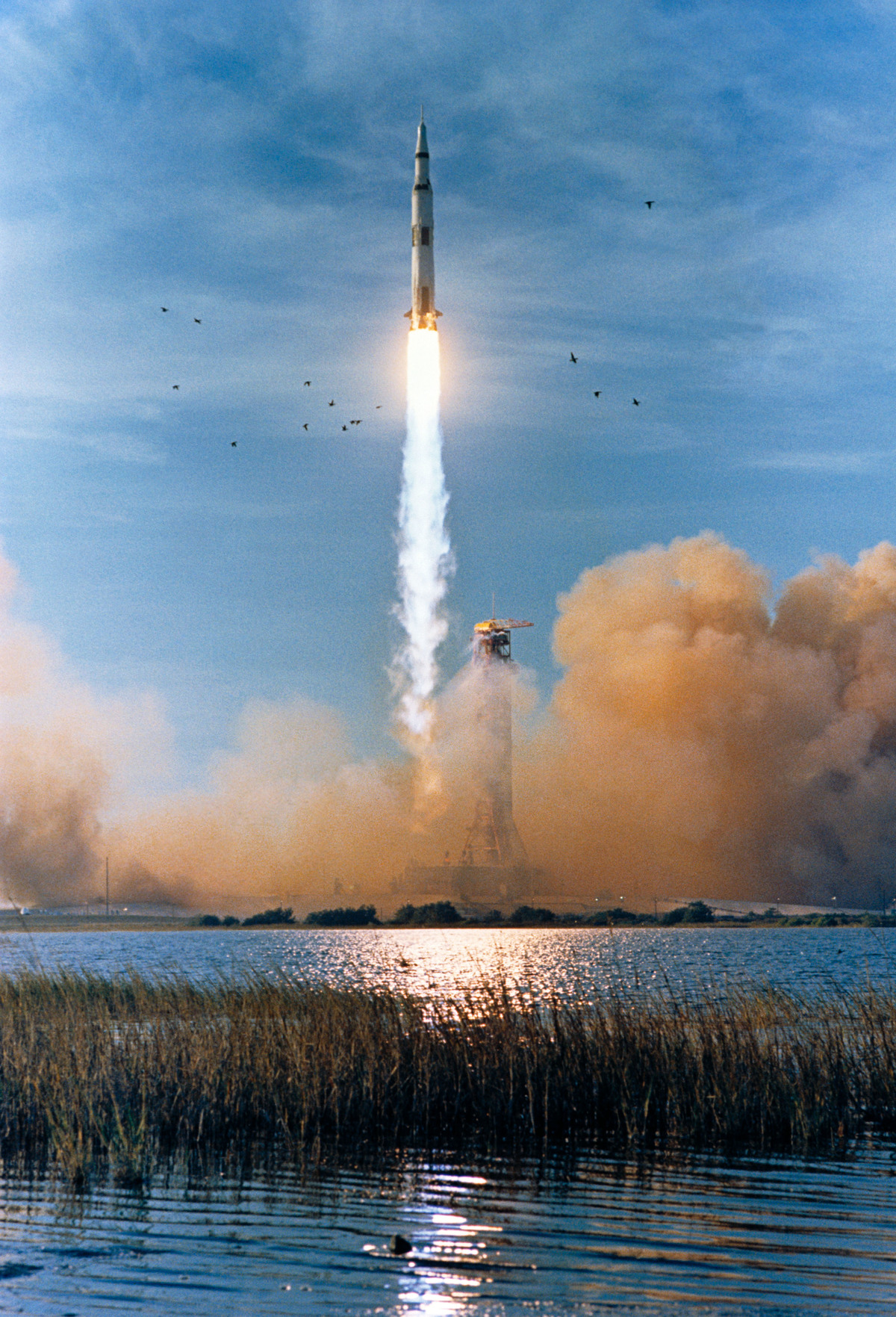
Glenn Mahone/Bob Jacobs<br />Headquarters, Washington July 16, 2004<br />(Phone: 202/358-1898/1600)<br /><br />RELEASE: 04-229<br /><br />NASA'S FIRST GENERATION OF ASTRONAUTS AND WALTER CRONKITE<br />NAMED AMBASSADORS OF EXPLORATION<br /><br /> During a special ceremony to commemorate the 35th <br />anniversary of human exploration of the Moon, Administrator <br />Sean O'Keefe will name NASA's first generation of astronauts <br />and former CBS News anchor Walter Cronkite "Ambassadors of <br />Exploration."<br /><br />The awards will be presented during a special ceremony <br />Tuesday night in Washington.<br /><br />On this date in 1969 at 9:32 a.m. EDT, a Saturn V rocket <br />lifted off from launch complex 39A at NASA's Kennedy Space <br />Center in Florida. About 12 minutes later, the Apollo 11 <br />crew was in orbit and ready for their journey into the <br />history books. On July 20, with Command Module pilot Michael <br />Collins in lunar orbit, astronauts Neil Armstrong and Buzz <br />Aldrin left the Lunar Module and set foot on the surface of <br />the Moon -- an accomplishment that today symbolizes American <br />ingenuity, adventure and spirit.<br /><br />The award celebrates the realization of a vision for <br />exploration first articulated by President John F. Kennedy <br />in May 1961, when NASA's fledgling human space flight <br />program had little more than 15 minutes of experience.<br /><br />"Shortly after Alan Shepard's historic flight in Freedom 7, <br />the President set a goal that captured the imagination of <br />the American people. The challenge of safely landing a man <br />on the Moon sparked unprecedented technological and <br />scientific achievements throughout the Mercury, Gemini and <br />Apollo programs," said Administrator O'Keefe. "As we work to <br />meet the goals set in our new Vision for Space Exploration, <br />the determination of these brave explorers renews our <br />commitment to expand human knowledge, revolutionize our <br />understanding of the Universe and advance science and <br />technology for the benefit of everyone on Earth."<br /><br />To recognize the sacrifices and dedication of the Mercury, <br />Gemini and Apollo astronauts, each will be presented a lunar <br />sample, part of the 842 pounds of Moon rocks and soil <br />returned during the six lunar expeditions from 1969 to 1972.<br /><br />Also among the honorees is famed CBS journalist Walter <br />Cronkite, the only non-astronaut selected as an Ambassador <br />of Exploration. Millions of Americans experienced the drama <br />and excitement of NASA's early years through the <br />knowledgeable reports of Cronkite, who considered the space <br />race as one of the most important events of the 20th century. <br />During the Apollo 11 mission, Cronkite was on the air for 27 <br />of the 30 hours it took for the Apollo 11 astronauts to <br />complete their mission on the lunar surface.<br /><br />The awards will remain the property of NASA, but Cronkite, <br />the astronauts and their surviving families, in coordination <br />with the agency, will select a museum or other educational <br />institution where their awards will be publicly displayed in <br />their name to help inspire a new generation of explorers.<br /><br />"These awards are a fitting tribute and serve to remind each <br />of us that great things can be achieved when we focus our <br />energies and our resources on a specific goal," added the <br />Administrator. "In January, President Bush charged us to <br />carry humanity forward into the Universe, to gain a new <br />foothold on the Moon, and to prepare for new journeys to <br />worlds beyond our own. Each of us can be an Ambassador of <br />Exploration and help secure America's preeminence in science <br />and technology by supporting the Vision for Space <br />Exploration."<br /><br />As Ambassadors of Exploration, the recipients will help <br />communicate the benefits and excitement of space exploration <br />and why the continuing investment in our future is vital to <br />the security and vitality of America.<br /><br />The 35th anniversary event can be seen live on NASA <br />Television and on NASA's Internet homepage at www.nasa.gov <br />beginning at 7:30 p.m. EDT, July 20.<br /><br />For more information about the achievements of the Apollo <br />program, Moon rocks and the Vision for Space Exploration, <br />visit the Internet at:<br /><br />http://www.nasa.gov/vision/space/features/apollo11_35th.html<br /><br /><br />.Support/Space.Science/Our.Solar.System/Earths.Moon/Moon.Roc<br />ks/ <br /><br />http://www.nasa.gov/missions/solarsystem/explore_main.html
Copyright 1996 - 2026 by David Cottle. Designed by David Bate Jr. All Rights Reserved.
By using this forum, the user agrees not to transfer any data or technical information received under this agreement to any other entity without the express approval of the AUS-CITY Forum Admins and/or authors of individual posts (Forum Admins and DoD/USSPACECOM for the analysis of satellite tracking data).
Two-line elements (TLE) and all other satellite data presented and distributed via this forum and AUS-CITY mailing lists are distributed with permission from DoD/USSTRATCOM.