|
0 members (),
1,264
guests, and
18
robots. |
|
Key:
Admin,
Global Mod,
Mod
|
|
S |
M |
T |
W |
T |
F |
S |
|
|
|
|
|
|
|
1
|
|
2
|
3
|
4
|
5
|
6
|
7
|
8
|
|
9
|
10
|
11
|
12
|
13
|
14
|
15
|
|
16
|
17
|
18
|
19
|
20
|
21
|
22
|
|
23
|
24
|
25
|
26
|
27
|
28
|
29
|
|
30
|
31
|
|
|
|
|
|
|
There are no members with birthdays on this day. |
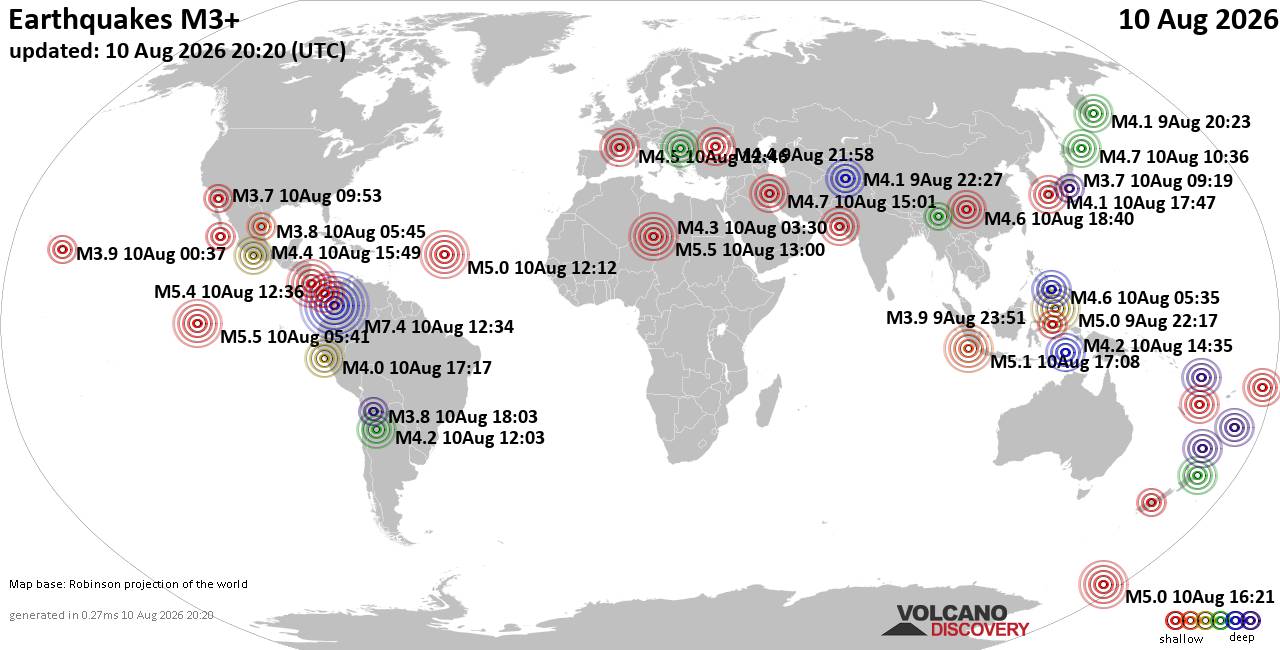
World Earthquake Report for Monday, 10 August 2026
• Volcano earthquake report for Monday, 10 Aug 2026
• Moderate mag. 4.0 earthquake - Zangilan Rayon, 58 km southwest of Ganja, Ga...
• Moderate mag. 4.6 earthquake - 31 km northeast of Xunchang, Sichuan, China,...
• Moderate mag. 4.2 earthquake - New Zealand on Tuesday, Aug 11, 2026, at 06:...
• World Earthquake Report for August 2026
|

#29296
Mon 22 May 2006 12:47:AM
|
Joined: Feb 2001
Posts: 3,536
Mission Commander
|
OP

Mission Commander
Joined: Feb 2001
Posts: 3,536 |
May 17, 2006<br /><br />Katherine Trinidad<br />Headquarters, Washington<br />(202) 358-3749<br /><br />Tracy Young<br />Kennedy Space Center, Fla.<br />(321) 867-2468<br /><br />RELEASE: 06-223<br /><br />NASA'S SPACE SHUTTLE DISCOVERY CARGO READY FOR FLIGHT<br /><br />The payloads that will launch aboard the next space shuttle mission, <br />STS-121, arrived Wednesday at Launch Pad 39-B at NASA's Kennedy Space <br />Center, Fla.<br /><br />Space Shuttle Discovery's cargo includes the Italian-built logistics <br />module Leonardo, which will carry 11 large racks filled with food, <br />clothing, spare parts and research equipment to the International <br />Space Station. Also included in the cargo is the Oxygen Generation <br />System, which can provide enough oxygen each day to support a <br />six-member crew. The system will be operational before the first <br />six-person crew arrives aboard the station in 2009.<br /><br />An integrated cargo carrier will deliver a spare pump module and <br />replacement mobile transporter reel assembly to the station. Another <br />carrier containing pieces of the shuttle's heat-shielding material is <br />also installed in Discovery's payload bay. The material will be used <br />to test heat shield repair methods in orbit during a potential third <br />spacewalk.<br /><br />Discovery's launch to the International Space Station is targeted for <br />July 1 in a launch window that extends to July 19. During the 12-day <br />mission, crew members will test new hardware and techniques to <br />improve shuttle safety.<br /><br />Imagery from the transfer and the latest information on the STS-121 <br />mission and crew is available at:<br /><br /> http://www.nasa.gov/shuttle<br /><br />Video highlights of the transfer to the launch pad will air on <br />Thursday's NASA TV's Video File segments. NASA TV's Video File news <br />feed is on the Media Channel (Program 103) at 6 - 8 and 9 - 11 a.m.; <br />12 - 2 and 4 - 7 p.m.; and 10 p.m. - midnight. All times are Eastern.<br /><br />The Media Channel is available on an MPEG-2 digital C-band signal via <br />satellite AMC-6; 72 degrees west longitude, transponder 17C, 4040 <br />MHz, vertical polarization. In Alaska and Hawaii, it's on AMC-7; 137 <br />degrees west longitude, transponder 18C, at 4060 MHz, horizontal <br />polarization. A digital video broadcast compliant integrated receiver <br />decoder is required for reception. For media unable to receive the <br />Media Channel, a modified version of Video-File airs on the Public <br />Channel at 9 a.m., 6 p.m., and 10 p.m. (Eastern). For downlink, Media <br />and Public Channel information and links to streaming video, visit:<br /><br /> http://www.nasa.gov/ntv<br /><br />For information about the International Space Station, visit:<br /><br /> http://www.nasa.gov/station
|
|



CMS The Best Conveyancing solicitors conveyancing quotes throughout the UK
For any webhosting enquiries please email webmaster@aus-city.com
|
|
Forums60
Topics796,363
Posts831,153
Members2,960
| |
Most Online102,106
Jul 10th, 2026
|
|
|