|
0 members (),
1,586
guests, and
58
robots. |
|
Key:
Admin,
Global Mod,
Mod
|
|
S |
M |
T |
W |
T |
F |
S |
|
|
|
|
1
|
2
|
3
|
4
|
|
5
|
6
|
7
|
8
|
9
|
10
|
11
|
|
12
|
13
|
14
|
15
|
16
|
17
|
18
|
|
19
|
20
|
21
|
22
|
23
|
24
|
25
|
|
26
|
27
|
28
|
29
|
30
|
31
|
|
|
There are no members with birthdays on this day. |
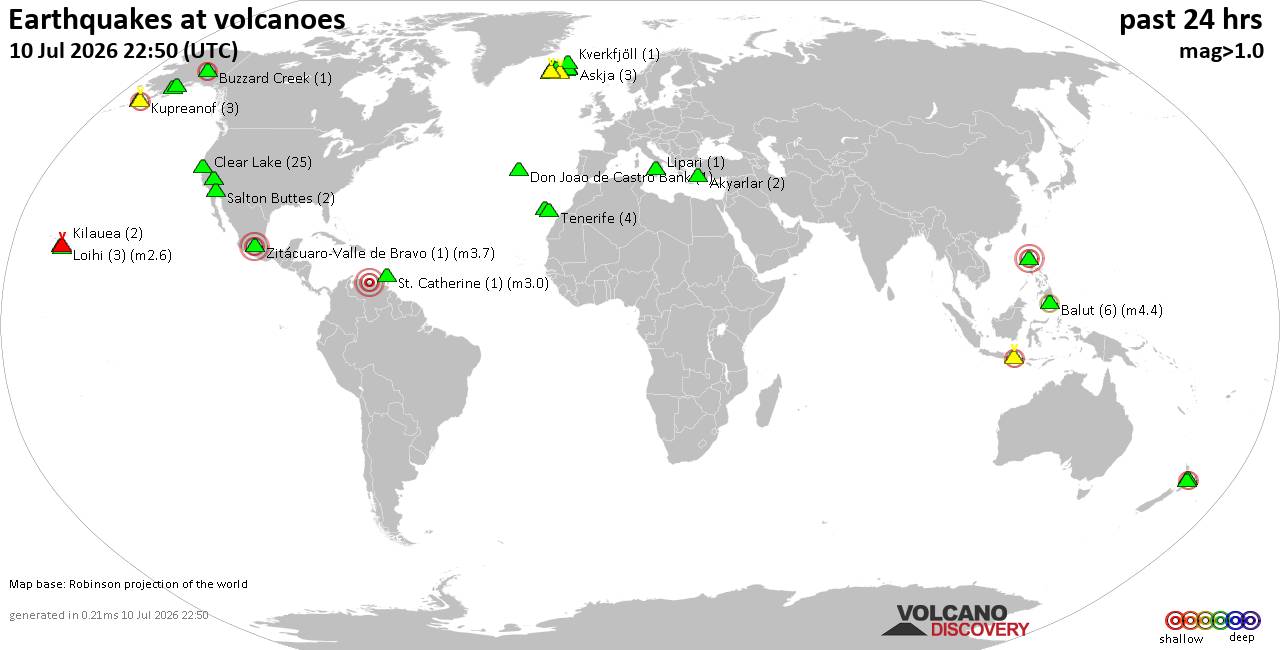
Volcano earthquake report for Friday, 10 Jul 2026
• Moderate mag. 4.2 earthquake - 133 km northwest of Ternate, Kota Ternate, N...
• World Earthquake Report for Friday, 10 July 2026
• Moderate mag. 4.6 earthquake - 17 km southwest of Comalapa, Estado de Chiap...
• Moderate mag. 4.1 earthquake - Olyutorskiy Rayon, 47 km northwest of Tilich...
• Moderate mag. 4.0 earthquake - Hawke's Bay, New Zealand, on Saturday, Jul 1...
|

#41474
Tue 04 Nov 2008 02:59:PM
|
Joined: Feb 2001
Posts: 678,976
Launch Director
|
OP

Launch Director
Joined: Feb 2001
Posts: 678,976 |
HUBBLE SPACE TELESCOPE - Continuing to collect World Class Science
DAILY REPORT #4730
PERIOD COVERED: 5am November 3 - 5am November 4, 2008 (DOY
308/1000z-309/1000z)
OBSERVATIONS SCHEDULED
ACS/SBC 11151
Evaluating the Role of Photoevaporation of Protoplanetary Disk Dispersal
Emission produced by accretion onto the central star leads to
photoevaporation, which may play a fundamental role in disk dispersal.
Models of disk photoevaporation by the central star are challenged by
two potential problems: the emission produced by accretion will be
substantially weaker for low-mass stars, and photoevaporation must
continue as accretion slows. Existing FUV spectra of CTTSs are biased to
solar-mass stars with high accretion rates, and are therefore
insufficient to address these problems. We propose use HST/ACS SBC
PR130L to obtain FUV spectra of WTTSs and of CTTSs at low masses and
mass accretion rates to provide crucial data to evaluate
photoevaporation models. We will estimate the FUV and EUV luminosities
of low-mass CTTSs with small mass accretion rates, CTTSs with transition
disks and slowed accretion, and of magnetically-active WTTSs.
ACS/SBC 11681
A Search for Ultraviolet Emission Filaments in Cool Core Clusters
We propose to use ACS SBC imaging to seek ultraviolet CIV emission
filaments in clusters of galaxies exhibiting strong cool-core X-ray
emission and optical line emission filaments. These short observations
are crafted to test thermal conduction models for the filament
excitation, and can significantly impact our understanding of the
overall physical processes dominant in the galaxy cluster ISM.
FGS 11212
Filling the Period Gap for Massive Binaries
The current census of binaries among the massive O-type stars is
seriously incomplete for systems in the period range from years to
millennia because the radial velocity variations are too small and the
angular separations too close for easy detection. Here we propose to
discover binaries in this observational gap through a Faint Guidance
Sensor SNAP survey of relatively bright targets listed in the Galactic O
Star Catalog. Our primary goal is to determine the binary frequency
among those in the cluster/association, field, and runaway groups. The
results will help us assess the role of binaries in massive star
formation and in the processes that lead to the ejection of massive
stars from their natal clusters. The program will also lead to the
identification of new, close binaries that will be targets of long term
spectroscopic and high angular resolution observations to determine
their masses and distances. The results will also be important for the
interpretation of the spectra of suspected and newly identified binary
and multiple systems.
WFPC2 11196
An Ultraviolet Survey of Luminous Infrared Galaxies in the Local
Universe
At luminosities above 10^11.4 L_sun, the space density of far-infrared
selected galaxies exceeds that of optically selected galaxies. These
Luminous Infrared Galaxies {LIRGs} are primarily interacting or merging
disk galaxies undergoing starbursts and creating/fueling central AGN. We
propose far {ACS/SBC/F140LP} and near {WFPC2/PC/F218W} UV imaging of a
sample of 27 galaxies drawn from the complete IRAS Revised Bright Galaxy
Sample {RBGS} LIRGs sample and known, from our Cycle 14 B and I-band ACS
imaging observations, to have significant numbers of bright {23 < B < 21
mag} star clusters in the central 30 arcsec. The HST UV data will be
combined with previously obtained HST, Spitzer, and GALEX images to {i}
calculate the ages of the clusters as function of merger stage, {ii}
measure the amount of UV light in massive star clusters relative to
diffuse regions of star formation, {iii} assess the feasibility of using
the UV slope to predict the far-IR luminosity {and thus the star
formation rate} both among and within IR-luminous galaxies, and {iv}
provide a much needed catalog of rest- frame UV morphologies for
comparison with rest-frame UV images of high-z LIRGs and Lyman Break
Galaxies. These observations will achieve the resolution required to
perform both detailed photometry of compact structures and spatial
correlations between UV and redder wavelengths for a physical
interpretation our IRX-Beta results. The HST UV data, combined with the
HST ACS, Spitzer, Chandra, and GALEX observations of this sample, will
result in the most comprehensive study of luminous starburst galaxies to
date.
WFPC2 11113
Binaries in the Kuiper Belt: Probes of Solar System Formation and
Evolution
The discovery of binaries in the Kuiper Belt and related small body
populations is powering a revolutionary step forward in the study of
this remote region. Three quarters of the known binaries in the Kuiper
Belt have been discovered with HST, most by our snapshot surveys. The
statistics derived from this work are beginning to yield surprising and
unexpected results. We have found a strong concentration of binaries
among low-inclination Classicals, a possible size cutoff to binaries
among the Centaurs, an apparent preference for nearly equal mass
binaries, and a strong increase in the number of binaries at small
separations. We propose to continue this successful program in Cycle 16;
we expect to discover at least 13 new binary systems, targeted to
subgroups where these discoveries can have the greatest impact.
WFPC2 11218
Snapshot Survey for Planetary Nebulae in Globular Clusters of the Local
Group
Planetary nebulae {PNe} in globular clusters {GCs} raise a number of
interesting issues related to stellar and galactic evolution. The number
of PNe known in Milky Way GCs, 4, is surprisingly low if one assumes
that all stars pass through a PN stage. However, it is likely that the
remnants of stars now evolving in Galactic GCs leave the AGB so slowly
that any ejected nebula dissipates long before the star becomes hot
enough to ionize it. Thus there should not be ANY PNe in Milky Way
GCs--but there are four! It has been suggested that these PNe are the
result of mergers of binary stars within GCs, i.e., that they are
descendants of blue stragglers. The frequency of occurrence of PNe in
external galaxies poses more questions, because it shows a range of
almost an order of magnitude. I propose a Snapshot survey aimed at
discovering PNe in the GC systems of Local Group galaxies more distant
than the Magellanic Clouds. These clusters, some of which may be much
younger than their counterparts in the Milky Way, might contain many
more PNe than those of our own galaxy. I will use the standard technique
of emission-line and continuum imaging, which easily discloses PNe.
WFPC2 11302
WFPC2 CYCLE 16 Standard Darks - Part III
This dark calibration program obtains dark frames every week in order to
provide data for the ongoing calibration of the CCD dark current rate,
and to monitor and characterize the evolution of hot pixels. Over an
extended period these data will also provide a monitor of radiation
damage to the CCDs.
WFPC2 11793
WFPC2 Cycle 16 Internal Monitor
This calibration proposal is the Cycle 15 routine internal monitor for
WFPC2, to be run weekly to monitor the health of the cameras. A variety
of internal exposures are obtained in order to provide a monitor of the
integrity of the CCD camera electronics in both bays (both gain 7 and
gain 15 -- to test stability of gains and bias levels), a test for
quantum efficiency in the CCDs, and a monitor for possible buildup of
contaminants on the CCD windows. These also provide raw data for
generating annual super-bias reference files for the calibration
pipeline.
WFPC2 11795
WFPC2 Cycle 16 UV Earth Flats
Monitor flat field stability. This proposal obtains sequences of earth
streak flats to improve the quality of pipeline flat fields for the
WFPC2 UV filter set. These Earth flats will complement the UV earth flat
data obtained during cycles 8-15.
FLIGHT OPERATIONS SUMMARY:
Significant Spacecraft Anomalies: (The following are preliminary reports
of potential non-nominal performance that will be investigated.)
HSTARS: (None)
COMPLETED OPS REQUEST: (None)
COMPLETED OPS NOTES: (None)
SCHEDULED SUCCESSFUL
FGS GSacq 12 12
FGS REacq 02 02
OBAD with Maneuver 28 28
SIGNIFICANT EVENTS: (None)
David Cottle
UBB Owner & Administrator
|
|



CMS The Best Conveyancing solicitors conveyancing quotes throughout the UK
For any webhosting enquiries please email webmaster@aus-city.com
|
|
Forums60
Topics788,488
Posts823,263
Members2,960
| |
Most Online102,106
Jul 10th, 2026
|
|
|