|
0 members (),
3,195
guests, and
16
robots. |
|
Key:
Admin,
Global Mod,
Mod
|
|
S |
M |
T |
W |
T |
F |
S |
|
1
|
2
|
3
|
4
|
5
|
6
|
7
|
|
8
|
9
|
10
|
11
|
12
|
13
|
14
|
|
15
|
16
|
17
|
18
|
19
|
20
|
21
|
|
22
|
23
|
24
|
25
|
26
|
27
|
28
|
|
29
|
30
|
|
|
|
|
|
|
There are no members with birthdays on this day. |
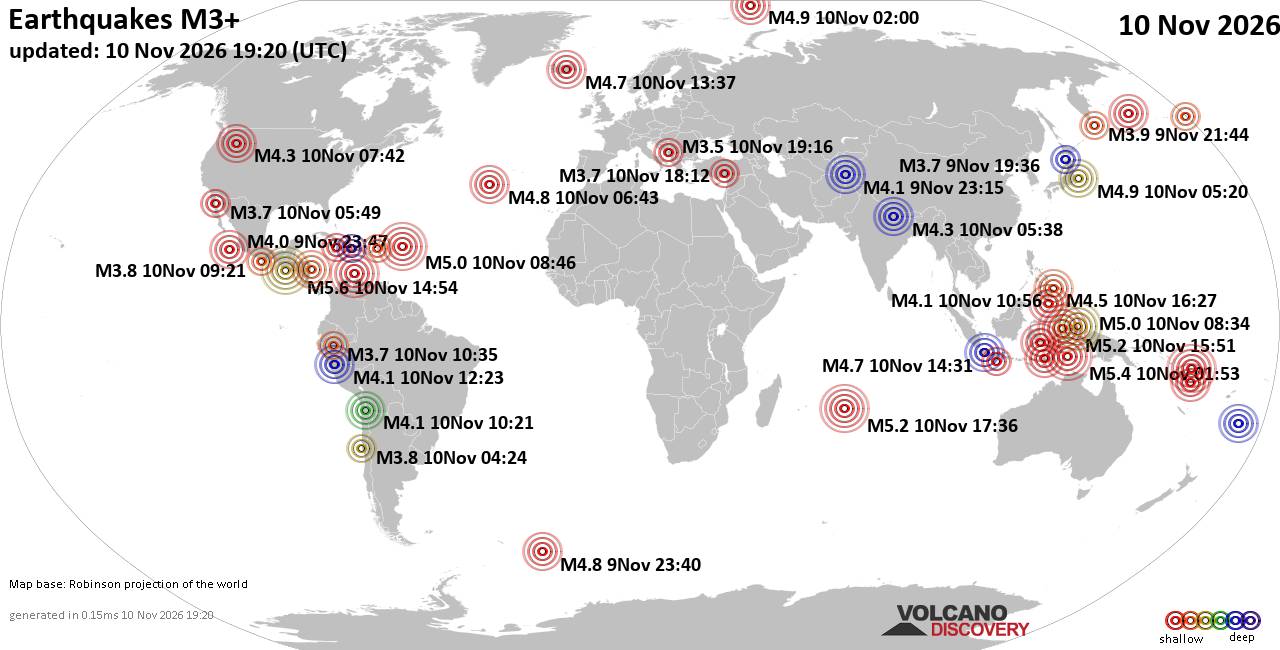
World Earthquake Report for Tuesday, 10 November 2026
• M 0.7 - 3 km SW of San Juan Bautista, CA
• Moderate mag. 4.1 earthquake - Philippine Sea, 52 km east of Siargao Island...
• M 1.3 - 15 km NNE of Milford, Utah
• M 2.0 - 37 km W of Petrolia, CA
• M 0.5 - 6 km SSW of Warner Springs, CA
• M 4.3 - 18 km SE of Joseph, Oregon
|

#1201
Sun 22 Feb 2004 07:48:PM
|
Joined: Feb 2001
Posts: 3,536
Mission Commander
|
|
Mission Commander
Joined: Feb 2001
Posts: 3,536 |
On-Orbit Status 20 Feb 2004<br /><br /> All ISS systems continue to function nominally, except as noted previously<br />or below.<br /><br />The station crew's sleep cycle is now shifted forward again by two hours<br />(wake: 11:00pm EDT last night; sleep: 3:00pm this afternoon).<br /><br />Early in the morning, on Daily Orbit 3 over RGS (Russian ground sites), the<br />crew conducted a review of the EVA-9 timeline for 2/26, supported by tagup<br />with specialists at TsUP/Moscow via S-band.<br /><br />After the timeline review, on DO 4, Kaleri and Foale prepared the SKK and<br />Kromka payload equipment, to be taken outside on the spacewalk, followed by<br />recording video and accompanying commentary on the DC-1 and equipment preps<br />with ground specialists. [Objectives of the spacewalk include<br />installation of the Matryoshka radiation measuring equipment, photography of<br />two Japanese contamination monitors (MPAC, SEED), removal and swapout of<br />foldable sampling panels (SKKs, removable cassette containers), replacement<br />of the Russian Kromka contamination monitoring SKK, ATV (automated transfer<br />vehicle) support engineering for EVA (removal/relocation of LSV laser<br />retroreflectors), and removal of a foreign object (cable strap) from the<br />WA-2 ham radio antenna. The crew today set up three sampling SKKs (#2, #3,<br />#4) to replace the older SKKs mounted outside the DC-1 and Service Module<br />(SM), and the Kromka SKK. They also recorded video imagery of their work<br />for the subsequent discussion with EVA specialists at TsUP.]<br /><br />Both crewmembers in turn performed the CHeCS (crew health care systems)<br />emergency medical operations OBT (on-board training) drill, a 30-min.<br />exercise to refresh the Crew Medical Officer (CMO)'s acuity in applying ACLS<br />(advanced cardio life support) in an emergency. [Today's computer-based<br />proficiency drill focused on administration of intravenous (IV) fluid<br />infusion and the diagnosis and treatment of a tension pneumothorax. (The<br />latter refers to a collection of gas in the pleural space in the chest<br />resulting in collapse of the lung on the affected side. A tension<br />pneumothorax is a life-threatening condition, where the air within the<br />pleural space is under pressure, displacing mediastinal structures and<br />compromising cardiopulmonary function).]<br /><br />After some more troubleshooting on the Elektron-VM oxygen generator by Sasha<br />Kaleri, the ground succeeded in powering up the unit, and it has been<br />running satisfactorily now for several hours on the primary pump.<br />[Background: With a recently introduced new procedure to prevent gas<br />bubbles from getting into the BZh fluid unit, the FE has to prime (fill) the<br />KOV thermal loops' EDV container with purified water from the<br />multifiltration/purification column unit (BKO) while checking for any air<br />bubbles. EDV water was not normally passed through the BKO, as is the case<br />for water from a CWC (contingency water container). The most recent series<br />of Elektron offnominal shutdowns started on 2/10, and since then the unit<br />has not been operating for longer than a 24-hour period. On 2/13, its RPD<br />pressure differential regulator was replaced to fix a noise problem that<br />cropped up several weeks earlier and had gotten louder, but the noise was<br />not completely eliminated, and air was/is still getting into the Elektron's<br />fluid unit (BZh). On 2/18, voltage readings taken on the two micropumps<br />were found nominal. Yesterday, the crew performed a nitrogen (N2) purge of<br />the BZh, intended to compress the buffer tank (BE) and force out any air<br />bubbles trapped in the micropumps; the Elektron failed seven minutes after<br />reactivation. It is now up and running again.]<br /><br />On the Vozdukh CO2 removal system, the FE performed the periodic functional<br />closure test of its AVK emergency vacuum valves (last time done: 1/14).<br />[The AVKs are critical because they close the Vozdukh's vacuum access lines<br />in the event of a malfunction in the regular vacuum valves (BVK) or a<br />depressurization in the Vozdukh valve panel (BOA). Access to vacuum is<br />required to vent carbon dioxide during the regeneration of the absorbent<br />cartridges (PP). During nominal operation, the AVK valves remain open.<br />Only two of the three absorbent channels are functioning.]<br /><br />Preparatory for its subsequent calibration with the MCA (major constituents<br />analyzer), Kaleri deactivated the IK0501 gas analyzer (GA) in the SM and<br />exchanged its BF carbon dioxide (CO2) filter assembly with a new unit from<br />the FGB. The spent BF was stowed for disposal (replaced last: 1/9). Sasha<br />also adjusted the IK0501 for its subsequent calibration readings from its<br />IG-3 O2 gas analyzer. [IK0501 is an automated system for measuring CO2,<br />O2, and H2O in the air, as well as the flow rate of the gas being analyzed.]<br /><br />After the U.S. MAS was switched from life extending mode (LEM) to full<br />operational mode by ground commands last night at 11:45pm EDT, the CDR<br />opened its VGA (verification gas assembly) valve in support of a<br />ground-controlled zero calibration of the analyzer six hours later. [In<br />LEM, the MCA is not sampling the ISS cabin air, but the ion pump is kept<br />operating in order to maintain vacuum in the mass spectrometer, which allows<br />the MCA to be returned easily and quickly to Operational status. Its<br />electrical current is greatly reduced in this mode, as is the rate of<br />erosion of the ion pump cathodes, thus prolonging the pump's life. During<br />the period in LEM, the MCA provides no atmosphere constituent partial<br />pressure data.]<br /><br />After the MCA zero calibration, Kaleri supported activation of the Russian<br />IK0501 GA to take ppO2 measurements for calibrating the instrument with the<br />MCA data obtained at about the same time.<br /><br />Also in support of the instrument calibrations, Foale used the U.S. CDMK<br />(carbon dioxide monitoring kit) to take the weekly reading of the cabin<br />air's CO2 partial pressure in the SM and Lab module, for calldown to the<br />ground (along with the battery status) for use in trending analyses.<br /><br />The crew worked out on TVIS, RED exerciser and VELO cycle with load trainer.<br /><br />As every week, Mike transferred data files from the physical exercise<br />equipment to the MEC (medical equipment computer) via memory card and RED<br />log entries, for downlink on OCA comm. Later, he completed the periodic<br />transfer of accumulated data files from the wristband HRM (heart rate<br />monitor) receiver stations to the MEC for downlink, then deleting them on<br />the HRM.<br /><br />In the Lab, the CDR completed the periodically required process of<br />transferring the water collected in the Lab condensate tank to a CWC (using<br />CWC #1042). The offloading took about 30 minutes. The necessary<br />jumper/plumbing setup was then removed again.<br /><br />Mike also conducted the daily routine maintenance on the SOZh life support<br />system, comprising the water supply equipment, food supply subsystem (SOP),<br />and sanitary hygiene equipment (SGO), and completed the regular routine<br />status checkup of the autonomous Increment 8 payloads.<br /><br />Sasha conducted his regular checkup of the BIO-5 Rasteniya-2 ("Plants-2")<br />experiment which researches growth and development of plants under<br />spaceflight conditions in the Lada-4 greenhouse.<br /><br />Kaleri worked on the SM Central Post, replacing its Laptop 1 with Laptop 3,<br />which up to then controlled some medical and payload experiments. Moscow<br />has requested U.S. assistance in repairing Laptop 1. [Laptop 1, working<br />with the Central Post computer (KTsP1), failed a week ago (2/12). After<br />operations were switched to the redundant (backup) laptop 2, with KTsP2,<br />Kaleri replaced its HDD (hard disk drive) #6136 on 2/13 with a spare<br />(#6059), but it again failed to reboot. After today's laptop swap, Laptop<br />3's medical and payload experiments can no longer be operated, making repair<br />of #1 relatively urgent, although #3 apparently is not required to support<br />medical activities prior to or following the EVA-9.]<br /><br />At 1:30pm, CDR Foale engaged in a ham radio pass with amateur radio fans at<br />Glenwood Elementary School, Perrysburg, OH. [The school is located in a<br />suburb of Toledo, OH, and has an enrollment of 485 students in grades K<br />through 6, of which a high percentage qualify for state and federally funded<br />programs. Students have participated in a videoconference with NASA JSC<br />personnel, have welcomed speakers from NASA GRC and were visited by<br />Astronaut Dr. Thomas.]<br /><br />The crew had their weekly teleconference with the ISS Flight Director at<br />MCC-H.<br /><br />At dinnertime (12:45pm), as every day, the crew supported the Renal Stone<br />prevention experiment by taking the test medication (either potassium<br />citrate or placebo tablets) until the next sample collection phase in early<br />April this year.<br /><br />Shortly after the EVA/Orlan demo yesterday, MCC-H lost Ku- and S-band comm<br />with the ISS for almost six minutes, when the required TDRS (Tracking & Data<br />Relay Satellite) connection was not established as scheduled. According to<br />initial explanations from White Sands, the TDRS Spare did not perform its<br />necessary pointing move for about five minutes, possibly due to a "hang-up"<br />on the ground computer that provides real-time pointing commands. The<br />anomaly is under investigation. [In the event of both Ku- and S-band<br />loss, the ISS has only one alternate comm path, i.e., via VHF over Russian<br />ground sites (or US ground sites if they have been activated). A loss of<br />this kind could severely impact any ongoing critical operations on ISS, such<br />as an EVA.]<br /><br />Moscow has prepared the reboost/phasing burn sequence required by Progress<br />13P to meet Soyuz 8S launch and 7S landing constraints. Current dates are<br />3/2 (delta-V: 2.3 m/s); 3/31 (~2.5 m/s); and 4/10-16 (~2 m/s). 8S launch is<br />scheduled on 4/19, 7S landing on 4/29.<br /><br />The crew's sleep time begins at 3:00pm EST. Tonight they can sleep really<br />long: until 5:45am tomorrow morning.<br /><br />Today's CEO targets, excluding almost all targets in the Americas due to<br />dominantly descending orbit tracks combined with the sleep shift, were<br />Seoul, South Korea (nadir pass), Taiwan Smog (very poor recent visibility<br />over Taiwan due to smog began to improve in the last 12 hours. Margins of<br />the smog mass should have been visible in oblique views left and right of<br />track as ISS passed over the southern part of the island), Ho Chi Minh City,<br />Vietnam (just right of track. Scattered cumulus cloud only was predicted.<br />Since this city of 5.5 million has a diffuse boundary, the ground suggested<br />capturing a wider area than the overt cityscape), Mekong River Delta<br />(detailed mapping swath requested to compare with prior images of land use<br />in this rapidly changing region), Internal waves, S China Sea (looking right<br />towards the glint disc for features generated over the shallow ocean bottom<br />between Vietnam and Borneo. The glint disc is relatively close to the<br />spacecraft, which should allow more detailed views; and this is the optimum<br />time of the month for internal waves to form), Lake Eyre, Australia (status<br />of water levels requested for another data point in this long term<br />monitoring site), Hyderabad, India (nadir pass over this major regional city<br />of 3.7 million people and six universities), Addis Ababa, Ethiopia (a recent<br />ISS/CEO image of this remote capital city is the best ground investigators<br />have, but clouds masked part of the urban area so that another attempt was<br />requested. This is a nadir pass), and Saharan dust (Dynamic event. ISS<br />passed over the Saharan city of Agadez in Niger where visibility was<br />reported reduced to 1 mile. Looking left towards the dust source area in<br />Chad where weather satellite images suggest thick blowing dust).<br /><br />CEO images can be viewed at the websites.<br /><br /> http://eol.jsc.nasa.gov<br /> http://earthobservatory.nasa.gov<br /><br />See also the website "Space Station Challenge" at<br /><br /> http://voyager.cet.edu/iss/<br /><br />U.S. and Russian Segment Status (as of 2:34am EST, 2/13).<br /><br />Environmental Control and Life Support (ECLSS) and Thermal Control (TCS):<br /><br />Elektron O2 generator is powered On (32A). Vozdukh CO2 scrubber is On (in<br />Automatic Mode). U.S. CDRA CO2 scrubber is on Standby (ready in dual-bed<br />mode). TCCS (trace contaminant control subsystem) is operating. SM Gas<br />Analyzer has been calibrated and is used for ppO2 and ppCO2 monitoring. MCA<br />(major constituents analyzer) is in Life Extending Mode (LEM). BMP Harmful<br />Impurities unit: absorbent bed #1 in Purify mode, bed #2 in Purify mode. RS<br />air conditioner SKV-1 is On, SKV-2 is Off (repair now completed; to be<br />tested ASAP).<br /><br /><br />SM Working Compartment: Pressure (mmHg) -- 742; temperature (deg C) --<br />26.2; ppO2 (mmHg) -- 159.4; ppCO2 (mmHg) -- 2.5;<br />SM Transfer Compartment: Pressure (mmHg) -- 751; temperature (deg C) --<br />21.4.<br />FGB Cabin: Pressure (mmHg) -- 744; temperature (deg C) -- 23.7.<br />Node: Pressure (mmHg) -- 739.44; temperature (deg C) -- 23.4 (shell); ppO2<br />(mmHg) -- n/a; ppCO2 (mmHg) -- n/a.<br />U.S. Lab: Pressure (mmHg) -- 742.59; temperature (deg C) -- 24.8; ppO2<br />(mmHg) -- n/a; ppCO2 (mmHg) -- n/a.<br />Joint Airlock (Equip. Lock): Pressure (mmHg) -- 742.80; temperature (deg<br />C) -- 23.7; shell heater temp (deg C) -- 23.3, ppO2 (mmHg) -- n/a; ppCO2<br />(mmHg) -- n/a.<br />PMA-1: Shell heater temp (deg C) -- 22.4<br />PMA-2: Shell heater temp (deg C) -- 12.9<br /><br />(n/a = data not available)<br /><br />Electrical Power Systems (EPS):<br /><br />Both P6 channels fully operational. BGA (beta gimbal assembly) 2B and 4B<br />both in Directed Position (2B: 235 deg; 4B: 125 deg); non-suntracking,<br />"night glider"/"sun slicer" drag reduction mode.<br />SM batteries: Battery #8, formerly known as #7, is failed (to be replaced);<br />all other batteries (7) are in "Partial Charge" mode.<br />FGB batteries: Battery #3 is off (capacity restoration mode, ROM); battery<br />#6 is in "Cycle" mode; all other batteries (4) are in "Partial Charge" mode.<br />Plasma Contactor Unit PCU-1 in Standby mode; PCU-2 in Standby mode.<br /><br />Command & Data Handling Systems:<br /><br />C&C-1 MDM is prime, C&C-2 is back-up, and C&C-3 is in standby.<br />GNC-1 MDM is prime; GNC-2 is Backup.<br />INT-2 is operating; INT-1 is Off.<br />EXT-2 is On (primary), EXT-1 is Off (both now upgraded to R3).<br />LA-1, LA-2 and LA-3 MDMs are all operating.<br />PL-1 MDM is Off; PL-2 MDM is Operational.<br />APS-1 (automated payload switch #1) and APS-2 are both On.<br />SM Terminal Computer (TVM): 2 redundant lanes (of 3) operational (string 1<br />dropped out 11/22).<br />SM Central Computer (TsVM): 2 redundant lanes (of 3) operational (string #3<br />dropped out 10/22).<br /><br />Propulsion System:<br /><br />Total propellant load available: 4070 kg (8972 lb) as of 2/12/04 [SM(755) +<br />FGB(2656) + Progress M(0) + Progress M-1(659)]. (Capability: SM -- 860 kg;<br />FGB -- 6120 kg).<br /><br />Attitude Control Systems:<br /><br />3 CMGs on-line (CMG-1 failed).<br />State vector source -- U.S. SIGI-1 (GPS)<br />Attitude source -- U.S. SIGI-1 (GPS)<br />Angular rate source -- RGA-1<br /><br />Flight Attitude:<br /><br />LVLH YVV (local vertical/local horizontal = "earth-fixed": z-axis in local<br />vertical, y-axis in velocity vector [yaw: -90 deg, pitch: -9 deg, roll: 1.7<br />deg]), with CMG/TA (thruster assist) Momentum Management.<br /><br />Communications & Tracking Systems:<br /><br />FGB MDM-1 is powered Off; FGB MDM-2 is operational.<br />All other Russian communications & tracking systems are nominal.<br />*S-band is operating nominally (on string 2).<br />Ku-band is operating nominally.<br />Audio subsystem is operating nominally (IAC-1 is prime, IAC-2 is off).<br />Video subsystem operating nominally.<br />HCOR (high-rate communications outage recorder) is operating nominally.<br /><br />Robotics:<br /><br />SSRMS/Canadarm2 based at Lab PDGF/LEE A, with Keep Alive (KA) power on both<br />strings.<br />MBS: KA power on both strings.<br />MT: latched and mated at WS4.<br />POA: KA power on both strings.<br />RWS (robotics workstations): Lab RWS is On (DCP connected); Cupola RWS is<br />Off.<br /><br />ISS Orbit (as of this morning, 5:52am EST [= epoch]):<br /><br />Mean altitude -- 366.6 km<br />Apogee -- 371.1km<br />Perigee -- 362.1 km<br />Period -- 91.88 min.<br />Inclination (to Equator) -- 51.628 deg<br />Eccentricity -- 0.0006683<br />Orbits per 24-hr. day -- 15.67<br />Solar Beta Angle -- -46.1 deg (magnitude decreasing)<br />Mean altitude loss last 24 hours -- 90 m<br />Revolutions since FGB/Zarya launch (Nov. '98) -- 29984<br /><br />For more on ISS orbit and worldwide ISS naked-eye visibility dates/times,<br />see http://www.hq.nasa.gov/osf/station/viewing/issvis.html
|
|



CMS The Best Conveyancing solicitors conveyancing quotes throughout the UK
For any webhosting enquiries please email webmaster@aus-city.com
|
|
Entire Thread
|
 ISS On-Orbit Status, 20-02-2004 |
VA3DBJ
|
Sun 22 Feb 2004 07:48:PM
|
|
Forums60
Topics920,725
Posts955,522
Members2,960
| |
Most Online102,106
Jul 10th, 2026
|
|
|