|
1 members (Alisa),
2,530
guests, and
26
robots. |
|
Key:
Admin,
Global Mod,
Mod
|
|
S |
M |
T |
W |
T |
F |
S |
|
|
|
1
|
2
|
3
|
4
|
5
|
|
6
|
7
|
8
|
9
|
10
|
11
|
12
|
|
13
|
14
|
15
|
16
|
17
|
18
|
19
|
|
20
|
21
|
22
|
23
|
24
|
25
|
26
|
|
27
|
28
|
29
|
30
|
|
|
|
|
There are no members with birthdays on this day. |
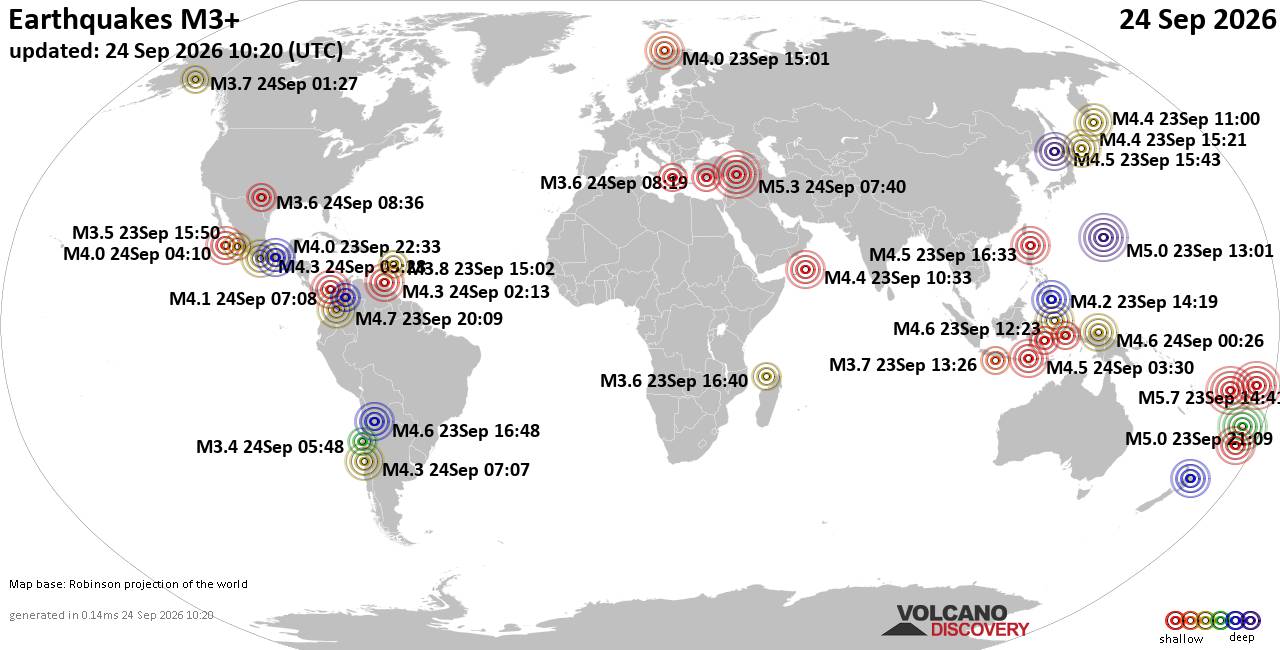
World Earthquake Report for Thursday, 24 September 2026
• Moderate mag. 4.3 earthquake - Madagascar: Mozambique Channel on Thursday, ...
• Small magnitude 3.9 earthquake hits near Hastings, Hastings District, Hawke...
• Volcano earthquake report for Thursday, 24 September 2026
• Light mag. 3.9 earthquake - South Pacific Ocean, 10.2 km south of Hastings,...
• Moderate magnitude 4.1 quake hits 31 miles southeast of Midland, Texas, Uni...
|

#227751
Wed 11 Jun 2014 06:54:AM
|
Joined: Feb 2001
Posts: 678,977
Launch Director
|
|
Launch Director
Joined: Feb 2001
Posts: 678,977 |
This week on HST
HST Programs: June 2 - June 8, 2014
Program Number Principal Investigator Program Title
13280 Esther Buenzli, Max-Planck-Institut fur Astronomie, Heidelberg Evolution of heterogeneous cloud structure through the T dwarf sequence
13297 Giampaolo Piotto, Universita degli Studi di Padova The HST Legacy Survey of Galactic Globular Clusters: Shedding UV Light on Their Populations and Formation
13302 J. Michael Shull, University of Colorado at Boulder COS Spectra of High-Redshift AGN: Probing Deep into the Rest-Frame Ionizing Continuum and Broad Emission Lines
13304 Grant R. Tremblay, Yale University Mysterious ionization in cooling flow filaments: a test with deep COS FUV spectroscopy
13305 Carolin Villforth, University of St. Andrews Do mergers matter? Testing AGN triggering mechanisms from Seyferts to Quasars
13314 Sanchayeeta Borthakur, The Johns Hopkins University Characterizing the Elusive Intragroup Medium and Its Role in Galaxy Evolution
13330 Bradley M Peterson, The Ohio State University Mapping the AGN Broad Line Region by Reverberation
13347 Joel N. Bregman, University of Michigan The Missing Baryons Around Nearby Dwarf Galaxies
13352 Matthew A. Malkan, University of California - Los Angeles WFC3 Infrared Spectroscopic Parallel Survey WISP: A Survey of Star Formation Across Cosmic Time
13366 Roelof S. de Jong, Leibniz-Institut fur Astrophysik Potsdam (AIP) The vertical disk structure of spiral galaxies and the origin of their thick disks
13370 Iskren Y. Georgiev, European Space Agency - ESTEC The Formation History of UGC 12591 - the Most Massive Known Field S0 Galaxy
13382 Mary E. Putman, Columbia University in the City of New York Warm Gas Flows in the Coma Cluster
13386 Steven A. Rodney, The Johns Hopkins University Frontier Field Supernova Search
13391 Nathan Smith, University of Arizona WFC3-IR Imaging of Dense, Embedded Outflows from Intermediate-Mass Protostars in Carina
13393 Dennis Zaritsky, University of Arizona Galaxy Transformation in the Infall Regions of Clusters
13412 Tim Schrabback, Universitat Bonn, Argelander Institute for Astronomy An ACS Snapshot Survey of the Most Massive Distant Galaxy Clusters in the South Pole Telescope Sunyaev-Zel'dovich Survey
13445 Joshua S. Bloom, University of California - Berkeley Absolute Calibration of the Extragalactic Mira Period-Luminosity Relation
13463 Kailash C. Sahu, Space Telescope Science Institute Detecting and Measuring the Masses of Isolated Black Holes and Neutron Stars through Astrometric Microlensing
13472 Wendy L. Freedman, Carnegie Institution of Washington The Hubble Constant to 1%? STAGE 4: Calibrating the RR Lyrae PL relation at H-Band using HST and Gaia Parallax Stars
13493 Tim Schrabback, Universitat Bonn, Argelander Institute for Astronomy An XMM-Newton+HST study of the likely most X-ray luminous z>=0.9 galaxy cluster
13513 Julia Comerford, University of Colorado at Boulder A Pilot Search for Spatially Offset AGN in Galaxy Merger Remnants
13517 Matthew A. Malkan, University of California - Los Angeles WFC3 Infrared Spectroscopic Parallel Survey WISP: A Survey of Star Formation Across Cosmic Time
Selected highlights
GO 13280: Evolution of heterogeneous cloud structure through the T dwarf sequence
An artist's rendition of brown dwarf atmospheric structure
Brown dwarfs are failed stars - objects that form like stars, by gravitational collapse within giant molecular clouds, but which have insufficient mass to raise the central temperature above 107 K, and which therefore are unable to ignite hydrogran fusion and maintain a long-lived central energy source. As such, these objects reach a maximum surface temperature of perhaps 3,000K some tens of millions of years after their formation, and subsequently cool and fade into oblivion. As they cool, they move through spectral types M, L and T, with the oldest brown dwarfs now likely to have temperatures close to 300K and emergent spectra characterised by water and ammonia bands, the putative signatures of the spectral class Y. As these dwarfs cool from L to T (~1500 to ~1200K), the atmospheres undergo significant changes, with heavier elements condensing to form dust. That dust can form clouds, perhaps giving the dwarf's surface a banded appearance, similar to Jupiter. The clouds themselves may appear and disappear over relatively short timescales, leading to photometric variations at particular wavelengths. Past programs have used both Spitzer and HST to monitor spectral variability in a number of systems, primarily objects with spectral types in the L/T transition zone. The present program focues on coole dwarfs, targeting three mid-type T dwarfs identified as variable objects from the Cycle 19 HST SNAP program 12550 (PI: D. Apai). The WFC3 grism G141 will be used to obtain time-resolved spectroscopy of the three objects, 2MASSJ559-0441 (T5), 2MASSJ1624+0029 (T6) and 2MASSJ1049-5319 (Luhman 16).
GO 13366: The vertical disk structure of spiral galaxies and the origin of their thick disks
Ground-based imaging of the edge-on spiral, NGC 891
The stars in the Milky Way are generally grouped into stellar populations, building blocks that provide insight into the process of galaxy assembly. The traditional populations are the near-spherical, metal-poor Halo, representing the first significant burst of star formation; the Disk, whose constituents have higher metallicities, a flattened density distribution (which defines the Galactic Plane) and significant angular momentum, suggesting a formation history that includes collapse and dissipation; and the central Bulge, which, with a spheroidal distribution and broad metallicity range, may be something of an amalgam of disk and halo. The original models for the Disk envisaged a relatively simple population, with a continuous star formation history and an exponential density distribution, both radially and perpendicular to the Plane. However, in the mid-1980s, starcount analyses revealed more complexity in the vertical density distribution, with evidence for two components with scaleheights ~300 and 1000-1300 pc. The extended component is clearly old (>9 Gyrs in age). A variety of emchanisms have been proposed for its formation, dubbed the thick disk, including dynamical scattering within the early disk, formation in situ, or perturbations as the result of major or minor mergers. Ground and space-based observations show that other spiral galaxies possess a similar component. Clearly, the frequency of such systems and their age distribution offer clues to the merging history of the average spiral galaxy. The present program will use ACS and WFC3 to image three massive edge-on spirals at several locations perpendicular to the Plane, with the aim of resolving the underlying stellar populations and tracing the metallicity distribution and overall morphology of the extended disk components.
GO 13412: An ACS Snapshot Survey of the Most Massive Distant Galaxy Clusters in the South Pole Telescope Sunyaev-Zel'dovich Survey
The South Pole Telescope at the Amundsen-Scott South Pole Station
The overwhelming majority of galaxies in the universe are found in clusters. As such, these systems offer an important means of tracing the development of large-scale structure through the history of the universe. Galaxy clusters can be identified at moderate redshifts by searching for signatures of the Sunyaev-Zeldovich effect: high energy electrons in the hot intercluster medium interact with radiation from the cosmic microwave background to distort the microwave spectrum. The South Pole Telescope is a 10-metre microwave/millimetre telescope located at Amundsen-Scott South Pole Station on the Antarctiva high plateau, close to the geographic South Pole. That telescope has been used to search for galaxy clusters. As intense mass concentrations, these systems are highly efficient gravitational lenses, capable of concentrating and magnifying light from background high redshift galaxies to allow detailed spectropic investigations of star formation in the early universe. Hubble imaging has already revealed lensed arcs and detailed sub-structure within a handful of rich clusters. At the same time, the lensing characteristics provide information on the mass distribution within the lensing cluster. The present program is using the Wide Field Camera on the Advanced Camera for Surveys to obtain SNAPshot images of up to 120 of the most massive clusters so far detected by the SPT. The HST data will be analysed for weak lensing signatures that can be combined with X-ray, IR and optical observations to constrain the mass estimates for these clusters.
GO 13472: The Hubble Constant to 1%? STAGE 4: Calibrating the RR Lyrae PL relation at H-Band using HST and Gaia Parallax Stars
RR Lyrae's light curve at visible wavelengths
The classical cosmic distance scale rests on a series of distance indicators that step outwards from the Milky Way, establishing reliable measurements to ever more distant galaxies. Cephids have long been the prime calibrators in this process, but other pulsating variables, notably Mira AGB long-period variables and RR Lyrae variables, also make significant contributions. RR Lyrae variables are evolved, near-solar-mass stars that are passing through the instability strip where it crosses the horizontal branch. With periods of 0.5 to 1.5 days, they have long served as distance indicators for old stellar populations (Baade's Population II). They have been known in the Galactic field and in Galactic globular clusters for over 150 years, and they are also present in the older stellar populations of the dwarf spheroidal Galactic satellites. Cluster (or dsph) RR Lyraes are particularly interesting, since their metallicities and ages can be deduced from analysis of the colour-magnitude diagrams for those systems. They are significantly less luminous than Cepheids, nonetheless, near-infrared photometric monitoring has demonstrated that these stars delineate a period-luminosity relation at those wavelengths that has the potential to establish distances to better than 1.5% accuracy. The absoltue calibration of that relationship, however, rests on only 4 nearby RR Lyraes with trigonometric parallax measurements. The present program aims to add to the sample of astrometricall well-observed RR Lyraes by using spatial scanning on WFC3 to determine accurate parallaxes for a sample of Galactic variables lying at distances up to several kpc from the Sun. Spatial scanning enables astrometry to an acuracy of ~40 microarcseconds, offering the prospect of distances accurate to 4% for individual stars, and an overall distance scale calibration accurate to better than 3%%.
Past weeks:
Cycle 14 observations (from March 13 2006 to June 30 2006)
Cycle 15 observations (from July 1 2006)
Cycle 16 observations (from July 1 2007)
Cycle 17 observations (from July 13 2009)
Cycle 18 observations (from August 30 2010)
Cycle 19 observations (from October 3 2011)
Cycle 20 observations (from October 1 2012)
Cycle 21 observations (from October 1 2013)
David Cottle
UBB Owner & Administrator
|
|



CMS The Best Conveyancing solicitors conveyancing quotes throughout the UK
For any webhosting enquiries please email webmaster@aus-city.com
|
|
Entire Thread
|
 HST This Week
|
Webmaster
|
Wed 11 Jun 2014 06:54:AM
|
|
Forums60
Topics840,505
Posts875,300
Members2,960
| |
Most Online102,106
Jul 10th, 2026
|
|
|