|
0 members (),
1,024
guests, and
23
robots. |
|
Key:
Admin,
Global Mod,
Mod
|
|
S |
M |
T |
W |
T |
F |
S |
|
|
|
|
|
|
1
|
2
|
|
3
|
4
|
5
|
6
|
7
|
8
|
9
|
|
10
|
11
|
12
|
13
|
14
|
15
|
16
|
|
17
|
18
|
19
|
20
|
21
|
22
|
23
|
|
24
|
25
|
26
|
27
|
28
|
29
|
30
|
|
31
|
|
|
|
|
|
|
|
There are no members with birthdays on this day. |
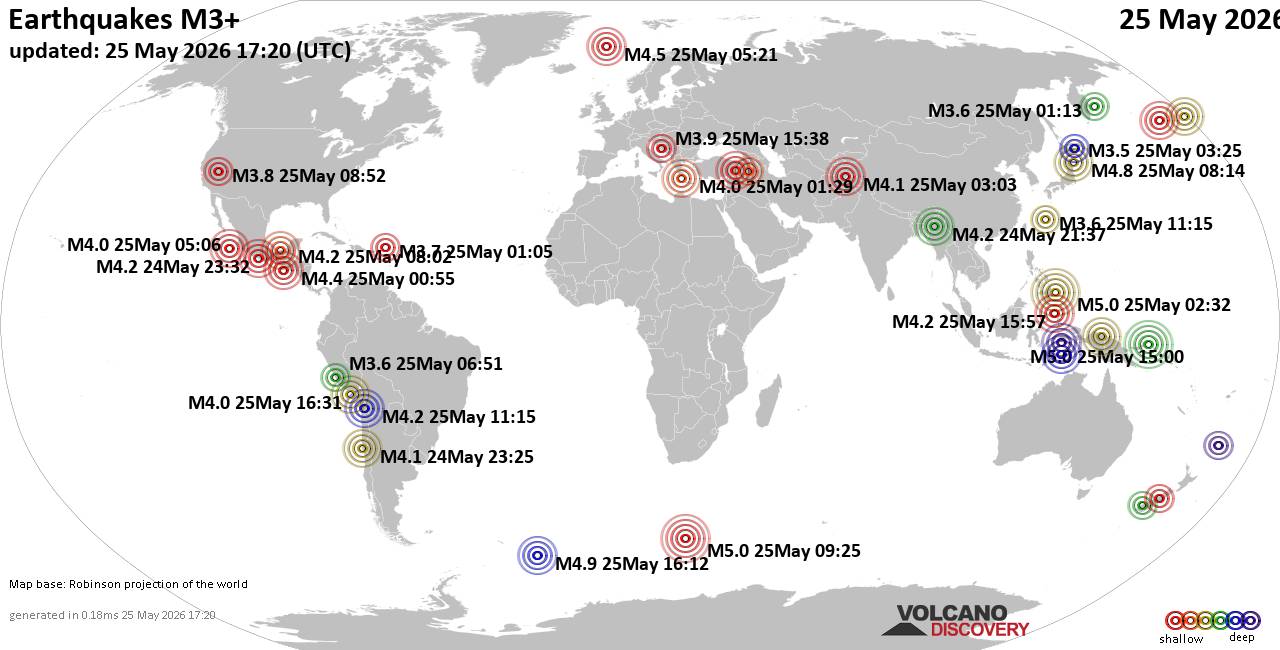
World Earthquake Report for Monday, 25 May 2026
• Moderate mag. 4.1 earthquake - 80 km northwest of Galela, Kabupaten Halmahe...
• Moderate magnitude 4.5 quake hits 102 km northeast of Manokwari, Indonesia ...
• Volcano earthquake report for Monday, 25 May 2026
• Moderate mag. 4.8 earthquake - South Pacific Ocean, 89 km northeast of Mano...
• Moderate mag. 4.0 earthquake - South Pacific Ocean, 81 km southwest of Moll...
|

#34323
Tue 17 Jul 2007 02:37:PM
|
Joined: Feb 2001
Posts: 381,904
Launch Director
|
OP

Launch Director
Joined: Feb 2001
Posts: 381,904 |
HUBBLE SPACE TELESCOPE - Continuing to collect World Class Science
DAILY REPORT # 4405
PERIOD COVERED: UT July 16, 2007 (DOY 197)
OBSERVATIONS SCHEDULED
ACS/WFC/WFPC2 10904
Star formation in extended UV disk {XUV-disk} galaxies
The Galaxy Evolution Explorer {GALEX} has discovered the existence of
extended UV-disk {XUV-disk} galaxies. This class of intriguing spiral
galaxies is distinguished by UV-bright regions of star formation located
at extreme galactocentric radii, commonly reaching many times the
optical extent of each target. XUV-disks represent a population of
late-type galaxies still actively building, or significantly augmenting,
their stellar disk in the outer, low-density environment. Prior to
GALEX, such regions were considered to be far more stable against star
formation than now realized. Our work on these targets has led to the
recognition of the XUV phenomenon as probing a diverse population of
galaxies which, although having certain commonality in terms of their
present XUV star formation, have apparently experienced different star
formation histories {as judged by their outer disk UV-optical colors and
morphology}. In ordinary spirals, disk formation occurred at a much
earlier epoch, making today's XUV-disks useful templates for
commonplace, high z galaxies. The diverse XUV-disks in our sample may
represent snapshots of different phases in the disk building process. We
seek to characterize the demographics of star forming regions occupying
this environmental range, especially in contrast to their inner disk
counterparts. HST imaging is needed to accurately characterize the
massive stars and clusters which have, in fact, managed to form. The
GALEX observations are limited by 5" resolution. Deep ACS FUV, B, V, I,
and H-alpha imaging {along with parallel WFPC2 data} will allow: {1}
photometric classification of the OB star population, {2} constraint on
the cluster mass function and age distribution, {3} critical accounting
for possible leakage of Lyman continuum photons in a porous ISM or an
IMF change, and {4} population synthesis modeling of the field SFH on
Gyr timescales. We benefit from extensive archival HST observations of
our target galaxies, although the outer disk has yet to be probed.
FGS 11210
The Architecture of Exoplanetary Systems
Are all planetary systems coplanar? Concordance cosmogony makes that
prediction. It is, however, a prediction of extrasolar planetary system
architecture as yet untested by direct observation for main sequence
stars other than the Sun. To provide such a test, we propose to carry
out FGS astrometric studies on four stars hosting seven companions. Our
understanding of the planet formation process will grow as we match not
only system architecture, but formed planet mass and true distance from
the primary with host star characteristics for a wide variety of host
stars and exoplanet masses. We propose that a series of FGS astrometric
observations with demonstrated 1 millisecond of arc per-observation
precision can establish the degree of coplanarity and component true
masses for four extrasolar systems: HD 202206 {brown dwarf+planet}; HD
128311 {planet+planet}, HD 160691 = mu Arae {planet+planet}, and HD
222404AB = gamma Cephei {planet+star}. In each case the companion is
identified as such by assuming that the minimum mass is the actual mass.
For the last target, a known stellar binary system, the companion orbit
is stable only if coplanar with the AB binary orbit.
NIC1/NIC2/NIC3 8794
NICMOS Post-SAA calibration - CR Persistence Part 5
A new procedure proposed to alleviate the CR-persistence problem of
NICMOS. Dark frames will be obtained immediately upon exiting the SAA
contour 23, and every time a NICMOS exposure is scheduled within 50
minutes of coming out of the SAA. The darks will be obtained in parallel
in all three NICMOS Cameras. The POST-SAA darks will be non-standard
reference files available to users with a USEAFTER date/time mark. The
keyword 'USEAFTER=date/time' will also be added to the header of each
POST-SAA DARK frame. The keyword must be populated with the time, in
addition to the date, because HST crosses the SAA ~8 times per day so
each POST-SAA DARK will need to have the appropriate time specified, for
users to identify the ones they need. Both the raw and processed images
will be archived as POST-SAA DARKSs. Generally we expect that all NICMOS
science/calibration observations started within 50 minutes of leaving an
SAA will need such maps to remove the CR persistence from the science
images. Each observation will need its own CRMAP, as different SAA
passages leave different imprints on the NICMOS detectors.
NIC3 10874
Search for Extremely Faint z>7 Galaxy Population with Cosmic Lenses
Deep UDF/NICMOS observations find a significant decrease in the number
of galaxy candidates between redshift z=6 and 7, but the sample at z>7
is too small to draw conclusions. >From our observations of 15 clusters
we have found a number of bright z-dropouts, aided by the lensing
amplification. We propose deep NICMOS observations of the best cases of
cluster centers where a rare combination of a significant lensing effect
and the richness in z-band dropouts in background may dramatically
increase the discovery rate. The NICMOS images will reach an
unprecedented depth of AB~27.8, or AB~30 in nonlensed intrinsic
magnitude, and may find many faint {~0.05L*} galaxies at z=7-10, at a
level that the UDF reaches for z~6 objects. We produce precision mass
distribution maps from weak-lensing models, which enable us to derive
the candidates' intrinsic magnitudes and their luminosity function. The
knowledge of such faint galaxy population at z>7 will facilitate the
models of the IGM reionization and future JWST planning.
WFPC2 11022
WFPC2 Cycle 15 Decontaminations and Associated Observations
This proposal is for the WFPC2 decons. Also included are instrument
monitors tied to decons: photometric stability check, focus monitor,
pre- and post-decon internals {bias, intflats, kspots, & darks}, UV
throughput check, VISFLAT sweep, and internal UV flat check.
WFPC2 11178
Probing Solar System History with Orbits, Masses, and Colors of
Transneptunian Binaries
The recent discovery of numerous transneptunian binaries {TNBs} opens a
window into dynamical conditions in the protoplanetary disk where they
formed as well as the history of subsequent events which sculpted the
outer Solar System and emplaced them onto their present day heliocentric
orbits. To date, at least 47 TNBs have been discovered, but only about a
dozen have had their mutual orbits and separate colors determined,
frustrating their use to investigate numerous important scientific
questions. The current shortage of data especially cripples scientific
investigations requiring statistical comparisons among the ensemble
characteristics. We propose to obtain sufficient astrometry and
photometry of 23 TNBs to compute their mutual orbits and system masses
and to determine separate primary and secondary colors, roughly tripling
the sample for which this information is known, as well as extending it
to include systems of two near-equal size bodies. To make the most
efficient possible use of HST, we will use a Monte Carlo technique to
optimally schedule our observations.
WFPC2 11218
Snapshot Survey for Planetary Nebulae in Globular Clusters of the Local
Group
Planetary nebulae {PNe} in globular clusters {GCs} raise a number of
interesting issues related to stellar and galactic evolution. The number
of PNe known in Milky Way GCs, 4, is surprisingly low if one assumes
that all stars pass through a PN stage. However, it is likely that the
remnants of stars now evolving in Galactic GCs leave the AGB so slowly
that any ejected nebula dissipates long before the star becomes hot
enough to ionize it. Thus there should not be ANY PNe in Milky Way
GCs--but there are four! It has been suggested that these PNe are the
result of mergers of binary stars within GCs, i.e., that they are
descendants of blue stragglers. The frequency of occurrence of PNe in
external galaxies poses more questions, because it shows a range of
almost an order of magnitude. I propose a Snapshot survey aimed at
discovering PNe in the GC systems of Local Group galaxies more distant
than the Magellanic Clouds. These clusters, some of which may be much
younger than their counterparts in the Milky Way, might contain many
more PNe than those of our own galaxy. I will use the standard technique
of emission-line and continuum imaging, which easily discloses PNe.
WFPC2 11289
SL2S: The Strong Lensing Legacy Survey
Recent systematic surveys of strong galaxy-galaxy lenses {CLASS, SLACS,
GOODS, etc.} are producing spectacular results for galaxy masses roughly
below a transition mass M~10^13 Mo. The observed lens properties and
their evolution up to z~0.2, consistent with numerical simulations, can
be described by isothermal elliptical potentials. In contrast, modeling
of giant arcs in X-ray luminous clusters {halo masses M >~10^13 Mo}
favors NFW mass profiles, suggesting that dark matter halos are not
significantly affected by baryon cooling. Until recently, lensing
surveys were neither deep nor extended enough to probe the intermediate
mass density regime, which is fundamental for understanding the assembly
of structures. The CFHT Legacy Survey now covers 125 square degrees, and
thus offers a large reservoir of strong lenses probing a large range of
mass densities up to z~1. We have extracted a list of 150 strong lenses
using the most recent CFHTLS data release via automated procedures.
Following our first SNAPSHOT proposal in cycle 15, we propose to
continue the Hubble follow-up targeting a larger list of 130 lensing
candidates. These are intermediate mass range candidates {between
galaxies and clusters} that are selected in the redshift range of 0.2-1
with no a priori X-ray selection. The HST resolution is necessary for
confirming the lensing candidates, accurate modeling of the lenses, and
probing the total mass concentration in galaxy groups up to z~1 with the
largest unbiased sample available to date.
FLIGHT OPERATIONS SUMMARY:
Significant Spacecraft Anomalies: (The following are preliminary reports
of potential non-nominal performance that will be investigated.)
HSTARS: (None)
COMPLETED OPS REQUEST: (None)
SCHEDULED SUCCESSFUL
FGS GSacq 07 07
FGS REacq 08 08
OBAD with Maneuver 30 30
COMPLETED OPS NOTES: (None)
SIGNIFICANT EVENTS: (None)
David Cottle
UBB Owner & Administrator
|
|



CMS The Best Conveyancing solicitors conveyancing quotes throughout the UK
For any webhosting enquiries please email webmaster@aus-city.com
|
|
Entire Thread
|
 Daily Report # 4405
|
Webmaster
|
Tue 17 Jul 2007 02:37:PM
|
|
Forums60
Topics776,784
Posts811,581
Members2,960
| |
Most Online22,463
May 9th, 2026
|
|
|