|
0 members (),
1,505
guests, and
26
robots. |
|
Key:
Admin,
Global Mod,
Mod
|
|
S |
M |
T |
W |
T |
F |
S |
|
1
|
2
|
3
|
4
|
5
|
6
|
7
|
|
8
|
9
|
10
|
11
|
12
|
13
|
14
|
|
15
|
16
|
17
|
18
|
19
|
20
|
21
|
|
22
|
23
|
24
|
25
|
26
|
27
|
28
|
|
29
|
30
|
|
|
|
|
|
|
There are no members with birthdays on this day. |
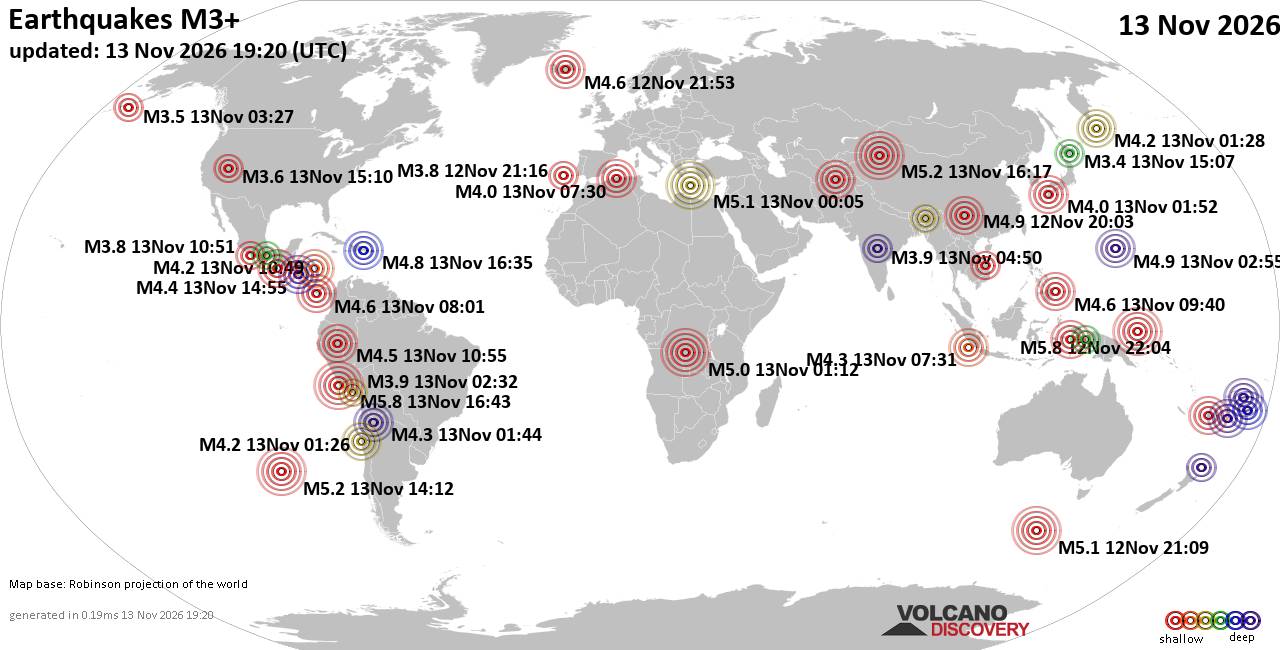
World Earthquake Report for Friday, 13 November 2026
• M 0.5 Other Event - 62 km ENE of Pedro Bay, Alaska
• M 0.5 Other Event - 64 km ENE of Pedro Bay, Alaska
• M 0.4 Other Event - 65 km ENE of Pedro Bay, Alaska
• M 4.5 - Mid-Indian Ridge
• M 0.4 Other Event - 63 km ENE of Pedro Bay, Alaska
• M 1.6 - 89 km NNW of Rachel, Nevada
|

#727
Mon 12 Jan 2004 10:35:AM
|
Joined: Feb 2001
Posts: 129
Astronaut Level 3
|
|
Astronaut Level 3
Joined: Feb 2001
Posts: 129 |
Microcom's Space Newsfeed 11 January 2004<br />Space Industry News from Around the World<br /><br />**********************************************************************<br /><br />Web resources from Microcom Systems:<br /><br />Satellite Industry Links: the largest free satellite and space industry directory on the web http://www.satellite-links.co.uk<br /><br />Satellite on the Net: white papers, industry events, launch information and space bookshop http://www.satelliteonthenet.co.uk<br /><br />Jobs in Space: space industry recruitment http://www.space-jobs.co.uk<br /><br />**********************************************************************<br /><br />Handbook of Satellite Services in Europe<br /><br />This unique publication provides detailed information on all aspects of the European satellite scene including extensive data on service providers, national regulations, satellites used in Europe as well as background on satellite communications technology. http://www.microcomsystems.co.uk/pubs/ssie.html<br /><br />Next issue available from 15 January.<br /><br />**********************************************************************<br /><br />Advertise on Microcom's websites and reach over 25,000 space and satellite industry professionals each month. http://www.spacenewsfeed.co.uk/ratecard.html<br /><br />**********************************************************************<br />**********************************************************************<br /><br />Contents<br /><br />**********************************************************************<br /><br />Satcoms:<br />China Airlines Selects Connexion by Boeing<br />DirecTV Requests FCC Authority To Share Spectrum with Telesat Canada<br />Emirates and Tenzing Redefine Premium Airline Travel with In-flight Email<br />EMS Technologies SARMaster Aids in the First PLB Rescue<br />Gilat Enters Chinese Agricultural Market<br />GlobalNet Announces Exclusive Telephony Contract for Cuba<br />Signal Mountain Networks Supplies Geo-Link with Broadband Service<br />Sirius Satellite Radio Ends 2003 With 261,061 Subscribers<br />Tandberg TV Provides Turnkey Solution for Intelsat Network<br />WildBlue Selects ViaSat to Supply Consumer Broadband Equipment<br />XM Exceeds 1,360,000 Subscribers at Year-End 2003<br /><br />Earth Observation:<br />Radarsat International Signs 4 Radarsat-1 Network Station Agreement Renewals<br /><br />Navigation:<br />Lockheed Martin Team Wins Contract for Next Generation GPS<br /><br />Science:<br />Mars Express: No Signal from Beagle 2 So Far<br />NASA's New Studies of Earth's Seas, Skies and Soils<br />SpaceDev Completes Lunar Lander Study<br />Spirit Prepares to Explore Mars<br />The Calm After the Cometary Storm<br /><br />Manned Space:<br />ISS Has a Slow Leak<br /><br />Technology:<br />ATK Helps Guide MER to a Safe Landing<br />ILC Dover Airbags Cushion MER Spirit Landing on Mars<br />Wind River Powers NASA's Space Exploration<br /><br />Launch Services:<br />Arianespace Wins Two New Contracts from Japan<br />Falcon V Launch Vehicle<br /><br />Business:<br />AGI Opens Center for Space Standards and Innovation<br />Orbimage Officially Emerges From Chapter 11<br />SAIC Completes Exchange Offer For 5 1/2 Percent Notes Due 2033<br />Space Foundation Opens Washington Office<br /><br />Products and Services:<br />Delphi Unveils Mobile Satellite TV Antenna System<br />First Satellite Access Gateway Solution Based on Microsoft's Embedded Technology<br />GlobalNet Announces Iraq Mobile Phone Service<br />Sirius Announces First Wireless Signal Distribution System for Interior Environments<br /><br />People:<br />David Propis Joins GlobalNet as President<br />NASA Names Assistant Administrator For Legislative Affairs<br />Spacehab Names Brian Harrington as Chief Financial Officer<br /><br />**********************************************************************<br />**********************************************************************<br /><br />Bolton Associates - Corporate Strategies applies 21st. Century thinking for the Earth Observation, SatCom and Environment Industries that penetrate new markets using creative commercial Risk models and innovation.<br /><br />Visit us at http://www.BoltonAssociates.com and/or download our Power Point presentation http://www.microcomsystems.co.uk/ads/EOConsult.ppt [131Kb]<br /><br />**********************************************************************<br /><br />Space Bookshop - books for space professionals.<br /> http://www.satelliteonthenet.co.uk/bookshop.html<br /><br />**********************************************************************<br />**********************************************************************<br /><br />Satcoms<br /><br />**********************************************************************<br /><br />China Airlines Selects Connexion by Boeing<br /><br />(5 January 2003) China Airlines (CAL) and Connexion by Boeing have signed a Letter of Intent that will bring high-speed connectivity to travellers on commercial flights in and out of Taiwan. The LOI calls for the broadband data and entertainment service to be installed on the CAL long-haul fleet of aircraft beginning in late 2004. Financial terms were not disclosed.<br /><br />Initially, the agreement with Connexion by Boeing will cover CAL's long-haul fleet including Boeing 747-400 and Airbus A340-300 aircraft, and CAL will extend the service to other aircraft at a later date. The agreement outlines connectivity on certain long-haul flights between Taipei and Europe, and Taipei and North America. Specific routes also will be announced at a later date. In the interim, China Airlines and Connexion by Boeing teams will work together to define the installation schedule and levels of service that will be offered to CAL passengers.<br /><br />Connexion by Boeing continues to build momentum as it prepares for the introduction of full-scale commercial service in early 2004. Lufthansa, Scandinavian Airlines System (SAS) and Japan Airlines have signed on as customers for the in-flight Internet, data and entertainment service. Singapore Airlines and All-Nippon Airways also have announced their intent to install the Connexion by Boeing service on their long-haul fleet of jetliners.<br /><br />(source: Connexion by Boeing)<br /><br />**********************************************************************<br /><br />DirecTV Requests FCC Authority To Share Spectrum with Telesat Canada<br /><br />(7 January 2003) DirecTV Inc has filed with the Federal Communications Commission (FCC) for authority to move the DirecTV 5 spacecraft into an orbital slot controlled by Telesat Canada. <br /><br />The DirecTV 5 satellite would be moved into the Telesat-controlled orbital location of 72.5° W, allowing DirecTV to expand local-into-local channel service to a minimum of 130 US markets by year-end - a commitment made to the FCC as a part of the News Corp. transaction completed in December of last year. DirecTV's goal is to begin the rollout of local-into-local service to these additional markets by early April 2004.<br /><br />The relocation of this in-orbit satellite will enable services to be made available immediately. DirecTV 5 would remain at the 72.5° orbital position until the launch of Telesat's new DBS satellite. Telesat's new DBS satellite will provide the ability to ensure continuity of service at the 72.5° location.<br /><br />The arrangement with regard to DirecTV 5 is contingent on the successful launch of the DirecTV 7S satellite later this quarter. DirecTV 7S will replace DirecTV 5 at 119° W, freeing up the latter satellite for its move to 72.5°, assuming FCC approval is granted for the relocation.<br /><br />DirecTV 5 will use the capacity at 72.5° through 2008, which will dramatically enhance its local channel service offerings in the United States. Customers will access local channel service from 72.5° with the addition of a second 18-inch satellite dish at their home or service location. Telesat Canada will assume telemetry, tacking and control (TT&C) of DirecTV 5 after an interim period.<br /><br />Upon moving DirecTV 5 to 72.5° and the successful launch of the DirecTV 7S spot-beam satellite later this quarter to the 119° West Longitude orbital slot, DirecTV will have sufficient capacity to offer local broadcast channels in a minimum of 130 markets by year-end.<br /><br />(source: DirecTV)<br /><br />**********************************************************************<br /><br />Emirates and Tenzing Redefine Premium Airline Travel with In-flight Email<br /><br />(7 January 2003) Emirates and Tenzing Communications have announced a new partnership to offer in-flight email service on the Emirates fleet. Starting in Q1 2004 with the brand new Airbus A340-500 aircraft and progressing across the fleet, Emirates' in-flight email will be enabled by simply loading Tenzing software onto a server already fitted to the aircraft and connected to an existing communications system. Passengers use their own email addresses, including corporate email, in a secure environment.<br /><br />The ultra-long-range A340-500 will be the first aircraft to include an onboard wireless LAN certified for passengers' own Wi-Fi-enabled laptop computers. This option will be available in addition to dial-up connections to the onboard server from passenger seats.<br /><br />An airline known for its exceptional level of service, Emirates offers ultra sophisticated in-flight entertainment on its brand-new A340-500s, including 500-plus channels, three times more than any other airline. It has also revolutionised First Class, with private, enclosed suites, mini-bars and room service. In-flight email completes the package, offering passengers an additional option for staying connected with business associates, family and friends.<br /><br />In-flight email on Emirates is made possible through Tenzing software and network support services, which bridge the gap between earthbound email networks and the aircraft cabin. This unique system allows passengers to access their email accounts from virtually anywhere in the world.<br /><br />(source: Tenzing Communications)<br /><br />**********************************************************************<br /><br />EMS Technologies SARMaster Aids in the First PLB Rescue<br /><br />(7 January 2003) EMS Technologies Inc's SARMaster search-and-rescue (SAR) information system has helped with the first rescue via a Personal Locator Beacon (PLB). PLBs were made available to the 48 contiguous states in the United States on July 1, 2003.<br /><br />At 10:45 a.m. EST, on November 14th, 2003, personnel at the Air Force Rescue Co-ordination Center (AFRCC), at Langley Air Force Base, Virginiaa., were notified of a distress call via the Search and Rescue Satellite Aid Tracking System (SARSAT), operated by the National Oceanic and Atmospheric Administration (NOAA). The distress alert was received at AFRCC via the SARMaster incident management system responsible for all search and rescue event management in the rescue centre. The AFRCC then notified the appropriate state emergency rescue agency in the area where the PLB was activated. Carl J. Skalak, Jr. of Cleveland, Ohio, activated his PLB after being snowed in at his campsite in the Adirondack Mountains in upstate New York. He faced frigid weather, four-foot snowdrifts and a frozen river on which he had paddled in. The Herkimer County (NY) Sheriff’s Department worked with the US Forest Service at Watson East Triangle to conduct the search.<br /><br />Due to heavy snow, flight assistance was called in from the Fort Drum Air Ambulance Detachment, which launched a UH-1 Huey Helicopter and medical team to assist. Carl Skalak was airlifted to Fort Drum for medical evaluation before being released and is very thankful to his rescuers.<br /><br />The EMS SARMaster information system is a product of the EMS Satcom Division’s Emergency Management Product Group. EMS has provided ground equipment and management systems for use with the COSPAS-SARSAT satellite system since its launch in 1981. Since that time, the system has been credited with saving more than 15,000 lives by using spacecraft and ground facilities to detect and locate signals from distress beacons.<br /><br />(source: EMS Technologies)<br /><br />**********************************************************************<br /><br />Gilat Enters Chinese Agricultural Market<br /><br />(7 January 2003) Gilat Satellite Networks Ltd will supply a hub and 300 Very Small Aperture Terminals (VSATs) of its SkyBlaster 360 broadband platform, to China’s Central Agriculture Broadcast and Television School (CABTS). CABTS has been nominated by the Chinese Ministry of Agriculture to run the National Farmers’ Science and Technology Training Center and has established the China Distance Education Network. CABTS will use the VSAT technology to provide interactive distance-learning applications to its municipal schools.<br /><br />The outbreak of SARS epidemic raised the need to quickly deliver health education to farmers throughout the massive regions of China in order to prevent the spread of the deadly disease. Gilat, which has considerable experience in implementing rural satellite-based VSAT networks in China, is providing CABTS with a network consisting of a hub and 300 VSAT terminals, of which part of the equipment will be donated, in order to expand the current Interactive Distance Learning (IDL) education network already in use by CABTS.<br /><br />CABTS was established in 1980. Since that time it has become one of the largest agriculture distance education schools in the world, with 38 provincial schools, 330 municipal schools, 2,408 county branch schools and 23,000 township classes, employing over 50,000 school staff. In 2000, CABTS implemented the China Distance Education Network using computers and two-way VSATs to link 54 Interactive Distance Learning stations to its provincial schools. The current initiative expands that project.<br /><br />(source: Gilat Satellite Networks)<br /><br />**********************************************************************<br /><br />GlobalNet Announces Exclusive Telephony Contract for Cuba<br /><br />(7 January 2003) GlobalNet Corporation announced today that it has been awarded an exclusive contract for world-wide termination of voice and data mobile satellite telecommunications traffic originating in Cuba. This follows similar contracts for Iraq and Libya.<br /><br />The exclusive telecommunications contracts were granted to GlobalNet by Global Telesat Corp, a privately held company that owns the only satellite simplex applique situated anywhere in the world outside of the United States. It recently decided to commercialise this gateway applique.<br /><br />The telephony contract covering the largest island in the Caribbean is expected to utilize a gateway located in Nicaragua. Like the Libya contract, approval of the US Department of State will be required before full-fledged service can be initiated in Cuba.<br /><br />In the meantime, though, it appears that GlobalNet can immediately begin servicing those stationed at the huge Guantanamo Bay Naval Base in Cuba without any further approvals because the facility is located on United States territory and can be serviced from a gateway situated in Puerto Pico, another US territory.<br /><br />(source: GlobalNet Corporation)<br /><br />**********************************************************************<br /><br />Signal Mountain Networks Supplies Geo-Link with Broadband Service<br /><br />(7 January 2003) Signal Mountain Networks Inc, an authorised value-added reseller of Hughes Network Systems' DirecWay broadband satellite solutions, has won a three-year contract with Geo-Link, a mudlogging and geological consulting company in the oil and gas industry. Under terms of the agreement, Signal Mountain will supply Geo-Link with a customised configuration of MotoSAT's mobile satellite systems, which operates with HNS' DirecWay DW4020 satellite terminal.<br /><br />The DW4020 satellite terminal boasts a four-port 10/100 base T Ethernet hub and incorporates a fast, self-hosted processor, eliminating the need for a dedicated host PC. It operates independently of networked computers, yielding overall greater network reliability and robustness.<br /><br />During Phase 1, Signal Mountain will install the MotoSAT/DW4020 mobile solution on four of Geo-Link's Data-Support Trailers. Geo-Link uses special drilling instrumentation and software from Mudlogging Systems Inc, which will run over the satellite system. With DirecWay, Geo-Link is equipped with real-time delivery of sensitive information related to deposits of oil and other natural resources. This data provides information necessary to make informed decisions about how to proceed with well drilling that is underway.<br /><br />In addition, Signal Mountain created a custom Ethernet solution for Geo- Link, which will allow Geo-Link to easily provide access for additional users to plug in laptops to a mini-hub in these on-site work trailers for access to drilling data, their company's corporate Web site and high-speed, always-on, secure Internet connectivity.<br /><br />(source: Signal Mountain Networks)<br /><br />**********************************************************************<br /><br />Sirius Satellite Radio Ends 2003 With 261,061 Subscribers<br /><br />(7 January 2003) Sirius has announced that it ended 2003 with 261,061 subscribers, up from approximately 30,000 subscribers at the end of 2002. This represents an increase of 772% over the year-ago figure. Sirius added over 100,000 subscribers in the fourth quarter of 2003 alone, due to increased sales at retail during the holiday season.<br /><br />This holiday season marked the first time that Sirius had a full complement of products to offer, especially in the transportable Plug and Play category. The Plug and Play satellite radio products can be moved from the car to the home, boat or RV, with special docking kits that install easily. According to company officials, Sirius' new Audiovox Plug and Play product was a best seller, and exceeded sales expectations in the retail market.<br /><br />(source: Sirius)<br /><br />**********************************************************************<br /><br />Tandberg TV Provides Turnkey Solution for Intelsat Network<br /><br />(6 January 2003) Tandberg Television is providing Intelsat with a turnkey video solution, including the latest digital compression and control and monitoring equipment plus integration services, for a hybrid satellite and fibre network connecting seven sites between the United States and Europe. The deal for five sites was initially announced to the Oslo stock market in October of last year, and has since expanded to include two further sites.<br /><br />The installations include both standard and high definition equipment and will be completed in spring 2004, connecting teleports in Riverside, California and Fuchsstadt, Germany, with five points of presence sites (POPs) in Washington DC, Los Angeles, San Francisco, Denver and New York City. The satellite and fibre network greatly increases capacity for Intelsat, which will expand its video offerings and provide space on the network to broadcasters interested in sending video and audio between any of the seven sites and Intelsat's global video distribution network. The Tandberg Television solution allows Intelsat to take advantage of new business opportunities made possible with this increased capacity, along with the ability to expand the video network when needed.<br /><br />Intelsat teamed with Level 3 Communications to create the state-of-the-art, fiber optic video network. Tandberg Television was selected based on its ability to provide all essential equipment - including third party equipment such as ATM switches and routers - and integration skills for the entire project, as well as a successful ongoing relationship with Intelsat. In addition to fifth-generation MPEG-2 standard and high definition compression equipment, Tandberg Television is also providing CORTEX, an advanced event scheduler that allows Intelsat to centrally manage and allocate resources and bandwidth. CORTEX, along with a Tandberg Television nCompass Monitoring system to monitor all equipment within the network, will be installed at Intelsat's Video Operations Center (VOC) in Washington DC.<br /><br />Another selling point of the turnkey solution was the easy upgrade path of Tandberg Television's E5720 MPEG-2 encoder. By adding a module to the back of the unit, the standard definition encoder is upgradable to an E5780 high-definition encoder. Rounding out the solution are: TT1260 SD and TT1280 HD integrated receiver-decoders, MA5300 ATM adapters for MPEG-2 to ATM bridging, and TT6120 MediaLink transport stream processors for interfacing between fibre and satellite systems.<br /><br />(source: Tandberg TV)<br /><br />**********************************************************************<br /><br />WildBlue Selects ViaSat to Supply Consumer Broadband Equipment<br /><br />(5 January 2003) ViaSat Inc is to supply satellite broadband equipment and ground systems for the WildBlue Communications consumer and small office/home office broadband service. The contract is valued at over US$ 33 million and includes final development and production of consumer premises equipment (CPE) and gateway equipment to support WildBlue's initial service launch. Customer equipment includes a ViaSat Ka band satellite modem and outdoor Ka band transceiver electronics from ViaSat subsidiary US Monolithics LLC. CPE deliveries are scheduled to begin in the first quarter of 2004.<br /><br />With a planned launch in the second half of 2004, the primary target of the WildBlue service will be an estimated 30 million homes and small offices that don't have access to other broadband options. To reach these customers, WildBlue is using a new approach to satellite communications. The CPE technology is based on the proven DOCSIS (Data Over Cable Service Interface Specification) networking standard, the leading consumer broadband technology in North America. Coupled with advanced satellite waveforms, ViaSat's implementation of DOCSIS for a satellite-based system lowers the cost of consumer terminals, reduces satellite bandwidth requirements, enables plug-and-play installation, and provides for mature customer service, billing and network control software and systems. WildBlue is also expected to be the first satellite broadband service based on next-generation Ka band spot beam technology, designed to lower the cost of providing high-speed Internet access via satellite.<br /><br />WildBlue's satellite modem is designed to serve the same purpose as DSL or cable modems. It will convert analogue data transmissions into Internet Protocol (IP) data packets, that can be read by the customer's PC or any digital Internet appliance. The agreement with ViaSat allows WildBlue to leverage standard components from the cable modem and satellite TV industries to lower the cost of satellite modems while providing excellent performance over the Ka band satellite link. This performance will enable WildBlue to offer attractively-priced two-way wireless satellite broadband service.<br /><br />(source: WildBlue)<br /><br />**********************************************************************<br /><br />XM Exceeds 1,360,000 Subscribers at Year-End 2003<br /><br />(7 January 2003) XM Satellite Radio has announced it signed up more than 1,360,000 subscribers, representing 1 million net additional subscribers in the year 2003.<br /><br />During the fourth quarter of 2003, XM added more than 430,000 customers, with more than 23,000 subscribers signing up on Christmas Day. By the end of 2004 XM expects to have 2.8 million subscribers, reflecting an increase of more than 1.4 million subscribers during 2004.<br /><br />Beginning in February 2004, XM will offer 100 percent commercial-free music channels.<br /><br />In 2004, XM will also roll out XM Instant Traffic & Weather channels, offering listeners in-depth, up-to-date information about road and weather conditions in 21 major metropolitan markets US-wide, 24 hours a day, seven days a week, with greater detail and more frequent updates than available elsewhere.<br /><br />In 2004 XM will offer a total of 121 channels - 68 music channels, 32 news, sports, talk, and variety channels, and 21 XM Instant Traffic & Weather channels - for the basic monthly fee of US$ 9.99 a month.<br /><br />(source: XM Satellite Radio)<br /><br />**********************************************************************<br /><br />Earth Observation<br /><br />**********************************************************************<br /><br />Radarsat International Signs 4 Radarsat-1 Network Station Agreement Renewals<br /><br />(7 January 2003) Radarsat International announced today that it has secured US$ 1.38 million in downlink agreements renewals with 4 Radarsat-1 network station clients. The renewal agreements range in commitment length from 1 to 2 years and include options for further extensions. The network stations renewal agreements are with Korea (Korea Earth Observation Centre), Thailand (Geo-Informatics and Space Technology Development Agency), Turkey (Istanbul Technical University), and an unnamed client.<br /><br />A global network of 23 Radarsat-1 ground receiving stations allows Radarsat International and its partners to offer near-real time data delivery. This is possible as Radarsat-1 data is downlinked and processed at the nearest network station, rather than being stored on board the satellite for downlink over Canada.<br /><br />With such a comprehensive network of ground receiving stations, clients are able to have access to Radarsat-1 data in as little as 1 - 4 hours after data acquisition. This has translated into the use of Radarsat-1 data to support time-sensitive surveillance and monitoring programs around the world.<br /><br />Three additional Radarsat-1 receiving stations are anticipated to join the Radarsat-1 group of network stations in 2004.<br /><br />(source: Radarsat International)<br /><br />**********************************************************************<br /><br />Navigation<br /><br />**********************************************************************<br /><br />Lockheed Martin Team Wins Contract for Next Generation GPS<br /><br />(5 January 2003) The US Air Force has awarded Lockheed Martin one of two industry contracts valued at approximately US$ 20 million each to enter the next development phase of an advanced Global Positioning System, to be known as GPS III.<br /><br />The awards are for the Phase A element of the program during which two teams will conduct studies culminating in a Systems Requirements Review in fourth quarter 2004. Phase B, the GPS III development program, is expected to be awarded by the US Air Force Navstar Joint Program Office in fourth quarter 2005.<br /><br />Today's Global Positioning System allows any properly equipped user to determine precise time and velocity and world-wide latitude, longitude and altitude to within a few meters. Although originally designed as a guidance and navigational tool for the military, GPS has proven beneficial in the commercial and civil markets for transportation, surveying and rescue operations.<br /><br />GPS III will address the challenging military transformational and civil needs across the globe, including advanced anti-jam capabilities, improved system security and accuracy, and reliability. The new satellite-based system will enhance space-based navigation and performance and set a new world standard for positioning and timing services.<br /><br />The GPSIII team ultimately selected will provide system and sustaining engineering, satellite development and production, Control Segment upgrades, and continuous research and development for this evolutionary system. Lockheed Martin has assembled a team that brings together industry expertise in all elements of the GPS III system, which includes Spectrum Astro, ITT, Raytheon and General Dynamics.<br /><br />(source: Lockheed Martin Space Systems)<br /><br />**********************************************************************<br /><br />Science<br /><br />**********************************************************************<br /><br />Mars Express: No Signal from Beagle 2 So Far<br /><br />(7 January 2003) ESA's Mars Express orbiter made its first attempt to establish contact with the Beagle 2 lander, after the two spacecraft separated on 19 December 2003.<br /><br />The orbiter made its first pass over the Beagle 2 landing site on 7 January at 13:13 CET, but could not pick up any signal from the tiny lander. More attempts to contact Beagle 2 are planned in the days to come.<br /><br />Beagle 2 was released on 19 December on a course towards the Red Planet by Mars Express, the mothership for the 400 million kilometre interplanetary cruise. Six days later it entered the Martian atmosphere and should have landed on the near-equatorial site of Isidis Planitia. Since then, attempts to communicate with the lander through NASA's Mars Odyssey orbiter and radio telescopes on Earth have been unsuccessful.<br /><br />The Mars Express orbiter successfully entered Mars orbit at about the same time as Beagle 2's landing. Then, in early January, it made a series of planned manoeuvres to change its equatorial orbit to a polar one, to prepare for its scientific mission and to make contact with Beagle 2.<br /><br />Unlike Mars Odyssey and the radio telescopes, Mars Express has a communication system that was fully tested to contact Beagle 2, which gives ESA more confidence of picking up the signal in the coming days.<br /><br />(source: ESA)<br /><br />**********************************************************************<br /><br />NASA's New Studies of Earth's Seas, Skies and Soils<br /><br />(6 January 2003) NASA has authorised three Earth System Science Pathfinder small-satellite program missions (Orbiting Carbon Observatory, Aquarius and Hydros) to proceed with mission formulation. Each mission performs a first-of-a-kind exploratory measurement that will help answer fundamental questions about how our planet works and how it may change in the future.<br /><br />The Orbiting Carbon Observatory will enhance understanding of Earth's carbon cycle and climate. Aquarius will examine the way oceans affect and respond to climate change. Hydros will study how water, energy and carbon are exchanged between land and Earth's atmosphere.<br /><br />The Orbiting Carbon Observatory's two-year mission is targeted for launch in August 2007. It will provide the first global, space-based measurements of atmospheric carbon dioxide. The measurements will have the precision to identify and monitor human and natural processes responsible for absorbing and emitting this important greenhouse gas, a fundamental building block for food, fibre and life on Earth.<br /><br />Precise ground-based measurements, collected since the 1970s, indicate only about half of the carbon dioxide emitted into the atmosphere by fossil fuel combustion has remained there. The land and oceans have apparently absorbed the rest. However, ground-based measurements are not adequate to determine how or where this absorption is occurring. These uncertainties compromise our ability to predict future atmospheric carbon dioxide concentrations or their effect on the climate system.<br /><br />Aquarius's three-year mission, targeted for launch in September 2008, is the first satellite mission specifically designed to provide monthly global maps of how salt concentration varies on the ocean surface. Variations in ocean surface salinity are a key area of scientific uncertainty. Scientists wish to better understand how these variations modify the interaction between ocean circulation and the global water cycle, which, in turn, affects the oceans' capacity to store and transport heat and regulate Earth's climate. The mission seeks to determine how the ocean responds to the combined effects of evaporation, precipitation, ice melt and river runoff on seasonal and interannual time scales, and their impact on the global distribution and availability of fresh water.<br /><br />Hydros will make unprecedented measurements of Earth's changing soil moisture and the freeze/thaw status of land surface that, together, define the state of Earth's hydrosphere. This state links the water, energy and carbon cycles over land. Hydros measurements will open new frontiers in our understanding of how these global cycles work together in the Earth system. Numerical models used for day-to-day weather prediction need soil moisture estimates as initial conditions for forecasts. Incorporating real observations into these models will significantly improve forecast accuracy. Soil moisture is among the top terrestrial environment measurement requirements of the Departments of Defense and Transportation because of the impact on land navigation and aviation weather.<br /><br />(source: NASA)<br /><br />**********************************************************************<br /><br />SpaceDev Completes Lunar Lander Study<br /><br />(5 January 2003) SpaceDev has completed the first phase of a privately funded study to design a low cost robotic return to the Moon. The study was performed for Lunar Enterprise of California (LEC, a wholly-owned subsidiary of Space Age Publishing Company), and follows an earlier SpaceDev Lunar orbiter mission and spacecraft design project funded by Boeing. The current study analyses mission and spacecraft options for a Lunar Dish Observatory to be placed near the south pole of the Moon.<br /><br />The SpaceDev study found that the south pole of the Moon is an ideal location for a variety of activities including a dish-type observatory. Certain areas near the pole experience extended periods of sunlight for solar power and warmth, and are in direct line of sight to communicate with the Earth. The study also found that insufficient data exists to choose a precise landing spot and describes the need for better navigation capabilities at and around the Moon. SpaceDev expects to begin working on the next phase of the study early next year.<br /><br />The Lunar mission being designed by SpaceDev for LEC would save money and reduce risk by using hardware and software technology already developed by SpaceDev. In addition to incorporating its miniature high performance CHIPSat flight computer and Internet-based mission operation and control software, the study is examining the use of SpaceDev's clean, safe hybrid rocket motor technology developed with government contracts and for the SpaceShipOne project.<br /><br />SpaceDev estimates that its Lunar Dish Observatory lander mission can be conducted for significantly less than the cost of previous missions such as the successful $100 million NASA Lunar Prospector, and the $150 million DoD Clementine orbiter (in today's dollars).<br /><br />(source: SpaceDev)<br /><br />**********************************************************************<br /><br />Spirit Prepares to Explore Mars<br /><br />(10 January 2003) Following its successful landing in Gusev crater just after midnight on January 4th, the probe has begun sending pictures back of the surface in preparation for its exploration.<br /><br />Initially, Spirit sent a series of black and white photos followed by high resolution pictures of the crater floor. Gusev crater is believed to, at one time, been filled with water forming a large lake. The crater floor is littered with rocks, many partially buried in the Martian soil. Fortunately, none are large enough to impede the six wheeled robotic rover which will soon be driving across the plain.<br /><br />Mission scientists believe that Spirit landed close to the centre of its planned landing zone, an ellipse about 68 x 5 km. They will now spend several days examining the first pictures from the lander, deciding on the first trips the rover will make across the surface.<br /><br />The rover's first trip will be late next week after the spacecraft is tested and batteries charged. The excursion will be a few days later than planned because one of the air bags used to slow the final drop of the spacecraft as it landed is partially blocking the primary exit ramp from the lander. Project scientists are hoping to clear the ramp, but if this is not possible, then an alternative ramp will be used.<br /><br />Project scientists have also established a direct data rate link between the Spirit and Earth. The first images were relayed via Mars Global Surveyor and Mars Odyssey, two spacecraft in orbit around Mars. The direct link to Earth has a data rate of between 1 and 11 kb/s compared to 128 kb/s transmitting via the orbiters. However, the direct data link has a higher capacity because it is available for several hours per day whereas the relay via the two orbiting spacecraft is only available for a few minutes once or twice a day.<br /><br />**********************************************************************<br /><br />The Calm After the Cometary Storm<br /><br />(6 January 2003) Having weathered its out-of-this-world sandblasting by cometary particles hurtling toward it at about six times the speed of a rifle bullet, NASA's Stardust spacecraft begins its two-year, 1.14 billion kilometre trek back to its planet of origin.<br /><br />"On January 2, comet Wild 2 gave up its particles but it did not do so without a fight," said Stardust Project Manager Tom Duxbury of NASA's Jet Propulsion Laboratory. "Our data indicates we flew through sheets of cometary particles that jostled the spacecraft and that on at least 10 occasions the first layer of our shielding was breached. Glad we had a couple more layers of the stuff."<br /><br />Stardust entered the comet's coma - the vast cloud of dust and gas that surrounds a comet's nucleus - on December 31, 2003. From that point on it kept its defensive shielding between it and what scientists hoped would be the caustic stream of particles it would fly through. And fly through cometary particles Stardust did, but not in the fashion the team envisioned while designing the mission.<br /><br />"We thought we would see a uniform increase in the number of particles the closer we came to the comet's nucleus and then a reduction," said University of Washington scientist Dr Don Brownlee, Stardust's Principal Investigator. "Instead, our data indicate we flew through a veritable swarm of particles and then there would be almost nothing and then we would fly through another swarm."<br /><br />Stardust scooped up these cometary particles, impacting at 6.1 kilometres per second, for almost instantaneous analysis from onboard instruments and stored other particles for later, in-depth analysis, here on Earth. The spacecraft also took some remarkable images of comet Wild 2's five-kilometre wide nucleus.<br /><br />"Our navigation camera was designed to assist in navigation, not science," said Stardust's imaging team lead Ray Newburn. "But these are the best images ever taken of a comet and there is a remarkable amount of information in those 72 pictures. Not only did we image the jets of material spewing out from the comet, but for the first time in history we can actually see the location of their origin on the surface of the comet."<br /><br />On Jan. 2, only minutes after its closest approach with the comet, Stardust pointed its high gain antenna at Earth and began transmitting a data stream that took over 30 hours to send but will keep cometary scientists busy for years to come. About six hours later another event took place that goes a long way to literally increasing the scientists task load exponentially.<br /><br />"Six hours after encounter we retracted the collector grid, with what we are all confident is an abundance of cometary particles, into the spacecraft's sample return capsule," added Duxbury. "The next time the sample return capsule is going to be opened is in a clean room at the Johnson Space Center in the days following Stardust's return to Earth in January 2006."<br /><br />Scientists expect in-depth terrestrial analysis of the samples will reveal much about comets and the earliest history of the solar system. Chemical and physical information locked within the particles could be the record of the formation of the planets and the materials from which they were made.<br /><br />(source: Jet Propulsion Laboratory)<br /><br />**********************************************************************<br /><br />Manned Space<br /><br />**********************************************************************<br /><br />ISS Has Slow Leak<br /><br />(10 January 2003) NASA reports that the International Space Station (ISS) has developed a slow leak.<br /><br />The two astonauts on board, Michael Foale and Alexander Kaleri, have checked valves and joints in the space station, as well as in a Russian cargo ship which is docked to the ISS, but have not discovered the source of the leak so far.<br /><br />The leak was detected on January 1st and is causing a pressure drop of some 2 mm of mercury per day. Such a slow leak will not cause immediate problems and, with the reserves available on board, the ISS should remain habitable for about a further six months if the leak cannot be found.<br /><br />**********************************************************************<br /><br />Technology<br /><br />**********************************************************************<br /><br />ATK Helps Guide MER to a Safe Landing<br /><br />(6 January 2003) ATK (Alliant Techsystems) has successfully helped guide the first Mars Exploration Rover (MER) named "Spirit" to its landing site at the Gusev Crater on Mars. The second MER, named "Opportunity" is scheduled to reach its destination on the Meridiani Planum on January 25.<br /><br />Before landing, three solid propellant gas generators manufactured by ATK inflated airbags that cocooned the lander and rover assembly for its descent onto the Martian surface. Three ATK Rocket Assisted Deceleration (RAD) solid rocket motors fired to slow the spacecraft's speed of descent to almost zero feet per second. During the descent, three ATK Transverse Impulse Rocket System (TIRS) motors compensated for lateral drift. The gas generators continued firing to keep the air bags inflated as the MER bounced and rolled to a stop. The RAD and TIRS motors and gas generators were designed and fabricated by ATK Elkton, Elkton, Maryland.<br /><br />ATK Composites also provided the composite/titanium optical mast that houses the MER's navigational and panoramic cameras. Essentially acting as the "head" and "neck" of the rover, the mast gives the rover the necessary height to see greater distances on the Martian surface.<br /><br />ATK has played critical roles throughout the journey to Mars, beginning with the launch where nine GEM-40 solid propulsion strap-on boosters provided the additional thrust to Boeing's RS-27A main engine to send the MER on its way. ATK Thiokol Propulsion manufactures the GEM family of boosters at its production facility in Magna, Utah. ATK Composites, Clearfield, Utah, manufactured the graphite epoxy cases for the GEM-40 boosters.<br /><br />Spirit travelled through space on its seven month journey encased in a strong, lightweight composite lander structure shielding it from the rigors of space travel and the impact of the Mars landing. Composite Optics Inc (COI), San Diego, California, built the lander structures and performed significant design and analysis for the project. In addition, COI manufactured the solar array substrates that provided power during the "cruise" stage to Mars and the solar array substrates mounted on the MER to provide power on the surface of Mars.<br /><br />(source: Alliant Techsystems)<br /><br />**********************************************************************<br /><br />ILC Dover Airbags Cushion MER Spirit Landing on Mars<br /><br />(6 January 2003) On January 4, 2004, NASA's Mars Exploration Rover (MER) Spirit, ended its 300-million-mile journey from Earth with a successful landing on the surface of Mars. ILC Dover Inc of Frederica, Delaware was NASA's prime contractor for the airbag subsystem that helped make the landing a success.<br /><br />The concept of a cushioned landing on Mars using ILC airbags was first successfully demonstrated on the NASA Pathfinder mission in 1997. These landings demonstrate the airbag technology's ability to accommodate the harsh landing conditions on rough Martian terrain. This technology is also a benefit to the scientific mission objectives, allowing more mass for the science instruments by minimising the mass used for the critical, but one-time use, landing system.<br /><br />ILC Dover's involvement in this mission is another example of its products being used in diverse space environments from Earth orbit extravehicular activities, to walking on the Lunar surface, and again, landing on Mars. ILC Dover is best known for producing all of the Extravehicular Activity (EVA) space suits since the start of Project Apollo.<br /><br />ILC worked with the NASA MER Team from mid-2000 through the delivery and integration of the flight airbags in the spring of 2003. The program started as a rebuild of the Pathfinder airbag design used in the successful 1997 Mars landing; however, as the payload mass increased the airbag performance had to be improved. Changes were made to the Pathfinder design, and new material configurations were used, which allowed a 52% increase in the lander mass with only a 27% increase in the airbag system mass.<br /><br />ILC Dover conducted airbag testing at NASA Plumbrook Station facilities for inflation tests, drop test verification, and retraction of the airbags. The large vacuum test chamber was configured to simulate the Martian environment with its thin atmosphere and its rocky surface.<br /><br />The same technology used to safely land the Spirit rover on Mars has a variety of other aerospace applications. ILC is developing low volume, lightweight aerocapture devices that can decelerate objects in orbit. Uses of this technology range from a support role in the EDL (entry, descent, landing) phase of a mission to controlled de-orbiting of spacecraft at the end of their useful life.<br /><br />ILC also is developing new technology to allow government, NASA and commercial satellite producers to significantly lower their launch costs and satellite component costs. This new technology, known as in-situ rigidisation, can replace expensive hardware with lower mass rigidisable composites. The component is packed in a small volume for launch, is deployed on-orbit to a predetermined shape, then rigidised via one of several available methods to form a composite structure which maintains a precise geometry. For some applications, this rigidisation technology becomes an enabler for missions where traditional mechanical components are too large or too heavy.<br /><br />(source: ILC Dover)<br /><br />**********************************************************************<br /><br />Wind River Powers NASA's Space Exploration<br /><br />(5 January 2003) For years, Wind River has provided reliable technology to NASA Jet Propulsion Lab (JPL) for space exploration in the Mars Exploration Rover program and the Stardust Project, among others. Wind River Systems Inc are world-wide market leader in embedded software and services.<br /><br />The Mars Exploration Rover, Spirit, powered by Wind River technology, successfully landed on Mars on January 4, 2004. Spirit is one of two twin robot geologists running on Wind River's real-time operating system (RTOS), VxWorks. The second twin, Opportunity, is scheduled to land on Mars on January 24, 2004. Once on Mars, Spirit will use Wind River's reliable technology to perform complex, mission-critical tasks, such as trajectory, descent and ground operations control, data collection and Mars-to-Earth communication relay.<br /><br />In addition to powering the Mars Rovers, Wind River's technology also operates within NASA JPL's Stardust spacecraft. Stardust is the first United States space mission dedicated solely to the exploration of a comet, named Wild 2, and the first robotic mission designed to return extraterrestrial material from outside the orbit of the Moon. On January 5, Stardust completed its four-year journey from Earth, arriving within 100 kilometres of the speeding nucleus of Wild 2 to collect dust samples from the comet's tail in order to help answer fundamental questions regarding the origins of the solar system. Wind River's VxWorks real-time operating system (RTOS) is responsible for Stardust's flight trajectory and path, the collection of interstellar dust and cometary material, the journey back to Earth, and the safe landing of the return capsule.<br /><br />Since its inception in 1981, Wind River has been a trusted advisor in the development of aerospace and defence products. The company's reliable technology has successfully powered countless products in the reaches of our universe, including NASA's space "lifeboat," NASA's Deep Space One satellite, and the European Space Agency's PROBA satellite, among others.<br /><br />(source: Wind River)<br /><br />**********************************************************************<br /><br />Launch Services<br /><br />**********************************************************************<br /><br />Arianespace Wins Two New Contracts from Japan<br /><br />(6 January 2003) Arianespace has announced two new launch contracts from the leading operator in the Asia-Pacific region. These are the 20th and 21st launch contracts for Japanese commercial satellite signed by Arianespace. The contract concerns the JCSAT-9 satellite and another future satellite.<br /><br />JCSAT-9 is the fifth JSAT satellite to book an Arianespace launch. The European launcher has already orbited JCSAT-1 (Flight 29), JCSAT-5 (Flight 103), N-Sat 110 (Flight 133) and JCSAT-8 (Flight 149).<br /><br />JCSAT-9 is a digital communications satellite that will gradually replace N-Star a. Built on the Lockheed Martin's A2100 AX platform, it will weigh approximately 4,500 kg at launch, and will be positioned at 132° East.<br /><br />An Ariane 5 launch is scheduled around the end of 2005, from Europe's Spaceport in Kourou, French Guiana.<br /><br />(source: Arianespace)<br /><br />**********************************************************************<br /><br />Falcon V Launch Vehicle<br /><br />(8 January 2003) Space Exploration Technologies Corporation (SpaceX) has announced the details of a substantial upgrade to its Falcon rocket family under development and scheduled for completion in 2005.<br /><br />Drawing from experience with the single engine Falcon I, unveiled in Washington DC last month and due to launch in mid 2004, SpaceX is developing a five engine version that will be the first American rocket with true engine out reliability in three decades. Depending upon the phase of flight, Falcon V will be capable of losing any three of the five engines and still complete its mission. Historically, engine related problems are the overwhelming cause of launch vehicle failures.<br /><br />Not since the Apollo program's Saturn V, developed over three decades ago, will there be this level of reliability available in the United States. Extremely rare among rockets, Saturn V had a flawless flight record, despite having an engine fail on two separate missions. Without engine out safety, the Apollo Moon program would have had two flight failures, possibly with tragic consequences.<br /><br />The Falcon V also significantly increases the capability of the Falcon family, with a capacity of over 9,200 pounds to low orbit and up to a 13.1 foot (4 meter) diameter payload fairing. The vehicle is also capable of launching missions to geostationary orbit and the inner solar system, as well as carrying supplies to the International Space Station with the addition of a lightweight automated transfer vehicle.<br /><br />With firm contract pricing set at US$ 12 million per flight (2003 dollars) plus range costs, the approximately US$ 1300 cost per pound to orbit will represent a new world record in the normally available cost of access to space for a production rocket (excluding only limited use, refurbished military hardware from the former Soviet Union).<br /><br />(source: SpaceX)<br /><br />**********************************************************************<br /><br />Business<br /><br />**********************************************************************<br /><br />AGI Opens Center for Space Standards and Innovation<br /><br />(8 January 2003) AGI has opened the Center for Space Standards and Innovation (CSSI) in Colorado Springs, Colorado, with Dr T S Kelso, Dr Salvatore Alfano, and David Vallado as the inaugural team. CSSI's mission is to become a centralised source of research, standards, data, and innovative technical solutions for the national security and space communities.<br /><br />Alfano, Kelso and Vallado are renowned astrodynamic experts in areas such as space operations, space control, and space exploration. Their combined 75 years of experience, backed by AGI's aerospace experts, will enable CSSI to become a "one-stop shop" for the enhanced efficiency of all aerospace researchers. The CSSI team will promote space-related best practices through data, tools, and consultation in areas such as: high-precision operations; space asset protection strategy; autonomous operations; space mission design and analysis; advanced navigation applications; conjunction and launch-window analysis techniques; and optimal orbit determination.<br /><br />Dr Salvatore Alfano has been a major contributor to the space operations community for more than 20 years at both the policy and technical development levels. Alfano retired as a Colonel from the US Air Force after 25 years, having last served at NORAD and U.S. Space Command. Alfano is most recognised for pioneering work in kinetic energy guidance, satellite visibility, high-accuracy orbit determination, continuous-thrust orbit transfers, and collision probability. Dr T.S. Kelso completed his 28-year US Air Force career serving as a Colonel and the first Director of the Air Force Space Command Space Analysis Center (ASAC). He brings to the CSSI group nearly 30 years' experience in space education, research, analysis, acquisition, development, operations, and consulting. Dr Kelso has supported the space surveillance community since 1985 by operating electronic data dissemination systems to provide the North American Aerospace Defense Command (NORAD) two-line orbital element sets, associated orbital models, documentation, software, and educational materials to users around the world. Lt Col David Vallado retired in 2000 from the US Air Force where he last served at US Space Command. He has obtained more than 20 years' experience in technical and operational aspects of orbital mechanics and space surveillance. He has authored several major publications such as Fundamentals of Astrodynamics and Applications, Systems Engineering Design, and Methods of Astrodynamics-A Computer Approach.<br /><br />(source: Analytical Graphics)<br /><br />**********************************************************************<br /><br />Orbimage Officially Emerges From Chapter 11<br /><br />(5 January 2003) Orbimage Inc (formerly Orbital Imaging Corporation) has officially emerged from bankruptcy protection effective December 31, 2003. Orbimage's final plan of reorganisation was confirmed on October 24, 2003 by the United States Bankruptcy Court for the Eastern District of Virginia. The company also officially changed its name to Orbimage Inc.<br /><br />As part of the final reorganisation, on December 31, 2003 all existing notes and shares of capital stock of Orbital Imaging Corporation were cancelled. Holders of the Company's old notes and the Company's other general unsecured creditors received US$ 50 million in new Senior Subordinated Notes due 2008 and 6 million shares of common stock, representing approximately 99% of the outstanding capital stock of Orbimage Inc. Holders of certain debt obligations incurred during the Company's bankruptcy received approximately US$ 19 million in new Senior Notes due 2008. Additionally, holders of the Company's Series A Preferred Stock received warrants to purchase up to approximately 319,000 shares of common stock of Orbimage Inc.<br /><br />(source: Orbimage)<br /><br />**********************************************************************<br /><br />SAIC Completes Exchange Offer For 5 1/2 Percent Notes Due 2033<br /><br />(6 January 2003) Science Applications International Corporation (SAIC) completed a registered exchange offer for certain of its outstanding notes on Monday, January 5, 2004. Under the exchange offer, SAIC offered to exchange certain notes, all of which have been registered with the Securities and Exchange Commission (SEC), for outstanding securities with the same terms that were issued in a private placement in June 2003.<br /><br />The outstanding securities consist of SAIC's 5 1/2 percent Notes due 2033 in the aggregate principal amount of US$ 300,000,000. SAIC has accepted for exchange all outstanding securities validly tendered in the exchange offer.<br /><br />According to the exchange agent for the offering, prior to the expiration of the exchange offer, holders had tendered or guaranteed delivery of US$ 299,000,000 principal amount of the outstanding 5 1/2 percent Notes due 2033, representing 99.67 percent of those outstanding notes.<br /><br />(source: SAIC)<br /><br />**********************************************************************<br /><br />Space Foundation Opens Washington Office<br /><br />(6 January 2003) The Space Foundation has opened a Washington DC office to better serve its mission and customers. The office, located at 1620 I Street-NW, opened January 5th.<br /><br />The Space Foundation has named Brian Chase to head the Washington office in the newly created position of vice president, Washington Operations. Chase was most recently executive director of the National Space Society (NSS) and will continue on an interim basis in that capacity. Chase will be available to decision makers and Space Foundation customers in Washington on a daily basis, representing the Foundation and advancing its mission in space policy, education, events, conferences and symposia and in media activities.<br /><br />Prior to joining the NSS, Chase served as deputy chief of staff and campaign manager, and press secretary and senior legislative assistant for US Congressman Dave Weldon (R-FL). He previously worked for NASA contractor United Space Alliance leading an interdisciplinary team of senior managers and executives charged with developing company-wide strategies for communications, public relations and government affairs activities. In his role with NSS, he has testified on space policy before the US Congress, appeared on network media and been quoted in leading national news publications.<br /><br />He began his career at NASA's Johnson Space Center as a co-operative education student and later was a program analyst with the International Space Station Program Office. He earned a Bachelor of Science Degree from the University of Texas at Arlington and is a senior member of the American Institute of Aeronautics and Astronautics.<br /><br />(source: Space Foundation)<br /><br />**********************************************************************<br /><br />Products and Services<br /><br />**********************************************************************<br /><br />Delphi Unveils Mobile Satellite TV Antenna System<br /><br />(6 January 2003) Delphi Corp has announced an innovative antenna system that tracks a geo-stationary satellite from a moving passenger vehicle. The technology is the first-known application to achieve this functionality while adhering to the stringent compact packaging and styling, cost and performance constraints associated with passenger car requirements.<br /><br />While there are currently military and other speciality vehicles that utilize geo-stationary satellite tracking technologies with large radomes, none exists in low-profile form or without modifications in the vehicle contour.<br /><br />The Delphi vehicle demonstrates antenna technology that is fully integrated into the roof of a current model, luxury sport utility vehicle. Delphi's satellite antenna reception system delivers excellent performance in all regions of the continental United States and is thin enough to fit between the roofline and the interior headliner.<br /><br />The demonstration vehicle uses multiple 7-inch television screens with radio frequency (RF) headsets for rear passenger
|
|



CMS The Best Conveyancing solicitors conveyancing quotes throughout the UK
For any webhosting enquiries please email webmaster@aus-city.com
|
|
Entire Thread
|
 Microcom's Space Newsfeed 11 January 2004 |
Mike Armstrong-Smith
|
Mon 12 Jan 2004 10:35:AM
|
|
Forums60
Topics926,339
Posts961,136
Members2,960
| |
Most Online102,106
Jul 10th, 2026
|
|
|