|
0 members (),
1,559
guests, and
52
robots. |
|
Key:
Admin,
Global Mod,
Mod
|
|
S |
M |
T |
W |
T |
F |
S |
|
|
|
|
|
|
|
1
|
|
2
|
3
|
4
|
5
|
6
|
7
|
8
|
|
9
|
10
|
11
|
12
|
13
|
14
|
15
|
|
16
|
17
|
18
|
19
|
20
|
21
|
22
|
|
23
|
24
|
25
|
26
|
27
|
28
|
29
|
|
30
|
31
|
|
|
|
|
|
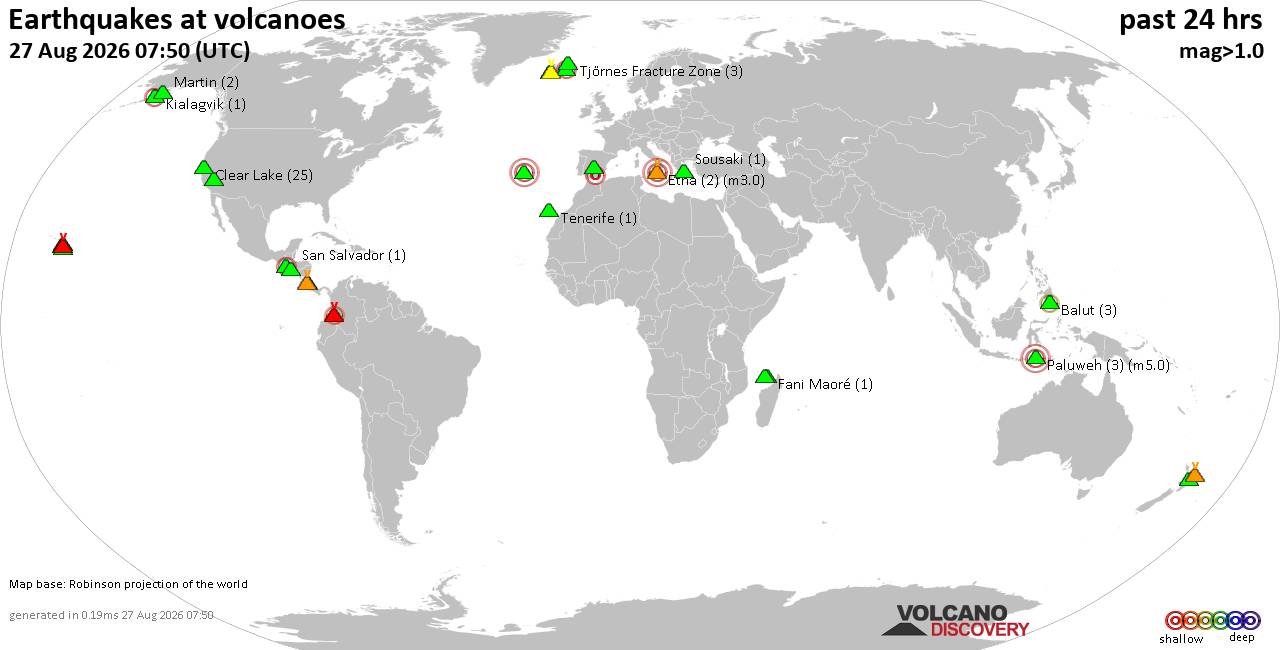
Volcano earthquake report for Thursday, 27 Aug 2026
• Strong mag. 5.2 earthquake - 334 km south of Ogasawara, Tokyo, Japan, on Th...
• Seismic-like event, possible earthquake, reported minutes ago near Granada,...
• World Earthquake Report for Thursday, 27 August 2026
• Possible earthquake reported near Acapulco de Juárez, Guerrero, Mexico, a ...
• Moderate mag. 4.3 earthquake - 16 km southeast of Acapulco de Juárez, Esta...
|

#820179
Mon 22 Jun 2026 08:00:PM
|
Joined: Feb 2001
Posts: 678,977
Launch Director
|
|
Launch Director
Joined: Feb 2001
Posts: 678,977 |
SPC Jun 22, 2026 2000 UTC Day 1 Convective OutlookSPC 2000Z Day 1 Outlook 
Day 1 Convective Outlook
NWS Storm Prediction Center Norman OK
0257 PM CDT Mon Jun 22 2026

Valid 222000Z - 231200Z

...THERE IS A SLIGHT RISK OF SEVERE THUNDERSTORMS ACROSS THE CENTRAL
HIGH PLAINS AND FROM THE SOUTHEAST TO THE MID ATLANTIC COAST...

...SUMMARY...
Scattered severe thunderstorms capable of producing damaging winds
and perhaps a couple of tornadoes should occur this afternoon and
evening across portions of the Mid-Atlantic into the Southeast.
Scattered severe thunderstorms are also expected across the
northern/central High Plains, with large to very large hail and a
tornado or two.

...20z Update Central High Plains...
Minimal changes were made to the prior outlook. Strong to severe
storms, including supercells, are developing across parts of WY and
CO and should spread east/southeastward this afternoon and evening.
Steep mid-level lapse rates and the discrete mode should favor
significant severe hail with these storms into this evening. A
tornado or two is also possible, focused mostly along the Cheyenne
Ridge where stronger low-level shear is being observed.

...Mid Atlantic...
Several rounds of storms remain likely this afternoon and evening
beneath the strong mid-level zonal flow aloft. Damaging winds appear
to be the most likely threat with scattered but mostly cellular
storms through this evening. A tornado or two remains possible. This
is most likely near the warm front across northern NJ and southern
Long Island where stronger and backed low-level flow is supporting
100-150 0-1km SRH.

Some guidance shows an increase in storm clustering and stronger
outflow gusts from northern VA into northern MD/DE and southern
PA/NJ this evening. Should this occur, a locally more favorable
corridor of damaging winds could develop. However, this remains very
uncertain given the more scattered and cellular convection observed
so far.

...TX/OK...
Some mode signal exists for isolated convective development this
afternoon along the trailing outflow boundary across north TX from
the morning MCS. Very large buoyancy and steep mid-level lapse rates
could support hail with these storms. However, the lack of broader
large-scale ascent suggests more isolated coverage through this
evening.

..Lyons.. 06/22/2026

.PREV DISCUSSION... /ISSUED 1120 AM CDT Mon Jun 22 2026/

...Mid Atlantic...
Relatively fast zonal flow is present today from the OH Valley into
the Mid-Atlantic and Northeast US, with a shortwave trough evident
over OH/MI.  As this feature tracks eastward, it will push a surface
cold front southward across the central Appalachians and into the
Mid-Atlantic region.  Considerable clouds are present ahead of the
front from KY/WV into VA/PA/NJ, limiting destabilization and
confidence in the details of where clusters of storms may form later
today.  However, given the relatively strong winds aloft and
dewpoints in the 60s, it would seem likely that scattered strong to
severe storms will occur, capable of locally damaging winds and
perhaps a tornado.

...TN/MS/AL/GA...
The remnants of a severe overnight MCS are over AR/west TN/northern
MS.  This system has considerable mesoscale organization with an MCV
noted over eastern AR.  A very moist and unstable air mass is in
place ahead of this system over northern MS/AL, where heating into
the mid 80s will foster thunderstorm intensification this afternoon.
Damaging winds are the main concern with these storms, but a
low-level jet feature associated with the MCV could result in a few
supercell structures and the risk of a tornado or two.  Activity
will track into north GA this evening.  Refer to MD #1252 for
further details.

...Central High Plains...
Similar to yesterday, low-clouds are slowly burning off across the
High Plains of eastern CO and western SD/NE/KS, where moderate CAPE
values will develop by mid-afternoon.  Easterly/upslope flow will
contribute to scattered thunderstorm development over eastern WY and
southward along the DCVZ in CO.  These storms will track into the
CAPE axis, where favorable deep-layer shear will promote supercells
capable of very large hail and a few tornadoes.
Read morehttps://www.spc.noaa.gov/products/outlook/day1otlk_2000.html
|
|



CMS The Best Conveyancing solicitors conveyancing quotes throughout the UK
For any webhosting enquiries please email webmaster@aus-city.com
|
|
Entire Thread
|
 SPC Jun 22, 2026 2000 UTC Day 1 Convective Outlook
|
Webmaster
|
Mon 22 Jun 2026 08:00:PM
|
|
Forums60
Topics813,277
Posts848,070
Members2,960
| |
Most Online102,106
Jul 10th, 2026
|
|
|