|
|
|
0 members (),
3,063
guests, and
25
robots. |
|
Key:
Admin,
Global Mod,
Mod
|
|
S |
M |
T |
W |
T |
F |
S |
|
|
|
1
|
2
|
3
|
4
|
5
|
|
6
|
7
|
8
|
9
|
10
|
11
|
12
|
|
13
|
14
|
15
|
16
|
17
|
18
|
19
|
|
20
|
21
|
22
|
23
|
24
|
25
|
26
|
|
27
|
28
|
29
|
30
|
|
|
|
|
There are no members with birthdays on this day. |
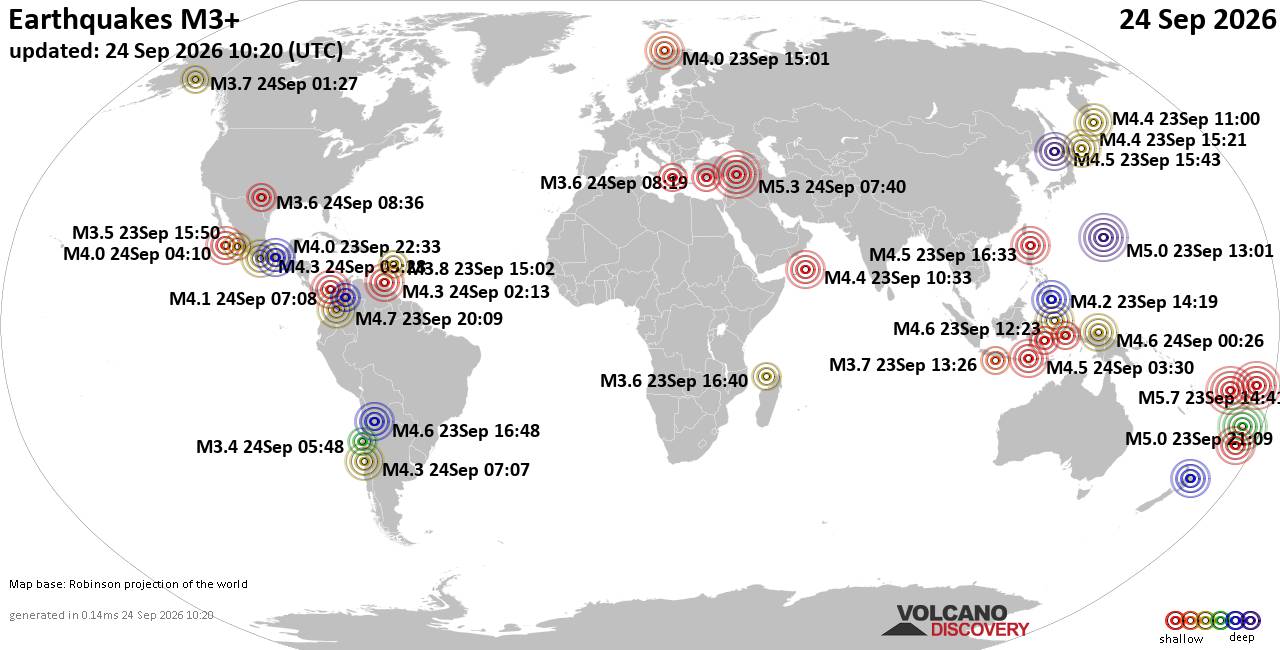
World Earthquake Report for Thursday, 24 September 2026
• Moderate mag. 4.3 earthquake - Madagascar: Mozambique Channel on Thursday, ...
• Small magnitude 3.9 earthquake hits near Hastings, Hastings District, Hawke...
• Volcano earthquake report for Thursday, 24 September 2026
• Light mag. 3.9 earthquake - South Pacific Ocean, 10.2 km south of Hastings,...
• Moderate magnitude 4.1 quake hits 31 miles southeast of Midland, Texas, Uni...
|

#853009
Mon 31 Aug 2026 02:41:AM
|
Joined: Dec 2002
Posts: 95,828
Launch Director
|
|
Launch Director
Joined: Dec 2002
Posts: 95,828 |
Philosopher’s Annual for 2025The articles that made it into the latest edition of Philosophers Annual have been announced. The list aims to “select the ten best articles published in philosophy each year—an attempt as simple to state as it is admittedly impossible to fulfill.” This volume—the 45th—covers the literature from 2024. The selections are: Evan Behrle (Harvard), “Desert and Economic Interdependence” from the Journal of Philosophy. Outside of philosophy, the idea that workers deserve to be paid according to their productive contributions is very popular. But political philosophers have given it relatively little attention. In this paper, I argue against the attempt to use this idea about desert and contribution to vindicate significant income inequality. I claim that reward according to contribution fails on its own terms when the following condition holds: the size of each worker’s contribution depends on what other workers only together do. When workers only together make another more productive, that is not reflected in the sum of their own contributions. Thus reward according to contribution recognizes individual accomplishments without recognizing their dependence on collectives, dependence that is, in complex economies, ubiquitous. Sam Berstler (MIT), “The Structure of Open Secrets” from the Philosophical Review. In conversation, we often do not acknowledge what we jointly know to be true. This article identifies a distinctive kind of non-acknowledgment norm, open secrecy norms, and analyzes how such norms constrain our speech. First, the author argues that open secrecy norms are structurally different from other everyday non-acknowledgment norms. Open secrecy norms iterate: when is an open secret, then there’s a norm not to acknowledge that , and this norm is itself an open secret. Then, the author argues that the non-acknowledgment at issue in open secrecy norms motivates a more complex understanding of discourse structure. When interlocutors are conforming to open secrecy norms, they rely on at least two disjoint common grounds, one of which has a privileged status. To understand why and how it is privileged, the author develops Erving Goffman’s notion of defining a social interaction. Finally, the author shows how strategic speakers can exploit the structure of open secrecy norms in order to both communicate about the open secret and shield themselves from retaliation for what they communicate. Kyle Blumberg (Melbourne) and Ben Holguín (Johns Hopkins), “Fictional.. The post Philosopher’s Annual for 2025 first appeared on Daily Nous. https://dailynous.com/2026/08/30/philosophers-annual-for-2025/
|
|



CMS The Best Conveyancing solicitors conveyancing quotes throughout the UK
For any webhosting enquiries please email webmaster@aus-city.com
|
|
Entire Thread
|
 Philosopher’s Annual for 2025
|
Alisa
|
Mon 31 Aug 2026 02:41:AM
|
|
Forums60
Topics840,728
Posts875,523
Members2,960
| |
Most Online102,106
Jul 10th, 2026
|
|
|
|
|

|