|
|
|
0 members (),
2,481
guests, and
31
robots. |
|
Key:
Admin,
Global Mod,
Mod
|
|
S |
M |
T |
W |
T |
F |
S |
|
1
|
2
|
3
|
4
|
5
|
6
|
7
|
|
8
|
9
|
10
|
11
|
12
|
13
|
14
|
|
15
|
16
|
17
|
18
|
19
|
20
|
21
|
|
22
|
23
|
24
|
25
|
26
|
27
|
28
|
|
There are no members with birthdays on this day. |

#4550
Wed 08 Mar 2006 12:16:PM
|
Joined: Feb 2001
Posts: 3,536
Mission Commander
|
OP

Mission Commander
Joined: Feb 2001
Posts: 3,536 |
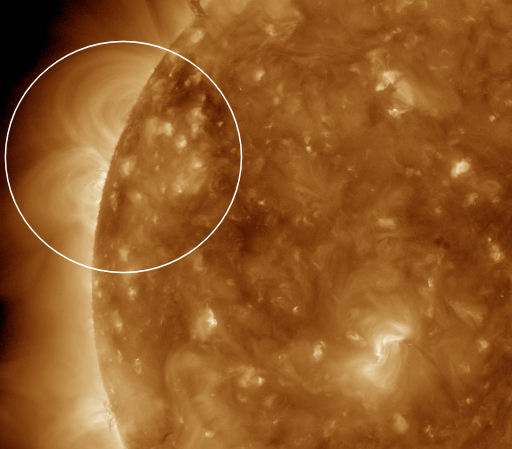
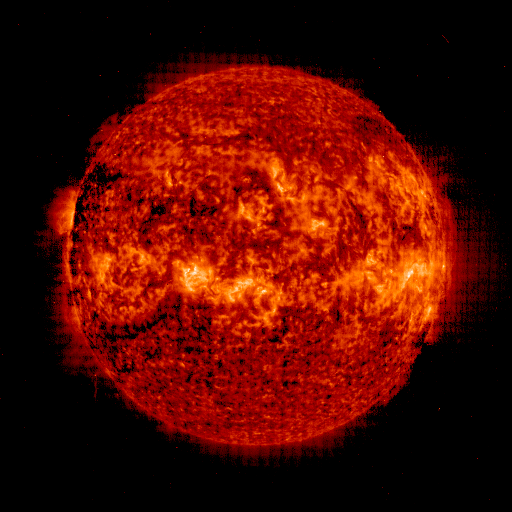
March 6, 2006<br /><br />Dwayne Brown/Erica Hupp <br />Headquarters, Washington <br />(202) 358-1726/1237 <br /><br />Bill Steigerwald/Nancy Neal-Jones <br />Goddard Space Flight Center, Greenbelt, Md. <br />(301) 286-5017/0039 <br /><br />RELEASE: 06-087<br /><br />NASA AIDS IN RESOLVING LONG STANDING SOLAR CYCLE MYSTERY<br /><br />Scientists predict the next solar activity cycle will be 30 to 50 <br />percent stronger than the previous one and up to a year late. <br />Accurately predicting the sun's cycles will help plan for the effects <br />of solar storms. The storms can disrupt satellite orbits and <br />electronics; interfere with radio communication; damage power <br />systems; and can be hazardous to unprotected astronauts. <br /><br />The breakthrough "solar climate" forecast by Mausumi Dikpati and <br />colleagues at the National Center for Atmospheric Research in <br />Boulder, Colo. was made with a combination of computer simulation and <br />groundbreaking observations of the solar interior from space using <br />NASA's Solar and Heliospheric Observatory (SOHO). NASA's Living With <br />a Star program and the National Science Foundation funded the <br />research. <br /><br />The sun goes through a roughly 11-year cycle of activity, from stormy <br />to quiet and back again. Solar storms begin with tangled magnetic <br />fields generated by the sun's churning electrically charged gas <br />(plasma). Like a rubber band twisted too far, solar magnetic fields <br />can suddenly snap to a new shape, releasing tremendous energy as a <br />flare or a coronal mass ejection (CME). This violent solar activity <br />often occurs near sunspots, dark regions on the sun caused by <br />concentrated magnetic fields. <br /><br />Understanding plasma flows in the sun's interior is essential to <br />predicting the solar activity cycle. Plasma currents within the sun <br />transport, concentrate, and help dissipate solar magnetic fields. "We <br />understood these flows in a general way, but the details were <br />unclear, so we could not use them to make predictions before," <br />Dikpati said. Her paper about this research was published in the <br />March 3 online edition of Geophysical Research Letters. <br /><br />The new technique of "helioseismology" revealed these details by <br />allowing researchers to see inside the sun. Helioseismology traces <br />sound waves reverberating inside the sun to build up a picture of the <br />interior, similar to the way an ultrasound scan is used to create a <br />picture of an unborn baby. <br /><br />Two major plasma flows govern the cycle. The first acts like a <br />conveyor belt. Deep beneath the surface, plasma flows from the poles <br />to the equator. At the equator, the plasma rises and flows back to <br />the poles, where it sinks and repeats. The second flow acts like a <br />taffy pull. The surface layer of the sun rotates faster at the <br />equator than it does near the poles. Since the large-scale solar <br />magnetic field crosses the equator as it goes from pole to pole, it <br />gets wrapped around the equator, over and over again, by the faster <br />rotation there. This is what periodically concentrates the solar <br />magnetic field, leading to peaks in solar storm activity. <br /><br />"Precise helioseismic observations of the 'conveyor belt' flow speed <br />by the Michelson Doppler Imager (MDI) instrument on board SOHO gave <br />us a breakthrough," Dikpati said. "We now know it takes two cycles to <br />fill half the belt with magnetic field and another two cycles to fill <br />the other half. Because of this, the next solar cycle depends on <br />characteristics from as far back as 40 years previously - the sun has <br />a magnetic 'memory'." <br /><br />The magnetic data input comes from the SOHO/MDI instrument and <br />historical records. Computer analysis of the past eight years' <br />magnetic data matched actual observations over the last 80 years. The <br />team added magnetic data and ran the model ahead 10 years to get <br />their prediction for the next cycle. The sun is in the quiet period <br />for the current cycle (cycle 23). <br /><br />The team predicts the next cycle will begin with an increase in solar <br />activity in late 2007 or early 2008, and there will be 30 to 50 <br />percent more sunspots, flares, and CMEs in cycle 24. This is about <br />one year later than the prediction using previous methods, which rely <br />on such statistics as the strength of the large-scale solar magnetic <br />field and the number of sunspots to make estimates for the next <br />cycle. This work will be advanced by more detail observations from <br />the Solar Dynamics Observatory, scheduled to launch in August 2008. <br /><br />SOHO is a project of international collaboration between NASA and the <br />European Space Agency. For images explaining the data on the Web, <br />visit: <br /><br /> http://www.nasa.gov/vision/universe/solarsystem/solar_cycle_graphics.html <br /><br /><br />For information about NASA and agency programs on the Web, visit: <br /><br /> http://www.nasa.gov/home
|
|



CMS The Best Conveyancing solicitors conveyancing quotes throughout the UK
For any webhosting enquiries please email webmaster@aus-city.com
|
|
Forums60
Topics762,137
Posts796,866
Members2,957
| |
Most Online17,963
Jan 15th, 2026
|
|
|
|
|
Copyright 1996 - 2026 by David Cottle. Designed by David Bate Jr. All Rights Reserved.
By using this forum, the user agrees not to transfer any data or technical information received under the agreement, to any other entity without the express approval of the AUS-CITY Forum Admins and/or authors of individual posts (Forum Admins and DoD/USSPACECOM for the analysis of satellite tracking data).
Two-line elements (TLE) and all other satellite data presented and distributed via this forum and e-mail lists of AUS-CITY are distributed with permission from DoD/USSTRATCOM.

Reprise Hosting

|

|