|
0 members (),
1,133
guests, and
20
robots. |
|
Key:
Admin,
Global Mod,
Mod
|
|
S |
M |
T |
W |
T |
F |
S |
|
|
|
|
1
|
2
|
3
|
4
|
|
5
|
6
|
7
|
8
|
9
|
10
|
11
|
|
12
|
13
|
14
|
15
|
16
|
17
|
18
|
|
19
|
20
|
21
|
22
|
23
|
24
|
25
|
|
26
|
27
|
28
|
29
|
30
|
31
|
|
|
There are no members with birthdays on this day. |
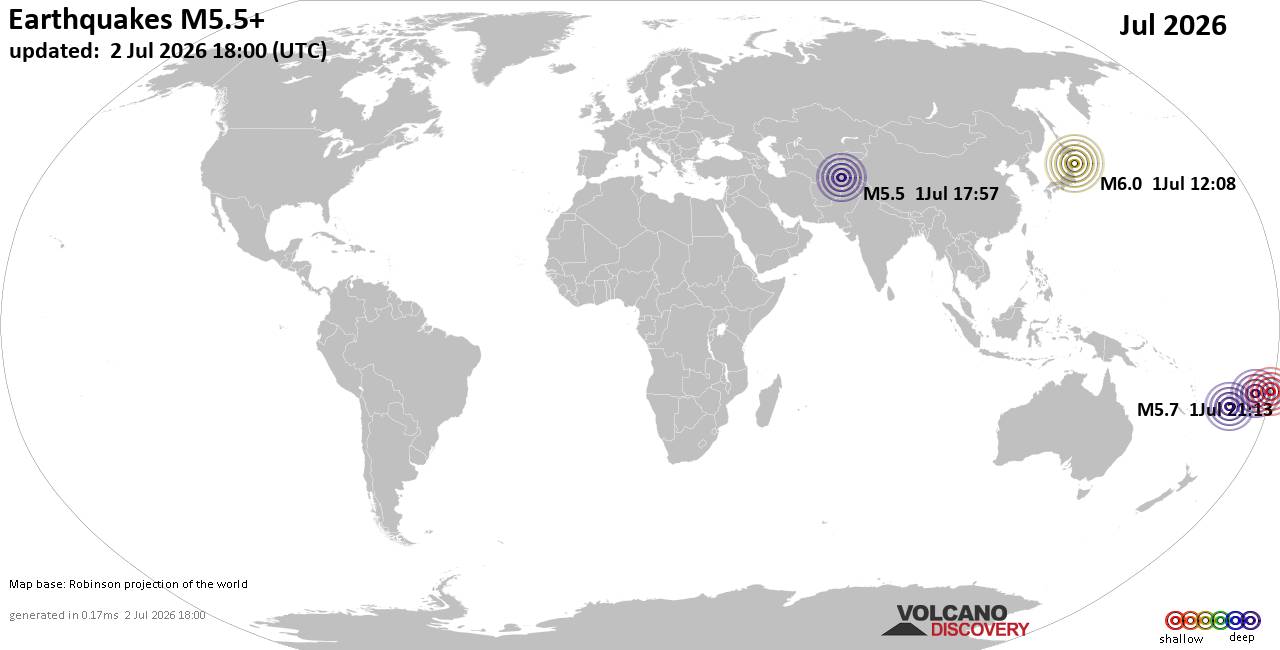
World Earthquake Report for July 2026
• World Earthquake Report for Thursday, 2 July 2026
• Volcano earthquake report for Thursday, 2 Jul 2026
• Small magnitude 3.2 quake hits 31 km west of Bergen, Norway early evening
• Moderate mag. 4.0 earthquake - 44 km northwest of Ancud, Provincia de Chilo...
• Moderate mag. 4.7 earthquake - Philippine Sea, 50 km northwest of Yonaguni-...
|

#800619
Sat 28 Feb 2026 07:49:PM
|
Joined: Feb 2001
Posts: 678,976
Launch Director
|
OP

Launch Director
Joined: Feb 2001
Posts: 678,976 |
SPC Feb 28, 2026 2000 UTC Day 1 Convective OutlookSPC 2000Z Day 1 Outlook 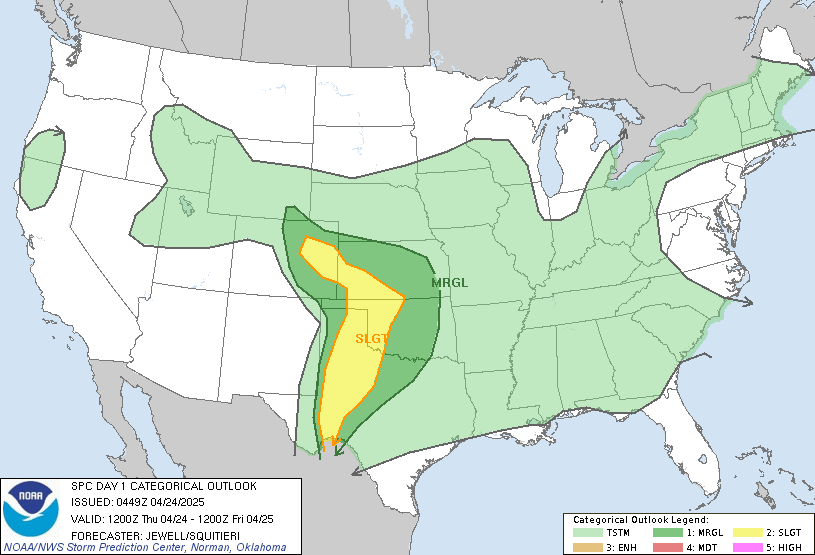
Day 1 Convective Outlook
NWS Storm Prediction Center Norman OK
0145 PM CST Sat Feb 28 2026

Valid 282000Z - 011200Z

...THERE IS A MARGINAL RISK OF SEVERE THUNDERSTORMS ACROSS PARTS OF
CENTRAL AND SOUTH FLORIDA...

...SUMMARY...
Isolated strong to severe thunderstorms may occur across parts of
the central/southern Florida Peninsula this afternoon and evening.

...20Z Update...
Only minor changes to the general thunderstorm forecast in North
Florida were made base on current observations. Mid-level ascent is
entering the northeastern Gulf per visible/water-vapor satellite.
This should continue to promote potential for additional
thunderstorms within the central and southern Florida Peninsula. See
the previous discussion for additional details.

..Wendt.. 02/28/2026

.PREV DISCUSSION... /ISSUED 1012 AM CST Sat Feb 28 2026/

...Central/Southern Florida Peninsula...
Late morning surface analysis places a cold front near the I-4
corridor across the central portion of the Peninsula, with upper 60s
to lower 70s dewpoints south of the boundary.  A mid-level vorticity
maximum over MS/AL this morning is forecast to continue
east-southeastward through the base of a larger-scale eastern US
trough and eventually reach the Gulf Stream east of GA and
southwestward to the southern 1/3 of the Peninsula by early Sunday
morning.  As this impulse progresses towards the region, the
aforementioned front will slowly move south.  This boundary, a
residual outflow boundary, and an east-coast sea breeze will help
focus thunderstorm development and a potential severe risk this
afternoon.  Ample heating of the moist boundary layer beneath a weak
cap, which will continue to erode by early to mid afternoon, will
result in 1500-2000 J/kg MLCAPE.  Low-level flow will likely remain
veered and relatively weak, but 30+ kt shear in the 700-300 mb layer
will support some updraft organization.  Scattered thunderstorms are
forecast to develop in the 18-20z period with a some of the stronger
storms potentially being capable of 55-65 mph gusts and 1 to 1.75
inch diameter hail.  Short-term CAM guidance suggests the most
concentrated corridor for severe may extend from the north side of
Lake Okeechobee, where an agitated cumulus field is developing along
the diffuse outflow boundary, southward into Broward/Palm Beach
counties.  Convection is forecast to eventually move east into the
Atlantic this evening with the severe risk diminishing.

...Oklahoma...
Weak MUCAPE should develop by this afternoon/early evening across
parts of OK near a surface trough.  A low-amplitude shortwave trough
embedded within broad cyclonic flow over the central/eastern CONUS
may support isolated thunderstorm development across this area in
tandem with peak afternoon heating. Instability should remain too
weak to support an organized severe threat with this activity,
although locally strong/gusty winds and small hail appear possible
given steepened low-level lapse rates and favorably strong
deep-layer shear.

...Northern California...
A mid-level shortwave trough will move east-northeastward today
across northern CA and vicinity. Cool temperatures aloft associated
with this shortwave trough combined with generally 40 to mid 50s
surface dewpoints and filtered daytime heating should promote around
500-750 J/kg of MUCAPE over this region by mid to late afternoon.
While a couple of stronger thunderstorms may form across this area,
the overall severe threat should tend to be limited by the weak
instability.
Read morehttps://www.spc.noaa.gov/products/outlook/day1otlk_2000.html
|
|



CMS The Best Conveyancing solicitors conveyancing quotes throughout the UK
For any webhosting enquiries please email webmaster@aus-city.com
|
|
Forums60
Topics786,013
Posts820,783
Members2,960
| |
Most Online22,463
May 9th, 2026
|
|
|