|
0 members (),
1,480
guests, and
38
robots. |
|
Key:
Admin,
Global Mod,
Mod
|
|
S |
M |
T |
W |
T |
F |
S |
|
|
|
|
1
|
2
|
3
|
4
|
|
5
|
6
|
7
|
8
|
9
|
10
|
11
|
|
12
|
13
|
14
|
15
|
16
|
17
|
18
|
|
19
|
20
|
21
|
22
|
23
|
24
|
25
|
|
26
|
27
|
28
|
29
|
30
|
31
|
|
|
There are no members with birthdays on this day. |
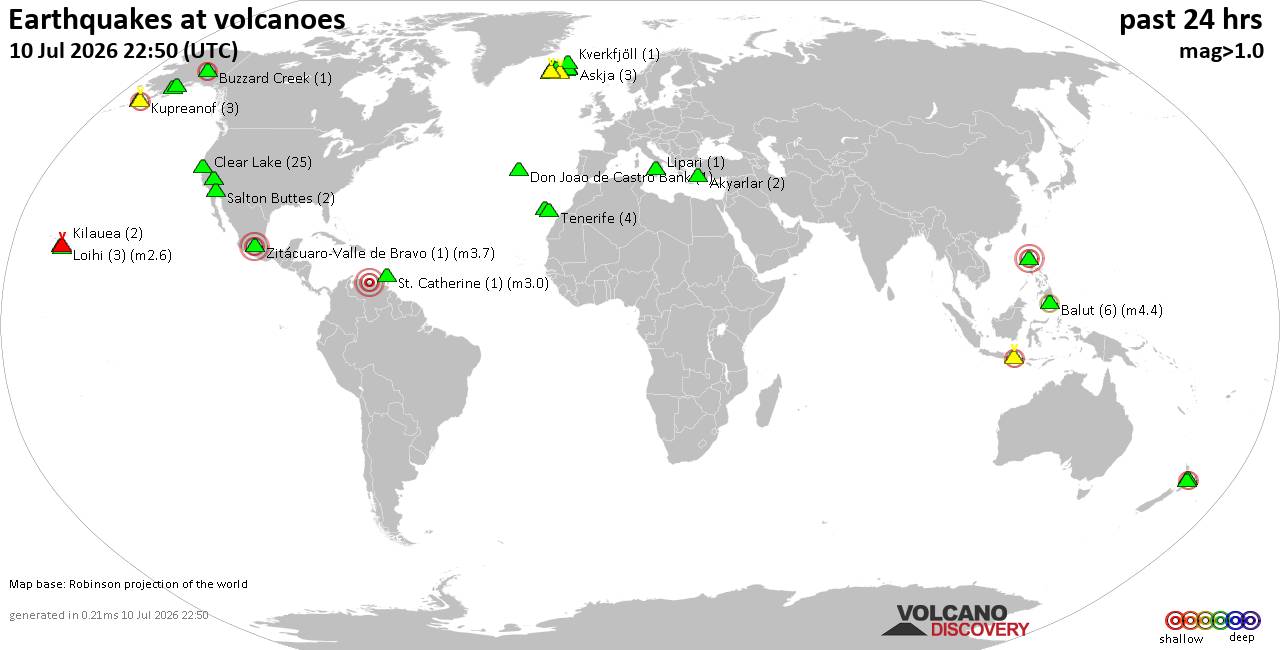
Volcano earthquake report for Friday, 10 Jul 2026
• Moderate mag. 4.2 earthquake - 133 km northwest of Ternate, Kota Ternate, N...
• World Earthquake Report for Friday, 10 July 2026
• Moderate mag. 4.6 earthquake - 17 km southwest of Comalapa, Estado de Chiap...
• Moderate mag. 4.1 earthquake - Olyutorskiy Rayon, 47 km northwest of Tilich...
• Moderate mag. 4.0 earthquake - Hawke's Bay, New Zealand, on Saturday, Jul 1...
|

#805806
Thu 16 Apr 2026 06:10:AM
|
Joined: Feb 2001
Posts: 678,976
Launch Director
|
OP

Launch Director
Joined: Feb 2001
Posts: 678,976 |
SPC Apr 16, 2026 0600 UTC Day 1 Convective OutlookSPC 1200Z Day 1 Outlook 
Day 1 Convective Outlook CORR 1
NWS Storm Prediction Center Norman OK
0109 AM CDT Thu Apr 16 2026

Valid 161200Z - 171200Z

...THERE IS A SLIGHT RISK OF SEVERE THUNDERSTORMS THIS AFTERNOON
ACROSS PARTS OF WESTERN AND CENTRAL NEW YORK INTO SOUTHERN
VERMONT...

CORRECTED FOR TYPOS AND WORDING

...SUMMARY...
A few severe thunderstorms are possible this afternoon in a corridor
across western through central New York (state) and adjacent
southern Vermont.

...Discussion...
A significant mid-level trough and embedded low now digging across
the Pacific Northwest is forecast to split as it continues inland
through this period.  One perturbation, perhaps including a
continuing cyclonic circulation, is forecast to turn eastward across
the northern Rockies through the central Canadian/U.S. border area.
Another perturbation is forecast to dig southeastward across the
Great Basin into early Friday.  It appears that the larger-scale
evolving troughing will be preceded by a significant cold frontal
surge to the lee of the northern U.S. Rockies, through much of the
northern and central Great Plains by 12Z Friday.

Downstream, initially prominent mid-level ridging centered near the
southern Atlantic Seaboard is forecast to become increasingly
suppressed, as one short wave trough, approaching southwestern
portions of the Great Lakes region early today, turns eastward then
southeastward across the lower Great Lakes vicinity into northern
Mid Atlantic.  It appears that this will be trailed by another
perturbation, which is forecast to progress east of the Ozark
Plateau through the lower Ohio and Tennessee Valleys, before digging
across the southern Appalachians, downstream of short wave ridging
building across and east of the mid/upper Mississippi Valley.

...Mid South into lower Great Lakes and Northeast...
The primary and trailing short wave troughs advancing to the east of
the Mississippi Valley are forecast to be preceded by the remnants
of overnight convection across parts of the lower Great Lakes, Ohio
Valley, and Mid South at the outset of the period.  The impacts of
associated cloud cover and outflow on destabilization within the
warm sector of a broad, but weak, surface low migrating northeast of
the lower Great Lakes during the day remain unclear.  However,
various model output, including convection allowing guidance,
suggest that destabilization and strengthening shear along a warm
frontal zone (as it strengthens with differential heating) may
become a focus for organized strong thunderstorm development across
New York state by afternoon.  It appears that this may include an
evolving cluster, perhaps preceded by more discrete thunderstorm
activity, in an environment conducive to evolving supercell
structures, with potential to produce severe hail, wind and a risk
for a couple of tornadoes.

Additional thunderstorm activity may eventually develop and
strengthen, accompanied by at least a risk for strong to severe wind
gusts by late afternoon, in a corridor of stronger daytime heating
ahead of a developing cold front spreading into the upper Ohio
Valley/Allegheny and Cumberland Plateau.

Farther west/southwest, there is not a well-defined signal in the
latest model output, but a corridor of differential surface heating
along weakening trailing convective outflow across the Mid South
vicinity could become a focus for supercell development.  It
currently appears that this potential could peak across north
central into northeastern Arkansas by late this afternoon, aided by
moderate boundary-layer destabilization and stronger mid-level
forcing for ascent associated with a cyclonic vorticity center
migrating across the region.

...Southern Great Plains...
Moderate to strong potential instability is forecast to develop
beneath steep lapse rates, along and east of a dryline which likely
will be retreating westward across the high plains by early this
evening.  While this will be conditionally supportive of severe
thunderstorm development, forcing to support initiation of sustained
thunderstorms remains unclear, aside from, perhaps, the higher
terrain near/east of the Texas Big Bend.  Beneath moderate to strong
southwesterly mid/upper flow, this could include an isolated
supercell or two which could propagate across the Rio Grande River,
before weakening in the presence of increasing inhibition this
evening.

..Kerr/Lyons.. 04/16/2026
Read morehttps://www.spc.noaa.gov/products/outlook/day1otlk_1200.html
|
|



CMS The Best Conveyancing solicitors conveyancing quotes throughout the UK
For any webhosting enquiries please email webmaster@aus-city.com
|
|
Entire Thread
|
 SPC Apr 16, 2026 0600 UTC Day 1 Convective Outlook
|
Webmaster
|
Thu 16 Apr 2026 06:10:AM
|
|
Forums60
Topics787,756
Posts822,530
Members2,960
| |
Most Online102,106
Jul 10th, 2026
|
|
|