|
1 members (Alisa),
4,276
guests, and
15
robots. |
|
Key:
Admin,
Global Mod,
Mod
|
|
S |
M |
T |
W |
T |
F |
S |
|
|
1
|
2
|
3
|
4
|
5
|
6
|
|
7
|
8
|
9
|
10
|
11
|
12
|
13
|
|
14
|
15
|
16
|
17
|
18
|
19
|
20
|
|
21
|
22
|
23
|
24
|
25
|
26
|
27
|
|
28
|
29
|
30
|
|
|
|
|
|
There are no members with birthdays on this day. |
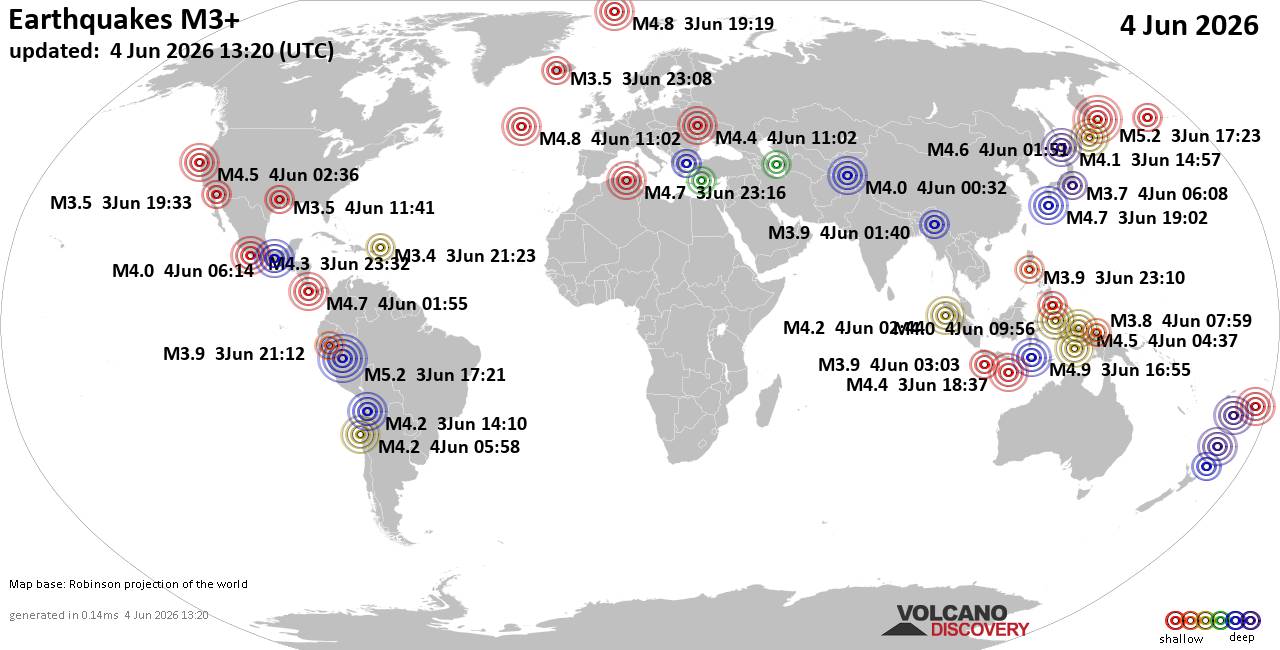
World Earthquake Report for Thursday, 4 June 2026
• Volcano earthquake report for Thursday, 4 Jun 2026
• Moderate mag. 4.1 earthquake - North Pacific Ocean, Estado de Michoacan de ...
• Moderate mag. 4.4 earthquake - Vinnytsya Oblast, 13 km southwest of Berdych...
• Moderate mag. 4.8 earthquake - Northern Mid-Atlantic Ridge on Thursday, Jun...
• Moderate mag. 4.0 earthquake - Banda Sea, 40 km southeast of Pulau Damar Is...
|
|
|
Joined: Feb 2001
Posts: 381,904
Launch Director
|
OP

Launch Director
Joined: Feb 2001
Posts: 381,904 |
SPC Jun 4, 2026 1630 UTC Day 1 Convective OutlookSPC 1630Z Day 1 Outlook 
Day 1 Convective Outlook
NWS Storm Prediction Center Norman OK
1128 AM CDT Thu Jun 04 2026

Valid 041630Z - 051200Z

...THERE IS A SLIGHT RISK OF SEVERE THUNDERSTORMS THIS AFTERNOON AND
EVENING OVER PORTIONS OF THE NORTHERN PLAINS...

...SUMMARY...
Severe thunderstorms capable of large to very large hail and
damaging winds are possible today from parts of the northern High
Plains across northern Nebraska and much of South Dakota. More
isolated occurrences of large hail and damaging winds appear
possible farther south across portions of the central Plains.

...Southeast MT through the Dakotas into southern MN...
Morning surface analysis places a weakening cold front from
northwest MN through south-central SD to a weak low near the
WY/SD/NE border intersection. Western portion of this boundary (from
central SD westward) is forecast to stall, with perhaps some retreat
northward during the late afternoon, while the eastern portion over
MN progresses slowly eastward. Dewpoints will likely stay in the 60s
along this boundary, with moderate to strong buoyancy developing by
late afternoon. Moisture convergence, augmented by modest
large-scale ascent attendant to a shortwave moving across MT, will
likely result in scattered convective initiation by the late
afternoon. Additional storms are expected farther west across
eastern MT ahead of the aforementioned shortwave. Moderate
deep-layer shear will support occasional supercells, with large to
isolated very large hail as the primary risk. Storms will spread
into the central Dakotas through the evening with a continued severe
threat.

Farther east, late afternoon thunderstorm development is expected
along the cold front. Deep-layer shear will be weaker than areas
farther west, and a more outflow-dominant storm mode appears likely.
Isolated hail is still possible early in the convective cycle,
particularly into central SD where steeper mid-level lapse are
expected.

...Central/Eastern KS into southeast NE/northwest MO/western IA...
Morning satellite imagery shows a well-defined MCV over western KS,
with widespread cloud cover throughout its eastern periphery from
central KS across south-central and eastern NE. Surface observations
show dewpoints in the mid 60s beneath this cloud cover, with
temperatures ranging from the upper 60s across central KS to the mid
70s across southwest IA. Southerly flow is anticipated throughout
the day today, maintaining low-level moisture advection within this
corridor. This increasing moisture coupled with sheltered/cloudy
conditions will likely result in dewpoints climbing into the upper
60s (perhaps even some low 70s) across this region by the late
afternoon. Modest heating is anticipated as well, with temperatures
likely in the mid 70s to low 80s. Mid-level lapse rates are poor
(generally less than 6 deg C per km from 700 to 500 mb), but the
ample low-level moisture will still support afternoon/late afternoon
MLCAPE around 1500 to 2000 J/kg and little, if any, convective
inhibition.

Ascent attendant to the MCV and low-level convergence throughout its
eastern periphery will support widespread thunderstorm development
within this unstable and uncapped environment. Deep-layer shear will
be weak (less than 25 kt from 0-6 km) across much of the region,
with a largely multicellular mode anticipated. That being said, an
increase in low-level southerly flow is expected throughout the
eastern periphery of the MCV, contributing to some moderate
lengthening of the low-level hodograph. This stronger low-level
southerly flow combined with the ample moisture in place (i.e. PW
values approaching 1.8" by the late afternoon, which is above the
90th percentile at TOP) results in a unique environment supportive
of brief tornadoes. Even so, the lack of stronger deep-layer shear
still suggests a predominantly disorganized storm mode, which should
keep any tornado threat isolated enough to keep probabilities at 2%.
A few water-loaded downbursts are possible as well.

..Mosier/Chalmers.. 06/04/2026
Read morehttps://www.spc.noaa.gov/products/outlook/day1otlk_1630.html
|
|



CMS The Best Conveyancing solicitors conveyancing quotes throughout the UK
For any webhosting enquiries please email webmaster@aus-city.com
|
|
Forums60
Topics778,516
Posts813,310
Members2,960
| |
Most Online22,463
May 9th, 2026
|
|
|